
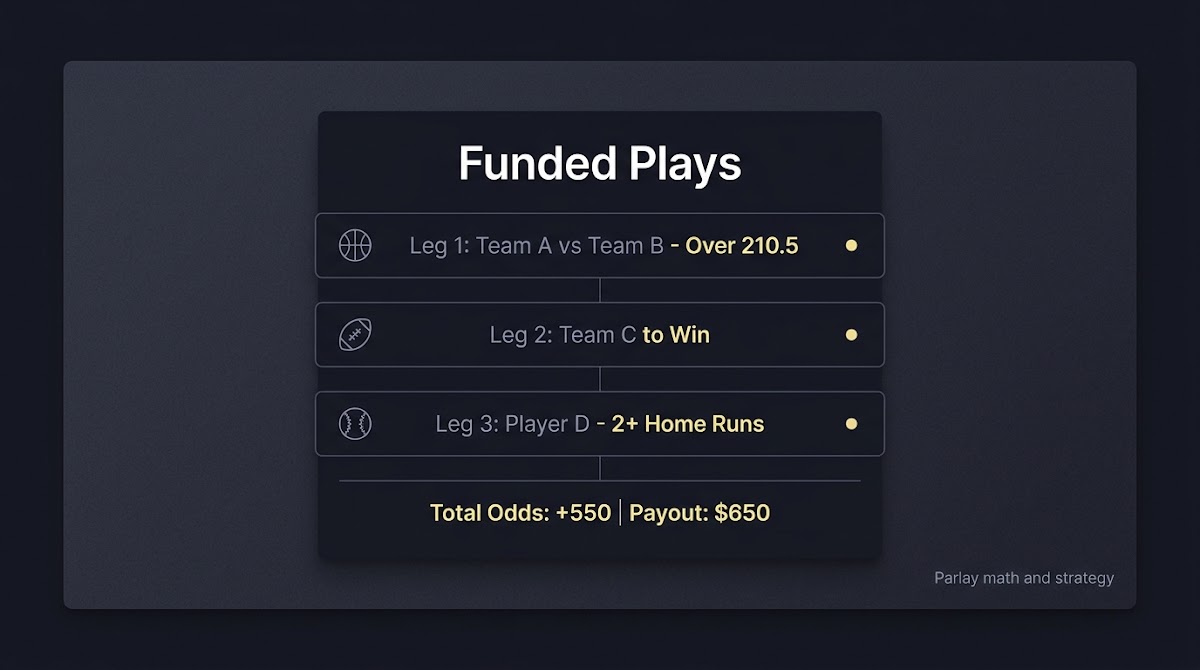
Quick answer and what this guide covers
Short answer, parlays are attractive for big payouts but are harder to win consistently because the parlay win probability equals the product of the individual leg probabilities and sportsbook margin compounds across legs, which reduces expected value, as explained in the Investopedia parlay guide Investopedia parlay guide.
Practical approach: limit ticket size to two to three high quality legs, insist each leg has a positive expected value, and size stakes conservatively using fractional Kelly or a smaller flat percent. This guide shows how to apply those rules step by step and how to check for correlated legs and hedging costs.
Practice disciplined parlays in a simulated challenge
Read the practical framework below to learn how to build smaller, higher quality parlays and how to practice disciplined staking in simulated challenges like FundedPlays without implying guaranteed rewards.
Short takeaways for winning parlays
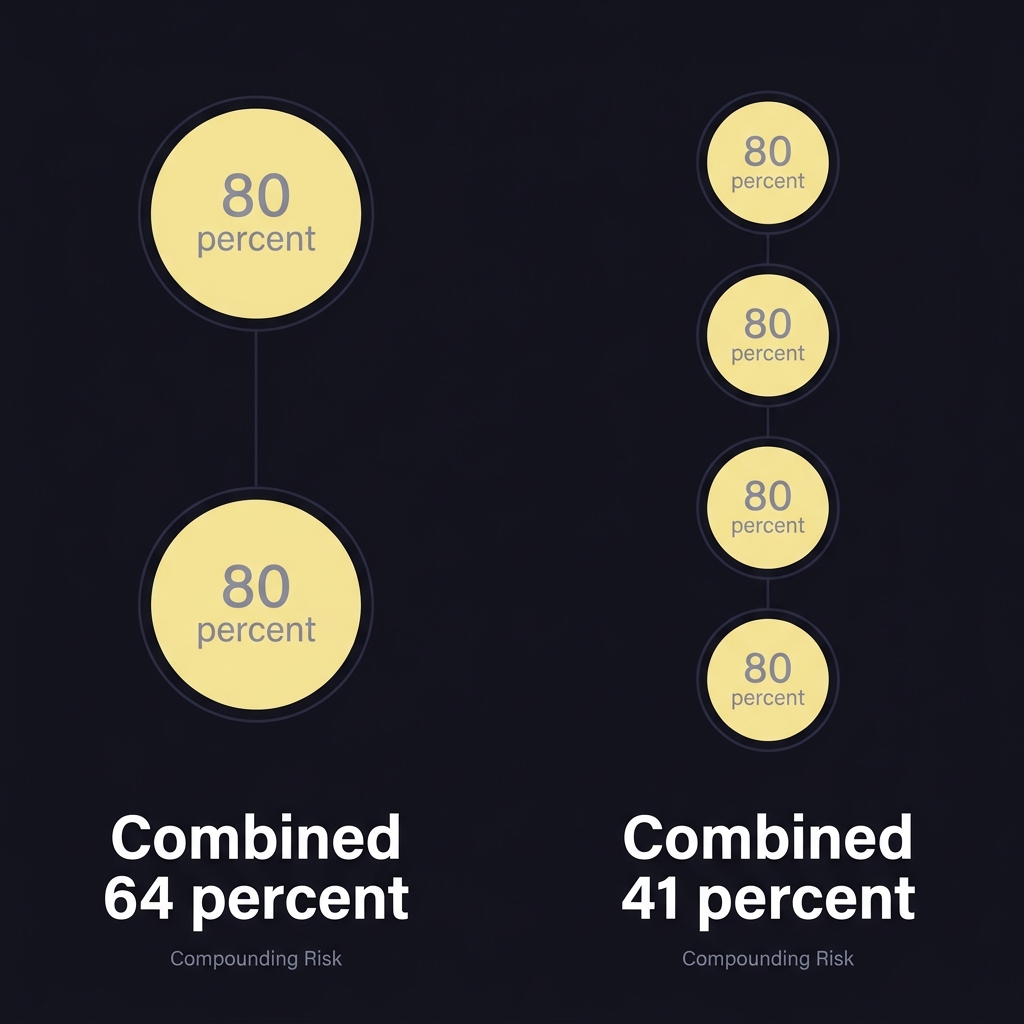
Winning parlays is mainly about controlling compounding risk: every additional leg lowers your chance to cash and increases how much vig erodes value, so fewer legs and better per-leg edges are essential.
We recommend two to three leg tickets when possible, conservative staking using fractional Kelly, and strict correlation checks for same-game combos.
How to use this article
Use the worked examples to test calculations, follow the decision checklist before placing any parlay, and track outcomes so you can measure whether your approach produces a reliable edge over time.

This article aims to be practical and evidence based, not promotional. It focuses on math, staking discipline, and concrete examples you can replicate.
How parlay math works: probability, odds and compounding vig
The core principle is multiplicative probability: a parlay's chance to win equals the product of each leg's probability. For example, if two independent legs each have a 60 percent chance to win, the parlay chance is 0.6 times 0.6, or 36 percent, which shows how quickly probability falls as legs are added; this relationship and explanation appear in the Investopedia parlay guide Investopedia parlay guide.
Bookmakers add margin to individual prices, often expressed as overround, and when you combine priced legs the margin compounds. That means the effective house edge on a multi-leg ticket can be materially higher than on single bets because the vig applies per leg and multiplies across the ticket, as noted in the same parlay primer Investopedia parlay guide.
Simple example 1, a two-leg parlay. Suppose leg A has fair win probability 55 percent and leg B has fair win probability 52 percent. Under fair odds the combined probability is 0.55 times 0.52, or 28.6 percent. If the market prices include small vig on each leg, the parlay payout and the implied value will be lower than naive fair odds suggest, illustrating how expected value declines with combined vig.
Simple example 2, a four-leg parlay. If four independent legs each have a 60 percent chance, the combined probability is 0.6 to the fourth power, or 12.96 percent. That steep drop in win probability demonstrates why long tickets are higher variance and why their long term return is more sensitive to small errors in per-leg pricing.
When building tickets, translate per-leg market prices back into implied probabilities and compare those to your assessed probabilities to identify potential edges. Because multiplication amplifies small errors, estimation accuracy matters more for parlays than for single bets.
Why sportsbooks favour parlays: market data and recent reporting
Recent regulator reporting and industry analysis show that parlay products, and especially same-game parlays, have delivered higher holds for operators in 2024 and 2025, which is one reason to treat parlay offerings skeptically; for an industry overview, see the Bloomberg coverage of bookmaker product economics Bloomberg same-game parlays and related coverage in the Wall Street Journal WSJ.
State level data also supports the higher hold pattern for parlay-type wagers, with regulator proceeds summaries from recent years documenting outsized operator returns from multi-leg products, as summarized in the Colorado Division of Gaming report Colorado Division of Gaming report.
The best practical approach is to limit parlays to a few high quality legs, verify per-leg positive expected value, avoid redundant correlated selections, and size stakes conservatively using fractional Kelly or small flat percentages while tracking results.
Implication for bettors: because markets have shown higher operator hold on these products, expect that long or heavily correlated parlays will require either unusually accurate forecasting or clear market mispricing to overcome the compounded house edge. See analysis of rising hold levels and parlay volumes ClosingLine analysis.
A practical framework for winning parlays: selection, legs, and EV
Rule one, limit the number of legs. Two to three leg parlays control compounded probability decline and limit how much vig reduces expected value. This practical limit is consistent with parlay math and market margin effects described earlier and in industry writing Investopedia parlay guide.
Rule two, insist on positive expected value for each leg. A parlay is only profitable in expectation when the multiplicative product of your assessed leg probabilities and the market payouts yields a positive overall edge. Evaluate each leg separately and only combine those where you believe you have an informational advantage versus the market.
Rule three, check correlations. Correlated legs, common in same-game parlays, can make a ticket look stronger while actually double counting the same information. Bookmakers explicitly price for correlation in same-game products, so avoid combining redundant outcomes unless you can document mispricing large enough to offset the correlation adjustment, a consideration discussed in the Bloomberg analysis Bloomberg same-game parlays and reporting in industry outlets Legal Sports Report.
Checklist for selecting legs before placing a parlay:
- Confirm each leg has a positive assessed edge versus market odds.
- Prefer independent events or clearly offset any correlation in your edge estimate.
- Limit legs to two or three to manage compounded vig and variance.
- Set a staking rule beforehand and avoid emotional increases after early wins or losses.
Use this framework as a filter: many tempting long tickets fail the checklist at one or more points, and those failures explain why long parlays often underperform over time.
Stake sizing and bankroll rules: Kelly, fractional Kelly, and practical limits
The Kelly criterion is the foundational staking rule for growth optimal sizing because it maximizes expected logarithmic growth of capital given known edge and odds; the theory and practical discussion of Kelly remain central to staking science World Scientific Kelly book.
In practice, full Kelly is highly volatile when edges are estimated with error, so fractional Kelly is commonly recommended as a safer alternative. Fractional Kelly reduces variance and the risk of ruin by scaling down the suggested stake, which is why many professional money managers and skilled bettors prefer half Kelly or smaller fractions in applied settings, as outlined in practical discussions of Kelly Investopedia Kelly criterion.

Practical numeric example. Assume a parlay offers combined edge such that Kelly recommends a 6 percent stake of your bankroll. Full Kelly at 6 percent can produce large swings. Using half Kelly would suggest 3 percent, and using quarter Kelly would suggest 1.5 percent. Many bettors choose flat percent rules in the 0.5 to 2 percent range per ticket if their edge estimates are noisy.
Comparison example. If your bankroll is 1000 units and full Kelly suggests 6 percent, a 60 unit stake may cause large drawdowns after repeated losing tickets. Half Kelly reduces that to 30 units which blunts volatility and makes your track record more reliable for evaluating whether your edge is real.
Record-keeping matters. If you plan to use Kelly or fractional Kelly, track bets, outcomes, and the inputs you used to estimate edges. Over time, adjust your fraction according to how accurate your edge estimates prove to be and to your personal tolerance for drawdown.
Same-game parlays and correlated legs: when to avoid them
Same-game parlays often bundle outcomes that are statistically linked, and bookmakers typically model those correlations directly. That explicit pricing for correlation means the apparent payout often already reflects the higher likelihood of joint outcomes, which erodes casual bettor advantage, as discussed in the Bloomberg analysis Bloomberg same-game parlays.
When might correlated legs still offer value? Only when you have a demonstrable informational edge about the joint distribution of outcomes that the market has not priced. Examples include access to verifiable injury or lineup information released after market adjustments or superior probabilistic modeling of event dependencies supported by historical data.
Decision rule for correlated legs: avoid them unless you can quantify the mispricing and show that it offsets the bookmaker's correlation adjustment. For most bettors, the time and expertise required to identify and validate such mispricing is substantial, so a conservative approach is to exclude same-game combinatorics unless you have clear, documented reasons to include them.
Practical example, if a team’s starter is out and the market has not fully adjusted both the points total and the player props, a correlated parlay might be worth further investigation. Even so, require documented evidence before committing significant stake.
Hedging, cash-outs and in-play decisions: reduce variance but mind the cost
Hedging and cash-out options can reduce variance by locking in a smaller guaranteed return or limiting downside, but those reductions usually come with additional cost or embedded vig which can reduce expected value, as explained in general hedging overviews Investopedia hedging.
small hedge calculator for parlay legs
Use to estimate net exposure after a proposed hedge
When to hedge: consider hedging when a large parlay reaches a payout that would cause an outsized change in your bankroll if lost, and only if the hedge price leaves you with acceptable residual expected value. Avoid reflexive hedges driven by fear rather than by a pre-defined plan.
In-play volatility can tempt bettors to cash out early. If you use cash-out options, do so under rules you set beforehand, such as hedging only when the hedge leaves you with at least a small positive expected value or when it protects significant realized gains relative to your bankroll.
Document every hedge and cash-out decision so you can evaluate whether those choices improved long term results. Because hedging often reduces EV, it should be used sparingly and with a clear objective, not as a default reaction to uncertainty.
Practical examples: building and evaluating 2-leg and 3-leg parlays
Two-leg example, step 1: identify two independent selections you believe are mispriced. Suppose you assess leg A at 58 percent and market implies 52 percent, and leg B you assess at 56 percent while market implies 50 percent. The combined assessed probability is 0.58 times 0.56 which equals 32.48 percent.

Step 2: convert market odds to implied parlay payout and compare to your assessed combined probability. If the market parlay payout implies 28 percent chance, and your assessed combined probability is 32.48 percent, this ticket has positive expected value in your model. Use a conservative fractional Kelly to size the stake because estimation error matters.
Three-leg example with correlation check. Suppose you have three legs assessed at 55 percent, 54 percent, and 53 percent independently. The naive combined probability is 0.55 times 0.54 times 0.53 which equals about 15.8 percent. If two of those legs are influenced by the same game conditions, adjust your combined probability downward to account for correlation before computing EV. If after adjustment your combined edge falls below a threshold, skip the ticket.
Same-game mini-case. Consider a same-game ticket tying a team total and a player prop that clearly depend on the same game tempo. Even if each leg looks favorable alone, the joint likelihood can be much different, and bookmakers usually price that dependency. Only proceed if your model of joint outcomes shows a material mispricing compared with market prices.
Interpretation. Worked examples show that careful calculation, conservative staking, and explicit correlation adjustments often rule out many parlays that appear attractive at first glance. Practicing these calculations improves judgment and helps avoid emotional or impulsive tickets.
Common mistakes, final checklist and next steps
Top pitfalls to avoid include using too many legs, ignoring per-leg expected value, staking too large relative to bankroll, chasing losses after a string of defeats, and misunderstanding correlation in same-game tickets.
One-page checklist to run before placing any parlay:
- Leg quality: do I have a clear edge on each leg?
- EV check: is the combined ticket positive in my model after accounting for vig?
- Correlation check: are legs independent or have I adjusted for dependency?
- Stake rule: does my fractional Kelly or flat percent limit the stake to an acceptable level?
- Hedge plan: do I have predefined rules for cash-out or hedging?
Next steps: track every parlay, simulate strategies using historical data, practice disciplined staking in simulated challenges, and adjust your approach only after sufficient results have accumulated.
Final thought, parlays are attractive tools when used sparingly by disciplined participants who focus on per-leg EV and conservative stake sizing. For most bettors, limiting legs and using fractional Kelly will better preserve capital and long term edge than chasing long tickets.
Parlays are harder to beat consistently because probability and bookmaker margin compound across legs. Some bettors can find value by limiting legs, insisting on per-leg positive EV, and using disciplined staking, but consistent profits are difficult and require rigorous tracking and validation.
Most evidence and math suggest two to three legs is a practical balance between payout and compounded probability decay. Longer tickets increase variance and often magnify vig effects.
Hedge only when a pre-defined rule shows the hedge preserves acceptable expected value or when it protects a significant realized gain relative to your bankroll. Frequent hedging often reduces long term EV.
References
- https://www.investopedia.com/terms/p/parlay.asp
- https://www.bloomberg.com/news/articles/2024-01-25/same-game-parlays-are-sportsbooks-secret-weapon
- https://sbg.colorado.gov/sites/sbg/files/2024%20Sports%20Betting%20Bet%20Type%20Proceeds.xlsx
- https://www.worldscientific.com/worldscibooks/10.1142/8431
- https://www.investopedia.com/terms/k/kellycriterion.asp
- https://www.fundedplays.com/challenges
- https://www.investopedia.com/terms/h/hedge.asp
- https://www.fundedplays.com/blogs/how-fundedplays-evaluations-work
- https://www.wsj.com/business/what-are-parlays-sports-betting-gambling-881bdaee
- https://closingline.substack.com/p/the-cashout-us-sports-betting-hold-plus-missouri-data
- https://www.legalsportsreport.com/263300/sportsbooks-make-more-money-from-slower-sports-betting-growth-in-2025/
- https://www.fundedplays.com
- https://www.fundedplays.com/blogs