

Introduction: why honest loss reporting matters
Concealing losses or rationalizing them as temporary or insignificant creates governance, legal, and operational risk for organizations and teams. The 2024 Global Internal Audit Standards emphasize timely documentation and escalation of significant issues, and hiding adverse outcomes directly contradicts those expectations, increasing exposure for leaders and the organization IIA Global Internal Audit Standards.
This article outlines why teams should resist the impulse to hide losses, summarizes evidence from recent enforcement and fraud research, and previews a concise, four-step reporting workflow you can apply immediately: log, report, investigate, act. Read on for practical templates and decision rules you can adapt to your environment.
What readers will get from this article
Readers will find an operational definition of reportable losses, the compliance and operational reasons to report promptly, practical logging and escalation templates, NIST-aligned postmortem steps, decision criteria for small losses, and examples showing how early reporting reduces cumulative harm.
A short, evidence-based thesis: Why Losses Should Never Be Hidden or Rationalized
Across audit standards, enforcement practice, and fraud research the direction is clear: transparent, documented handling of losses reduces the risk of larger regulatory and operational consequences, and it improves organizational learning.
Definition and context: what counts as a reportable loss
For operational use, define a reportable loss broadly enough to capture monetary, reputational, operational, and compliance impacts. A working definition that teams can adopt is: any unexpected adverse event that causes or could cause measurable financial harm, customer impact, regulatory exposure, or material degradation of key processes.
Organizational policy should map that definition to concrete triggers: any realized financial loss above a monetary threshold, any incident that affects regulated activity, any data loss involving personal or sensitive information, and any service interruption that affects users for a defined period. Those rules align with expectations for timely documentation in internal audit guidance IIA Global Internal Audit Standards.
Transparent loss reporting reduces legal and operational exposure, enables faster containment, preserves evidence for audits, and supports organizational learning so similar failures are less likely to recur.
Borderline cases are common. Use three simple rules of thumb: if the event might affect external stakeholders, if it could trigger regulatory scrutiny, or if it repeats, log it. Treat near-misses and small but systemic errors as signal rather than noise, and escalate them when patterns emerge.
Practical examples: a reconciliation error that understates liability, a customer complaint that reveals a payment processing gap, or a small data leak in a nonproduction environment that nonetheless includes real user identifiers. Each should at least be recorded in an incident register and assessed against escalation thresholds.
Why transparency matters: compliance, trust, and financial exposure
Regulators and enforcement bodies make clear that concealment and misreporting carry tangible consequences. The SEC's fiscal year 2024 enforcement summary underlines that misstatements and concealment can lead to enforcement actions and investor redress, so organizations that fail to disclose or document losses increase their legal exposure SEC enforcement results for FY 2024. See also the SEC's Fiscal Year 2026 Examination Priorities SEC FY 2026 exam priorities and a PwC summary of SEC cyber disclosure rules PwC.
Beyond enforcement, fraud research shows concealment is a common element of occupational fraud and that earlier detection reduces the total loss. That evidence supports a conservative approach to logging and prompt escalation, because identifying issues early typically limits harm ACFE Report to the Nations 2024.
Operationally, hiding losses delays containment and corrective action, which compounds impact. When a problem is reported promptly, teams can isolate affected systems, preserve evidence, and apply fixes before errors propagate. Transparency also preserves stakeholder trust: disclosed, documented remediation signals competence and control, while later disclosures under pressure often erode credibility.
The psychology behind hiding and rationalizing losses
Understanding why people hide losses helps design countermeasures. Prospect theory explains that losses feel larger than equivalent gains, which creates strong emotional pressure to avoid admitting them. This subjective amplification of harm encourages minimization or rationalization unless procedures require objective logging and oversight Prospect Theory paper.
Escalation of commitment, or the sunk-cost effect, leads decision-makers to persist with a failing course to justify earlier choices. Without independent checkpoints, teams can keep allocating time and resources to a problem rather than switching to containment and recovery, increasing aggregate losses.
Adopt the four-step logging and postmortem workflow used for structured challenge programs
Adopt a simple four-step workflow now: log the event, report to the right owner, investigate with evidence preservation, and assign corrective actions with owners and deadlines.
Practical cues to spot bias include repeated verbal assurances that 'we will fix this informally', requests to bury an incident in routine reporting, or pressure to avoid written records. When those cues appear, escalate to a neutral reviewer or an audit contact to get an independent assessment.
Practical framework: how to log, escalate, and document losses
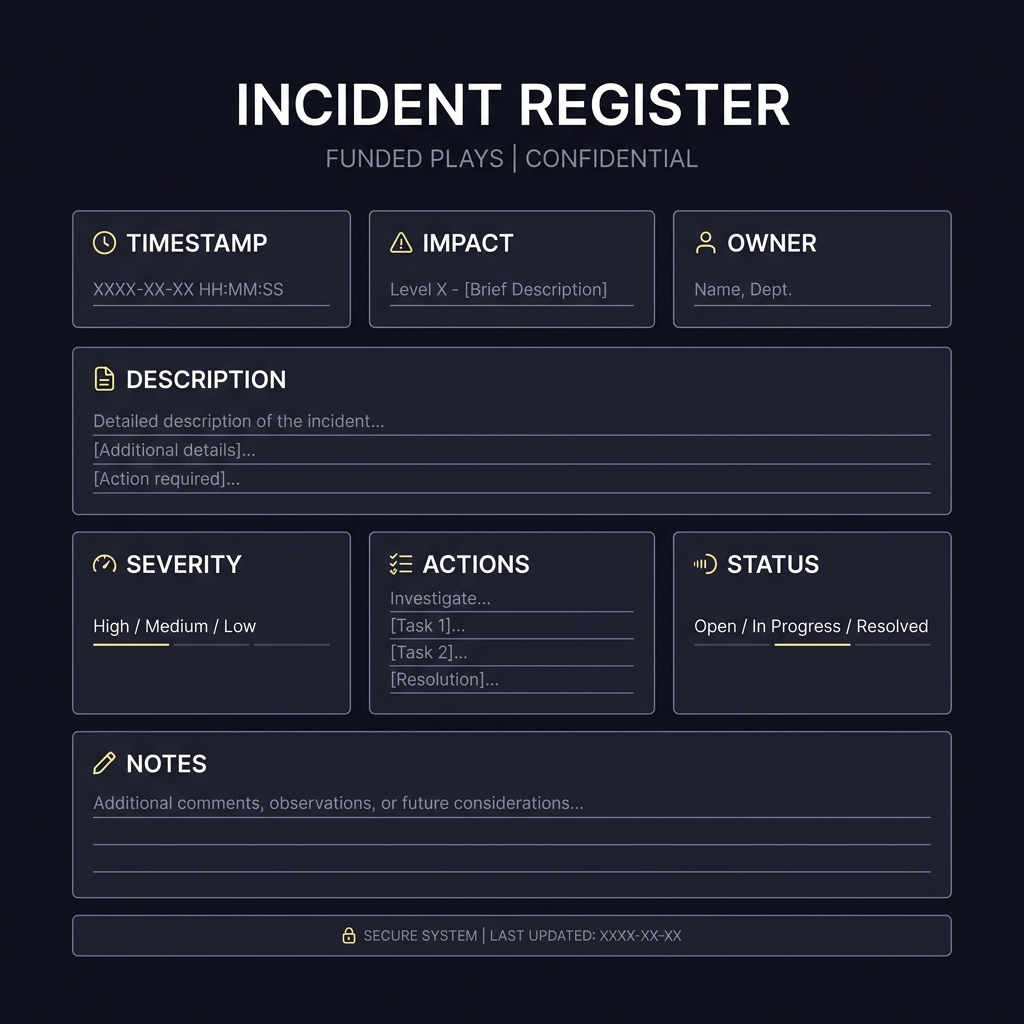
Start with a minimal logging template teams can use in any ticketing system or incident register. Required fields should include: timestamp, concise summary, estimated impact, primary affected components, immediate mitigation steps taken, reporter contact, and whether evidence was preserved. Recording these items creates a reliable audit trail for internal review and regulators.
Link escalation channels to severity thresholds and ownership. Define who receives an alert for low-severity incidents, who must sign off on medium-severity escalations, and which roles are responsible for high-severity incidents. Make escalation criteria explicit so decisions are auditable and repeatable, and document cases where a decision was made not to escalate and who approved that decision.
When logging an event, preserve evidence immediately: copies of relevant logs, database snapshots, configuration exports, email records, and any relevant transaction details. Preserving an unaltered chain of evidence helps both internal review and external audits, and it supports the lessons-learned process by ensuring root-cause analysis is based on reliable data.
For teams in regulated or challenge-based environments like Funded Plays, add a note in the incident record about whether the event affects evaluation performance, customer-facing processes, or compliance obligations. That helps route the event to the right governance forum and aligns operational handling with regulatory and platform rules.
How to run postmortems and capture lessons learned
Use a short, consistent postmortem agenda aligned with incident-handling guidance: timeline, facts, impact assessment, root-cause analysis, corrective actions, and lessons learned. NIST formalizes a post-incident 'lessons learned' phase that focuses on identifying what went wrong and what will change to prevent recurrence NIST incident-handling guide. See also the NIST Cybersecurity Framework NIST Cybersecurity Framework.
Run postmortems promptly but with discipline: collect evidence, assemble a cross-functional team, and separate the factual timeline from interpretations. Produce a concise findings summary and a corrective action plan that lists specific actions, owners, target dates, and measurable success criteria. Track closure publicly within governance rhythms so audits can verify remediation.

For platforms that run skill-based evaluations or virtual funded accounts, run tabletop exercises using anonymized incidents so processes are tested under realistic conditions. Structured simulation helps teams practice evidence preservation, role assignment, and communications without real-world exposure.
Decision criteria: when small losses matter and when to escalate
Small losses matter when they indicate systemic problems or when they aggregate. Set quantitative thresholds appropriate to your context, for example a financial limit where any single loss above that level triggers automatic escalation, but also define qualitative triggers such as customer impact, regulatory exposure, or recurrence.
Aggregation risk is critical: many trivial-seeming errors can sum to a material effect. Monitor recurring patterns in your incident register and run periodic aggregation reviews. If similar incidents appear multiple times, escalate for deeper investigation even if each individual event fell below numeric thresholds.

Document decisions not to escalate. Require a short justification and an approving party for any choice to keep an incident at low priority. This record reduces hindsight disputes and demonstrates that judgment was applied, which is important for auditability and governance.
Typical mistakes and how teams can avoid them
Common failures include relying on informal verbal fixes, failing to preserve evidence, missing written audit trails, and incentive structures that reward short-term fixes over correct remediation. These gaps let small issues persist and sometimes grow into material problems.
Controls that work include independent checkpoints where a neutral reviewer validates that an incident was logged correctly, protected tip channels that encourage early reporting, and routine audits of the incident register to find patterns the operational team might overlook ACFE Report to the Nations 2024.
a minimal incident register configuration for immediate logging
Ensure required fields cannot be cleared
Culture matters. Build psychological safety so people can report mistakes without fear of immediate punishment, while keeping a clear separation between fact finding and disciplinary processes. That balance encourages truthful reporting and protects learning.
Scenario 1, hidden near-miss: a team notices intermittent failures in a reconciliation script and verbally agrees to patch the script after a release. Because no record exists, the failures escalate into months of cumulative misstatements that become costly to unwind. Early logging would have captured the pattern and enabled small fixes before the issue compounded, saving time and reputational harm.
Scenario 2, early catch: a recurring small error in user crediting appears three times in a month. An engineer logs each instance with impact estimates and preserved logs. The pattern triggers an aggregation review, the root cause is fixed within two weeks, and affected users are remediated promptly. The incident remains small because it was recorded and escalated early.

Include a fill-in-the-blank logging template in your incident system: 'Timestamp / Reporter / One-line summary / Estimated impact / Systems affected / Immediate mitigation / Evidence preserved (Y/N) / Escalation level / Assigned owner'. Attach a short postmortem checklist that asks for timeline, root cause, corrective actions, owners, dates, and validation criteria.
Conclusion and a short action checklist
Transparent loss reporting reduces regulatory, legal, and operational risk and improves organizational learning. The practical steps below let teams operationalize that transparency without excessive overhead.
Quick checklist: 1) Log every incident using the minimal template; 2) Preserve evidence immediately; 3) Escalate per defined thresholds; 4) Run a prompt postmortem; 5) Assign corrective actions with owners and dates; 6) Track closure in governance rhythms; 7) Share lessons in postmortem summaries.
Adopting these practices aligns teams with contemporary audit expectations and incident-handling guidance while reducing the temptation to rationalize losses. Make small changes this week: add the minimal logging template to your incident register and run one tabletop postmortem on a recent near-miss to exercise the workflow.
Log any error that affects users, could trigger regulatory scrutiny, or repeats; if uncertain, record it and assess against escalation thresholds.
A minimal template reduces overhead; focus on quick triage and preserve evidence, then escalate only those incidents that meet thresholds or show patterns.
Build psychological safety, separate fact finding from discipline, provide protected channels for tips, and reinforce that reporting is part of professional duty.