
What are key numbers and why they matter in line movement
Definition of key numbers
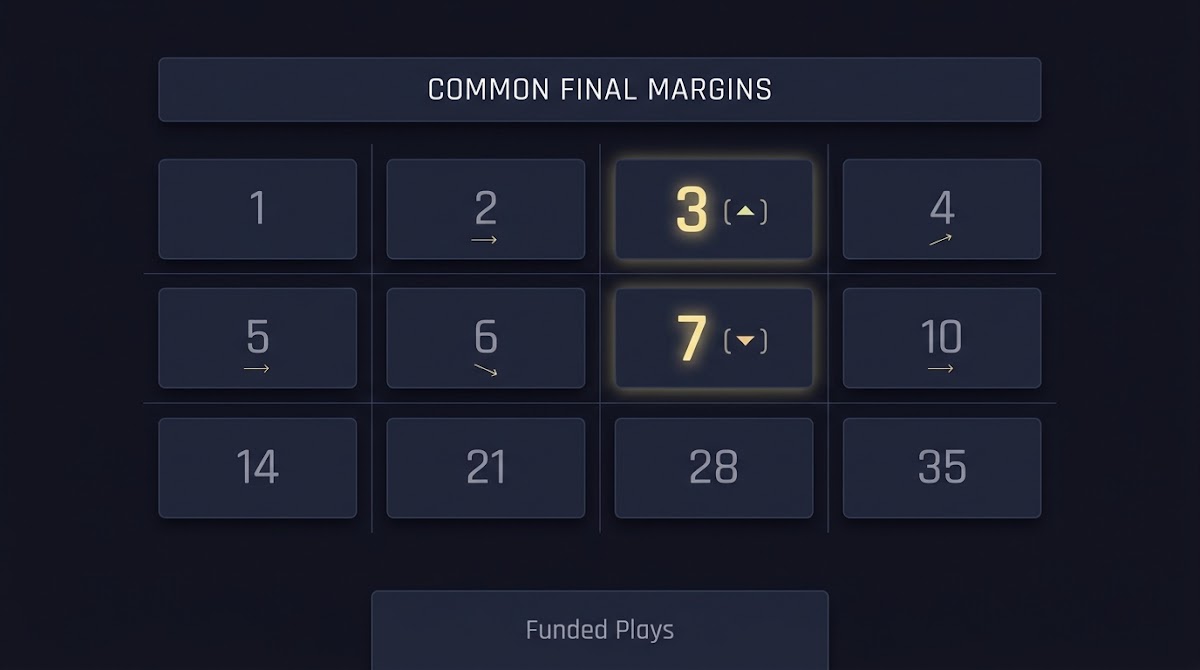
Key numbers are specific margins of victory that show up more often than others because of how scoring works in the NFL. They are not mystical; they are a direct consequence of standard scoring increments. Bettors and market makers watch these margins because a line that sits on one of those numbers has different push and cover odds than a line on a non-key number.
Rule changes can shift field position and return rates, which alter scoring opportunities and the distribution of final margins; multi-season monitoring is needed to see whether those changes create durable shifts in key numbers.
Why scoring increments create frequency peaks
The way teams score - touchdowns, extra points, field goals, and two-point conversions - creates natural clusters in final margins. For example, the combination of a touchdown plus an extra point commonly yields margins of seven, and field goals push several outcomes into the three-point neighborhood. Those mechanical effects create frequency peaks that betting markets price differently than margins that occur less often.
Why Key Numbers Matter in Line Movement
Why Key Numbers Matter in Line Movement is central to understanding why a half-point means more in some spots than others, and why market behavior around those margins often looks conservative. Knowing which margins are keys helps you prioritize where to hunt edges and when to expect lines to be sticky.

How scoring rules and recent rule changes shape key numbers
2015 extra point change and its effects
The 2015 extra-point rule change moved the line of scrimmage for the try, which raised the difficulty and nudged the incidence of one- and two-point differentials upward relative to prior eras. This rule is a foundational change that bettors should treat as the first major pivot when comparing era-by-era margin frequencies NFL extra point rule changes. For additional context on recent rule activity see NFL featured rules.
2024 kickoff overhaul and early signals
The 2024 kickoff overhaul introduced changes intended to alter return rates and field position, which in turn can shift scoring opportunities and the distribution of final margins. These channels are plausible mechanisms for margin-frequency change, and they justify watching multi-season trends before declaring new permanent key numbers NFL kickoff rule.
Because rule-driven shifts operate through field position and scoring opportunities, their effects on which margins become keys can be gradual, requiring multiple seasons of data to confirm.
How sportsbooks and markets behave around key numbers
Juice adjustments and reluctance to move off keys
Sportsbooks commonly adjust the juice around key numbers instead of moving the spread through them, because crossing a key alters the book's push and cover liabilities in a measurable way. In practice this means you will often see price changes in vig before the spread itself shifts through a key number TheLines on line movement.
collect lines and juice timestamps for CLV and margin tracking
Keep each entry time-stamped for audit
Market shading and early lines reflect risk management. Books may open a game on a comfortable number and use juice to discourage one-sided money near a key rather than shift the line and change the book's push profile.
When a line crosses a key number, the probability of a push changes nonlinearly, which shifts expected value for both sides. A move that takes a standing position through a key can convert what looked like a small edge into a materially different expectation for cover and loss outcomes.
The math: push, cover probabilities and the value of a half point near keys
How a half point changes push versus cover odds
Moving from +2.5 to +3 or from -2.5 to -2 changes the set of final margins that result in a push and alters cover probabilities. Because margins cluster around certain numbers, that half point can move you from a likely push outcome into a likely cover outcome, which is why the same half point has asymmetric value when placed near a key Unabated on NFL key numbers.

A half point away from a key typically slices a set of common outcomes differently than the same half point further from a key. That means the expected gain in probability for covering the spread is greater near a key than away from it, holding other factors constant. Books often compensate by increasing juice, so traders must compare the probability shift to the price of taking action.
Transaction costs matter: the effective advantage created by a half-point change must exceed the extra juice or fees needed to get that number, or the theoretical EV will evaporate.
Closing Line Value and long run performance
What closing line value measures
Closing line value, or CLV, measures how your price compares to the market's closing price. Positive CLV shows that you consistently obtain better prices than where the market ultimately settles, and that consistency correlates with stronger long-run results when paired with sound staking and recordkeeping Unabated on closing line value.
Why holding or beating keys matters for CLV
Beating or preserving value around key numbers often explains part of CLV's predictive power, because securing half-point improvements at key thresholds can materially change push and cover outcomes. CLV is a useful indicator but not an absolute guarantee; it should be one of several metrics you monitor.
Good recordkeeping and consistent review cycles help you understand whether CLV gains stem from real edge or from timing and variance.
A practical framework: how to use key numbers when you trade the spread
Define triggers and pre-set entry rules
Start by defining trigger prices tied to key numbers. For example, set rules that you will accept a bet when the market gives you at least a half point that brings a line to or past a key, provided your model still rates the position as favorable. Doing this converts ad hoc decisions into repeatable actions and reduces emotional chasing Unabated key numbers.
Pair triggers with strict bankroll allocations. If a trade's edge depends mainly on a half point near a key, limit exposure so a single variance swing cannot derail your plan.
Prioritize markets where movement risks crossing 3 or 7, since those keys produce the largest changes in push and cover probabilities. Give early action higher priority when your model shows a stable advantage and the market is thin or prone to early correction.
Also build rules for when to step back: predictable juice drift toward a key or anticipated information releases that typically move lines are valid reasons to wait rather than commit early.
Decision criteria: when to take the early number and when to wait
Balancing line movement risk and expected value
Take early action when you have a clear model edge, the line threatens to cross a key, and juice does not negate the edge. Conversely, wait when juice is likely to move against you or when you expect news that historically shifts prices.
Special cases around rival matchups and situational edges
Certain situational factors can justify deviation from your standard triggers, such as weather, injuries, or matchup-specific tendencies that your model already accounts for. Use these as conditional signals rather than gut feelings.
Practice disciplined prediction with FundedPlays Challenges
Sign up for an email update or download a simple tracker template to capture line timestamps and CLV, and to keep decisions disciplined.
Common mistakes and cognitive traps when using key numbers
Overfitting to historical keys
One common error is overfitting to past key-number frequencies without accounting for rule changes or evolving play styles. The kickoff rule changes and other era shifts mean a historical key may weaken or strengthen over time, so treat older data with appropriate caveats NFL kickoff rule.
Chasing small edges without accounting for juice
Another trap is taking tiny half-point advantages while ignoring the juice and transaction costs that erode EV. Even when a half point looks attractive on paper, the net expected return can be negative after fees and vigorish are accounted for, so always net out transaction costs before sizing.
Confirmation bias and survivorship bias can also lead you to overstate the importance of certain wins decided by keys; keep an audit trail to evaluate true effectiveness.
Practical scenarios: hypothetical examples where a half point changes outcomes
Scenario A: capturing a half point to avoid a push
Imagine you have a model that rates a team as a three-point favorite but the market opens at -2.5. Taking -2.5 immediately converts a portion of likely pushes into covers for you. The change from -3 to -2.5 or vice versa can flip a close subset of outcomes and therefore your expected payoff, especially when margins cluster around the key. Use this kind of hypothetical to test whether your model edge survives market friction Unabated example context.
Scenario B: waiting and losing half-point value
In contrast, if you wait for more confirmation and the market drifts to -3, you may lose a half point that would have avoided a push. That lost half point can materially change the realized result for that wager. These hypotheticals show why pre-defined triggers tied to keys help capture value and control regret.
Always remember these examples are illustrative and not tied to any specific historical game.
What to monitor in 2026 as the kickoff-rule environment matures
Key metrics to watch
In 2026, monitor updated frequencies for 1-, 2-, 3-, 6-, and 7-point margins. Watch multi-season trends rather than single-year blips so you do not prematurely relabel a number as a key Unabated on evolving key numbers.
How to update your key-number map
Combine margin frequency charts with return-rate and field-position metrics tied to the kickoff rule. Use rolling multi-season windows and set sample-size thresholds before changing your trigger rules, because the full impact of the 2024 kickoff rule may take several seasons to stabilize.
Tools and data sources to track key-number movement
Where to get line histories and margin distributions
How to set up simple trackers
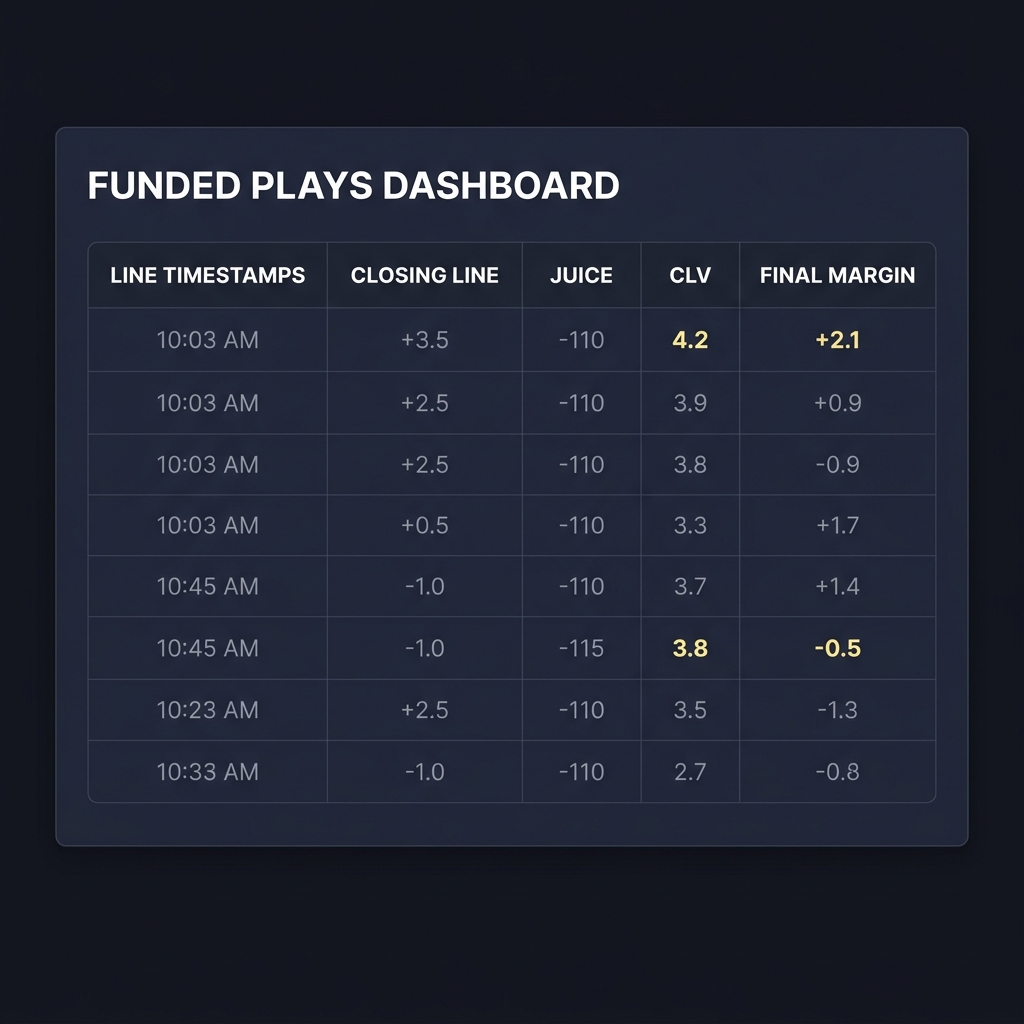
A minimal tracker captures timestamped lines, the closing line, juice, and final margin. Calculate CLV routinely and segment margin frequency by season and rule era to spot meaningful shifts rather than noise.
Keep an auditable spreadsheet and avoid changing strategies on small sample sizes; rule-era markers such as pre-2015, 2015-2023, and post-2024 are helpful partitions.
How to fold key-number thinking into a disciplined betting plan
Bankroll rules tied to key-number edges
Size bets conservatively when the trade depends mainly on a half-point around a key. For example, reduce stake size compared with stronger model edges that do not hinge on narrow margins. This preserves your bankroll against variance when outcomes cluster near those keys Unabated guidance.
Record and review cadence
Review CLV, margin frequency, and your win rate monthly and aggregate results by season. If CLV moves and margin frequencies drift together, that signals a need to re-calibrate triggers rather than to double down without investigation.
Treat this as risk management: disciplined bookkeeping is how you know whether your key-number approach is truly additive.
Measuring outcomes: metrics that matter for long-term improvement
Key metrics to track
Track closing line value, win rate, return on stake, and the share of wagers decided by key margins. These metrics together tell you whether key-based sizing and triggers are improving expected outcomes over time Unabated on CLV.
How to interpret CLV and margin frequency together
If CLV is positive but margin frequencies shift away from historic keys, your edge may be temporary. Conversely, if CLV aligns with consistent margin-frequency patterns, your methods for capturing half-point value are likely robust. Use minimum review windows of multiple seasons to avoid overreacting to noise.
Conclusion: key numbers are a durable tool, but they require ongoing monitoring
Summary of main takeaways
Key numbers, with 3 and 7 still central, remain a durable lens for thinking about spread markets, but rule changes like the 2015 extra-point modification and the 2024 kickoff rule can nudge distributions and should prompt multi-season monitoring NFL extra point rule changes.
Practical next steps
Set clear trigger prices for half-point value, build a simple timestamped tracker, and review CLV and margin frequency on a routine cadence. Keep sizing conservative when an edge depends primarily on a key-number move, and remember that no approach guarantees success.
Key numbers are margins that occur more frequently because of how scoring works, such as 3 and 7, and they affect push and cover probabilities.
A half point near a key can materially change push and cover odds; its practical value depends on juice and transaction costs.
Wait for multi-season trends and sufficient sample sizes before declaring permanent shifts tied to rule changes.
References
- https://www.covers.com/nfl/key-numbers
- https://operations.nfl.com/updates/the-rules/nfl-owners-approve-extra-point-rule-changes/
- https://operations.nfl.com/rules-officiating/featured-rules
- https://sports.yahoo.com/nfl/betting/article/nfl-betting-odds-lines-3-rule-changes-that-could-affect-wagering-strategy-153202587.html
- https://pmc.ncbi.nlm.nih.gov/articles/PMC12712303/
- https://operations.nfl.com/updates/the-rules/owners-approve-new-kickoff-rule/
- https://www.thelines.com/line-movement-sports-betting/
- https://unabated.com/insights/nfl-key-numbers-are-changing/
- https://www.fundedplays.com/challenges
- https://unabated.com/insights/closing-line-value/
- https://www.fundedplays.com/blogs
- https://www.fundedplays.com
- https://www.fundedplays.com/blogs/how-fundedplays-evaluations-work