
Why Freshman-Heavy Teams Are Hard to Price: definition and context
A concise operational definition helps clarify the modeling problem. Call a roster freshman-heavy when it combines low returning production, a high share of first-year players on the two-deep, and a notable concentration of blue-chip recruits who may push expectations upward without delivering immediate snaps or production.
Returning production is a widely used preseason signal, and when it is low the starting priors for a team are less informative; that creates wider uncertainty bands rather than a simple systematic bias toward over- or under-performance, which complicates early pricing decisions ESPN's SP+ overview.
Two NCAA policy changes affect roster stability and therefore preseason volatility. Transfer-notification windows create new cadence and timing for movement, and the four-game redshirt rule allows coaches to introduce freshman contributors late in the season without burning eligibility, both of which increase the chance of midseason usage shocks that models must anticipate NCAA announcement on transfer windows.
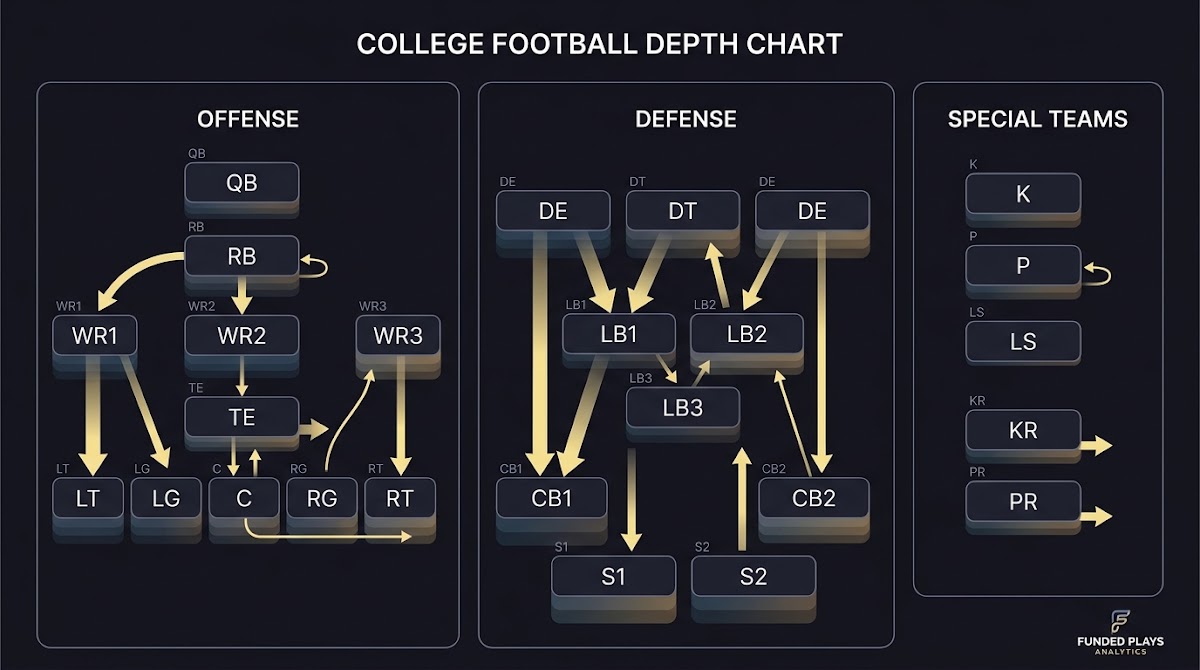
In practice, defining freshman-heavy in model code is straightforward: set thresholds on returning-production percentiles and share of true freshman snaps in recent practices or fall drills. Treat those teams as high-variance processes in your preseason layers, and log them for close midseason monitoring.

Why Freshman-Heavy Teams Are Hard to Price: how preseason models use returning production
Major preseason systems put weight on returning production because past snaps and production are the best direct predictors available before new-season data arrives. SP+ treats priors as starting beliefs and then blends observed early results with those priors in a way that intentionally widens uncertainty when priors are weak or the roster has high turnover ESPN's SP+ overview.
FEI and similar systems also use explicit priors and regression toward historical expectations, which means teams with low returning production receive less informative priors and therefore show larger preseason error variance until in-season samples accumulate FEI methodology update.
Returning-production rankings provide a practical way to operationalize that intuition. Teams low in returning-production percentile usually exhibit higher early-season forecast errors because the model, lacking informative priors, must rely on uncertain recruit conversions and coaching changes, a pattern visible in preseason to early-season error analyses ESPN returning-production rankings for 2025.
For model builders, the takeaway is to encode returning production as both a mean shift and an uncertainty multiplier. Practically, use returning-production percentile to scale variance in preseason lines, then progressively reweight observed game data as roles and snap distributions stabilize. Updated returning-production breakdowns for 2026 are available from ESPN here.
Download the checklist and model notebooks referenced in this guide via the FundedPlays Challenges page
Download a concise checklist or subscribe to receive model notebooks and update examples for pricing high-variance rosters, delivered as a single-page reference for preseason and early-season workflows.
Why Freshman-Heavy Teams Are Hard to Price: Talent versus experience, blue-chip recruits, conversion noise, and ceilings

Recruit quality signals talent and potential ceiling. The Blue-Chip Ratio work shows that teams stocked with a higher share of blue-chip recruits tend to possess higher championship ceilings, but that does not imply immediate production from those recruits; translating rankings into first-year snaps is noisy and inconsistent Blue-Chip Ratio 2025.
That tension creates a classic variance problem. Blue-chip heavy rosters raise optionality, increasing upside scenarios in a projection, while leaving the short-term forecast with wider tails because the probability distribution must accommodate both immediate impact and adjustment periods. Treating recruit share as only a mean adjustment underestimates this extra variance.
To handle that in practice, modelers can use recruit-to-performance conversion curves. Instead of converting star counts directly into expected production, anchor conversions to blue-chip share and historical conversion volatility for similarly profiled teams. That preserves the ceiling signal while explicitly inflating early-season uncertainty for freshman-driven depth charts.
Why Freshman-Heavy Teams Are Hard to Price: in-season dynamics, how priors should shift as snaps and roles clarify
As the season begins, models should shift weight from priors to observed results in a sample-size-aware way. The general principle is principled shrinkage, where early results are regressed toward priors but the regression strength weakens as the sample grows, a practice consistent with SP+ and FEI approaches to early-season weighting ESPN's SP+ overview.
Operationally, implement a schedule of effective sample sizes by position and by snap threshold. For example, increase the weight on observed quarterback production after a starter clears a season-level snap threshold, while requiring a larger snap share for inexperienced groups before shifting offensive line ratings. FEI-style adjustments that combine quality of opponent and schedule strength with live data help reduce early mispricing as meaningful game samples accumulate FEI methodology update.
Preseason models rely on returning production and priors that become less informative when rosters are young, increasing uncertainty. Talent signals like blue-chip recruits raise ceilings but add conversion noise, so models need explicit variance controls and sample-size driven reweighting to avoid early-season errors.
Monitor for policy-driven roster shocks such as late redshirt usage or portal arrivals, and treat those events as structural signals rather than ordinary noise. The four-game redshirt rule makes late-season freshman usage a predictable source of shock, and transfer windows alter the timing of roster churn in ways your pipeline should flag automatically NCAA four-game redshirt approval.
Live-market calibration is another tool in the toolbox. Compare model-implied prices to market prices and use a controlled damping factor to nudge lines when persistent divergence appears alongside stabilizing snap data. Markets often incorporate non-public information rapidly, so calibration should be incremental and logged to avoid overreacting to short-term noise. See the Funded Plays blog for related posts.
Why Freshman-Heavy Teams Are Hard to Price: core framework, concrete modeling adjustments for freshman-heavy teams
Start with a variance multiplier, a simple scalar applied to your preseason uncertainty based on returning-production percentile. Teams below a chosen returning-production cutoff should receive an elevated multiplier that widens confidence intervals and encourages conservative pricing moves.
Next, use positional weights tied to historical conversion volatility. Not every freshman position converts at the same rate; quarterback and edge rusher impacts follow different trajectories than interior linemen in many programs. Anchor positional weights to observed conversion patterns, then tune them with regular backtests to avoid overfitting.

Third, design a recruit-to-performance conversion that uses blue-chip share as a primary anchor. Rather than converting star counts naively, map blue-chip share to a distribution of likely initial production outcomes and use that distribution to create asymmetric upside adjustments while keeping median projections conservative see 2026 trends.
Finally, require live-market calibration steps. When your model and the live market diverge by a persistent margin and in-season snap data starts to support a reweighting, apply incremental adjustments with an explicit log entry that records trigger signals, magnitude, and rationale. This makes later diagnostics and model refinement straightforward and defensible FEI methodology update.
Why Freshman-Heavy Teams Are Hard to Price: decision criteria, when to favor youth and when to trust priors
Make decisions using threshold rules rather than ad hoc judgments. For example, overweight recruit signals only when a blue-chip concentration exceeds a predefined share and early snap evidence confirms role stability. Otherwise, default to conservative priors and larger uncertainty bands until evidence accumulates.
As a safe default, cap upside adjustments to a fraction of your preseason variance until a player reaches a role threshold, such as a target snap share across consecutive games. Document these thresholds in your model governance notes so that every significant projection change has a recorded rationale.

Open questions remain about optimal positional weights and how quickly portal-heavy rosters converge to true strength across different schedules. Treat these as research priorities, and prefer conservative defaults until you have robust cross-season evidence to justify more aggressive rules Blue-Chip Ratio 2025. Learn more at Funded Plays.
Why Freshman-Heavy Teams Are Hard to Price: common mistakes and pitfalls when pricing freshman-heavy teams
A frequent error is overfitting to small samples. Reacting strongly to a single-game breakout or collapse without considering role stability often leads to reversals and model degradation. Enforce minimum sample sizes before making large projection shifts to avoid this trap ESPN's SP+ overview.
Another pitfall is treating recruit rankings as immediate predictors rather than probabilistic signals. Star ratings are valuable but noisy for first-year production, and relying on them without explicit variance handling increases early-season forecast error Blue-Chip Ratio 2025.
Finally, ignoring policy-driven roster volatility undermines model credibility. Transfer windows and the four-game redshirt rule change the timing and frequency of roster shocks, and failing to encode those institutional patterns will increase surprise events in your forecasts NCAA announcement on transfer windows.
Why Freshman-Heavy Teams Are Hard to Price: practical scenarios and examples of model evolution during the season
Scenario A, early snap clarity reduces uncertainty. Imagine a freshman quarterback who earns starting reps across the first three games and reaches a predefined snap-share threshold. At that point, the model reduces the variance multiplier for the quarterback position and increases the weight of observed production, which tightens team-level projections and narrows market spreads.
quick gating checklist for reweighting priors
Use before making large projection changes
Scenario B, late-season usage shocks from redshirt freshmen or transfers. A coach may insert redshirted freshmen late in the season under the four-game rule, creating abrupt usage spikes that require immediate model attention. When this happens, treat the event as structural, flag affected positions, and apply conditional rules that modestly widen uncertainty until a small sample confirms role and production NCAA four-game redshirt approval.
In both scenarios, monitor market divergence as a secondary signal. If the market moves sharply while your model remains conservative but snap evidence supports the move, consider incremental calibration. Conversely, if markets move without supporting snap or role data, resist following and instead increase logging and manual review FEI methodology update.
Why Freshman-Heavy Teams Are Hard to Price: conclusion and actionable checklist for pricing freshman-heavy teams
Here is a compact checklist to implement before and during the season. First, set wider preseason uncertainty intervals for low returning-production teams and document the multiplier you apply. Second, anchor recruit conversions to blue-chip share and model them as distributions, not point estimates Blue-Chip Ratio 2025. Implementation notes are available in our evaluations overview.
Third, implement positional snap thresholds that trigger incremental reweighting of observed data. Fourth, log every major calibration or market-driven adjustment with the trigger signals and magnitude, and use these logs for end-of-season diagnostics and model refinement. Fifth, prefer conservative defaults when in doubt and treat freshman-heavy teams as high-variance opportunities, not guaranteed mispricings ESPN returning-production rankings for 2025.
Finally, keep a short research docket for unresolved questions such as positional weight tuning and convergence timing across schedules. Recording assumptions and outcomes will convert intuitive practices into reproducible improvements over multiple seasons FEI methodology update.
Use returning production as both a mean and uncertainty signal; low returning production should increase preseason variance and delay aggressive reweighting until snaps clarify roles.
Blue-chip share raises the upside ceiling but does not guarantee immediate production, so treat it as an upside signal while inflating early-season variance.
After predefined snap-share thresholds and consecutive-game role confirmation, reduce uncertainty; until then prefer gradual updates and require market calibration.
References
- https://www.espn.com/college-football/insider/story/_/id/29350517/what-sp-how-espn-college-football-power-ratings-are-calculated
- https://www.ncaa.org/news/2022/8/31/media-center-division-i-council-adopts-transfer-windows.aspx
- https://www.bcftoys.com/2024/08/fei-ratings-methodology/
- https://www.espn.com/college-football/insider/story/_/id/39622386/college-football-returning-production-rankings-2025
- https://www.cbssports.com/college-football/news/blue-chip-ratio-2025-these-18-college-football-teams-can-actually-win-the-national-championship/
- https://www.ncaa.org/news/2018/6/13/di-council-approves-four-game-redshirt-in-football.aspx
- https://www.fundedplays.com/challenges
- https://www.espn.com/college-football/story/_/id/48259759/college-football-returning-production-2026-notre-dame-texas
- https://www.cbssports.com/college-football/news/college-football-stats-2026-returning-production-trends-insights/
- https://www.puntandrally.com/viewreturnprod.php
- https://www.fundedplays.com
- https://www.fundedplays.com/blogs
- https://www.fundedplays.com/blogs/how-fundedplays-evaluations-work