

Why Broadcast Delay Matters in Live Trading: Overview
Why Broadcast Delay Matters in Live Trading because the price you act on can be older than the market state by the time your system receives a tick, and that age can change outcomes in rapid markets. Traders, engineers, and operations teams need to map that time gap to execution risk rather than treat data delivery as instantaneous.
Exchanges and venue operators publish latency information that makes the problem measurable, and recent venue reports show very low internal processing times for co-located participants while consolidated tape paths are measurably slower in dissemination during busy periods. For example, exchange publications document sub-millisecond internal processing for co-located participants, helping teams set realistic expectations about what part of delay they can control Nasdaq latency statistics.
Baseline your latency and compare feed options
Baseline your own end-to-end delay using synchronized clocks before changing feeds or networks. Start with a short measurement plan to know whether millisecond differences matter for your strategy.
Understanding whether a millisecond matters starts with a clear definition: broadcast delay is the time between a market event at the venue and when a trader's system can receive and process the corresponding market data tick. That single definition ties directly to practical outcomes such as slippage, missed fills, and increased adverse selection when markets move quickly.
What broadcast delay is and where it appears
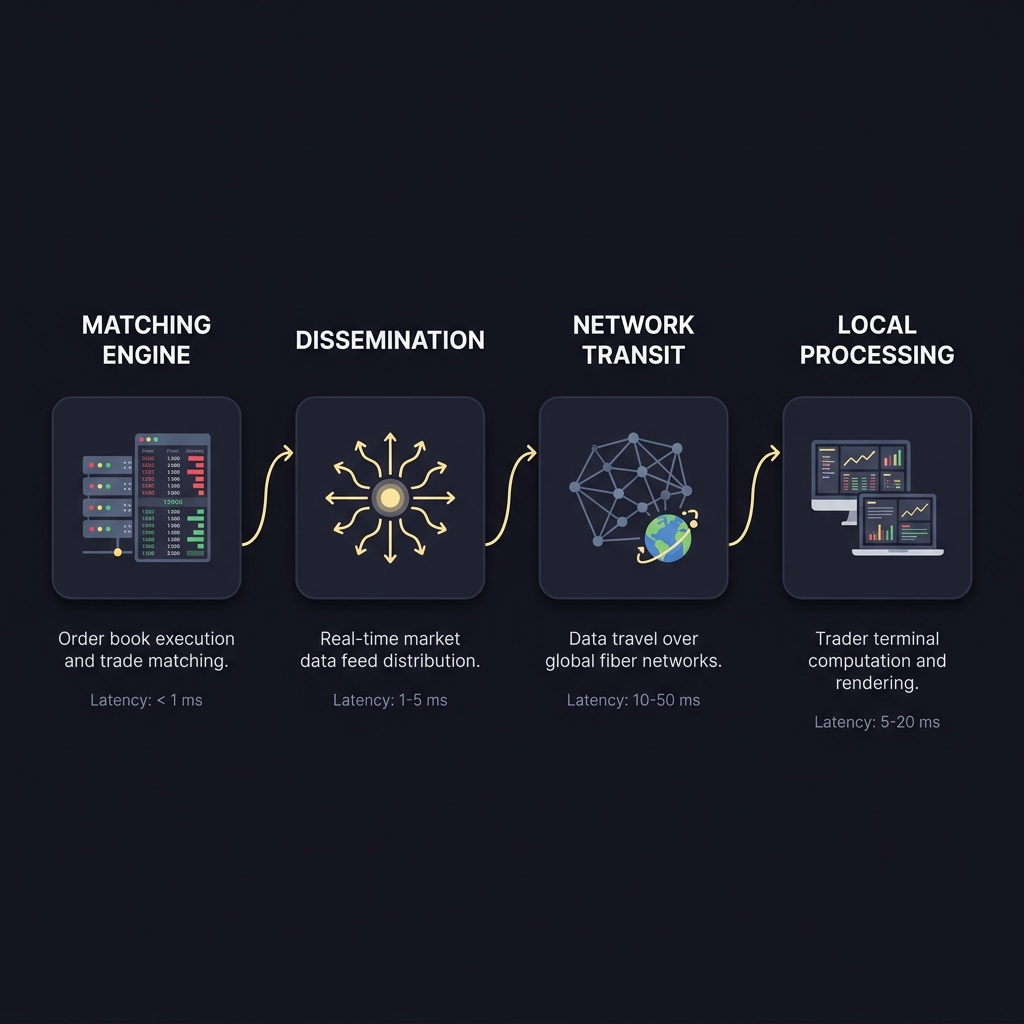
Think of broadcast delay as a sequence of stages you can measure and optimize. Break it into numbered micro-steps so it maps to people and systems.
1) Venue internal processing. The exchange receives orders, matches them in the matching engine, and prepares dissemination messages. Modern venues publish these internal timing characteristics so teams know how much time is consumed on-site Cboe latency statistics.
2) Dissemination path. Venues distribute market data via proprietary multicast or direct feeds and also through consolidated tapes such as SIP. Aggregation and re-publication by consolidated systems introduce additional dissemination steps compared with direct feeds, which can add measurable delay in fast markets CTA operating metrics.

3) Network transit and peering. The physical path between the venue and your systems, whether by direct private links or the public internet, adds propagation delay and variability from peering, congestion, and distance. Public internet paths can be especially variable and exhibit jitter that matters for time-sensitive workflows ThousandEyes internet performance report.
4) Local processing stacks. Once a feed arrives, local handlers, middleware, and application logic add processing time. Even small per-message overheads multiply under high message rates and can turn sub-millisecond venue times into multi-millisecond end-to-end delays.
How broadcast delay is generated in modern venue architectures
At venue scale, several tightly integrated subsystems create the end result that market participants see. The most visible are the matching engine and the distribution fabric that turns matched trades and quotes into multicast or feed messages.
Modern matching engines are designed to be extremely fast, and exchange disclosures show that co-located participants experience very low internal processing and dissemination delays. That transparency helps teams choose connectivity and hosting models that align with their speed requirements Eurex T7 system characteristics.
Broadcast delay can change execution quality by making the data you act on older than the current market, increasing slippage and the chance of missed fills during fast markets; measuring end-to-end delay with synchronized clocks shows where to focus mitigation.
Distribution models vary. Proprietary direct feeds typically use multicast or dedicated low-latency protocols that push updates to co-located or directly connected subscribers almost immediately. In contrast, consolidated tape systems gather data from many venues and perform aggregation and sequencing before distribution, which logically adds processing steps and time. The additional work of aggregation explains why SIP paths can lag direct feeds under load CTA operating metrics.
SIP versus direct proprietary feeds: measurable differences
The consolidated tape is designed to ensure a single, consolidated view of trade and quote activity for public dissemination, but that design introduces extra processing stages compared with direct feeds. CTA operating metrics make this behavior observable, showing measurable dissemination intervals that are typically larger than direct feed paths during busy periods CTA operating metrics.
Exchange publications from major venues also provide latency breakouts that allow buyers to compare paths. For participants who can co-locate or accept direct feeds, venue statistics often show lower dissemination times for those paths compared with consolidated tape recipients, giving teams a basis for purchase decisions Nasdaq latency statistics.
When does the difference matter in practice? It matters when market conditions change quickly and execution decisions need the freshest quote. Extra milliseconds increase the chance that an incoming tick no longer reflects the immediately available executable price, which raises slippage and can produce missed fills or worse execution quality under fast markets. Treat these observations as operational realities to weigh against cost and complexity rather than as hard guarantees.
Measuring end-to-end delay: clocks, methodology, and practice
Accurate measurement depends on disciplined clock synchronization. In the U.S., FINRA establishes clock synchronization guidance that ties system clocks to recognized time sources such as NIST, and following that guidance is the baseline for consistent timestamp comparisons FINRA clock synchronization guidance.
Use a simple, repeatable workflow to measure end-to-end delay: record the venue timestamp on the market data message, record arrival time in your system clock, send and timestamp an order and its acknowledgement, and compare the deltas across synchronized clocks to estimate one-way and round-trip components. Be explicit about which timestamp is authoritative and ensure all involved systems align to the same time source.
Quick clock sync and timestamp validation checklist
Run checks before baseline tests
Common measurement pitfalls include unsynchronized clocks, ambiguous timestamp provenance, and local processing that biases arrival times. Document the measurement path end to end so that timestamps map directly to a specific network hop or process stage rather than to a vague concept of "arrival."
Network transport: co-location, the public internet, and routing effects
Choosing co-location or direct connectivity reduces the number of network hops and eliminates much of the uncertainty introduced by public internet paths. Venue publications and hosting options make latency characteristics visible so decision makers can estimate gains from proximity hosting Eurex T7 system characteristics.
By contrast, the public internet adds variable delay and jitter that depend on region, provider, and routing. Annual internet performance reviews document path-dependent spikes and regional differences that can erode low-latency advantages if a critical leg traverses congested or poorly peered networks ThousandEyes internet performance report.
Practical network factors to evaluate include the quality of ISP peering, last-mile performance, and the predictability of transit paths. Improving these components often requires cooperation with network providers and a willingness to test routing alternatives under realistic traffic patterns.
How extra milliseconds translate into execution risk
Acting on an older tick increases the chance that a trade will execute at a worse price than expected or not execute at all. Exchanges and consolidated tape publications make latency differences measurable, and that measurability lets teams quantify potential slippage and missed execution risk under fast markets Nasdaq latency statistics.
Delay is most harmful during rapid price moves and news-driven volatility, when quotes can change many times in seconds. In such windows, even a small broadcast delay can create adverse selection because the quoting party may have already moved off the price you see. Lower latency reduces exposure to this effect, but it does not eliminate market risk or guarantee fills.
Practical mitigation strategies for lowering broadcast delay
Prioritize mitigations based on the strategy's sensitivity to latency. For many strategies the largest measurable wins come from choosing direct proprietary feeds and using co-location or proximity hosting when feasible, supported by venue latency disclosures that help estimate expected gains Cboe latency statistics.

Complement connectivity choices with software optimizations: reduce per-message processing, use efficient parsers, and avoid synchronous I/O in hot paths. Also, enforce strict clock synchronization so measurements remain reliable and so monitoring alerts are meaningful FINRA clock synchronization guidance.
Additional steps include improving routing and peering, instrumenting the stack for tail latency, and deploying monitoring that correlates market data delay with order execution outcomes. Each step has cost; choose pilots that can demonstrate value before broader investment.
Choosing the right feed and connectivity for your strategy
Begin with clear decision criteria: how sensitive is the strategy to quote freshness, what budget is available for connectivity and hosting, and what operational discipline exists to measure and maintain latency. Venue latency publications provide inputs you can use in this evaluation Nasdaq latency statistics.
SIP may be acceptable for strategies that tolerate slightly older consolidated ticks and prioritize cost efficiency. When microsecond or very low-millisecond advantages change outcomes, direct feeds and co-location become more compelling. CTA metrics and venue statistics let you test those tradeoffs empirically CTA operating metrics.
Before purchase, verify vendor and exchange published latency figures, confirm clock synchronization requirements, and request realistic load testing scenarios. Ask vendors for reproducible measurement guidance so you can validate claims under your own conditions.
Implementation checklist: measuring, testing, and rolling out low-latency access
Pre-deployment tests to capture a baseline:
- Confirm clocks are synchronized to a common authoritative source.
- Capture venue timestamps and local arrival timestamps under representative load.
- Measure median and tail latency across multiple runs to capture variability.
During rollout, stage the deployment to non-critical hours and run verification trades to check that observed execution behavior aligns with baseline measurements. Use metrics such as median latency, 95th and 99th percentile latency, and correlation between delayed ticks and fill outcomes to validate behavior Nasdaq latency statistics.

Post-deployment, maintain a monitoring baseline and run periodic stress checks to detect regressions early. If measurements shift, re-baseline and investigate routing, peering, or software stack changes as potential causes.
Monitoring, alerting, and continuous validation
Combine synthetic probes with production measurements to detect regressions. Synthetic probes can exercise specific paths on demand while production telemetry captures real user-facing experience; together they give a reliable view of health ThousandEyes internet performance report.
Set alert thresholds on tail latency and jitter rather than only on medians, because rare high-latency events often cause the most significant execution problems. Regularly re-baseline thresholds since ISP and peering changes can shift expected behavior over time.
Keep alerting actionable: when an alert fires, the runbook should list quick checks such as recent routing changes, vendor notices, clock drift, and recent software releases that might affect processing time.
Common mistakes and how to avoid them
Do not trust a single median number. Vendors and venues often report medians that hide tail behavior, which is frequently the source of execution problems. Audit vendor claims with your own synchronized measurements to validate them under realistic load FINRA clock synchronization guidance.
Avoid operational mistakes like overly complex middleware in hot paths, poor network path testing, or missing instrumentation. Simple corrective steps include auditing timestamps end to end, validating vendor figures under stress, and instrumenting the stack for tail latency analysis ThousandEyes internet performance report.
Practical scenarios and example workflows
Small-market liquidity event example. In a thinly traded instrument a rapid order can sweep available liquidity and change the best executable price several times in seconds. If you rely on consolidated tape data that arrives after aggregation, your view may be an older state and your order can slip or not fill. Mitigations include co-location or direct feeds and reducing local processing latency to improve responsiveness CTA operating metrics.
News-driven spike example. During a surprise announcement, quote rates multiply and network congestion can spike on public internet paths. A hybrid response is often effective: route critical orders over direct low-latency links while using consolidated tape for less time-sensitive monitoring, and ensure monitoring detects any increase in tail latency promptly Nasdaq latency statistics.
Conclusion: next steps for teams that care about latency
Venue publications, consolidated tape metrics, and internet performance data together explain where broadcast delay comes from and where teams can act. Use them to guide a measurement-driven plan rather than guesswork CTA operating metrics.
Immediate next steps are simple: baseline your end-to-end delay with synchronized clocks, review whether your strategy needs direct feeds or SIP, and run a small pilot to validate expected gains. Lower latency improves the odds of better execution but does not remove market risk or guarantee fills.
Broadcast delay specifically measures the time from a venue event to when a trader's system receives and can act on the corresponding market data tick, while network latency is a component of that delay encompassing packet transit times.
Not always; SIP may be acceptable for strategies that tolerate slightly older consolidated ticks, but direct feeds and proximity hosting are preferable when microsecond or very low-millisecond advantages affect execution.
Synchronize system clocks to a reliable source, capture venue timestamps and local arrival times under representative load, and compare the deltas to create an initial baseline.
References
- https://www.nasdaqtrader.com/Trader.aspx?id=USLatency
- https://www.cboe.com/us/equities/market_statistics/latency/
- https://www.ctaplan.com/metrics
- https://www.thousandeyes.com/research/internet-performance-report
- https://www.eurex.com/ec-en/technology/t7/system-characteristics
- https://www.finra.org/rules-guidance/key-topics/clock-synchronization
- https://www.fundedplays.com/challenges
- https://databento.com/blog/proprietary-feeds-vs-sip-data
- https://microstructure.exchange/slides/Latency_TME_2024_JW.pdf
- https://onlinelibrary.wiley.com/doi/10.1111/fire.12037
- https://www.fundedplays.com
- https://www.fundedplays.com/blogs
- https://www.fundedplays.com/blogs/how-fundedplays-evaluations-work