

Why a Short Price Is Not Automatically a Safe Trade
What 'short price' means in practice
A short price is simply an offered market with low decimal odds or tight American lines, implying a high probability of an outcome. Traders often equate short odds with safety because the headline probability looks high, but that misses two important facts: the published probability includes bookmaker margin and the product context can change value dramatically.
Put another way, seeing a short price is not the same as seeing a positive edge. To convert an offered decimal or American line into a useful comparison, you should first translate the quote into an implied probability and then adjust for the bookmaker margin that is embedded in every line.
How bookmakers convert probability to odds and embed margins
Bookmakers convert their internal probability estimates into prices by adding an overround, which ensures the operator expects to earn a margin on the book; this process means the headline odds are not pure fair odds and can make short prices appear safer than they really are. For an explanation of margin mechanics and how to calculate them, see the bookmaker guidance on betting margins by a major sportsbook education source Pinnacle betting margins primer.
Even single-leg odds carry that same embedded margin, so a favorite that looks safe may still be negative expected value if your estimate of true probability does not beat the margin-adjusted price. Aggregate industry hold, which shows how operators consistently retain a percentage of stakes over time, reinforces that the market is built around those margins rather than around making every short price a fair bet.
Convert offered odds to a margin-adjusted implied probability
Use market overround as a scaling factor
How bookmaker margins and product mix affect apparent safety
Aggregated sportsbook hold and where it comes from
At the industry level, sportsbooks produce consistent hold across markets and product types, which means that the house edge is a structural feature of regulated markets rather than an occasional anomaly. The American Gaming Association's industry survey provides a clear view of aggregate operator economics and how hold is realized across products AGA State of the States 2024.
That consistent hold matters for bettors because it changes the baseline for what counts as a positive expected value. A short price that sits inside the operator margin can still be a value-losing bet if the bettor's probability estimate does not sufficiently exceed the margin-adjusted implied probability.
Why parlay and multi-leg products increase operator margin
Parlay and multi-leg products typically generate higher margins for operators because multiple overrounds compound and because parlay pricing often includes structural limits or reduced payouts designed to manage correlated risk. This combination can make a product with one or more short legs much worse value than the single-leg numbers might imply, particularly when the product is restricted by rules on correlated outcomes.
When you assemble short-priced legs into a parlay, the compounded margin and any applied correlation rules mean the apparent safety of the individual legs can be overwhelmed by the product's total negative expected value. This difference helps explain why bettors who only look at headline odds on multi-leg products face greater long-run cost than bettors who focus on single-leg pricing and margin adjustments.

Why closing line value matters more than backing short odds
What Closing Line Value (CLV) measures
Closing Line Value, or CLV, measures whether your wager was priced better than the market's final published line at the event start. CLV captures collective information and late market moves, so consistently beating the closing line is evidence that your selections reflect genuine edge rather than luck or timing. A practical primer on CLV and its role in evaluating expected value is available from a specialist betting education source Pinnacle primer on CLV, and an accessible primer at BetHeroSports.
CLV is not perfect, and short-term samples are noisy, but it remains a more reliable signal of whether you are finding value than simply backing short odds on the basis that they look safe. When new information arrives, the market tends to consolidate it into the closing price, so early short prices that do not survive to the close are less likely to offer a reproducible edge.
Practice CLV tracking with structured challenges
Track closing line value for your next ten wagers to see whether your short-priced selections consistently improve or worsen versus the market close; this simple habit reveals execution and valuation patterns quickly.
How CLV signals whether you are beating the market
Beating the closing line means your implied probability exceeded the market's final implied probability after accounting for margin and late adjustments. Over time, a positive CLV record is one of the most robust indicators that your process adds value, independent of whether any given initial quote was short. Use CLV to separate timing luck from a repeatable advantage. (See research on market efficiency Weak Form Efficiency in Sports Betting Markets.)
Execution timing and liquidity affect CLV measurements, because if you cannot reliably obtain the same price again, observed CLV may overstate the practical edge available to you. For practical evaluation, track CLV alongside execution notes so that you can tell whether gains came from better selection or from being able to bet at advantageous moments.
Biases and mispricing across the odds spectrum
The favourite-longshot bias and its implications
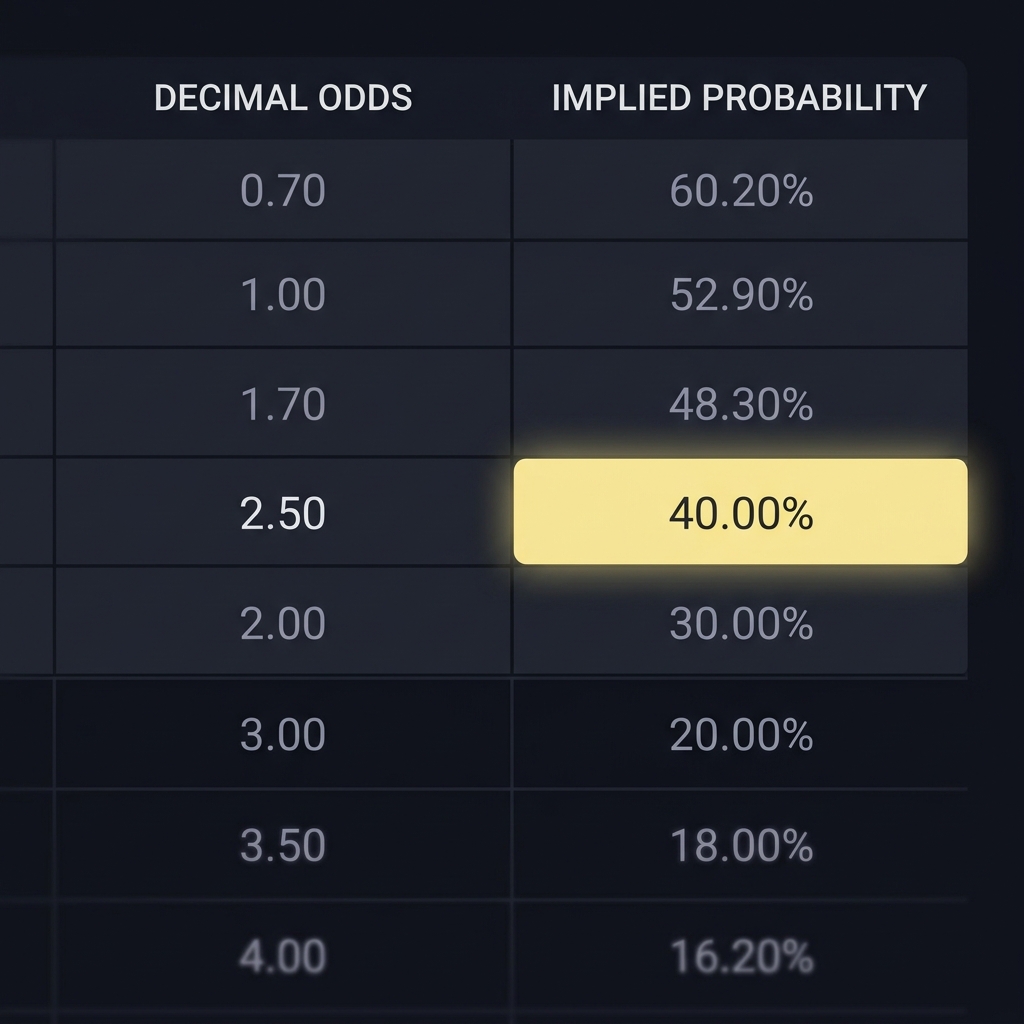
The consequence for traders is straightforward: a favorite that looks like a safe short price may still be overpriced by the market, and assuming safety based on odds alone can lead to overconfidence and sizing mistakes. Always approach favorites with a valuation-based view rather than a reflexive trust in the headline probability.
Why favorites can still be systematically mispriced
Mispricing arises from bettor behavior, information asymmetry and market microstructure; favorites may attract overbetting from casual bettors or underreaction to relevant information, producing patterns that a disciplined trader can detect and exploit. However, identifying and exploiting these mispricings requires a process and follow-through, including consistent CLV tracking and margin-aware valuation.
When favorites are mispriced, the mispricing is not necessarily obvious from the odds themselves. You need an independent probability model or a disciplined comparative process that adjusts for overrounds and gathers evidence from line movement to conclude whether a favorite is genuinely good value.
Correlation, house rules, and hidden exposure
How correlated outcomes magnify risk
Correlation between outcomes can dramatically increase portfolio risk because dependent events make tail losses far more likely than independent probability calculations suggest. Placing multiple short-priced bets that are linked by the same causal factor, for example injuries or weather, concentrates exposure even when each leg looks individually safe.
Sportsbooks explicitly manage this risk and often restrict correlated wagers through house rules, which signals that operators view correlated exposures as higher risk and price them differently. See sportsbook house rules for guidance on correlated and multi-leg restrictions DraftKings general betting rules.

House rules that limit correlated wagers and why they matter
House rules that disallow certain correlated combinations or reduce payout on dependent outcomes are practical reflections of the same risk math traders face: dependency increases variance and the chance of large losses. Those rules reduce operator exposure and also highlight why bettors should check terms before structuring multi-leg strategies.
Before placing multiple short-priced bets, simulate correlated scenarios and check the operator's posted rules so you know whether the bet structure is allowed and how the payout will behave under plausible outcomes. That step can prevent unexpected rejections, voids, or reduced returns when outcomes are not independent.
Bankroll sizing and the perils of overbetting short prices
The Kelly framework and why stake matters
The Kelly criterion remains a foundational sizing framework because it links stake to estimated edge and variance. Using Kelly or a fractional Kelly variant helps control drawdown and tail risk, and it is particularly relevant when you face short-price opportunities that feel safe but carry small or uncertain edges; the classic exposition of the approach and its logic is available in the academic literature on the Kelly criterion Foundational Kelly discussion.
Relying on headline odds without a realistic edge estimate can lead to overbetting, which increases the probability of ruin even when the stated win probability is high. Fractional Kelly is a practical compromise for uncertain edges, because it reduces volatility and the risk of catastrophic drawdowns when your probability estimates are noisy.
How even high win-rate bets can produce ruin if oversized
Even a streak of small losses or a single large adverse run can overwhelm an account if stakes are too large relative to the true edge. Overbetting relative to Kelly assumptions is a common failure mode for traders who mistake short prices for safe bets, and keeping sizing conservative when edge is small or uncertain markedly lowers tail risk over long samples.

Execution, liquidity, and when a short price is stale or unsafe
Liquidity, price impact and thin markets
Thin markets and low liquidity can make a published short price effectively unreachable or expensive to execute, because attempting to secure a large stake into a small market can move the price against you and erase apparent edge. When liquidity is low, published odds may be indicative rather than executable, so check market depth and recent matched volumes where available before committing significant size.
In addition, price impact is not just about size; it is about timing and the presence of competing liquidity. If others are also trying to trade the same short-priced line, your ability to lock in the quoted price at scale can be limited, which turns a superficially safe market into a risky execution problem.
Timing, stale prices and rapid market moves
Late information and rapid line moves can change expected value quickly, so a short price seen early in the day may be stale by kickoff. Paying attention to recent line movement and the reason for moves helps you decide whether a short price still represents acceptable risk or whether it was simply an early quote that the market subsequently corrected.
As a practical checklist, verify market depth, review recent line changes, and compare similar market makers to assess execution quality before risking sizable stakes on short prices that might be ephemeral.
A practical framework to assess whether a short price is acceptable
Step 1: Convert offered odds to fair-implied probability, margin-aware
Start by converting the offered odds into an implied probability and then adjust for the bookmaker margin to estimate the fair-implied probability. One straightforward approach to the margin adjustment is to proportionally scale implied probabilities by the market overround, as described in bookmaker educational materials Pinnacle betting margins primer.
When you have a margin-aware fair-implied probability, compare it to your own independent estimate. If your probability estimate is not meaningfully above the margin-adjusted number, the short price is not acceptable at scale.
Step 2: Check CLV and recent line history
Use closing line value as a decision gate. If your historical selections at similar prices show positive CLV, you have evidence your process outperforms the market. If not, treat short prices with greater skepticism and reduce size accordingly Pinnacle primer on CLV, see also PropsBot CLV glossary.
Also review intra-day line moves to see whether the market has recently adjusted; persistent adverse movement against your selection is a warning sign that the initial short price was not as safe as it appeared.
Step 3: Test correlation and operator rules
Before placing multiple short-priced bets, model correlated outcomes and confirm the sportsbook's house rules about correlated wagers and parlay limitations. House rules often explicitly restrict certain correlated combinations, and checking them prevents unexpected rejections or altered payoffs DraftKings general betting rules.
Run simple scenario tests for plausible event clusters that could wipe out a sequence of short-priced bets, and adjust position sizes or avoid correlated combinations when the simulated portfolio risk exceeds your tolerance.
Step 4: Size conservatively with a Kelly-informed rule
Use a Kelly-based size as an objective benchmark, then apply a fraction such as one quarter or one half Kelly to account for estimation error and execution uncertainty. The academic and practical literature on Kelly explains why a fractional approach reduces tail risk while still linking position size to edge Foundational Kelly discussion.
Combine the Kelly-derived stake with absolute caps and a volatility budget so that even repeated short-priced bets cannot create ruinous exposure. If margin-adjusted edge is small or CLV is negative, reduce to a minimal test size and gather more data rather than scaling up immediately.
Common mistakes, scenarios and a quick checklist
Typical trader errors when trusting short prices
Traders commonly make several recurring errors: ignoring bookmaker margin, overbetting relative to edge, failing to check correlated exposure, relying on headline odds without checking execution quality, and neglecting to track CLV. Each of these mistakes turns apparent safety into hidden risk.
Another frequent misstep is treating parlay payouts as additive improvements in certainty rather than recognizing the compounded margin and correlation rules that often make parlays worse value than their single-leg components.
A short price is acceptable when margin-adjusted valuation shows a meaningful edge, CLV demonstrates consistent outperformance, correlated exposures are managed, house rules permit the structure, and position sizing is conservative relative to edge and execution risk.
Scenario walk-throughs and what to do instead
Scenario 1, short-priced favorite with small edge: A trader sees a favorite at very short odds, converts the price to a margin-adjusted probability and finds the edge is near zero. If they stake heavily based on nominal win rate, they risk large drawdowns from variance and possible ruin. The framework would instead recommend reducing size to a small test stake, tracking CLV and execution, and only increasing if CLV indicates reproducible edge.
Scenario 2, multi-leg parlay with correlated drivers: A bettor combines multiple short legs linked by the same match event or team factor. The parlay appears attractive because each leg has a short price, but correlation and compounded margin make the overall expected value strongly negative. The correct approach is to test correlation scenarios, confirm house rules, and avoid combining dependent legs or else reduce exposure significantly.
Quick checklist before you stake
- Adjust for bookmaker margin, convert to margin-aware implied probability.
- Check CLV for similar selections and recent line history.
- Test correlation and review operator house rules.
- Size conservatively with a fractional Kelly and absolute caps.
- Verify execution, market depth and recent price movement.
Conclusion: discipline and valuation beat headline odds
Key takeaways
Short prices are not automatically safe; margins, product design, correlation, execution and sizing determine the real risk of any stake. Industry-level hold and margin mechanics mean that a low quoted price can still be a negative expected value proposition without an independent edge assessment AGA State of the States 2024.
Adopt a repeatable process: margin-aware valuation, CLV tracking, correlation checks, and conservative Kelly-informed sizing. Platforms that emphasize structured evaluation and disciplined forecasting, such as skill-based challenge environments, are practical places to practice this process without conflating simulation with guarantees.
Bookmaker margin inflates implied probabilities so the offered odds include an overround; you must adjust for this margin to see the fair-implied probability before judging whether a short price has value.
Closing line value compares your entry price to the market close; consistent positive CLV suggests your process finds value, while negative CLV warns that timing or selection needs work.
Not automatically; favorites can be mispriced and still lose value after margin and correlation are considered, so use valuation, CLV and conservative sizing rather than assuming safety.
References
- https://www.pinnacle.com/en/betting-resources/educational/what-are-betting-margins/
- https://www.americangaming.org/wp-content/uploads/2024/05/AGA-State-of-the-States-2024.pdf
- https://www.pinnacle.com/en/betting-resources/educational/what-is-closing-line-value/
- https://sportsbook.draftkings.com/help/general-betting-rules/general-rules
- https://www.fundedplays.com/challenges
- https://papers.ssrn.com/sol3/papers.cfm?abstract_id=2040376
- https://www.pinnacle.com/en/betting-resources/educational/favourite-longshot-bias-explained/
- https://betherosports.com/blog/closing-line-value-explained
- https://propsbot.ai/glossary/closing-line-value/
- https://myweb.ecu.edu/robbinst/PDFs/Weak%20Form%20Efficiency%20in%20Sports%20Betting%20Markets.pdf
- https://www.fundedplays.com
- https://www.fundedplays.com/blogs
- https://www.fundedplays.com/blogs/how-fundedplays-evaluations-work