

What it means when waiting for a slightly better quote goes wrong
Quick definition and everyday examples
Imagine placing a tight limit to shave a tick off a planned entry, then watching the market move through that level without your order filling. That disappointment is at the heart of when waiting for a better price backfires, a situation where the decision price you planned around and the actual executed price diverge enough to make you worse off overall. In many cases the loss is not the visible commission or fee but the implementation shortfall, the gap between the decision price and the final execution.
Implementation shortfall is a core concept for traders evaluating whether patience paid off or cost them, because delayed or missed fills can accumulate into meaningful performance drag over many trades, particularly in fast or thin markets.
Simple TCA checklist to log fills, realized spreads, and decision prices
Use daily aggregation for small samples
How execution quality is judged today
Execution quality is now measured across multiple dimensions, not just best price, and modern disclosures make those dimensions observable. The updated Rule 605 framework gives clearer statistics on fill rates, realized spreads, and execution speed that let traders and operations teams compare outcomes objectively, rather than guessing whether waiting improved results SEC Rule 605 press release and industry summaries Sidley.
Those metrics matter because they directly feed into transaction cost analysis and provide the empirical basis for deciding when a tight limit is practical and when it is likely to produce non-execution risk.
Why best price is only one axis: speed and likelihood of execution
FINRA best-execution framework in practice
Regulatory guidance emphasizes that best execution is a multi-dimensional obligation. Firms and traders are expected to weigh price, speed, and the likelihood of execution when routing orders, which means a marginally better quoted price is not always the smarter objective if it reduces the chance your trade actually happens FINRA best-execution guidance.
Put simply, the best theoretical price on a feed may never become a realized price in your account if the order does not fill, or if it fills later at a worse level after the market moves.
How speed and fill probability change the calculus
When comparing a tight limit that waits for a favorable quote versus a market-or-better approach, the tradeoff is between micro-price improvement and execution certainty. In many situations, prioritizing certainty reduces implementation shortfall even though it appears to give up a small theoretical price improvement.
Practical implication: for time-sensitive decisions or when liquidity is low, prefer execution methods that prioritize fill probability; for large, passive exposures, price-first strategies may still make sense but should be tested with venue metrics first.
How implementation shortfall turns a patient plan into a net loss
What implementation shortfall measures
Implementation shortfall measures the difference between the hypothetical decision price and the realized execution price, incorporating delay, partial fills, and market moves that occur during the decision-to-execution window. This metric often captures far more cost than explicit fees, because it includes opportunity cost and slippage documented in transaction cost analysis literature CFA Institute TCA guide.
Examples showing decision price vs executed price
Consider a simple example: you decide to buy at 100.00 and post a one-tick tight limit at 99.90 hoping for a better fill. The market instead trades to 100.50 before you fill, or never fills and you execute later at 100.30. The realized cost includes the missed opportunity and the eventual worse price, which can exceed any commission savings you hoped to gain.
CTA:
Practice your execution rules in challenge-style simulations
Download the checklist to make pre-trade rules routine, or subscribe for regular execution tips to help build disciplined entry habits.
That pattern, repeated across many entries, is why patient plans without guardrails can add up to a net loss when implementation shortfall and missed fills are common.
Order types and their tradeoffs: limit orders, market orders, and hybrids
Limit orders: price control versus fill risk
Limit orders let you specify the maximum price you will pay or minimum you will accept, which controls explicit price paid but introduces the risk of partial fill or no fill if the market moves away. That tradeoff between price control and non-execution risk is well documented in practical order-type guidance CME Group order types overview.
Limit orders are valuable when you can wait without hurting your strategy and when displayed liquidity supports the size you need; they are less appropriate when speed matters or when the order size is large relative to available liquidity.
Market orders and impact costs
Market orders accept the next available price and prioritize certainty of execution. The cost is paying the spread and possible market impact in thin books, which can be preferable to missing a fill entirely if the trade is time sensitive.
In many cases a market order reduces implementation shortfall by eliminating the decision-to-execution delay, even though it clearly gives up price control.
Hybrid options: pegged, IOC, FOK and price bands
Hybrid order types and time-in-force flags such as immediate-or-cancel (IOC) and fill-or-kill (FOK), or pegged orders and price bands, let you blend price control with execution constraints. These tools allow more nuanced tradeoffs, for example attempting a tight limit for a defined short window and falling back to a market-or-better instruction if the limit does not fill.
Using such hybrids in a disciplined way reduces the chance that waiting converts a small theoretical gain into a larger realized loss.
Practical rule sets to avoid getting burned by waiting
Pre-trade checks: liquidity, volatility, and size
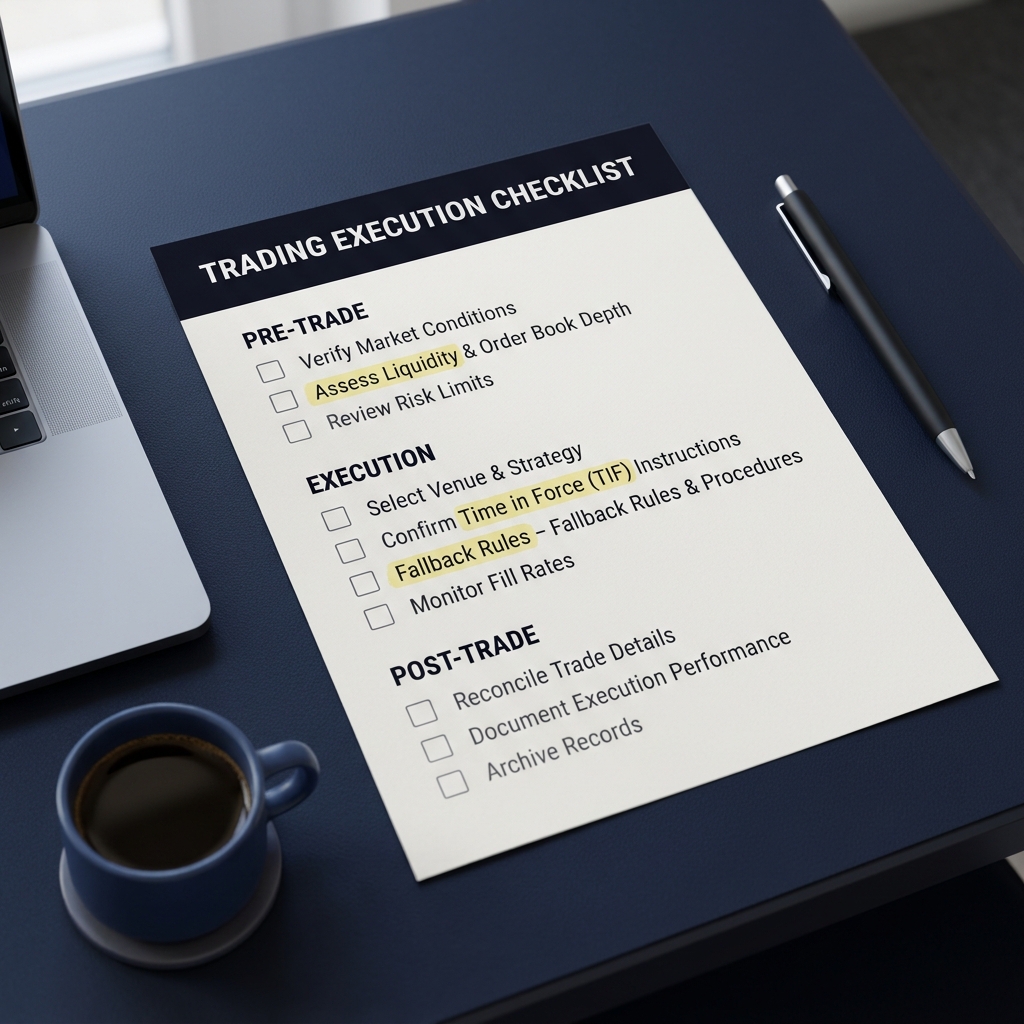
Before sending an order run a short checklist: confirm displayed liquidity at your target price, check recent realized spreads or venue behavior if available, and size the order relative to average daily volume to avoid outsized market impact. These checks lower the risk that a narrow limit will go unfilled or that a partial fill will force awkward rebooking.
One useful question to ask yourself in the moment is whether you can tolerate a delayed fill or partial execution without changing the trade thesis.
Compare potential micro-price improvement to the likelihood and cost of delay using liquidity checks, volatility filters, fallback time-in-force rules, and post-trade TCA; prefer certainty when fill probability is low or time sensitivity is high.
Operationalizing these checks into your pre-trade routine reduces ad hoc waiting and the cognitive bias that causes traders to anchor to ideal prices.
Concrete rules: price bands, time-in-force, and partial-fill logic
Concrete rule examples include setting a sensible price band around decision price with a short time-in-force for tight limits and a clear fallback to market-or-better if not filled within the window. Also define partial-fill rules: accept partials up to a percentage of intended size or cancel and rebook based on updated liquidity reads.
Having these rules written down and rehearsed prevents last-second adjustments that increase implementation shortfall and helps maintain consistent behavior under stress.
When volatility and thin markets make waiting especially costly
How slippage behaves in stress and thin conditions
Slippage tends to widen when volatility spikes or when visible liquidity is thin, making tight limits much less likely to fill and increasing the chance you either miss a move or suffer a larger execution cost later Investopedia slippage explanation.
In stress conditions, execution speed and venue choice often dominate small price improvements because the market can move quickly through posted levels.
When to switch strategies or pause entries
Use volatility filters and event blackout periods to avoid routine attempts at micro-price improvement during predictable illiquidity windows, such as immediately after major economic releases or within minutes of a company news event. In those windows, prefer execution methods that prioritize fill probability or delay entries until conditions normalize.
These switches reduce the likelihood that well-intended patience becomes a costly source of implementation shortfall.

How to use modern Rule 605 reports to test your execution choices
What new 605 fields reveal about fill rates and speed
Enhanced Rule 605 disclosures provide metrics like venue-level fill rates, realized spreads, and execution speed distributions that show how often orders fill at or near quoted prices and how long fills typically take. That visibility helps quantify the actual tradeoffs you face when choosing a tighter limit versus a faster execution SEC Rule 605 press release and practical explanations Clear Street.
Seeing the empirical fill behavior for the instruments and venues you use makes it easier to set practical price bands and time windows supported by data rather than intuition.
Practical steps to compare venues and brokers
Start by pulling a simple venue comparison: track fill rate, median execution time, and realized spread for a representative sample of orders and compare them side by side. Use those comparisons to select default execution paths and to tune your fallback time-in-force thresholds.

Using challenge-style simulations and test runs helps you rehearse fallbacks and observe how different rules play out without risking capital, and the 605 benchmarks give context for which venues are likely to meet your execution objectives.
Short checklist: pre-trade rules to reduce missed fills
Copyable pre-trade checklist
Use a short, copyable checklist in your trading plan: confirm displayed liquidity at target price, check recent realized spreads on your venue, set a maximum order size as a percent of ADV, define a price band and a short time-in-force, and set a fallback to market-or-better if not filled within the window.
Keep the checklist visible during trading hours so it becomes a habit rather than an afterthought.
Quick decision rules for common scenarios
For small, time-sensitive trades favor execution certainty. For passive entries on liquid names, permit wider price bands and longer windows. When entering around news, prefer cancellation and rebooking after the event rather than waiting through the spike.
These quick rules help prevent common limit order pitfalls and keep implementation shortfall manageable.
Post-trade review: how to measure whether waiting helped or hurt
Key metrics to compute: slippage types and realized spreads
Track implementation shortfall, realized spread, fill rate, and execution speed for each trade. Compute simple aggregates weekly or monthly and look for patterns by instrument, venue, and order type to see where waiting produced net benefits or losses CFA Institute TCA guide.
These metrics let you distinguish random bad luck from systematic rule failures so you can adjust decision thresholds accordingly.
Using TCA and 605 to refine rules
Combine your internal TCA with Rule 605 venue data to attribute poor outcomes to causation: was it slow fills on a particular venue, wider realized spreads during specific hours, or frequent partial fills when liquidity was thin? Use that evidence to update your price bands and fallback times.
Set a review cadence, for example monthly, and commit to only incremental rule changes based on statistically meaningful differences.
Common execution mistakes and cognitive traps that encourage waiting
Behavioral biases: anchoring, loss aversion, and overconfidence
Anchoring to a perceived fair price can make traders set unrealistically tight limits and then rationalize waiting rather than following a pre-planned rule. Loss aversion leads people to try squeezing a better price to avoid immediate regret, and overconfidence can make them underestimate non-execution risk.
Recognizing these tendencies and replacing ad hoc choices with written rules reduces the behavioral pressure to wait and the resulting implementation shortfall.
Operational mistakes: poor size checks and missing fallback rules
Operationally, skipping size checks against displayed liquidity or not programming a fallback time-in-force are common mistakes that turn patience into missed fills. Ensuring that systems and playbooks enforce these checks prevents human error from amplifying market risk.
Address the operational gaps first, then work on behavioral fixes so process and psychology are both aligned toward reliable execution.
Three practical scenarios: retail trader, funded-challenge-style player, and algorithmic entry
Retail trader example: single stock entry around news
A retail trader posts a tight limit ahead of an earnings print and never fills because liquidity evaporates. Later the stock gaps away and the trader either misses the position or pays a worse price. A simple volatility blackout rule or a short IOC attempt followed by a planned rebook could have avoided the cost.
Those constructive habits limit the cumulative effect of waiting mistakes across many trades.
Funded-challenge-style example: simulated bankroll and discipline
In a challenge-style simulation that mirrors funded evaluation programs, discipline around fallback rules and size checks can be practiced without risking capital. Simulations help solidify the habit of sticking to pre-trade rules and of evaluating outcomes with TCA metrics.
Simulated environments give players a safe place to confirm whether tight limits actually improve performance over time, and to tune parameters before applying them in live trading situations.
Algorithmic entry: how execution rules are automated
Algorithmic strategies automate the same decision logic: liquidity filters, short time windows for passive attempts, and explicit fallback actions. Well-built algorithms reduce human hesitation and apply consistent tradeoffs between price and execution probability.
Automation combined with robust post-trade analytics shrinks implementation shortfall by enforcing rules and rapidly identifying when those rules need adjustment.
A simple decision flow to decide whether to wait or execute
Flowchart steps and conditional checks
Use a short decision flow: 1) Check liquidity at target price, 2) Assess volatility and time sensitivity, 3) Compare order size to displayed liquidity, 4) If liquidity sufficient and not time-sensitive, use a short limit window; otherwise choose market-or-better or an IOC attempt.
Keep the flow concise and binary so decisions can be made quickly and consistently under pressure.
When to escalate to a more aggressive execution
If an intended position is time-sensitive, or if price moves contrary to the trade thesis while waiting, escalate to a more aggressive execution path rather than stretching the limit and increasing implementation shortfall. Have clear thresholds for escalation to avoid indecision.
Documenting these thresholds in your playbook reduces hesitation and aligns behavior across traders and systems.
How to test and iterate using simulation and checklists
Setting up a simple TCA experiment
Run a controlled experiment: define control rules and test rules, execute a sample set of simulated or small live trades, and compare implementation shortfall, fill rate, and realized spreads across the groups. Use a sufficiently large sample to detect consistent differences.
Benchmarks from Rule 605 provide venue context so you can tell whether a change underperformed due to your rules or due to broader venue behavior SEC Rule 605 press release.
What to measure and how to interpret results
Measure mean and median implementation shortfall, fill rate, and execution time, and look for consistent directional improvements before rolling changes into live trading. Favor incremental rollouts and keep a rollback plan if live performance deviates from simulated results.
Simulated validation plus staged live rollout helps you adapt without suddenly increasing risk from an untested rule change.
Conclusion: concise takeaways and next steps
Three action items to implement this week
Set a minimum displayed liquidity threshold and a maximum order size as a percent of ADV. Pick a default short fallback time-in-force for tight limits and document partial-fill acceptance rules. Run a first-week TCA check to compare implementation shortfall on a small sample.
Use Rule 605 data and routine TCA to iterate: update thresholds only when supported by evidence, and treat the processes as living parts of your trading playbook rather than one-off fixes CFA Institute TCA guide.
The net effect of these steps is not to eliminate cost but to make waiting a deliberate, measured choice rather than a cognitive reaction that increases total trading cost.
Waiting can create implementation shortfall when markets move or orders do not fill, meaning the realized price is worse than the decision price despite saving on visible fees.
No. Market orders prioritize certainty but pay the spread and potential impact; choose based on time sensitivity, liquidity, and size.
A monthly review is a practical cadence for many traders, with weekly checks while testing new rules.
References
- https://www.sec.gov/news/press-release/2023-248
- https://www.cfainstitute.org/en/research/foundation/2020/transaction-cost-analysis
- https://www.finra.org/rules-guidance/key-topics/best-execution
- https://www.cmegroup.com/education/courses/introduction-to-futures/market-orders-vs-limit-orders.html
- https://www.investopedia.com/terms/s/slippage.asp
- https://www.fundedplays.com/challenges
- https://www.fundedplays.com
- https://www.fundedplays.com/blogs
- https://www.fundedplays.com/blogs/how-fundedplays-evaluations-work
- https://www.sidley.com/en/insights/newsupdates/2024/04/sec-adopts-amendments-to-modernize-disclosure-of-order-execution-information
- https://www.finra.org/filing-reporting/regulation-nms/sec-rule-605-reports
- https://clearstreet.io/legal/rule-605-606-detail