

What Professional Habits Can Sports Traders Learn from Financial Markets: definition and context
When people ask What Professional Habits Can Sports Traders Learn from Financial Markets they usually mean which repeatable, risk-aware routines used by professional traders map to sports prediction challenges and funded accounts. In this article a sports trader is someone who makes structured, repeatable predictions within a funded challenge or virtual account rather than placing informal wagers; that distinction matters because funded challenges emphasize rules, drawdown limits and measured performance.
A core reason the comparison is useful is that institutional risk frameworks provide a stepwise cycle you can adopt for any performance domain: set context and appetite, assess risks, treat risks with controls, then monitor and communicate outcomes. Those stages are central to ISO 31000 and form a practical checklist for sports traders to adapt to funded challenge settings ISO 31000 guidelines.
Quickly compute allowable drawdown amount for a given bankroll and drawdown percentage
Use this to set session limits
This article uses supervisory reports and investor guidance as practical anchors because regulators and market supervisors report persistent elevated risks and recommend explicit limits, stress scenarios and monitoring that translate directly to funded account routines. Expect clear, stepwise habits rather than promises of quick wins.
The rest of the article breaks these habits into implementable items: risk appetite and limits, position sizing, written plans, model validation, decision journals and emotion regulation techniques you can adopt right away.

Core risk management framework sports traders can adopt
Start each session with a simple cycle based on the ISO risk management approach: define objectives and risk appetite, identify the risks to those objectives, apply controls to limit exposure, and monitor outcomes to close the loop. Translating ISO 31000 into a trader workflow gives you a repeatable structure to reduce ad hoc choices and impulsive decisions ISO 31000 guidelines.
Practically, think of the workflow as four pre-session checks: a written plan stating goals, a capital limit setting the maximum exposure, approved event types you will trade, and a daily drawdown cap that triggers an automatic stop. Write these as one-page rules you can follow without thinking.
Operational checklist, step 1: Clarify your objective and appetite. State whether you are trying to demonstrate consistency for a funded challenge or to test a new model. Translate appetite into a numeric drawdown cap and a maximum percent of bankroll per pick.
Operational checklist, step 2: Identify risks. List what can go wrong, such as correlated events, late-breaking injuries or model data errors, and assign simple controls like exposure limits and event exclusions.
Explore FundedPlays challenge rules and map a one-page checklist to your chosen evaluation program
Try the one-page checklist this session to see how it reduces impulsive moves and clarifies what you will and will not trade
Operational checklist, step 3: Apply controls. Controls include position sizing rules, required pre-event checks, and mandatory cooling-off times after a loss sequence. Controls should be written and easily checked before each pick.
Operational checklist, step 4: Monitor and report. Capture session outcomes in a short log and compare against your appetite daily. Monitoring helps you separate variance from broken rules so adjustments are evidence-based.
Stress scenarios, drawdown caps and position sizing: direct lessons from supervisors
European market supervisors reported in 2024 that overall risks remained elevated and recommended stress testing, position sizing rules and drawdown planning before taking exposure; that supervisory view supports adding stress scenarios to sports prediction routines ESMA trends and risks report.
In practice, stress testing for sports prediction means asking what would happen if multiple correlated outcomes occur or if several favorites lose in a short span. A simple tabletop stress test is to model losing streaks of five picks at your typical stake and check whether the resulting drawdown breaches your cap.
Drawdown caps are easy to translate. If your virtual bankroll is 1000 units and you set a 5 percent drawdown cap, your absolute stop is 50 units for that challenge session. Use the calculator template to convert percentage caps to absolute limits and then set per-pick stakes that keep you inside that cap under reasonable loss sequences.
Position sizing heuristics useful for single-event picks include capping single-game exposure to a small percent of bankroll, reducing stake when bets are correlated across a slate, and using smaller default stakes for markets you understand less well. The goal is to protect capital and stay able to demonstrate consistency over many events.
Written trading plans and capital limits: reducing impulsive exposure
FINRA cautions that active day trading is risky and recommends written plans, capital limits and risk controls to avoid large losses; that advice applies to sports traders who often face the temptation to escalate stakes after losses FINRA day trading guidance.
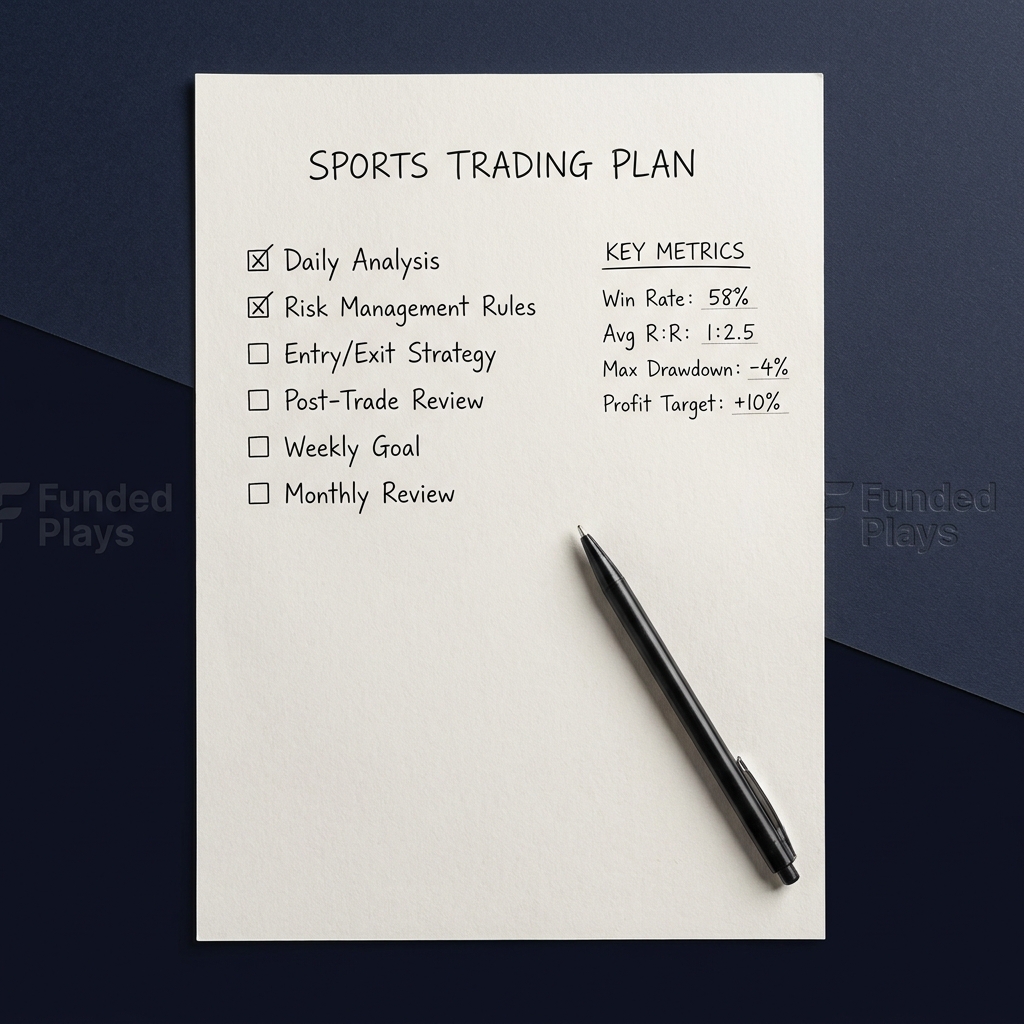
A one-page sports trading plan should be concise. Include your objective for the session, a daily loss cap, allowed markets and event types, stake sizing rules, stop rules and a brief note on how you will record outcomes. Keep the plan visible when you trade.
Template example for a one-page plan: state session goal, bankroll amount, max percent per pick, daily drawdown cap, allowed leagues or bet types, and a single-line cooling-off rule that requires a fixed break after a loss beyond a threshold. That short structure reduces decision friction and limits emotionally driven increases in stake.
Capital limits reduce long-term variance by constraining the amplitude of both wins and losses. When you force smaller, consistent stakes you also increase the chance that skill shows up across many trials instead of being obscured by a few large outcomes.
Data governance, backtesting and model validation for sports analytics
IOSCO's analysis on AI and market tools emphasizes governance, data quality and model validation to mitigate overfitting and bias; those principles are directly applicable when you build data-driven sports handicapping models or automated signals IOSCO thematic note on AI. See also the IOSCO supervisory toolkit IOSCO supervisory toolkit and relevant model risk guidance such as the Canadian OSFI model risk guideline OSFI Guideline E-23.
Begin with a simple backtesting discipline: separate data into training and out-of-sample holdout sets, and report performance on the holdout before risking real stakes. Resist fine-tuning model parameters on the full data set because that invites overfitting.
Data quality checklist: document source provenance for each data field, log cleaning steps you take, and monitor any changes in upstream feeds. Small data shifts can change model behavior; governance reduces silent failures.
Model validation steps include sanity checks such as checking that edge estimates do not explode as you add variables, and running sensitivity tests where you remove or perturb inputs to see if results are stable. Validation should be part of a pre-session checklist when you depend on automated signals. For additional context see KPMG coverage of AI model risk KPMG AI model risk.
Decision journals and post-trade reviews: learning from management science
Management research finds that decision journals and checklists improve decision quality by making assumptions explicit and enabling structured post-mortems; keeping a short decision journal helps you learn from outcomes and spot recurring mistakes HBR decision journal guidance.
Keep entries brief to ensure you actually maintain the journal. For each pick record the date, your concise rationale, expected edge or reasoning, stake size and a one-line stop rule. Later add the outcome and a single insight about why the pick worked or failed.
Weekly and monthly post-trade reviews turn raw logs into learning. On a weekly cycle check whether edge per pick is trending up or down and whether hit rates or average profit per pick remain in expected ranges. Monthly reviews are for larger changes such as strategy pivots or model retraining.
A one-page decision journal template helps adoption. Columns can be: Date, Event, Rationale, Edge Estimate, Stake, Outcome, Post-note. The simple structure makes post-session reviews quick and actionable.
Emotion regulation, if-then plans and maintaining discipline under pressure
Psychology research indicates cognitive reappraisal and if-then implementation intentions help sustain discipline in high-pressure choices; those behavioral tools are useful when a losing streak tempts impulsive action APA coverage of emotion regulation.
Simple if-then statements work in practice. Examples you can memorize include: If I lose two consecutive picks then I will take a fifteen-minute break, and If a pick would exceed my single-event cap then I will reduce the stake to the cap immediately. These short scripts reduce the need for in-the-moment deliberation.
Brief breathing routines or pause checks are also effective. Before placing a pick take three steady breaths and run a two-line checklist: does this pick fit the plan, and does it exceed my allowed stake? The pause buys time for reappraisal and often stops reflexive escalation.
Monitoring, reporting and continuous improvement cycles
Linking monitoring back to the ISO cycle means you should track both controls and outcomes, and use reports to decide whether rules or models need adjusting. Documenting this loop enforces governance even for an individual trader ISO 31000 guidelines.
Common performance metrics suited to funded challenges include ROI on the virtual bankroll, maximum drawdown, hit rate and average edge per pick. Track these metrics daily in a compact dashboard so you can spot rule breaches quickly.

Written plans, explicit drawdown and position sizing rules, disciplined model validation, decision journals and brief emotion-regulation scripts are the most transferable routines.
Cadence matters: keep a daily log for immediate rule checks, a weekly dashboard review to spot trends, and a monthly strategy check where you decide whether to change rules, run new backtests or accept variance. A governance mindset helps you treat the process as research rather than emotional reacting.
Practical examples and scenarios: applying the habits in a funded challenge
Scenario 1, single-event staking with drawdown guardrails. Suppose you enter a funded challenge with a 1000-unit virtual bankroll and a 5 percent drawdown cap. Pre-session you set a per-pick cap of 1 percent of bankroll and a rule that correlated picks cannot exceed 1.5 percent in total exposure. You record each pick in your decision journal and stop if the absolute drawdown reaches 50 units. This stepwise plan keeps risk limited and decisions reviewable.
During the session, if a favorite loses unexpectedly and you are tempted to chase, apply an if-then rule: if two losses occur, take a fixed break and review entries. That behavioral trigger prevents impulsive stakes and aligns execution with your written plan.
Scenario 2, correlated bets across a slate. When multiple events within a slate are correlated, compute combined exposure by summing stakes adjusted for correlation and downsize each pick so the net slate exposure remains below your allowed percentage of bankroll. After the slate, enter outcomes into your journal and run a short post-mortem to see whether correlation assumptions held.
Translate a 5 percent drawdown cap into allowable stakes across three correlated picks by first calculating the maximum absolute drawdown, then allocating a conservative fraction to each correlated position so that the worst reasonable outcome stays within the cap. Document the calculation in your journal so the choice is auditable and repeatable HBR decision journal guidance.
Common mistakes and pitfalls when adopting finance habits
One common error is overcomplicating models and overfitting to historical data. IOSCO cautions about governance and validation for AI systems because complexity without validation produces fragile strategies, so favor simple, validated checks before trusting model outputs IOSCO thematic note on AI.
Another pitfall is misapplying institutional rules directly to personal bankrolls. Institutional limits are set for different capital sizes and incentives; copy the approach, not the exact numbers. Test limits on a small virtual run before scaling stake sizes.
Practical fixes include simplifying models, validating out of sample, and running small virtual experiments to test rules. These steps reduce the risk of surprise and make any change in behavior evidence-based.
Adapting professional habits to funded challenge platforms responsibly
Funded account rules change risk choices because platforms may impose drawdown limits, restrict market types or define withdrawal criteria. Map platform rules to your one-page plan so you trade inside both your own appetite and the platform's constraints by visiting the Funded Plays homepage. Regulators and platform rules both incentivize explicit limits and monitoring ESMA trends and risks report.

When adapting habits, prioritize compliance with platform drawdown limits and allowed event lists. Use your decision journal to note platform-specific deviations and update your pre-session checklist accordingly so that platform rules become part of your routine rather than an afterthought. For more on how evaluations work see how our evaluations work.
How to build a personal habit checklist and 30-day plan
Week 1: Build and commit to a one-page written plan, set bankroll and drawdown caps, and start a decision journal. Keep daily pre-session checks under five items so you can follow them reliably. For guidance see our blog.
Week 2: Add position sizing rules and simple backtests for one strategy. Run out-of-sample checks and document any data assumptions you make. Continue daily logging and start weekly post-trade reviews.
Week 3: Focus on emotion regulation. Create if-then statements and rehearse short pause routines. Track whether you actually take breaks when rules trigger and note deviations in the journal.
Week 4: Tie it together with a monthly review. Assess metrics, check whether drawdown behavior matched expectations and decide whether to adjust rules or continue. The plan should emphasize habit adoption rather than earnings targets.
Conclusion: disciplined routines, not quick wins
High-value habits you can adapt from financial markets include written plans, explicit drawdown caps, disciplined position sizing, data validation, decision journals and simple emotion-regulation scripts. These elements form a coherent process that increases the odds that skill, rather than luck, shows up over many trials ISO 31000 guidelines.
Start with one habit this week, such as a one-page written plan or a decision journal, and build from there. Habits reduce risk and improve learning but do not guarantee results; the objective is consistent, evidence-based improvement rather than chasing quick wins.
Habits improve process quality and decision consistency over weeks and months; measurable changes typically appear after sustained logging and weekly reviews rather than immediately.
No. Simpler validated models and clear controls reduce fragility; validation and out-of-sample testing are more important than complexity.
Yes. Adapt drawdown caps and allowed markets to each platform's rules and document deviations in your plan and journal.
References
- https://www.iso.org/standard/65694.html
- https://www.iosco.org/library/pubdocs/pdf/IOSCOPD804.pdf
- https://www.iosco.org/library/pubdocs/pdf/IOSCOPD823.pdf
- https://www.esma.europa.eu/press-news/esma-news/esma-publishes-trends-risks-and-vulnerabilities-report-no-1-2024
- https://www.finra.org/investors/insights/day-trading
- https://www.osfi-bsif.gc.ca/en/guidance/guidance-library/guideline-e-23-model-risk-management-2027
- https://kpmg.com/us/en/articles/2026/ai-model-risk.html
- https://hbr.org/2024/06/how-to-use-a-decision-journal-to-improve-your-decisions
- https://www.apa.org/monitor/2024/07/feature-emotion-regulation
- https://www.fundedplays.com/challenges
- https://www.fundedplays.com
- https://www.fundedplays.com/blogs
- https://www.fundedplays.com/blogs/how-fundedplays-evaluations-work