
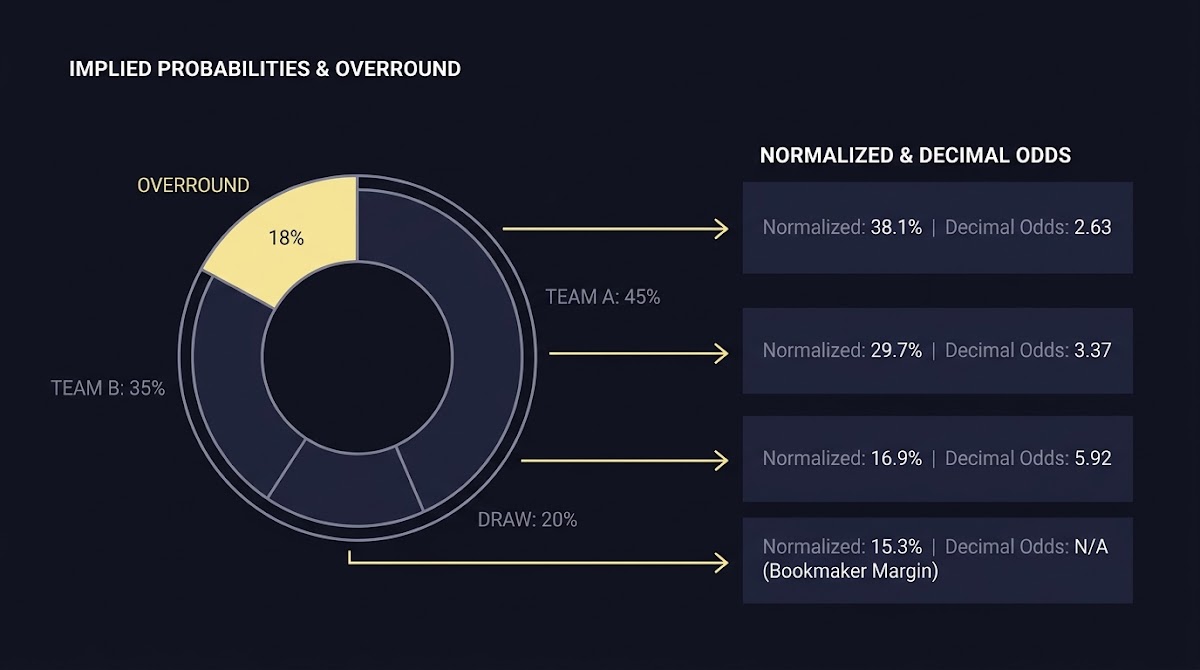
What the vigorish (overround) is and why it matters
Basic definition, What Is the Vigorish and How Does It Affect Value
The phrase What Is the Vigorish and How Does It Affect Value asks a practical question for anyone comparing odds across books. In short, vigorish, also called the overround, is the built-in margin a bookmaker embeds in market prices so that the sum of implied probabilities exceeds 100%, which creates a long-term edge for the operator; this relationship and the calculation method are explained in betting education material that walks through removing the margin from odds Pinnacle betting resources.
Why this matters: when implied probabilities sum to more than 100%, the excess represents the bookmaker margin rather than the true event probability. Recognizing that margin is the first step toward estimating fair or no-vig prices and then comparing those prices to your own probability estimates to find potential value. Keep the focus on clear arithmetic: convert odds to probabilities, sum them, and view the excess above 100 percent as the market's vigorish; a concise explanation of overround and its effect on spread and pricing also appears in platform help documentation Smarkets help centre. An accessible overview is also available at Fox Sports.
For an immediate practical sense, think of a two-outcome market where each side's implied probability adds to 105 percent. That 5 percent is not randomness; it is the margin that tilts long-run expectation toward the operator. Knowing to look for this excess, and how to compute it, lets you convert quoted prices into fair comparisons and assess whether a given quote deserves further attention.
Practice no-vig calculations with structured challenges on FundedPlays
Read on for step-by-step examples showing how to calculate implied probabilities, measure the overround, and convert to no-vig odds for straightforward value checks.
How regulated markets show the effect of vigorish (hold and industry data)
Operator hold and gross revenue
Regulated markets provide measurable context for vigorish because operators report revenues and handle, and the portion retained as gross revenue is often described as the operator's hold. Industry reporting makes clear that sportsbooks retain a share of handle as revenue, which reflects the combined effects of pricing margin and bettor behavior; survey-level reporting covering commercial gaming performance documents these relationships in public industry reports State of the States 2025.
Hold is not a one-to-one representation of the overround in every event, because actual operator revenue depends on both the margin built into prices and how bettors distribute stakes across outcomes. Still, consistent reporting of positive gross revenue in regulated markets is evidence that margins and bettor behavior typically generate a positive expected return for operators over time, which is important to consider when evaluating long-run value.
Regulatory reports that illustrate margins
Regulators publish aggregate statistics that show the betting sector delivers returns consistent with a non-zero margin in multiple jurisdictions. For example, UK regulatory statistics and state-level reporting provide public figures and commentary that align with the presence of a pricing margin in ordinary markets, indicating that vigorish is not restricted to a single market or geography UK Gambling Commission industry statistics.
These reports help set expectations: margins exist, they vary by market and venue, and they appear in aggregate revenue data. For practitioners, the takeaway is simple: expect that quoted prices already include a margin and that you should remove it when you want to compare a quoted price to your own probability estimate.
These reports help set expectations: margins exist, they vary by market and venue, and they appear in aggregate revenue data. For practitioners, the takeaway is simple: expect that quoted prices already include a margin and that you should remove it when you want to compare a quoted price to your own probability estimate.
What industry numbers imply about typical vig
Publicly reported results from states and commercial surveys provide a reality check on pricing practices and operator returns without asserting exact margins for any single event; New Jersey and other state reports illustrate how monthly and year-end returns reflect the net result of pricing, bettors choices, and volume New Jersey Division of Gaming Enforcement.
In short, industry data confirm that vigorish is a consistent feature of regulated sports wagering markets, and that evaluating value requires adjusting quoted prices for that margin before comparing them to your own probability estimates.
Step-by-step: converting odds to implied probabilities and calculating the overround
Decimal, fractional and American odds conversions
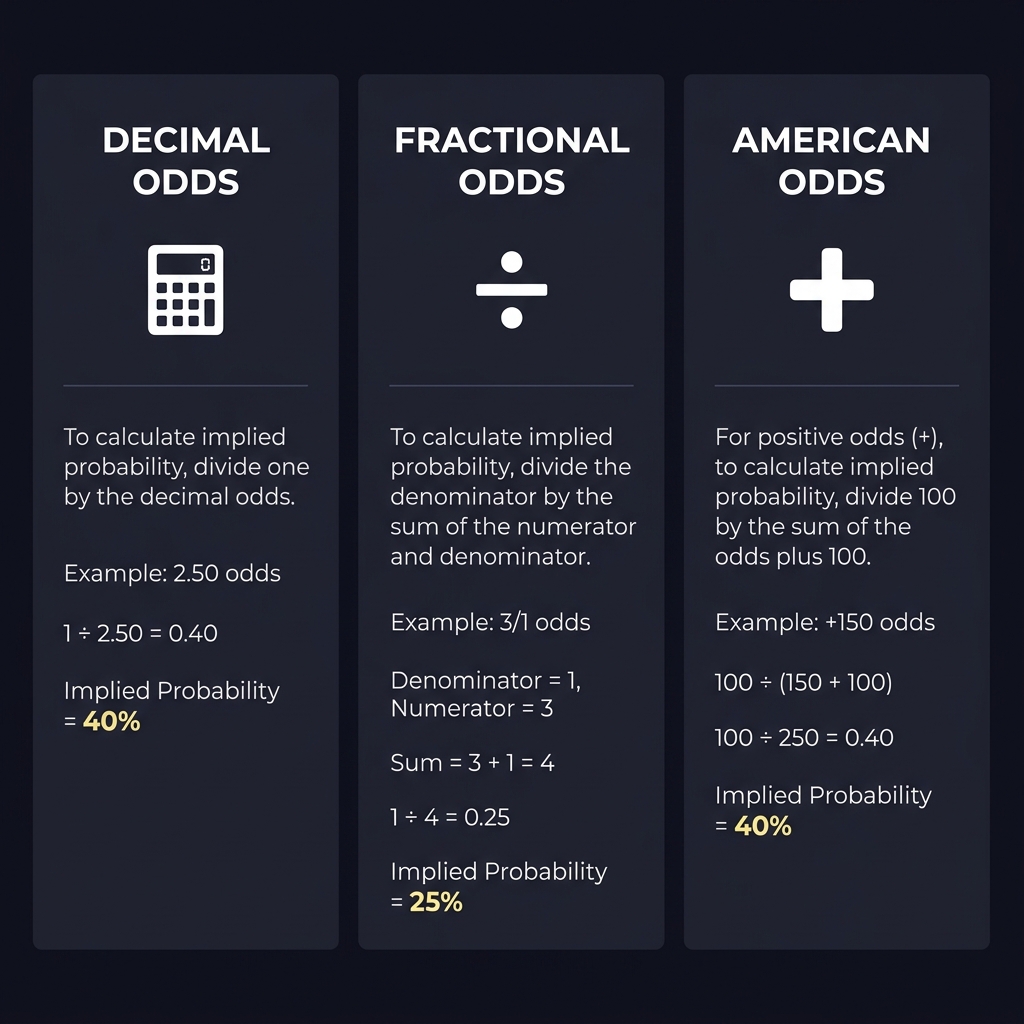
Start with the formulas that turn common odds formats into implied probability. For decimal odds the implied probability is 1 divided by the decimal price. For fractional odds, convert the fraction to decimal first and then apply 1 divided by decimal odds. For American odds, use the standard conversions depending on whether the line is positive or negative. These conversion formulas and a practical explanation are laid out in educational material that explains how to remove margin from odds Pinnacle betting resources.
Short numeric examples make this concrete. Decimal: 2.00 implies 1/2.00 = 0.5 or 50 percent. Fractional: 3/1 converts to decimal 4.00, so implied probability is 1/4.00 = 0.25 or 25 percent. American: +150 converts to decimal 2.50, so implied probability is 1/2.50 = 0.40 or 40 percent using the conversion steps above. Each conversion must be consistent to avoid errors when summing outcomes.
Convert decimal odds to implied probabilities, sum overround and output no-vig decimal odds
Use decimal odds only and exclude voided selections
Formula: implied probability and summing outcomes
After converting each outcome to implied probability, add them. The overround is the sum minus 100 percent. For example, if three outcomes convert to 45 percent, 35 percent and 26 percent, the sum is 106 percent and the excess 6 percent is the market margin. This procedure for measuring overround is a standard calculation described in betting education on overround and markets Betfair betting education.
Edge cases matter. Markets with many outcomes or with inactive/void selections require that you treat voided lines as removed when computing totals, and that you understand book adjustments where operators tweak prices to balance liability. When many outcomes are present, rounding can accumulate, so keep precision during calculation and only round final results for reporting or decision-making.
Worked two-way and three-way market example
Two-way example: Home 1.90 and Away 2.00. Implied probabilities are 1/1.90 = 52.63 percent and 1/2.00 = 50 percent, summing to 102.63 percent, so the overround is 2.63 percent. Three-way example: Home 2.10, Draw 3.40, Away 3.60 convert to implied probabilities 47.62 percent, 29.41 percent and 27.78 percent respectively, summing to 104.81 percent with an overround of 4.81 percent. Each of these arithmetic steps follows the implied probability conversion method and summing approach noted in bookmaker math guides Pinnacle betting resources.
These worked examples show the basic workflow you will reuse: convert, sum, report the excess, and then decide whether to normalize to no-vig probabilities for value checks.

How to remove the margin and derive no-vig (fair) prices
How to remove the margin and derive no-vig (fair) prices
Normalization method: divide by total overround
Removing the margin uses normalization: divide each implied probability by the total sum so that the rescaled probabilities add to 100 percent. That is the standard no-vig conversion method used in betting education and tools to rescale market probabilities to their fair equivalents Pinnacle betting resources.
For a quick numeric check, if outcomes have implied probabilities 52 percent and 50 percent summing to 102 percent, the normalized probabilities become 52/102 = 50.98 percent and 50/102 = 49.02 percent. The normalization process removes the built-in margin and produces a set of fair probabilities you can compare to your own estimates.
Converting normalized probabilities back to odds
Once you have normalized probabilities, convert them back into decimal odds by taking the reciprocal. Using the example above, normalized 50.98 percent corresponds to decimal 1 / 0.5098 = 1.96 and normalized 49.02 percent corresponds to decimal 2.04. Those are the no-vig or fair decimal prices for the market, and you can use them to judge whether a quoted price offers value compared to your assessment.
Remember that no-vig prices are theoretical fair prices. They do not incorporate bettor behavior, commissions, or execution costs. Use them as a baseline for assessing expected value rather than as a guaranteed payout that will be available in practice.
When no-vig conversion is most useful
No-vig conversion is helpful when you want to compare prices across books, evaluate whether a given quote contains value relative to your model, or measure how much of the quoted price reflects margin rather than event probability. Use it as an analytical tool when you have a reasoned probability estimate to compare against the normalized prices.
It is less useful when you lack a reliable probability estimate or when liquidity and execution costs will materially change the practical return. Still, normalizing prices is a foundational skill for anyone who wants to separate market margin from the underlying probabilities.
How the vigorish affects expected value and your betting decisions
Expected value formula with vig-adjusted prices
Expected value (EV) compares your estimated probability for an outcome to the implied or no-vig price. A simple approach is: EV = (decimal odds * your probability) - 1, or for a no-vig comparison use the no-vig decimal odds instead of the quoted price to understand how much the margin reduces theoretical EV. The mathematical steps behind this calculation and how vig changes the numbers are outlined in betting maths guides that demonstrate removing margin and re-evaluating prices Pinnacle betting resources.
If your model gives a 55 percent chance for an outcome and the no-vig price implies 52 percent, that gap signals potential value, whereas quoting the original vig-inflated price would understate the required edge because part of the quote is the operator margin.
The vigorish is the built-in bookmaker margin that makes quoted implied probabilities sum to more than 100 percent; removing it by normalizing probabilities yields no-vig prices that act as fair baselines for comparing against your probability estimates and deciding whether a quoted price offers positive expected value.
When a quoted price can still be positive EV
A quoted price can still be positive EV if your assessed probability exceeds the no-vig probability by an amount that covers variance and execution costs. The normalization process reveals the true baseline you must beat. In practice, you should require a buffer above the theoretical difference to account for line movement, commissions, and uncertainty in your probability estimate.
In short, removing the margin lets you compare apples to apples: your probability estimate versus the fair market price, and then decide whether the remaining edge is actionable.
Practical decision rules for quick checks
Use short heuristics: require a meaningful gap between your probability and the no-vig probability, prefer liquid markets, and factor in your staking and bankroll rules before acting. These practical checks reduce the chance of chasing small edges that evaporate under variance and transaction costs. Educational sources that cover no-vig adjustments emphasize doing this math before concluding that a price is valuable Betfair betting education.
One plain-language takeaway: always remove the margin with a quick normalization, compare to your probability, and only bet when the net edge justifies the risk and fits your staking plan.
How market type and competition change the size of the vig
Retail sportsbooks versus betting exchanges
Market structure matters. Retail sportsbooks often embed larger margins in many lines to manage risk and profit, while betting exchanges and deep liquidity venues typically show overrounds that compress toward near 100 percent, sometimes roughly 100 to 102 percent in liquid markets, which narrows the minimum edge needed to find value; educational material on exchange pricing discusses how competition compresses margins Betfair betting education.
That difference influences strategy. Value hunters who can access exchanges or highly competitive books face tighter margins but also need faster execution and more precise probability estimates to realize positive expected value.
Futures, prop markets and niche lines
Niche markets and futures tend to have wider spreads and higher overrounds because liquidity is lower and sportsbook exposure can be harder to hedge. That means vig can be larger on props and long-term markets, so small model edges in those markets may not be sufficient to overcome the built-in margin without a clear statistical advantage.
When assessing these markets, place extra emphasis on sample size and the quality of your probability model, because the larger margins make execution risk and overfitting more costly.
How liquidity compresses the overround
As liquidity and competition increase, the overround compresses. Market makers and exchange competition push prices toward more efficient levels, reducing the built-in margin and forcing bettors to seek smaller, more precise edges or scale up to profitably exploit them. This dynamic is documented in platform education about overround and maker spreads Smarkets help centre.
For practical value hunting, that means focusing on execution, monitoring line movement, and understanding that the same model advantage will look different depending on venue liquidity.
Decision criteria: when to treat a quoted price as actionable value
Checklist: edge size, sample size, liquidity, variance
Use a simple checklist before committing capital: compute the no-vig probability, subtract it from your probability estimate to get the raw edge, require a minimum edge threshold that accounts for variance and costs, ensure market liquidity is sufficient to execute at the quoted price, and confirm you have an adequate sample or justification for your estimate. Guides on removing the margin and assessing value recommend this stepwise approach Pinnacle betting resources.
Put another way, a small theoretical edge in a low-liquidity prop is often worse than no edge at all, because execution and variance can erase any expected advantage quickly.
Practical scoring: how to weight criteria
Create a simple scorecard that weights edge size most heavily, liquidity and execution second, and sample support third. For example, assign 50 percent weight to edge magnitude, 30 percent to liquidity and execution confidence, and 20 percent to model sample size or robustness. Tally the score and set a pass threshold that aligns with your risk tolerance and bankroll rules.
This structured approach turns a subjective judgement into a repeatable process, making it easier to avoid chasing small or poorly supported edges across different markets.

When to ignore a perceived small edge
Ignore small edges when the scorecard fails to meet your threshold, when liquidity is insufficient to place the required stake, or when the edge rests on very limited data. Transaction costs, commission, and line movement can all flip a small advantage into a loss, so a conservative pass rule is often the correct choice.
Stick to your checklist and document why you passed on an edge; over time the record will help calibrate your thresholds and reduce emotional or biased decisions.
Practical worked examples: finding value in common market types
Two-way moneyline example with no-vig calculation
Walkthrough, two-way: Home 1.90, Away 2.10. Convert to implied probabilities: Home = 1/1.90 = 52.63 percent, Away = 1/2.10 = 47.62 percent. Sum = 100.25 percent, so overround = 0.25 percent. Normalize: Home no-vig = 52.63/100.25 = 52.51 percent, Away no-vig = 47.62/100.25 = 47.49 percent. Convert back to decimals: Home no-vig = 1/0.5251 = 1.90, Away no-vig = 1/0.4749 = 2.11. This step-by-step conversion follows standard methods for removing margin and restoring fair prices Pinnacle betting resources.
Compare these no-vig prices to your model. If your model assigns Home 55 percent, compare 55 to 52.51; the difference is the theoretical edge you can evaluate against variance and staking rules.
Compare these no-vig prices to your model. If your model assigns Home 55 percent, compare 55 to 52.51; the difference is the theoretical edge you can evaluate against variance and staking rules.
Three-way match result example
Example, three-way: Home 2.10, Draw 3.40, Away 3.60. Implied probabilities: Home 47.62 percent, Draw 29.41 percent, Away 27.78 percent. Sum = 104.81 percent, overround = 4.81 percent. Normalized probabilities: Home = 47.62/104.81 = 45.44 percent; Draw = 29.41/104.81 = 28.06 percent; Away = 27.78/104.81 = 26.50 percent. No-vig decimal odds are the reciprocals: Home 2.20, Draw 3.57, Away 3.77. This conversion demonstrates how the same raw quote can shift materially after removing the margin Betfair betting education.
If your model gives Home 48 percent, the comparison to the no-vig 45.44 percent suggests an edge, but remember to adjust for sample size and market liquidity before sizing a stake.
Small-prop example where vig dominates
Props often carry high overrounds. For a small prop with wide odds and low liquidity, the normalized no-vig price can move a lot relative to the quoted price. If a prop's quoted sum of implied probabilities is 120 percent, the 20 percent margin is substantial and will require a large model edge to overcome. Use the same normalization math to see whether a prop contains any realistic value before acting.
In many such cases, the prudent choice is to avoid betting unless you have a robust model and clear execution path, because the high vigorish makes extracting edge very difficult in practice.
Scenario comparison: liquid exchange market versus retail sportsbook
How to compute and compare overrounds across venues
Compute overround at each venue using the same conversion steps and then compare. If an exchange market sums to 101.5 percent and a retail book sums to 104 percent, the exchange offers a smaller built-in margin and thus a closer baseline to fair pricing. Exchange education notes that highly liquid exchange markets can compress to roughly 100 to 102 percent, reflecting the effect of competition and maker activity Betfair betting education.
When comparing, also check commissions and execution risk; an exchange commission can offset a tight overround advantage in some scenarios, so compute net expected return carefully.
What compressed margins mean for value hunting
Compressed margins mean smaller theoretical edges are needed to be profitable, but they also require more precise probability estimates and faster execution. Professional value hunters often move to venues with lower overrounds to preserve margin, but doing so increases competition and the need for operational discipline.
Smaller margins raise the bar for model accuracy and execution, so only pursue those opportunities if you can scale reliably and maintain an edge after costs.
Execution and timing considerations
Timing matters because lines move. A perceived edge can evaporate quickly as prices adjust or as the exchange liquidity changes. Monitor quotes and be ready to act or accept that some edges are too thin to pursue. In fast markets, execution speed and order strategy determine whether a thin edge turns into realized value.
Always include an execution plan as part of your decision checklist when comparing venues and overrounds.
Bankroll and portfolio-level implications of vigorish
Adjusting staking plans for vig
Vig lowers theoretical return per bet, so incorporate it into your staking plan. That means using your edge estimate after normalizing prices and adjusting stake sizes to reflect the net expected value, not the raw quoted price. Track realized performance net of vig to ensure your staking assumptions match outcomes; this reconciliation is essential for disciplined long-term practice and is consistent with recommended tracking approaches in industry resources State of the States 2025.
In practice, that might mean reducing stakes where overrounds are high or preferring venues where competition keeps margins narrow, provided you account for execution costs and commission differences.
Portfolio diversification across markets
Diversify across market types and venues to balance vig impacts. Mixing liquid exchange bets with carefully selected retail props can smooth variance and reduce exposure to any single high-margin market. Treat overround as another risk factor to manage at the portfolio level rather than as an isolated technicality.
Keep a record of returns by market type and venue so you can spot structural differences in realized return after vig and adjust allocation accordingly.
Measuring realized return net of vig
Measure realized return net of vig by tracking actual payout rates and comparing them to theoretical no-vig expectations. Regular reconciliation helps identify whether your model's edge survives real-world execution and whether your assumptions about margin and liquidity hold up over time. For operational details and evaluation methodology, see how Funded Plays evaluations work.
This ongoing measurement is the most reliable way to judge whether your process adds value once margins and execution are accounted for.
Common mistakes and pitfalls when evaluating vig and value
Ignoring the overround
A frequent mistake is neglecting to remove the margin before comparing quotes to your probability estimate. That error leads to overstating expected value because part of the quoted price is the bookmaker margin rather than a genuine payout expectation. Always normalize prices before making value judgments, following standard margin-removal steps Pinnacle betting resources.
Making the normalization step routine avoids this basic but costly error.
Using stale prices or low-liquidity lines
Another pitfall is evaluating stale or low-liquidity quotes, where execution costs and line movement are likely to erode perceived edges. Prefer live, liquid markets for tighter margins, and be cautious with snapshots that do not represent execution reality.
Validate a candidate price by checking current quotes and assessing how easy it is to place the intended stake at that level before committing.
Overfitting on single-event 'edges'
Chasing a single-event edge without sufficient sample support is risky. Behavioral biases can make small, unsupported edges feel convincing, but without sample size they are likely noise. Emphasize repeatability and test ideas across events rather than betting heavily on isolated perceived advantages.
Mitigate this by requiring documented sample support for any model edge and by scaling stakes only as confidence grows through verified results.
Tools, calculators and resources to check overround and no-vig prices
Spreadsheet templates and simple formulas
A basic spreadsheet can compute implied probability as 1/decimal odds, sum probabilities, and normalize by dividing each implied probability by the sum. These formulas are compact and transparent, and they are the most reliable low-friction way to check overround and derive no-vig odds quickly Pinnacle betting resources. You can also use a No-Vig Calculator such as TheRundown.
Build a two-row sheet: enter decimal odds, compute implied probabilities, sum the totals, then compute normalized probabilities and reciprocal decimals. That sequence gives you no-vig prices in seconds and avoids manual arithmetic errors. For worked examples and explanations, see our blog.
Common online calculators and platform education pages
Many platform education pages and calculators explain overround and offer quick tools to validate your calculations. Use them as a cross-check rather than a black box, and verify that any calculator you use treats odds formats correctly and handles voided selections appropriately Betfair betting education. See a Vig Calculator at SharkBetting.
When in doubt, reproduce the calculation in a spreadsheet so you understand each step and can audit assumptions.
What to verify in a tool (inputs and assumptions)
Check that the tool accepts the odds format you have, correctly converts fractional and American odds, excludes voided selections, and returns decimal no-vig prices that match a manual calculation. These checks prevent silent errors that would mislead your value assessments.
Always test a tool with a known example to confirm it is working as expected before trusting it for decision-making.
How competition and market efficiency compress the vigorish over time
Why liquid, competitive markets approach 100-102% overround
Competition and liquidity push overround lower because multiple price-setters and traders arbitrage away persistent mispricings. In highly liquid markets, overrounds often compress to roughly 100 to 102 percent, illustrating the practical effect of competitive pricing and exchange matching on margins Betfair betting education.
For value hunters this dynamic means fewer large margins to exploit but more opportunities for precise, small advantages at scale if you can execute reliably.
Role of market makers and exchanges in narrowing spreads
Market makers and exchanges provide continuous pricing and often take positions that reduce visible spreads, which helps compress overround. These participants add liquidity and enforce competitive pricing that reduces bookmaker margin on basic lines.
As a consequence, persistent edges in major markets tend to be small and require disciplined modeling and execution to exploit.
Implications for professional value hunters
Smaller margins raise the bar for statistical accuracy and operational capacity. Professionals focus on refining models, reducing latency, and scaling marginal edges across many events rather than relying on a few large mispricings that are rarer in efficient venues.
Even small remaining margins matter at scale, so disciplined measurement and execution become the deciding factors in long-term performance.
Conclusion: how to use no-vig calculations to make better decisions
Quick summary of the process
Compute implied probabilities from quoted odds, sum them to find the overround, normalize each probability by dividing by the total to get no-vig probabilities, and convert those back to decimal odds. Use the resulting no-vig prices as the fair baseline when comparing to your probability estimates to identify edges; this straightforward workflow is the backbone of value assessment and is grounded in standard overround and margin removal methods Pinnacle betting resources. For further reading visit Funded Plays.
Final checklist before placing money: compute the no-vig price, compare to your probability, check liquidity and execution, ensure the edge covers variance and costs, and align the stake with your bankroll rules.
Responsible practice reminder: no-vig checks are a tool for decision-making, not a guarantee. Track results, keep records of prices and outcomes, and refine thresholds based on realized performance rather than hindsight.
Convert each outcome's decimal odds to implied probability (1/decimal), sum them, and subtract 100 percent; the excess is the overround.
No-vig refers to normalized probabilities or odds after removing the bookmaker margin so the probabilities sum to 100 percent.
Ignore small edges when liquidity is low, sample support is weak, or execution costs and line movement can erase the advantage.
References
- https://www.pinnacle.com/en/betting-resources/betting-tools/how-to-remove-the-margin-from-odds
- https://help.smarkets.com/hc/en-gb/articles/213679965-Overround-and-market-maker-spread-explained
- https://www.americangaming.org/resources/state-of-the-states-2025/
- https://www.gamblingcommission.gov.uk/statistics-and-research/publication/industry-statistics-may-2025
- https://www.njoag.gov/division-of-gaming-enforcement-announces-december-2024-and-year-end-2024-sports-wagering-results/
- https://betting.betfair.com/betting-beginners/what-is-overround-170715-609.html
- https://www.fundedplays.com/challenges
- https://www.sharkbetting.com/calculators/vig
- https://therundown.io/betting-calculators/no-vig-calculator
- https://www.foxsports.com/stories/betting/what-is-the-vig
- https://www.fundedplays.com/blogs
- https://www.fundedplays.com/blogs/how-fundedplays-evaluations-work
- https://www.fundedplays.com