
Quick overview: what this article will teach you
Who should read this
This article explains What Is Funded Sports Trading and How Does It Work in plain language for sports enthusiasts, experienced bettors, and analytics users who want a skill-focused alternative to traditional wagering. You will see how funded sports trading explained borrows ideas from prop trading to create evaluation challenges using simulated capital, and you will learn which metrics and rules usually decide success.
High-level comparison to traditional sports betting
Funded models are distinct from sportsbooks and from investment products because they center on structured testing rather than accepting outside money or promising returns. The model evaluates a participant's forecasting and risk management under controlled conditions before offering a funded account opportunity; this draws on the prop trading concept where firms trade with their own capital and sometimes share profits with approved traders Investopedia proprietary trading overview.
What Is Funded Sports Trading and How Does It Work
In short, this approach uses simulated bankrolls and defined pass-fail conditions so you can prove consistent decision-making without risking real platform capital until you qualify. The article will cover definition, core mechanics, key metrics such as drawdown and profit split, the main U.S. compliance constraints, common participant mistakes, and practical steps to evaluate offers.
Readers should leave with an understanding of how evaluation challenges work, what to watch for in official rules, and why outcomes depend on individual performance rather than any guarantee from the platform.
What funded sports trading means and where it comes from
Relation to proprietary trading firms
The basic idea behind funded sports trading is adapted from proprietary trading: firms trade with firm capital and sometimes share a portion of profits with approved traders, which provides a structure for evaluating skill without acting as a broker for client funds Investopedia proprietary trading overview.

How funded-challenge models differ from sportsbooks and investments
Funded-challenge platforms frame their offerings as skill-based evaluations using virtual funded accounts rather than as sports wagering or investment accounts. They set rules that participants must follow, such as time-limited objectives, drawdown limits, and documented progression paths, and they typically describe rewards as performance-based opportunities rather than guaranteed earnings.
That boundary is important because U.S. advertising and promotional rules restrict how hypothetical or simulated performance may be presented and forbid implying typical or guaranteed results 17 CFR § 4.41 on advertising. Industry resources such as the American Gaming Association discuss sports event contracts Sports Event Contracts.
Explore structured evaluation steps and funded account progression
Read the next section to see a step-by-step view of the evaluation stage, progression rules, and common reward models.
How funded sports trading works: the funded-challenge framework
Evaluation stage: simulated bankroll and objectives
Most funded challenges begin with an evaluation stage where participants select a challenge level and receive a simulated bankroll to use for forecasts and selections. The evaluation defines clear pass-fail criteria such as a target return, a maximum drawdown, a time window, or a minimum number of qualifying events. These pass-fail mechanics are enforced to test consistent forecasting and risk control rather than a single large winning outcome.
Evaluation conditions often include explicit loss rules and position or stake limits to prevent behavior that would make the simulation unreliable as a test of skill; drawdown is a common metric used to measure peak-to-trough decline and trigger disqualification if limits are exceeded Investopedia drawdown guide.
The funded-challenge model gives participants a simulated bankroll and specific pass-fail metrics such as drawdown limits and activity requirements to test consistent forecasting skill; successful participants may progress to funded accounts with performance-based reward terms, all governed by official rules.
Progression to funded accounts and performance rules
If you pass the evaluation, platforms typically offer access to a funded account tier; see Funded Plays evaluations: Funded Plays evaluations. That funded account is not an investment product but a continuation of the evaluation framework under real or semi-real conditions where your ongoing performance is monitored against defined rules. Continued compliance with drawdown rules, minimum activity, or periodic checks may be required to stay eligible for profit withdrawals.
Operators vary widely in how they structure profit-sharing, fees, and eligibility, and those details must be checked in the official terms because platforms cannot promise earnings in advertising materials FTC prize promotions guidance.

Reward models range from fixed profit splits after thresholds are met to tiered payouts based on account level and continued performance. Some arrangements include platform fees, scaling rules for larger funded accounts, or staged progression where higher tiers require stricter rules. Because these terms differ across operators, treat any advertised payout as an example to confirm in the governing documents rather than a guaranteed outcome.
Key metrics and decision criteria: drawdown, limits, and profit split
Drawdown defined and why it matters
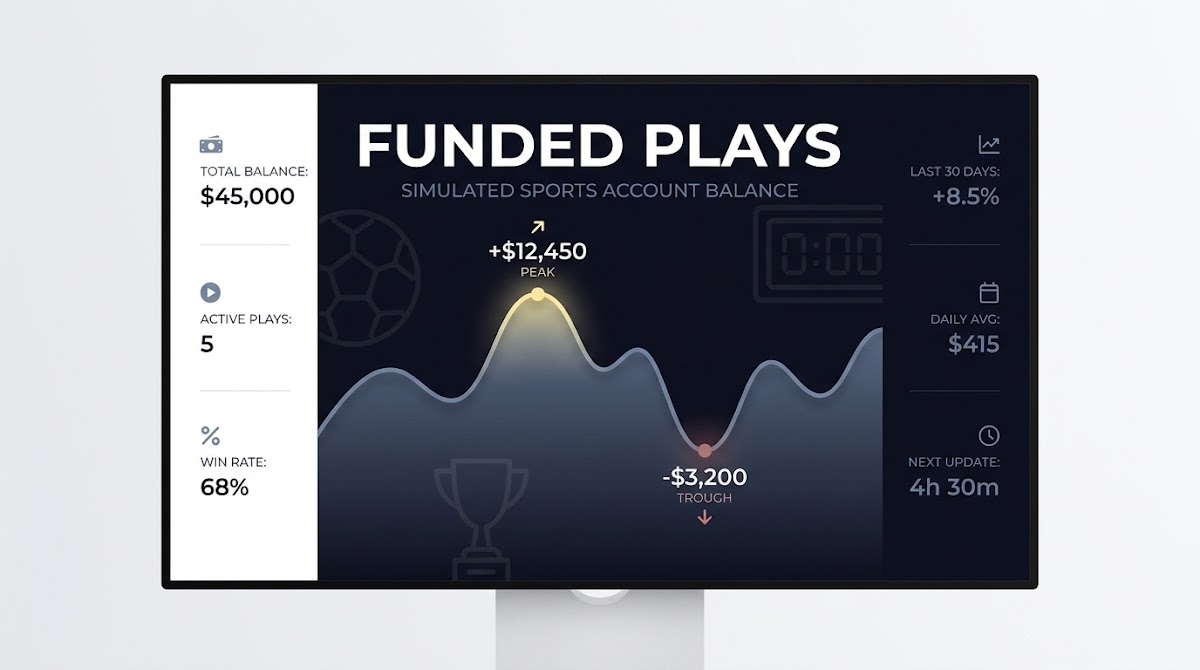
Drawdown measures the decline from a peak account value down to the lowest subsequent trough and is a standard control used to enforce disciplined risk management in evaluations. When a program sets a maximum drawdown, it is effectively requiring participants to limit peak-to-trough losses so the operator can assess consistent forecasting behavior rather than luck.
As a practical matter, understanding exactly how drawdown is calculated for a challenge matters because definitions vary: some use intraday peaks, others use end-of-day balances, and some apply cumulative or trailing measures that produce different outcomes in volatile periods Investopedia drawdown guide.
quick drawdown calculator to track peak-to-trough declines
Simple check to track peak-to-trough declines
Other pass/fail limits and risk controls
In addition to drawdown, evaluations commonly include per-trade caps, daily loss limits, minimum activity requirements, and position-size rules that prevent oversized bets or correlated exposures that can quickly destroy a simulated bankroll. Those controls exist to measure sustainable decision-making across many events rather than allowing single large wagers to decide outcomes.
When you read an official rulebook, look for the concrete definitions of each limit and examples of disqualification triggers so you can adapt position sizing and selection frequency to the program's risk controls.
How to read profit-sharing and fee schedules
Profit-splitting mechanisms vary: some programs offer a percentage of net profits after thresholds and fees, others use tiered splits and require monthly or quarterly reporting. Be sure to check for platform fees, withdrawal minimums, hold periods, and any performance or compliance conditions that could reduce or delay payouts; these terms are material and must be disclosed in official documents FTC prize promotions guidance.
Compliance and advertising rules you need to know in the U.S.
Hypothetical performance and commodity advertising rules
When platforms show simulated or hypothetical results, U.S. commodity advertising rules require clear cautionary statements and forbid implying those results are typical or guaranteed. That requirement limits how an operator can present example performance and aims to prevent misleading impressions about likely outcomes 17 CFR § 4.41 on advertising. See legal analysis: What Sports Executives Need to Know.
Prize-promotion and sweepstakes obligations under FTC guidance
Where a funded challenge is structured as a prize promotion or sweepstakes, FTC guidance requires publishers to provide clear, conspicuous official rules that disclose material terms, entry conditions, and how winners or rewards are determined. Those disclosures are central to avoiding deceptive promotional claims and ensuring participants understand conditions and limits FTC prize promotions guidance. Additional reporting on regulatory oversight is available CFTC signals new era of oversight for sports prediction markets.

State-level requirements - example: Florida game-promotion rules
States can add further requirements for game promotions. For example, Florida's 2024 statute on game promotions introduced registration or bonding thresholds for qualifying promotions and prohibits conditioning entry on a purchase, showing how state-level rules can layer on top of federal guidance and require specific operational steps Florida game-promotion statute.
Common mistakes and pitfalls participants make
Misunderstanding drawdown and loss definitions
A common error is assuming drawdown will be calculated the same way across programs. Misreading the definition can lead to unexpected disqualification if, for example, intraday peaks are used instead of end-of-day values. Always confirm the exact calculation rule and how resets or corrections are handled Investopedia drawdown guide.
Ignoring official rules and fine print
Not saving or closely reading official terms is another frequent pitfall. Fees, withdrawal eligibility, activity minimums, and communications policies can materially affect your experience; these are the clauses that determine how profit-sharing and payouts actually work, and they can vary widely by operator.
Chasing short-term returns instead of disciplined risk management
Strategies that chase short-term wins often increase volatility and the probability of breaching drawdown or daily loss limits. Evaluations reward steady, repeatable performance, so prioritizing discipline and consistent position sizing usually produces better outcomes than high-variance approaches in the long run.
Practical example scenarios and step-by-step walkthroughs
Conservative strategy walkthrough
A conservative participant focuses on low-variance selections and tight position sizing designed to protect the simulated bankroll from large peak-to-trough moves. The day-to-day routine includes tracking running drawdown, keeping a log of each selection reason, and avoiding correlated exposures that could create simultaneous losses across multiple events. That approach lowers the chance of hitting a preset maximum drawdown while demonstrating disciplined judgement.
Checklist items during a conservative evaluation include monitoring your current drawdown percentage, limiting stake size relative to the simulated bankroll, and reviewing the rulebook daily for any updates or clarifications.

Aggressive short-term approach and its risks
An aggressive approach aims for rapid returns by taking larger positions or higher-variance selections. While this can produce quick gains, it also increases intraday volatility and the likelihood of a peak-to-trough decline that exceeds the program's drawdown limit. In many evaluations, a single adverse sequence of outcomes is enough to fail, making aggressive strategies a risky way to pursue short-term success.
Put simply, higher expected variance raises the probability of failing objective-based pass-fail criteria, so weigh the trade-off between speed and survival when you plan your approach.
Checklist: what to track during an evaluation
Use a daily checklist to keep performance and compliance visible: record peak account value, trough value, drawdown percentage, position sizes, stake limits, communication logs from the platform, and any rule changes. Keeping a timestamped record helps reconcile disputes and lets you adjust strategy early if you see risk creeping up.
How to evaluate platforms and next steps
Checklist for comparing offers
Compare offers by checking official rules, exact drawdown definitions, profit split and fee schedules, withdrawal terms, and any compliance disclosures. See the Funded Plays blog: Funded Plays blog. Prioritize transparency in official documentation and look for examples or worked scenarios that show how limits and payouts are calculated.
Questions to ask and documents to save
Ask for or download the full official terms, a clear definition of pass-fail metrics, examples of drawdown calculations, and the promoter's contact method for disputes. Save promotional materials, rulebooks, and screenshots of any claims to ensure you have a record of material representations.
When to try a challenge and when to step back
Consider starting with a low-stakes or entry-level evaluation if you are new to the format. Track results for several cycles to see if your process produces consistent outcomes. If you repeatedly breach stated limits despite disciplined adjustments, pause to reassess rather than increasing risk to chase a quick pass.
Final takeaways
Funded sports trading adapts prop-firm evaluation ideas to sports forecasting by using simulated capital, explicit pass-fail limits such as maximum drawdown, and performance-based reward mechanics that vary by operator. It rewards consistent, disciplined forecasting rather than promising easy earnings.
Before participating, read and save official terms, confirm how drawdown and other limits are calculated, and treat advertised payouts as examples that require verification in the governing documents. See Funded Plays: Funded Plays. Start conservatively, track your metrics daily, and prioritize risk controls over quick wins.
Drawdown is typically the peak-to-trough decline measured according to the program's definition; confirm whether they use intraday peaks, end-of-day balances, or trailing calculations in the official rules.
No. Earnings depend on individual performance and compliance with platform rules; operators must not imply guaranteed or typical returns in advertising.
Save the full official terms, promotional materials, examples of payout calculations, and any platform communications that describe rules or fees.
References
- https://www.investopedia.com/terms/p/proprietarytrading.asp
- https://www.ecfr.gov/current/title-17/chapter-I/part-4/section-4.41
- https://www.investopedia.com/terms/d/drawdown.asp
- https://www.ftc.gov/business-guidance/resources/prize-promotions-guide-businesses
- https://www.fundedplays.com/challenges
- http://www.leg.state.fl.us/statutes/index.cfm?App_mode=Display_Statute&URL=0800-0899/0849/Sections/0849.094.html
- https://www.fundedplays.com
- https://www.fundedplays.com/blogs
- https://www.fundedplays.com/blogs/how-fundedplays-evaluations-work
- https://www.wilmerhale.com/en/insights/client-alerts/20260526-what-sports-executives-need-to-know-about-prediction-markets
- https://www.mcdermottlaw.com/insights/double-coverage-cftc-exchanges-signal-new-era-of-oversight-for-sports-prediction-markets/
- https://www.americangaming.org/sports-event-contracts/