
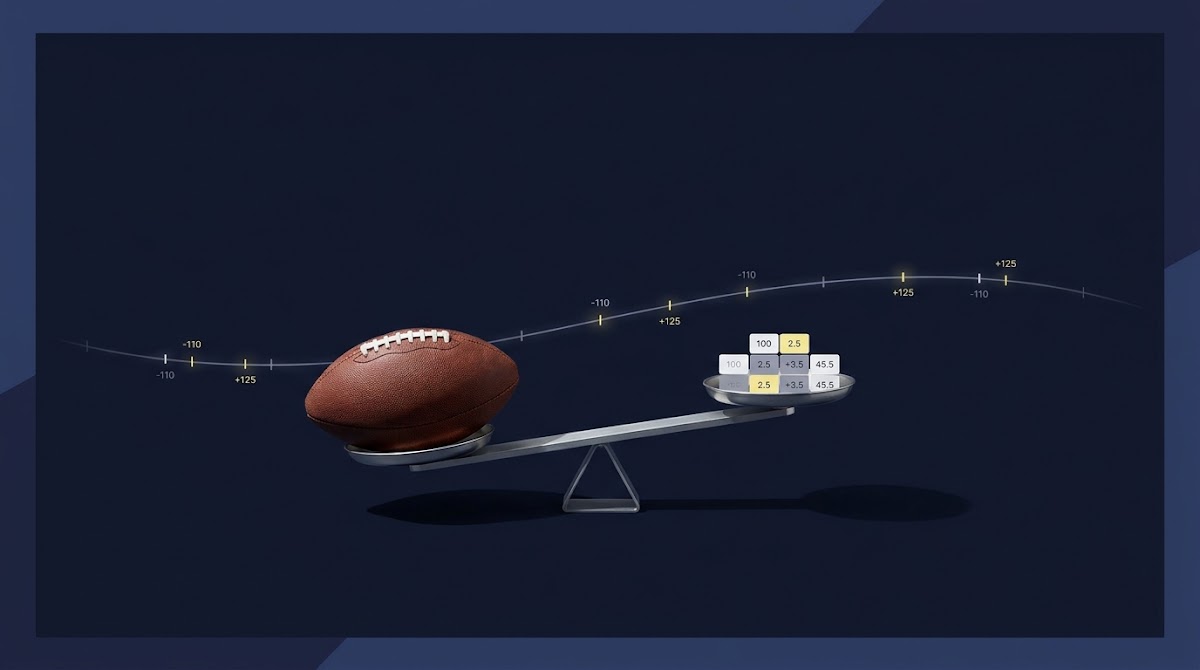
What Is a Point Spread? A quick primer
What Is a Point Spread is a simple way to describe the handicap oddsmakers place on a matchup so that a favorite and an underdog become roughly even propositions. In that setup the favorite carries a negative number and the underdog a positive number, and the final margin is compared to the posted number to determine whether the favorite "covers" or the underdog does, with whole-number ties resulting in a push; this basic definition is consistent with industry glossaries and consumer guides Investopedia point spread explainer. For another clear overview see Fox Sports.
The practical terms to know are favorite, underdog, cover and push. The favorite is the team expected to win and is shown with a minus sign, the underdog is shown with a plus sign, a cover means the chosen side beats the spread, and a push means the final margin equals a whole-number spread and many operators void the wager and return stakes, as explained by regulator consumer materials Massachusetts Gaming Commission consumer guide.
Spreads are posted along with prices, sometimes called odds or the price, and both the spread and the associated price can move before kickoff as oddsmakers and market participants react to new information and betting activity ESPN sports betting guide.
Across U.S. legal markets authoritative glossaries and regulator guides use consistent terminology for point spreads, so reading a glossary or a state consumer guide will give the same core definitions American Gaming Association sports betting glossary.
Learn structured sports prediction challenges
Continue through the sections that follow to see how spreads are shown, why lines move, common grading procedures, and practical worked examples that mirror regulator guides.
Keep in mind that using point spreads is not a guarantee of outcome; results depend on game performance, the operator's grading rules, and the accuracy of the inputs you rely on when making a selection.
How the point spread is shown and read
When you look at a posted line you will usually see a sign and a number such as -7 or +3.5. The minus sign denotes the favorite and the plus sign denotes the underdog, and reading that notation correctly is the first step in interpreting a spread; authoritative glossaries use this same notation and explain the convention AGA sports betting glossary.
A key distinction is between whole-number spreads and half-point spreads. A whole-number spread like -7 can result in a push if the final margin is exactly seven, while half-point spreads such as -3.5 remove the possibility of a push because game scores cannot produce a half-point margin Investopedia point spread explainer.
Simple numeric examples make this concrete. Suppose the line is Team A -7 and the final score is Team A 28, Team B 20. The final margin is 8, which exceeds the spread, so Team A covers. If Team A wins 24 to 20 the margin is 4 and the underdog covers. If Team A wins 27 to 20 the margin is 7 and the result is a push on a -7 line and many operators void the wager and return stakes Massachusetts Gaming Commission consumer guide.

How oddsmakers set and adjust point spreads
Oddsmakers combine quantitative inputs and qualitative information to set an initial spread. Typical inputs include power ratings, matchup analysis, injury reports, weather, and public betting tendencies; public-facing explanations and industry resources describe these common factors without suggesting any single operator uses an identical proprietary method ESPN sports betting guide. For additional detail on how spreads are constructed see OddsJam.
Power ratings are a common internal tool that convert factors such as recent performance and opponent strength into a numeric estimate of team strength. Injury reports and matchup details add context that can shift an initial rating. Public betting patterns and early sharp action can then push a posted line to move, because operators adjust to balance liability or respond to new information Washington State Gambling Commission player resources. See also a practical walk-through on team ratings at The Score.
Quick checklist to track common inputs oddsmakers use
Use this as a reminder not a prediction
Different operators may have different workflows and thresholds for moving lines, but public regulator and industry materials consistently list similar input types and explain why lines change as new facts and market activity arrive AGA sports betting glossary.
It helps to remember that a posted spread and its price are two related but distinct items: the spread sets the margin condition you need to beat, while the price determines payout for a successful wager. Both can be adjusted to manage exposure or reflect evolving information ESPN sports betting guide.
Reading outcomes: who wins, who covers and when a push happens
To grade an outcome against the spread, compare the final margin to the posted number. If the favorite's margin of victory is greater than the spread the favorite covers. If the margin is less than the spread the underdog covers. If the margin equals a whole-number spread the result is a push and most operators void the wager and return stakes; regulator guides provide step-by-step examples of this grading process Massachusetts Gaming Commission consumer guide.
Follow these steps when you check a settled game: 1) Note the posted spread and which team is the favorite. 2) Calculate the final margin of victory. 3) Compare the margin to the spread. 4) Determine cover, underdog cover, or push according to the comparison. Consumer guides use very similar steps when they illustrate grading rules AGA sports betting glossary.
Worked example, plain text: Line: Team X -6 Final score: Team X 30, Team Y 24 Final margin: 6 Result: push, wager voided and stakes returned on many operator rules Massachusetts Gaming Commission consumer guide.
Another worked example: Line: Team X -3.5 Final score: Team X 27, Team Y 24 Final margin: 3 Result: underdog covers because the favorite did not exceed 3.5 Investopedia point spread explainer.
Spreads, prices and line movement: how odds interact with the spread
The posted price, often shown as -110 or similar, indicates how much you must risk to win a given payout and therefore interacts with the spread to determine expected payout for a successful selection. Explainer resources note that spread and price together define the economic terms of a ticket ESPN sports betting guide.
Lines move for several common reasons: new injury information or lineup changes, unusual public volume on one side, early sharp action from professional bettors, and risk-management adjustments made by operators. Movement reflects changing information and the need to manage liability rather than a prediction that a particular side will ultimately win Washington State Gambling Commission player resources.
A point spread is a handicap assigning a negative number to the favorite and a positive number to the underdog; compare the final margin to that number to determine whether the favorite covers, the underdog covers, or a push occurs when the margin equals a whole-number spread.
Consider this: a late injury to a starter can cause both the spread and the price to move as oddsmakers rebalance exposure and bettors react. That movement can signal fresh information but does not guarantee an outcome; it is a market response to new facts.

Decision criteria: when a spread pick makes sense
When deciding whether to take a spread, consider a checklist of factors: your own power rating versus the posted line (see how Funded Plays evaluations work), current injury and lineup information, situational context such as rest or travel, weather when relevant, and how much the posted price affects the payout. These considerations help you judge line value relative to your model or assessment.
Think in terms of value rather than certainty. Value exists when your view of expected outcome differs sufficiently from the market to offset the price. That may be a modest edge, and it does not guarantee a win. Discipline and consistency in applying your criteria are crucial for assessing whether a spread pick fits your process.
Risk and bankroll considerations are non-prescriptive reminders: only stake amounts you can afford to lose, set limits per your rules, and check the operator's grading and settlement policies before committing funds or participating in a challenge environment. Platforms that use performance-based evaluation models emphasize stable rules and transparent grading to help participants understand outcomes.
Common mistakes and pitfalls to avoid with point spreads
A frequent error is misreading the line sign and confusing the favorite with the underdog. Verify the sign and the team listed to avoid basic mistakes that turn a winning idea into a losing ticket Investopedia point spread explainer.
Another common pitfall is ignoring pushes on whole-number spreads. If you do not account for the possibility of a push you can misestimate risk and expected return. Half-point spreads are one way the market reduces pushes, but always check how your operator grades pushed wagers Massachusetts Gaming Commission consumer guide.

Chasing small line moves without investigating why they happened is also a typical mistake. A move caused by public bettors may not carry the same informational value as a move caused by credible sharp action or substantive lineup news Washington State Gambling Commission player resources.
Finally, do not assume uniform grading across operators. Always review the published house rules on settlement, grading, and edge cases so you know how a ticket will be treated if the final margin produces a close result.
Practical scenarios: worked examples and what they teach you
Scenario A: whole-number spread that results in a push. Line: Team Alpha -7 Final score: Team Alpha 28, Team Beta 21 Final margin: 7 Result: push, stakes returned under typical grading rules. This example mirrors regulator-style illustrations that show how exact ties are handled Massachusetts Gaming Commission consumer guide.
Scenario B: half-point spread and a clear cover. Line: Team Gamma -3.5 Final score: Team Gamma 24, Team Delta 20 Final margin: 4 Result: favorite covers because 4 is greater than 3.5. The half-point prevents a push and gives a clear settled outcome Investopedia point spread explainer.
Scenario C: line move after injury news. Initial line: Team Epsilon -4 By midweek a starter is ruled out and the line moves to -2.5 Final score: Team Epsilon 21, Opponent 20 Final margin: 1 Result: underdog covers. The midweek move reflected new information that materially changed the expected outcome and also affected the price and potential value for bettors Washington State Gambling Commission player resources.
Another worked example that shows grading: Line: Underdog +10 Final score: Favorite 35, Underdog 28 Final margin: 7 Result: underdog covers because favorite did not exceed the 10-point spread. Regulator guides present similar arithmetic to help consumers verify outcomes AGA sports betting glossary.
Practice by writing out the posted spread and final score and doing the subtraction yourself. That small step avoids misunderstandings and helps you internalize how covers and pushes are calculated following standard consumer education materials. Read more on our blog.
Key takeaways and where to learn more
Takeaways: 1) A point spread is a handicap that assigns a negative number to the favorite and a positive number to the underdog to make either side a roughly even proposition. 2) Compare the final margin to the spread to determine cover, underdog cover, or push. 3) Whole-number spreads can produce pushes; half-point spreads eliminate that possibility. 4) Spreads and prices can move before kickoff in response to new information and market action. 5) Always check the operator's published grading and settlement rules before participating. Visit Funded Plays for our site and resources.
For authoritative definitions and worked examples consult industry glossaries and state regulator consumer guides, which present consistent terminology and practical grading illustrations AGA sports betting glossary.
Remember that rules and grading follow the operator's published terms and that point-spread outcomes are not guaranteed. Use regulator materials to confirm settlement procedures and rely on disciplined, transparent processes when evaluating spreads.

Funded Plays Logo
A push occurs when the final margin exactly equals a whole-number spread; most operators void the wager and return the stake according to their grading rules.
Lines move because oddsmakers and markets react to new information such as injuries, matchup details, or significant betting volume, and operators adjust spreads and prices to manage risk.
No, grading and settlement practices can vary; always check the operator's published rules and consumer guidance before placing a wager.
References
- https://www.investopedia.com/terms/p/pointspread.asp
- https://massgaming.com/wp-content/uploads/Sports-Wagering-101.pdf
- https://www.espn.com/chalk/story/_/id/29121326/sports-betting-101-beginners-guide
- https://www.americangaming.org/resource/sports-betting-glossary/
- https://www.fundedplays.com/challenges
- https://wsgc.wa.gov/players/sports-wagering
- https://oddsjam.com/betting-education/point-spread
- https://www.thescore.com/nfl/news/2680767/nfl-betting-how-to-using-team-ratings-to-calculate-point-spreads
- https://www.foxsports.com/stories/betting/what-is-point-spread
- https://www.fundedplays.com/blogs/how-fundedplays-evaluations-work
- https://www.fundedplays.com/blogs
- https://www.fundedplays.com