
What a moneyline bet is and why it matters
Quick plain-language definition, What Is a Moneyline
A moneyline bet is a straight wager on which team or player wins the contest, with no point spread or margin requirement. This means you win the bet if your side wins outright, and you lose if they do not. When you want a simple answer to who wins, a moneyline offers that answer directly, using American odds to show the price and potential payout American Odds (Moneyline): Definition, Formula, and Examples.
Moneylines matter because they price the probability of a result rather than how much one side will win by. That distinction affects strategy: a bet on a moneyline is a bet on the outcome itself, while other markets like point spreads ask you to predict the margin. U.S. consumer guides use the same plain definition when explaining betting basics for regulated markets Sports Wagering 101.
Where moneylines appear in U.S. markets
In licensed U.S. markets, moneylines are normally shown as American odds with a plus or minus sign. Positive odds indicate the size of profit on a $100 stake, and negative odds show how much is required to win $100. That American format is the standard display used by both educational pages and industry glossaries Sports Betting Glossary.
Because the format is familiar to many U.S. bettors, you will see moneylines across apps, broadcasts, and consumer-facing regulator pages. Knowing the basic meaning helps you compare prices, translate odds into likely chances, and decide whether a quoted number fits your view of an event. This simple clarity is why the moneyline remains a primary market for many casual and experienced users Sports betting 101: How to bet point spreads, totals and moneylines.

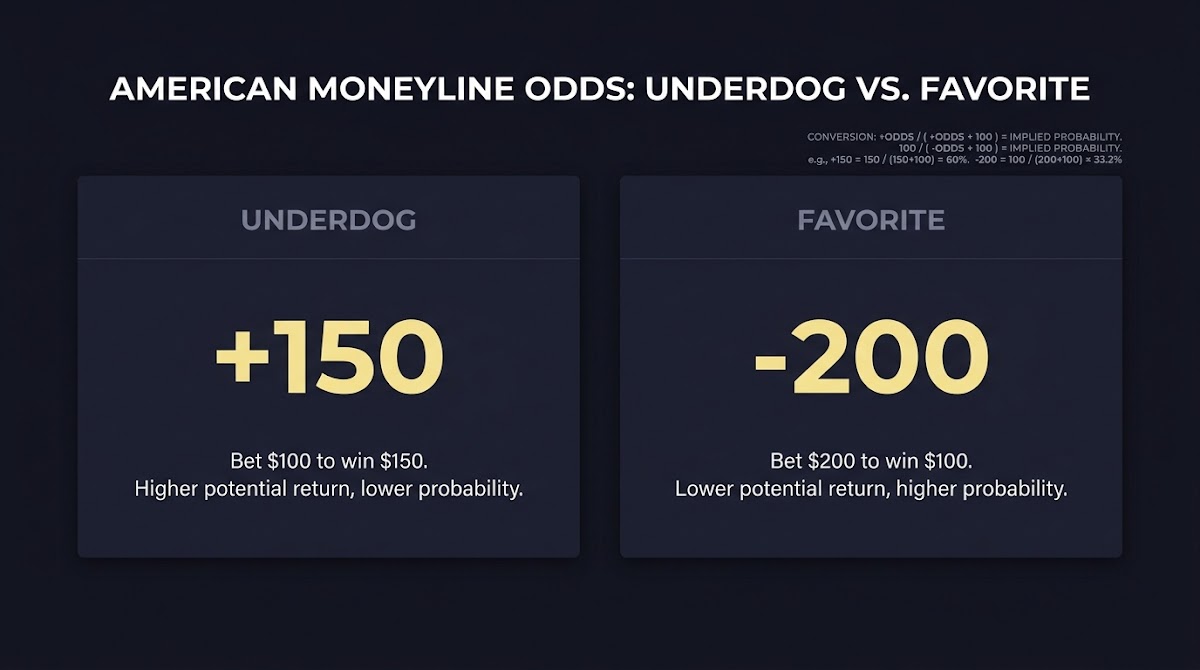
Positive American odds, written with a plus sign, show how much profit you would earn on a $100 stake. For instance, a price of +150 means a winning $100 stake returns $150 profit, plus the original $100 stake for a total return of $250. That presentation keeps profit and stake explicit, so readers can quickly see net gain and full payout in plain dollars American Odds (Moneyline): Definition, Formula, and Examples.
Positive odds also scale: a smaller stake earns a proportionate share of the profit. If you bet $10 at +150, the profit is one tenth of $150, and the total return is stake plus profit. Thinking in both profit and total return helps avoid confusion between what you win and what you get back in cash.
Negative odds explained (-200 style)
Negative American odds, shown with a minus sign, tell you how much you must stake to win $100. A line of -200 means staking $200 would yield $100 profit, and a total return of $300. The negative format flips the presentation so favorites require larger stakes for the same standard $100 profit Sports betting 101: How to bet point spreads, totals and moneylines.
Reading negative odds this way makes it easy to convert any stake into expected profit: profit equals stake times 100 divided by the absolute value of the negative odds. Framing odds as both the stake required and the profit produced keeps math straightforward when you compare favorites and underdogs.
Converts American Odds and stake into implied probability and payout
Use this to check whether a price matches your estimate
Practical payout examples and worked calculations
Common examples: +150, -200, and mixed lines
Worked examples help fix the formulas in your head. For +150, a $100 stake yields $150 profit and a $250 total return. For -200, staking $200 wins $100 profit and returns $300 total. These concise labels reduce mistakes when users move between quoted prices and wallet amounts American Odds (Moneyline): Definition, Formula, and Examples. Try an odds converter for quick checks.
To make this practical beyond the $100 baseline, scale the same ratios. Betting $25 at +150 returns profit equal to 25 percent of the $150 base profit, so you would make $37.50 profit and receive $62.50 back in total. When you scale from round numbers, always keep the distinction clear between profit and total return to avoid overstating outcomes.

Also note rounding practices in real-world displays: many apps round cents to whole dollars or show prices without breaking down fractions. When a platform shows a whole-dollar payout, treat it as a practical display choice rather than a different math rule.
Converting American moneyline odds to implied probability
Formulas for positive and negative odds
You can translate moneyline odds into implied win chances with a simple formula. For negative odds use p = (-odds)/((-odds)+100). For positive odds use p = 100/(odds+100). These formulas let you compare a quoted price to your own estimate of an event's chance Implied Probability: Definition, Formula, and Use in Betting Odds, or check with an implied probability calculator.
For example, -200 converts to an implied probability of 200 divided by 300, or about 66.67 percent. A +150 line converts to 100 divided by 250, or 40 percent implied chance. This way of thinking turns dollar labels into percentages you can use when assessing value.
Practice odds conversion and value assessment with challenge programs
Practice converting odds and percentages to sharpen your judgement, then compare those implied chances to your own estimates to spot potential advantage.
Interpreting implied probability in plain language
Implied probability is not a promise of an actual outcome. It is the market's price for a result, reflecting both the bookmaker's view and the public's money. Because bookmakers include a margin, the implied probabilities you calculate from both sides will often add to more than 100 percent, which you should account for when judging value Sports betting 101: How to bet point spreads, totals and moneylines.
Use implied probability to compare the market view against your independent estimate. If your estimate of a team's true chance exceeds the implied probability even after adjusting for the bookmaker margin, you may have identified a positive expected value situation to explore further.
Moneyline versus point spread: when to use each
Core conceptual difference
Moneyline bets ask which side wins the match. Point spread bets ask by how much a team wins or loses. That difference is fundamental: one prices the outright outcome, the other prices the margin of victory. Consumer guides and sports wagering glossaries make this distinction a core part of their explanations for newcomers Sports Wagering 101.
The choice between the two depends on your view. If you are confident one team will win but not by a large margin, a moneyline might be cleaner. If you think a favorite will win by a set margin, a spread market expresses that view more directly. Keep your reasoning separate from hoped outcomes to avoid bias when choosing between markets Sports betting 101: How to bet point spreads, totals and moneylines.
Practical scenarios where moneyline is preferable
Moneylines are often preferred in lower-scoring contests, single-elimination events, or any situation where the margin is unpredictable but a clear winner is expected. Because the moneyline focuses on the result instead of the margin, it simplifies decisions in those contexts and can be a better fit for straightforward outcome-based forecasts Sports betting 101: How to bet point spreads, totals and moneylines.
That said, the moneyline typically pays less on heavy favorites because negative odds demand larger stakes. Evaluate whether you prefer a bet that is simply right or one that also requires predicting by how much a team will win. Each market tests a different skill set in forecasting.
How sportsbooks set moneylines and the effect of the vig
Bookmaker margin and how it shows up in prices
Sportsbooks include a margin, often called the vig or overround, to ensure a profit edge. This margin is why the implied probabilities derived from both sides of a moneyline commonly total more than 100 percent. That excess is the bookmaker cushion and an important adjustment when you compare market prices to your own probability estimates Implied Probability: Definition, Formula, and Use in Betting Odds. See an implied probability tool for comparison.
Because of this margin, a simple comparison of your estimated chance against the implied probability should include an allowance for the sportsbook overround. That step prevents overstating value when market prices already embed a profit margin for the house.
Why the two sides rarely sum to exactly 100 percent
Line setting is influenced by public money, new information such as injuries, and the bookmaker's own risk management. As money flows, prices shift to balance liability. Those adjustments and the built-in margin mean the two implied probabilities rarely add to only 100 percent Sports Wagering 101.

Common mistakes, decision criteria, and quick checklist
Typical errors bettors make with moneylines
Readers commonly misread odds, confuse profit with total return, ignore the vig, or overbet favorites based on emotional bias rather than a probability edge. Converting odds into implied probabilities and checking for the bookmaker margin can prevent many of these errors Implied Probability: Definition, Formula, and Use in Betting Odds.
Another frequent mistake is assuming American-odds format is universal. While U.S. markets typically use American odds, other regions or informational pages may show decimal or fractional odds. Check the format before you calculate to avoid applying the wrong formula Sports Gaming Frequently Asked Questions.
A short checklist for deciding whether a moneyline offers value
Use this rule set before you place a moneyline bet: convert the quoted price to implied probability, compare that to your independent estimate, adjust for the bookmaker margin, and only place a stake sized to fit your overall plan. This checklist focuses on discipline and comparison rather than promising returns American Odds (Moneyline): Definition, Formula, and Examples.
Keep this checklist visible while you practice. Over time, the habit of translating odds into probabilities and checking for overround will sharpen your judgement when evaluating moneyline betting examples and other markets.
Scenario 1, Favorite in a single elimination match: A favorite is listed at -200, which implies roughly a 66.7 percent chance by formula. If your model estimates a 72 percent chance and you account for the bookmaker margin, you may consider the price relatively fair or slightly valuable depending on the margin estimate Implied Probability: Definition, Formula, and Use in Betting Odds.
Scenario 2, Underdog payout test: An underdog at +150 implies a 40 percent chance. If you believe the true chance is only 30 percent, the market price overstates the underdog's chance and you would likely decline the bet. This example shows how the same math helps in either direction American Odds (Moneyline): Definition, Formula, and Examples.
Use the simple formulas for positive and negative American odds to calculate the implied probability, then compare that percentage to your independent estimate while accounting for the bookmaker margin.
Scenario 3, Close matchup with small signals: Two teams trade near-even moneylines. Converting each price to implied probability and checking late-breaking news can reveal where the market mispriced a small advantage, but uncertainty is high and disciplined stake sizing is vital in such cases Sports betting 101: How to bet point spreads, totals and moneylines.
Final takeaways and next steps
Moneyline bets are a direct way to back a winner and are displayed in American odds across U.S. markets. By learning to read positive and negative prices, convert them to implied probabilities, and adjust for the bookmaker margin, you can make more informed decisions about whether a quoted price matches your view Sports Wagering 101.
For practice in a skills-based environment that focuses on disciplined forecasting, consider exploring structured challenge programs that let you practise odds reading and value assessment under controlled rules. Official regulator glossaries and consumer pages remain a reliable reference for definitions and transparency expectations Sports Gaming Frequently Asked Questions.
Use the formula for American odds: for negative odds use p = (-odds)/((-odds)+100), and for positive odds use p = 100/(odds+100). This yields the implied probability as a decimal or percentage.
Bookmakers include a margin, called the vig or overround, which causes the summed implied probabilities to exceed 100 percent. Adjusting for that margin is important when assessing value.
Choose a moneyline when you want to back an outright winner, especially in low scoring or single elimination events, or when you do not want to predict the margin of victory.
References
- https://www.investopedia.com/terms/a/americanodds.asp
- https://massgaming.com/responsible-gaming/sports-wagering-101/
- https://sbg.colorado.gov/sports-betting-glossary
- https://www.espn.com/chalk/story/_/id/34208531/sports-betting-101-how-bet-point-spreads-totals-moneylines
- https://www.investopedia.com/terms/i/implied-probability.asp
- https://casinocontrol.ohio.gov/Sports-Gaming/Frequently-Asked-Questions
- https://www.fundedplays.com/challenges
- https://www.aceodds.com/bet-calculator/odds-converter.html
- https://www.omnicalculator.com/statistics/implied-probability
- https://oddsjam.com/betting-calculators/implied-probability
- https://www.fundedplays.com
- https://www.fundedplays.com/blogs
- https://www.fundedplays.com/blogs/how-fundedplays-evaluations-work