
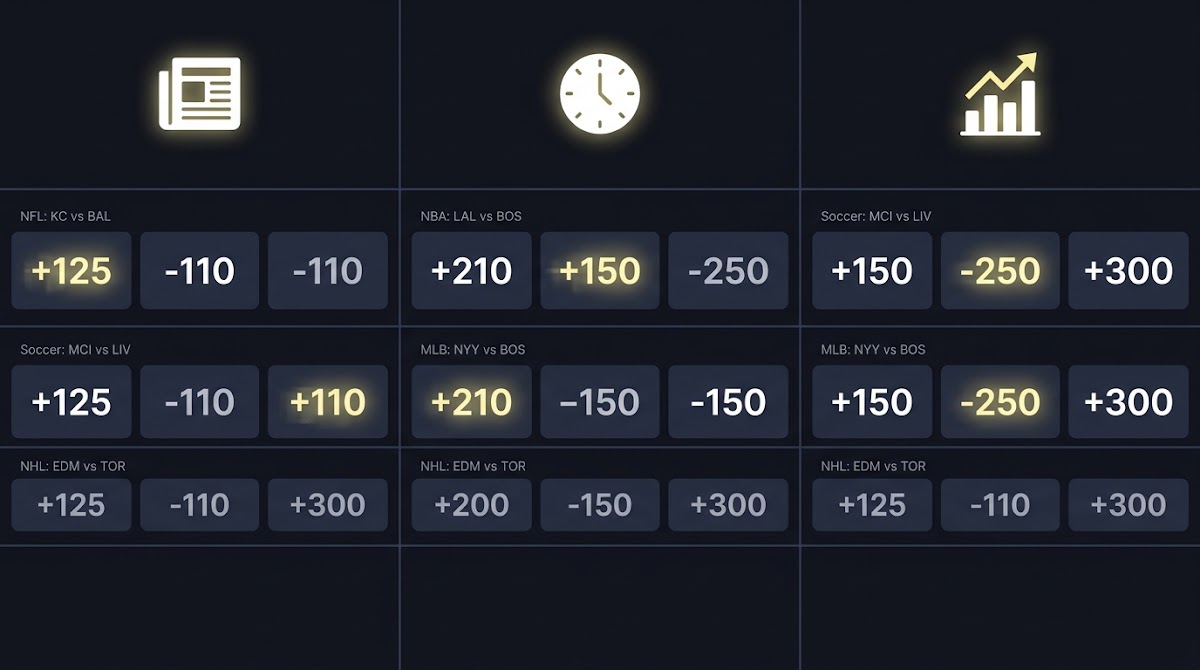
What does line movement mean? Definition and context
What Causes Sports Lines to Move is a phrase that points to several related ideas: an opening price set by a bookmaker or exchange, subsequent shifts as new bets or news arrive, and a final closing line before an event starts. In regulated markets the process blends bookmaker pricing and exchange liquidity, so a single market observation can reflect both proprietary prices and matched orders on an exchange; this mix is a core part of modern price discovery Pinnacle Betting Resources.
The key distinctions are simple but important. An opening line is the initial price offered publicly, subsequent line moves are the adjustments that occur as information and bets arrive, and the closing line is the final public reference used for many performance measures. Closing Line Value is one such benchmark that bettors use to judge whether they beat the market over time, because the closing mark aggregates late liquidity and market consensus SSRN working paper on Closing Line Value.
Track CLV and line snapshots to evaluate moves
Update after each event close
Understanding line movement explained means treating each observed shift as a signal with uncertain meaning. Sometimes a move reflects fresh information, sometimes it reflects a flow imbalance that a book wants to hedge, and sometimes it is a transient response to public sentiment. For bettors, the practical value is in learning which moves have informational weight and which are noise.
How opening lines are set: pricing methodology and risk management
Opening lines are not magic. Sportsbooks typically combine proprietary statistical models with trader judgment to produce an opening price that balances a realistic probability view against the operator's risk appetite. That combination allows operators to set competitive prices while keeping exposure sensible, and it explains why opening lines can differ across books even before any bets arrive (who sets the sports betting line).

Opening lines are not magic. Sportsbooks typically combine proprietary statistical models with trader judgment to produce an opening price that balances a realistic probability view against the operator's risk appetite. That combination allows operators to set competitive prices while keeping exposure sensible, and it explains why opening lines can differ across books even before any bets arrive (who sets the sports betting line).
Betting exchanges work differently: they rely on matched orders for liquidity, so early exchange prices can reflect ankle-deep market consensus from users willing to offer terms. That liquidity-driven mechanism often reveals different information than a bookmaker's calculated opener, and successful traders watch both venues for complementary signals (market maker process on betting exchanges).
Risk management then shapes how those opening lines behave. Operators set limits, monitor liability by event and market, and will shade or move lines to rebalance exposure as bets come in. In practice that means a line may move not only because the probability changed but because the book needs to reduce potential loss on one side, a pragmatic choice that is part of active market-making Pinnacle Betting Resources.
Early moves versus late moves: sharps, public money and liquidity timing
Early moves often carry different informational content than late moves. When a line moves soon after release, it can reflect sharper, more informed activity operating under lower limits; traders and professional bettors will sometimes move a market early when their private models or sources indicate an edge Pinnacle Betting Resources.
Those early shifts are valuable primarily because they can reveal professional conviction before the market widens. However, they occur in an environment of limited liquidity and position sizing, so a single early move is not automatically decisive; it is best treated as a high-quality signal to be verified against correlated markets and follow-up activity Betfair Exchange guide.
Betting lines change because new information, the balance of bets, and market structure alter perceived probabilities; bettors should watch timing, source verification, correlated markets and Closing Line Value rather than assuming instant correctness.
Late moves toward lock time usually reflect heavier public participation and more available liquidity, which can accelerate adjustments as large recreational flows or late-informed bets arrive. Because the late market includes broad participation, moves near start time often represent a market consensus being formed rather than a narrow professional opinion Betfair Exchange guide.
Information-driven moves: injuries, lineups, weather and breaking news
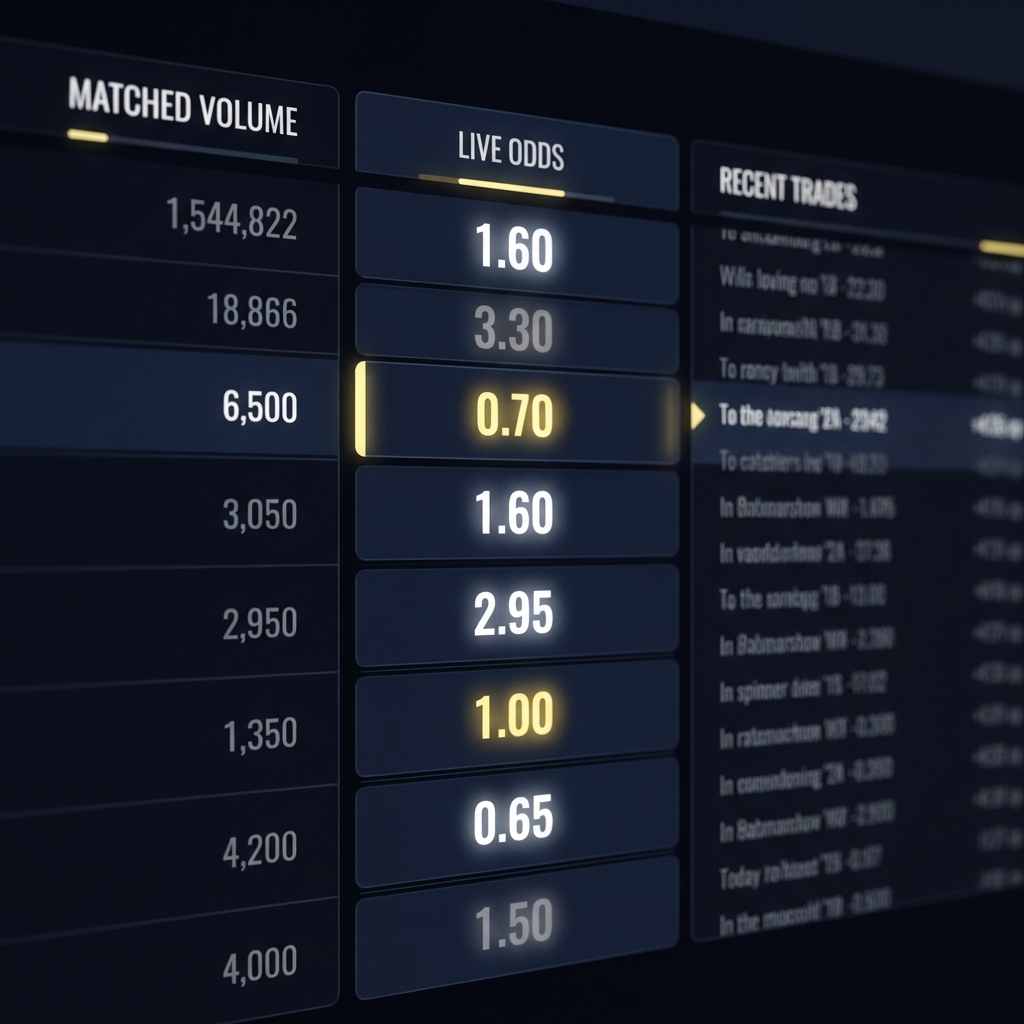
Certain types of news reliably move lines. Injury reports, last-minute lineup changes, suspensions and significant weather updates are classic triggers that prompt traders and exchanges to reprice quickly, because these items can materially change event probabilities Sportradar Integrity Services report.
Traders and exchanges both react fast when sources are vetted and confirmed. A verified injury or an official lineup release will usually produce an immediate repricing from books and a parallel adjustment in exchange markets as liquidity repricers and market makers incorporate the new information into odds Pinnacle Betting Resources.
It is important to note that integrity monitoring sits alongside this information flow. Rapid moves that accompany unverified tips, or that coincide with unusual betting patterns, can trigger reviews and alerts. Those alerts are part of the industry's effort to separate genuine information-driven adjustments from potentially manipulative activity Sportradar Integrity Services report.
Order flow and market participants: sharps, syndicates and the public
Different market participants move lines in distinct ways. Sharp bettors and syndicates typically trade with larger information edges and can move a market through sustained, targeted bets. Operators watch the profile of incoming orders and may react faster to patterns that match professional behavior Pinnacle Betting Resources.
Recreational or public bettors tend to bet in larger numbers but with smaller per-bet size, which creates heavier liquidity later on and can produce dramatic-looking moves when volume concentrates near event start. Books balance these flows by adjusting odds and limits, attempting to manage overall liability rather than simply mirror bet direction Betfair Exchange guide.
For readers who want to practice interpreting order flow in a low-risk setting, skill-focused challenge platforms like Funded Plays let participants make prediction decisions using simulated funds and structured evaluations. These environments are designed for learning market signals, tracking outcomes and refining discipline without wagering real money.

Correlation and market structure: exchanges, cross-market transmission and syndication
Markets are interconnected. A move in a moneyline market will often prompt adjustments in totals and related prop markets because bookmakers and exchanges seek internal risk balance across correlated lines. This cross-market transmission can produce cascading updates as books reconcile positions across multiple markets Pinnacle Betting Resources.
Exchanges and market makers act as conduits for these signals by offering transparent pricing and visible liquidity. When an exchange shifts, it can create a public reference that books monitor and sometimes match, which accelerates the spread of price information across venues and types of bets (prediction markets overview).
Integrity alerts, unusual patterns and regulatory responses
Not every rapid or extreme move is an ordinary market response. Integrity monitoring systems look for unusual patterns such as sharply lopsided volume, bets that arrive at odd times relative to news flow, or sudden price divergence across related markets. When these patterns appear, operators and regulators can open investigations and, if warranted, suspend or adjust markets to protect fairness IBIA Annual Report 2024.
Learn how FundedPlays challenges evaluate prediction skill
If a market shows signs of suspicious activity, consult official integrity notices and platform rules before making decisions; platforms and regulators publish guidance on how they handle alerts and investigations.
Regulatory responses vary by jurisdiction and operator, but common actions include temporary market suspension, bet voiding under certain rules, and information sharing with integrity services. These steps are aimed at preserving market confidence rather than influencing legitimate trading Sportradar Integrity Services report.
Closing Line Value and practical takeaways for bettors
Closing Line Value, or CLV, measures the difference between the price at which you placed a bet and the final market closing price. Consistently securing positive CLV is often cited as a benchmark for long-term bettor skill, because it suggests your selections beat the aggregated market consensus over time SSRN working paper on Closing Line Value.
In practice, use disciplined evaluation as one component of disciplined evaluation: record opening and closing lines, track results over a series of events, and avoid overtrading around marginal moves. CLV helps clarify whether your process is adding value or whether short-term variance is masking true performance.
Common pitfalls, quick checklist and final advice
There are common errors that lead bettors to misread movement. Overreacting to late public moves, treating every shift as insider information, or ignoring correlated markets are typical misreads that reduce long-term edge. Recognize that movement is a signal, not a guarantee.
Use a short checklist when a line moves: verify the source of any news, check correlated markets for confirmation, note the timing and liquidity profile, and record the opening and current lines for CLV tracking. This structured approach helps separate noise from potentially valuable signals Pinnacle Betting Resources.
Use a short checklist when a line moves: verify the source of any news, check correlated markets for confirmation, note the timing and liquidity profile, and record the opening and current lines for CLV tracking. This structured approach helps separate noise from potentially valuable signals Pinnacle Betting Resources.
Final advice: treat line movement as part of a broader decision process. Respect risk limits, prioritize discipline and keep records so you can measure whether your interpretation of moves produces consistent value. Markets incorporate many forces, and prudent, repeatable methods matter more than chasing individual swings.
Readers who test these habits in skill-focused settings can learn to interpret order flow and CLV without risking real funds, while maintaining realistic expectations about variance and outcomes.
Lines move mainly because of new information, like verified injuries or lineup changes, and because of order flow from bettors that forces books to rebalance exposure.
Treat early moves as potentially informative but verify them against correlated markets and follow-up activity; early moves can reflect sharper bettors under lower limits.
No. Line movement is a signal, not a certainty; use it with discipline, CLV tracking and sound bankroll management rather than assuming guaranteed outcomes.
References
- https://www.pinnacle.com/en/betting-resources/educational/why-do-bookmakers-move-lines
- https://papers.ssrn.com/sol3/papers.cfm?abstract_id=4567891
- https://betting.betfair.com/betting-exchange/how-the-exchange-works/what-makes-odds-move-010924-699.html
- https://www.fundedplays.com/challenges
- https://sportradar.com/performance-insights/betting-corruption-and-match-fixing-2024/
- https://ibia.bet/wp-content/uploads/2025/02/IBIA-Annual-Report-2024.pdf
- https://www.fundedplays.com
- https://www.fundedplays.com/blogs
- https://www.fundedplays.com/blogs/how-fundedplays-evaluations-work
- https://unabated.com/articles/who-sets-the-sports-betting-line-market-makers
- https://tesi.luiss.it/16438/1/656531.pdf
- https://www.nytimes.com/athletic/6826803/2025/12/23/prediction-markets-sports-what-you-need-to-know/