

What Are Player Prop Markets? Definition and core examples
Player prop markets are wagers that focus on an individual athlete's measurable performance, not the final team score or match outcome. Regulators often classify these as proposition wagers, so availability and rules can vary by sport and jurisdiction; for a view of typical categories and eligibility you can consult a state sports wagering catalog such as the one maintained by the Massachusetts Gaming Commission Massachusetts Gaming Commission sports wagering catalog.
At their simplest, a player prop translates a single, countable event or stat into an offered market price. Three concrete examples clarify the idea: an over/under on passing yards for a quarterback, a milestone like scoring 20 or more points in a basketball game, and a discrete outcome such as an anytime scorer in soccer or football. Each example asks you to predict a single player's outcome rather than which team wins.
Player prop markets ask you to predict a single player's statistical outcome. Before evaluating, convert odds to implied probability, check event eligibility in your state catalog, adjust your forecast for usage and matchup context, account for bookmaker margin, and set a clear staking limit.
Because props are tied to stats, operators and regulators define which competitions, events, and players are eligible; the exact labels you see on a menu can differ across operators and state catalogs. Common labels you will encounter include over/under, anytime scorer, first scorer, and milestones tied to thresholds or discrete events.
For newcomers asking what is a player prop bet, the practical takeaway is this: you are forecasting a player's statistical event within a game, and you must check both the market wording and any local rulebooks before you act.
How player prop markets are offered and regulated in the U.S.
State sports wagering catalogs document the categories of player props that operators may offer and often list sport specific eligibility rules that affect whether a given prop can be published in that jurisdiction; check those catalogs when you are uncertain about local availability New York State Gaming Commission sports wagering catalog.
Policy shifts at the national or league level can change what is available. In March 2024 the NCAA publicly urged the elimination of college athlete prop bets to protect student athletes, and following that guidance several jurisdictions moved to restrict or prohibit college player props, so college availability is more limited in some states NCAA statement on college prop bets.
That split means a reader should treat professional and college props differently: pro sports props remain widely used, while college props face additional policy and eligibility checks. Always verify event and league eligibility in your state catalog before you spend time building a forecast.
How to read player prop odds and convert them to implied probability
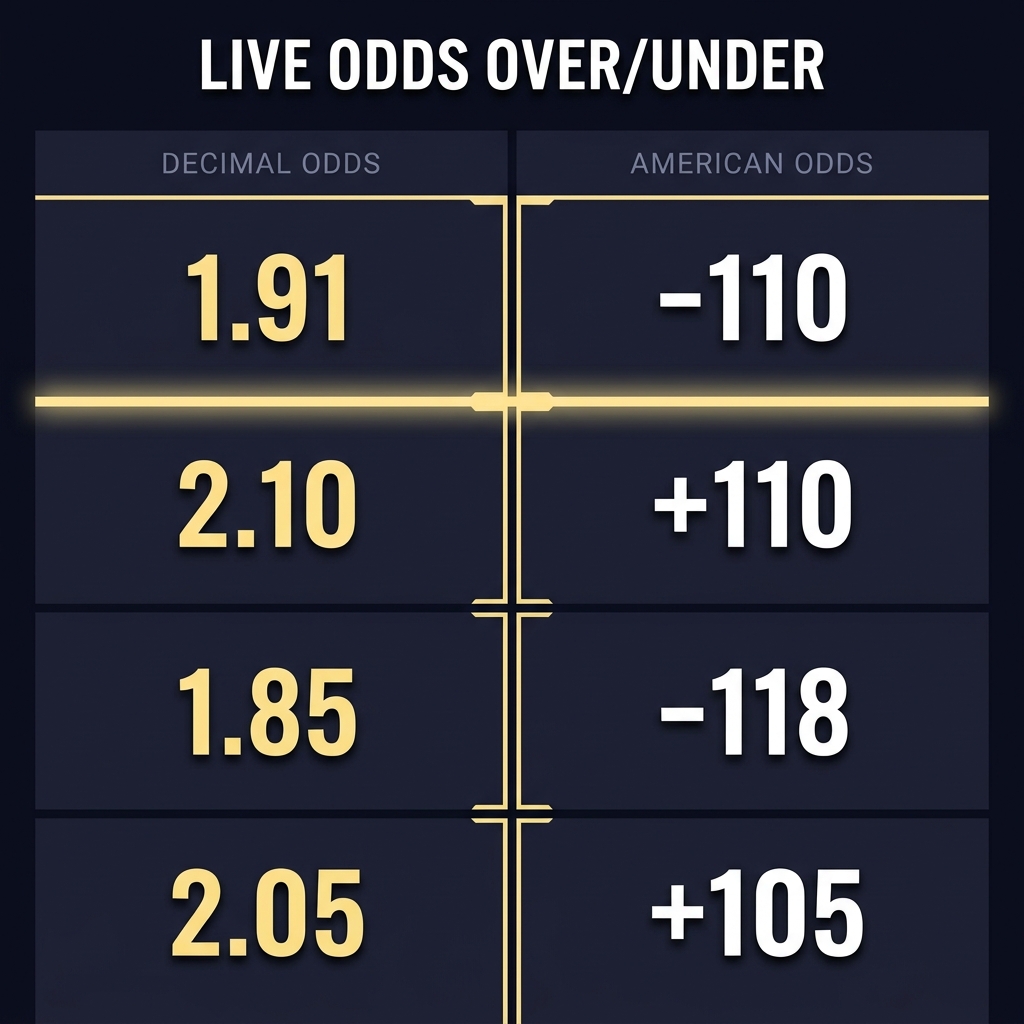
Reading prop prices begins with converting the listed odds into an implied probability so you can compare the market price to your forecast. For decimal odds, implied probability is simply 1 divided by the decimal line; for American odds the conversion depends on whether the number is positive or negative. Investopedia provides clear conversion steps and examples you can follow when you first learn the mechanics Investopedia implied probability guide.
Step 1, identify the odds format. Step 2, convert to implied probability using the appropriate method. Step 3, if you are checking a two-way over/under, compute both sides and see how the pair totals before margin adjustments.
Practical conversion example: if a player prop is +150 in American odds, that implies a probability you can compute from the positive American formula; if a prop is 2.50 in decimal odds, the implied probability is 1 divided by 2.50, which equals 40 percent. Use these conversions as your baseline when comparing forecasts to market prices.
Next, account for the bookmaker margin. Listed odds embed a house margin, often called the vigorish or overround, which means implied probabilities derived from market prices typically sum to more than 100 percent; understanding that margin is essential if you want to compare your estimate against a fair price Investopedia vigorish explanation.

Quick odds to implied probability converter
Enter the odds exactly as shown
After you convert odds to implied probability, you can compare the market's implied chance to your forecast. If your forecast probability is higher than the market implied probability after adjusting for margin, the line may offer positive expected value.
A statistical framework for evaluating an individual player prop
Begin by defining the stat distribution that drives the prop. For a points prop, that means establishing a per game points distribution for the player in the relevant sample: use recent season data but filter to the same role and minutes range you expect for the upcoming game.
Step 1, choose the right sample window and event definition. Step 2, model the distribution shape by checking means, variance, and the frequency of zero or low outcomes where applicable. Step 3, convert the distribution into probabilities for the thresholds in question.
Next, adjust for context drivers. Usage rate and projected minutes are primary levers in most sports; a small change in minutes or role often shifts the expected stat materially. Team pace matters for volume stats, and matchup context can move both mean and variance.
Also account for injuries and rotations. Late scratches, minute restrictions, or new lineup patterns can make historical data a poor guide. When sample size is small or role changed recently, widen your uncertainty range and reduce stake sizes accordingly.
Turning your forecast into fair odds and spotting value
Translate your forecast probability into fair decimal odds by dividing 1 by your probability. For example, a forecast probability of 35 percent becomes fair decimal odds of 1 divided by 0.35, which equals about 2.86. Convert to American odds if you prefer that format and use the result as your benchmark for comparison.
Once you have fair odds, adjust for the bookmaker margin to estimate the true market cost. The market's implied probabilities typically sum above 100 percent because of vigorish, so scale the market implied probabilities down proportionally to remove the overround and compare on equal footing.

Short example: you forecast a 40 percent chance that a player hits the stat line, which gives fair decimal odds of 2.50. If the market offers 2.20 decimal, adjust the market implied probability for overround and then compare; if your adjusted forecast still implies a higher chance than the market, it may represent positive expected value.
Practical pre-bet checklist: rules, eligibility and responsible limits
Confirm league and event eligibility in the applicable state wagering catalog before evaluating college or restricted props; catalogs list sport and event exclusions you must respect Massachusetts Gaming Commission sports wagering catalog.
Set a clear staking budget before you create a forecast and stick to it. Decide the bankroll percentage you will risk on any single prop and enforce time and spend limits to avoid impulsive actions.
Know how to use platform tools such as self-exclusion and deposit limits, and if you rely on an operator for practice or evaluation, confirm their rules for accounts and any simulated or funded challenges.
Common mistakes and cognitive traps when evaluating player props
One frequent error is ignoring the vig or overround when you measure value; treating listed odds as if they were fair will overstate your edge because the market embeds a house margin Investopedia vigorish explanation.
Behavioral traps include recency bias, where a single recent performance is overweighted, and overfitting small samples to produce an overconfident forecast. Chasing losses or increasing stakes after a bad run compounds these errors.
Corrective habits work. Keep a record of your forecasts, stakes, and outcomes, limit stake sizes relative to your bankroll, and compare multiple independent models or sources before acting. These practices reduce the harm from small-sample noise and emotional decisions.
Practice disciplined prop evaluation with a clear checklist
Use the checklist above and record your forecast and stake before you act to improve learning while keeping risk controlled.
Another common mistake is treating player props as independent when they are often correlated with team pace, opponent strategy, or teammate availability. Explicitly model those correlations when you can, or reduce stakes if uncertainty is high.
Worked examples: evaluating a passing-yards prop and a basketball points prop
Passing yards example. Step 1, define the stat: quarterback passing yards in a single game. Step 2, choose a sample: use the last eight starts where the quarterback had a similar game plan. Step 3, estimate a forecast probability for the offered line by counting the sample frequency adjusted for matchup and projected game script.
Step 4, convert your forecast probability into fair odds and compare to the market line, accounting for the market margin as described earlier. Step 5, if your adjusted fair odds show positive edge, record the decision and stake according to your bankroll rule. Check the state catalog for any event eligibility notes if the game involves a restricted league.
Basketball points example. Step 1, define the stat: player points in a game. Step 2, model the per game distribution for the player using minutes and usage filtered to recent games where the role was stable. Step 3, adjust for matchup defense and expected minutes; if a starter is questionable, simulate a minutes reduction and re-estimate probabilities.
Convert the forecast to fair odds, compare to the posted market price after removing vigorish, and decide using your staking rule. If the player has a sudden minutes change or a late injury report, treat the initial forecast as stale and update it before finalizing any stake.
College player props: regulatory caution and player-protection concerns
The NCAA has publicly urged the elimination of college athlete prop bets to protect student athletes, and that position prompted regulators to reexamine whether such markets should be permitted in their jurisdictions NCAA statement on college prop bets.
As a result, several jurisdictions have restricted or prohibited college player props and state catalogs document those limitations; before you evaluate or attempt to place a college prop, verify local catalog guidance to avoid prohibited activity New York State Gaming Commission sports wagering catalog.
When college props are available, treat them with additional caution. Student athletes have distinct protections and policy risks can change market availability without much notice, so factor that regulatory uncertainty into your evaluation and staking decisions.
Responsible participation: bankroll rules, self-limits and support resources
Adopt a simple bankroll percentage staking rule and apply it consistently. For props with higher variance, use smaller percentage stakes so individual outcomes do not move your confidence or bankroll excessively.
Make use of time and spend limits, deposit caps, and self-exclusion options provided by operators and learn about formal resources from responsible gaming organizations if you feel limits would help; the American Gaming Association offers materials on planning and limits American Gaming Association responsible gaming guidance.
Keep a tradebook or log of your forecasts, market prices, stakes, and outcomes. Reviewing that record regularly is the single best habit to improve forecasting skill and to spot behavioral errors early.
How platforms price and present player props
Operators embed the house margin in listed prices so the vig appears across paired outcomes and in single-way markets; pricing also reflects expected liability and the operator's appetite for action on a given market Investopedia vigorish explanation.
Platforms typically group props by player, by market type, and by milestone, and they label options in ways that can differ across operators. Compare multiple listings when liquidity or limits may affect the offered price, and be mindful that thin markets or low limits often carry wider hidden costs.
How skill-based prediction platforms differ from sportsbooks
Skill-based funded-challenge platforms emphasize structured evaluation using virtual funded accounts and performance based rewards, rather than direct cash wagering on outcomes. These platforms are designed for practice, disciplined testing, and performance measurement under defined rules.
FundedPlays is an example of a funded sports prediction platform that runs evaluation challenges and simulated funded accounts where users demonstrate forecasting consistency; it is a skill based alternative for practicing prop evaluation without traditional wagering mechanics.
Expect differences in account mechanics, risk controls, and the absence of direct betting liquidity when you practice on a funded-challenge operator compared with a sportsbook. Use these environments to refine forecasting, record keeping, and bankroll discipline.
Glossary: common player prop terms you should know
Vigorish, also called vig, is the house margin built into listed odds and it directly affects the implied probabilities you compute.
Implied probability is the market's chance for an outcome derived from the posted odds and it is your baseline for comparing forecasts.
Over/under is a two-way stat market where you choose whether a player will be above or below a specified total.
Anytime scorer is a discrete-outcome prop asking whether a player will score at least once in the event.
Usage rate describes how often a player is involved in offensive plays and it matters for volume stats like shots or touches.
Pace is the expected number of possessions or plays in a game and it scales volume driven stats.
Conclusion: key takeaways and next steps for thoughtful participation
What Are Player Prop Markets in short: they are stat and event based markets on individual athletes that require you to convert odds into implied probabilities and check eligibility before acting; converting odds to implied probability helps you see the market price clearly and is central to disciplined evaluation Investopedia implied probability guide.
Next steps: keep a log of forecasts and outcomes, apply the statistical checklist to each prop you evaluate, and use self limits or formal resources if you need help managing risk; responsible gaming resources can help you set sensible controls if that would be useful American Gaming Association responsible gaming guidance.
No. Legal availability varies by state and many jurisdictions reviewed college props after a 2024 NCAA advisory, so always check your state sports wagering catalog for local rules.
For positive American odds use 100 divided by (odds plus 100); for negative odds use the absolute value divided by the absolute value plus 100. Decimal odds use 1 divided by the decimal value.
Use a small, fixed percentage of your bankroll for each high variance prop, and reduce stake size when sample sizes or role certainty are low.
References
- https://massgaming.com/sports-wagering/sports-wagering-catalog/
- https://www.gaming.ny.gov/pdf/Sports_Wagering_Catalog.pdf
- https://www.ncaa.org/media-center-ncaa-urges-gambling-commissions-to-eliminate-prop-bets/
- https://www.investopedia.com/implied-probability-4583023
- https://www.investopedia.com/terms/v/vigorish.asp
- https://www.americangaming.org/advocacy/responsible-gaming/have-a-game-plan-bet-responsibly/
- https://www.fundedplays.com/challenges
- https://sports.betmgm.com/en/blog/ncaab/which-states-allow-ncaa-player-props-college-betting-bm06/
- https://www.actionnetwork.com/ncaab/college-basketball-player-prop-rules-by-state
- https://www.fundedplays.com
- https://www.fundedplays.com/blogs
- https://www.fundedplays.com/blogs/how-fundedplays-evaluations-work