
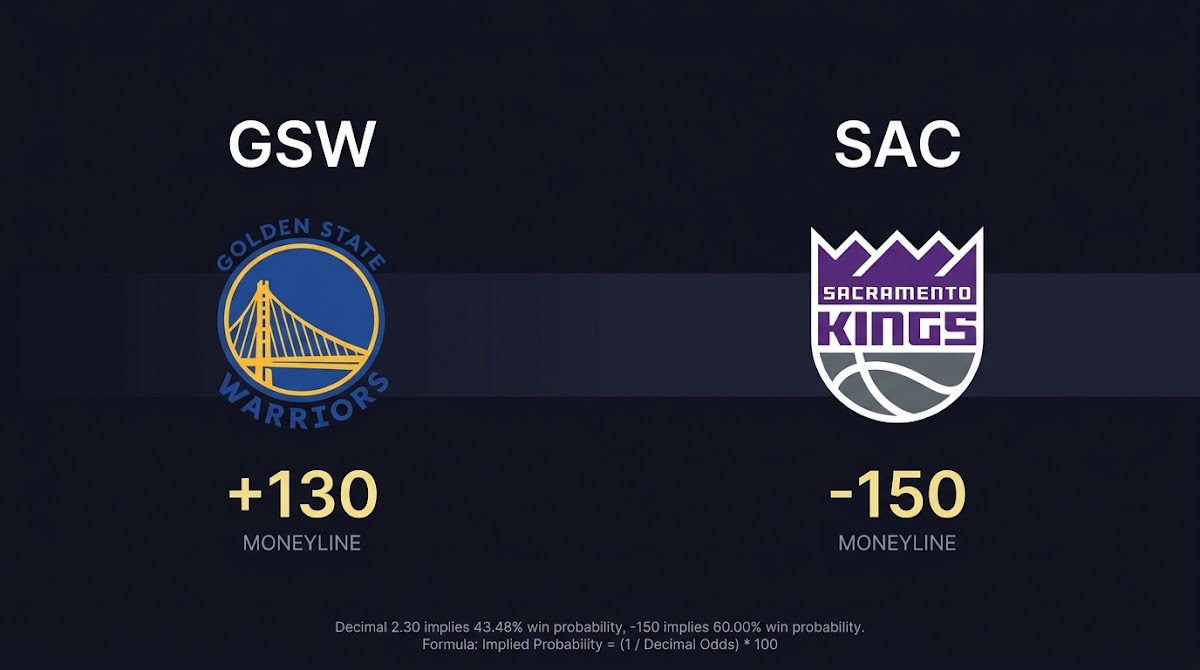
Quick answer: which side the market favors today
Short headline verdict (warriors odds)
If you want a fast verdict, the team with the shorter, more negative moneyline is the market favorite in U.S. betting markets; that convention makes it simple to read which side bookmakers expect to win.
Keep in mind raw moneylines include the bookmaker margin, and last-minute news can change lines quickly, so a snapshot price may not represent a fair, vig-free probability without adjustment.

Where to check availability and stability before acting: the NBA publishes an official daily injury report and that report is the authoritative source for player availability in the hours before tipoff.
What this answer depends on
The short answer depends on three practical steps: reading the quoted American odds to see which side is shorter, converting those odds to implied probabilities, and removing the bookmaker margin to compare to any model or edge you may have.
How to read an NBA moneyline and convert it to implied probability
American odds to implied probability: the formulas
American moneylines use a signed format where negative values indicate the amount you would need to risk to win 100, and positive values indicate how much you win on a 100 stake; converting either sign into an implied probability is a straightforward formula readers can apply. For negative odds the probability is calculated by dividing the absolute value of the odds by the absolute value plus 100, and for positive odds you divide 100 by the odds plus 100. For a stepwise explanation of those conversions, see a betting resources guide that covers both formulas and worked examples.
Try a structured challenge to test your moneyline workflow
Before you go further, check the current moneyline and do a quick conversion to implied probability so the rest of the article maps to a concrete line you care about.
Those two formula forms let you translate a quoted moneyline into a market implied probability you can compare directly against a model or another book's price, helping to identify which side is favored on a consistent basis.
To confirm the calculation method and see example steps, consult a reputable odds conversion resource that explains American odds to implied probability conversion.
Reading favorites vs underdogs and what the sign means
In practice, when you see a negative sign next to a team on the moneyline it tells you the market expects that team to win more often than not, while a positive moneyline marks the underdog; translating to probability makes the comparison numeric and repeatable.
Using the conversion steps above removes ambiguity between different formats and creates a single probability measure you can use alongside matchup context and any model you maintain.

Removing the bookmaker margin: how to get vig-free probabilities
Why the vig matters
Bookmakers build a margin into quoted prices so the implied probabilities on both sides usually sum to more than 100 percent, a situation called overround that means raw implied probabilities are not fair; removing that margin is essential for any fair comparison with a model's probability estimate.
To convert quoted implied probabilities into vig-free probabilities the standard normalization approach rescales each side's implied probability by dividing each by the sum of the sides' implied probabilities, producing a set that sums to 100 percent and represents the market's fair odds absent margin.
quick reminder to normalize implied probabilities into vig-free shares
Use the sum of both implied probabilities as the denominator
This normalization method is widely explained in betting theory resources and is the practical step that converts a quoted market price into a fair-market probability you can compare to your own estimate.
Normalization method and practical considerations
After normalization remember that books adjust lines for liquidity, liability, and hedging considerations, so vig-free probabilities are a useful baseline but not a perfect substitute for observing broader market moves across multiple books.
For readers building a repeatable workflow, normalization is the mechanical step that separates a snapshot market quote from the underlying implied chance the market assigns to either team winning.
Accounting for injuries and late news before you decide
Using the NBA official injury report
The NBA publishes an official daily injury report that lists player status updates and is the primary source to confirm whether a starter or rotation player is listed as available, questionable, probable, or out; checking that report should be part of any last-minute assessment.
Line moves near tipoff often react to official status updates and credible reporter confirmations, so if a key player shifts from probable to out you can expect the moneyline to move and the market favorite designation to potentially flip.
The team with the shorter, more negative moneyline is the market favorite, but you should convert odds to implied probability, normalize to remove the bookmaker margin, and check injury and rating context before acting.
When a late availability change appears, the market will often price in the impact quickly; that is why confirming the NBA injury report and watching initial line movement should be routine for anyone making a moneyline decision.
How line moves reflect availability and market reactions
Sharp early moves can indicate professional risk adjustments or informed market activity; slower, gradual changes may reflect recreational betting patterns. Either way, treat rapid moves around injury news as a signal to re-run your conversion and normalization steps before sizing any stake.
Before locking a decision, check the official injury update and re-calc vig-free probabilities so the final comparison reflects the actual expected line at the moment you act.
Team performance context: SRS, offensive and defensive ratings
What SRS and ORtg/DRtg tell you
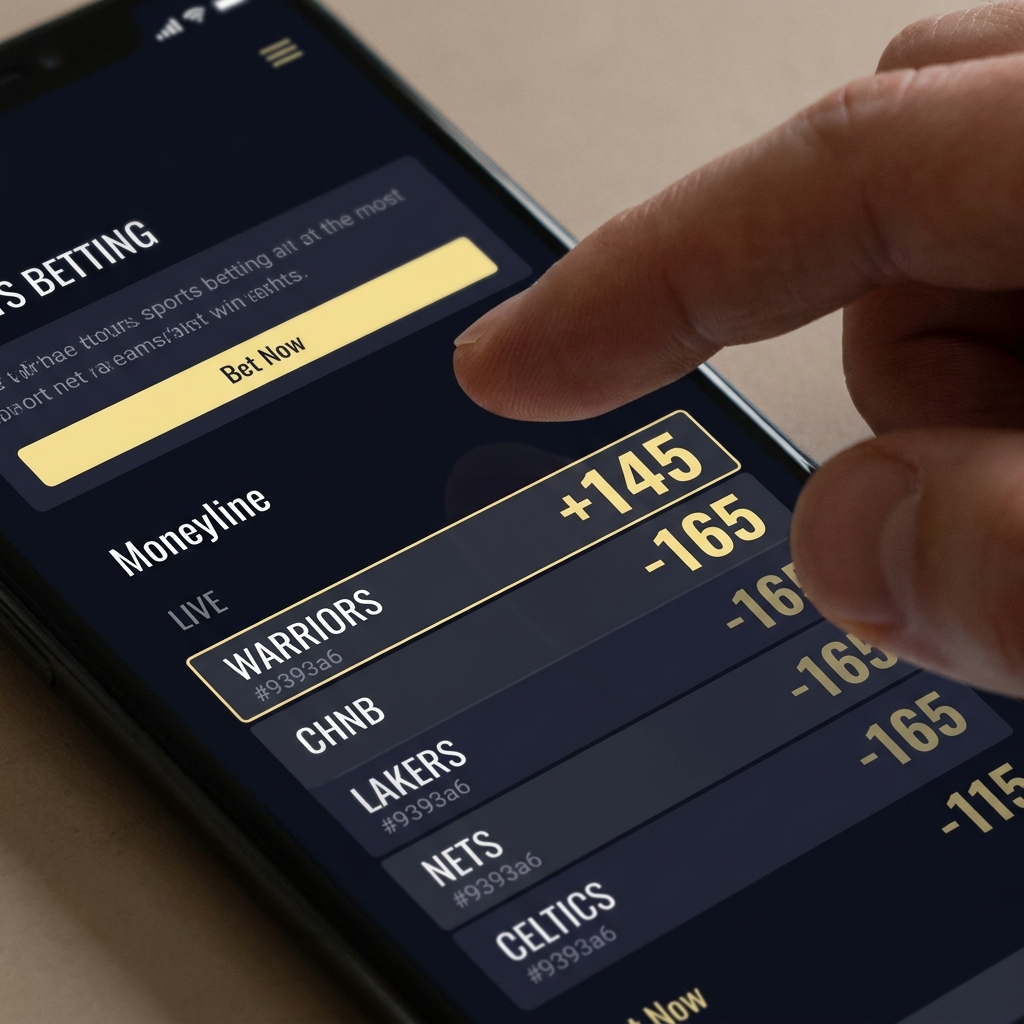
Team-level metrics such as Simple Rating System and offensive and defensive ratings summarize recent season form into compact numbers that capture relative strength and scoring efficiency, which helps when a moneyline seems inconsistent with on-court performance trends.
Using those season-level indicators alongside market probabilities gives you context about whether a short moneyline aligns with the teams' demonstrated strengths or could be an opportunity if your model sees a different picture.
How matchup-level metrics complement the market
Ratings help detect matchup advantages like a weak opponent defense or a team with unusually high offensive efficiency; they do not replace market probabilities but they provide a sensible input to adjust your model estimate before you compare it to a vig-free price.
Consulting team rating summaries for the most recent full season can quickly flag when a moneyline looks inconsistent with season-level trends and is a practical screen before deeper game-level analysis.
Sizing stakes responsibly: using a Kelly-style framework
Estimating a realistic edge
The Kelly criterion connects your assessed edge and the available price to a theoretically optimal stake fraction, but the calculation requires a realistic estimate of your edge and an honest account of uncertainty; without sensible inputs Kelly can recommend stakes that are too aggressive for practical use.
For pragmatic bettors and simulation participants who prefer safety, fractional Kelly is commonly used to scale the full Kelly recommendation down to reflect model misspecification and personal risk tolerance.
Fractional Kelly and risk management
Before sizing any stake, stress-test your edge estimate against plausible error and consider using a conservative fraction of Kelly or fixed-percentage bankroll rules; disciplined sizing keeps the emphasis on long-term skill over trying to win one outcome.
For readers who want the formal definition and worked examples of the Kelly approach, a financial resources overview explains the formula and its practical caveats.
Decision checklist: when to favor Warriors or favor Kings on the moneyline
Start by converting the posted moneyline into implied probabilities and then normalize to remove the vig so you have vig-free probabilities to compare with your model estimate or view.
Next confirm player availability on the NBA injury report and factor in any matchup-level signals from SRS or offensive and defensive ratings; only after these steps combine the gap between your estimated probability and the vig-free market probability to identify value.
Use a threshold for a minimum edge before acting, decide a stake using fractional Kelly or a bankroll rule you can follow consistently, and avoid increasing stake size solely because of recency or emotion.
Before you press submit, re-check the latest official updates and the live price to ensure you are staking on the intended vig-free probability at the size you planned.
Common mistakes to avoid when using warriors odds for a pick
What bettors commonly misread
A frequent error is treating raw moneylines as fair prices without removing the vig; doing so overestimates your true edge because the bookmaker margin inflates implied probabilities.
Another common mistake is reacting to a single line move without checking whether the move reflects reliable new information or temporary market imbalance; high-quality decisions come from disciplined process, not from chasing short-term swings.
How to avoid confirmation bias
To limit confirmation bias, lock in a clear process for converting odds, normalizing to vig-free probabilities, checking injury status, applying ratings context, and then sizing stakes with a pre-specified method; follow the process even when the outcome feels urgent.
Keeping a trading or prediction log that records your inputs and why you acted is a practical habit that helps identify recurring errors and improves calibration over time.
Practical scenarios: applying the process without guessing
Scenario A: late injury to a key player
Imagine a scenario where a starter is listed doubtful in the morning and then moved to out shortly before tipoff; the correct workflow is to re-calc the implied probabilities from the live moneyline, normalize to vig-free probabilities, and then re-assess matchup ratings and expected lineup impact before sizing a stake.
Late injury news often produces sharp line moves; treat those moves as prompts to re-run your conversion and normalization so that the decision you take uses the actual market probability after the information has been absorbed.
Scenario B: small model edge and how to size it
If your model shows a modest edge over the vig-free market probability, a conservative approach is to use fractional Kelly or a small fixed percentage of bankroll so you can test the edge over many events without risking outsized variance.
Document your stake-sizing choice, remain consistent with your fraction of Kelly or bankroll rule, and resist increasing risk because you expect a short-term run of wins; consistent execution matters more than chasing single results.
Conclusion: using market prices and metrics responsibly
Key takeaways
The market favorite in a Warriors vs Kings matchup is the team with the shorter moneyline, but fair comparison requires removing the bookmaker margin and adding context from injury reports and team ratings before deciding.
Next steps for disciplined practice
Build a simple workflow that converts odds to implied probabilities, normalizes to vig-free shares, checks official injury updates, and sizes stakes with a conservative Kelly fraction; practice that sequence in simulated challenges to improve calibration without risking real capital.

In U.S. markets the favorite is the team with the shorter, more negative moneyline; converting that number to implied probability confirms how the market views the matchup.
Vig-free probability rescales raw implied probabilities to remove the bookmaker margin so you can compare market chances fairly against a model estimate.
Full Kelly can be aggressive if your edge estimate is uncertain; many practitioners use fractional Kelly or fixed bankroll percentages for safety.
References
- https://therundown.io/betting-calculators/implied-probability-calculator
- https://unabated.com/betting-calculators/no-vig-fair-odds-calculator
- https://oddsjam.com/betting-calculators/no-vig-fair-odds
- https://www.fundedplays.com/blogs
- https://www.fundedplays.com/blogs/how-fundedplays-evaluations-work
- https://www.fundedplays.com
- https://www.fundedplays.com/challenges