
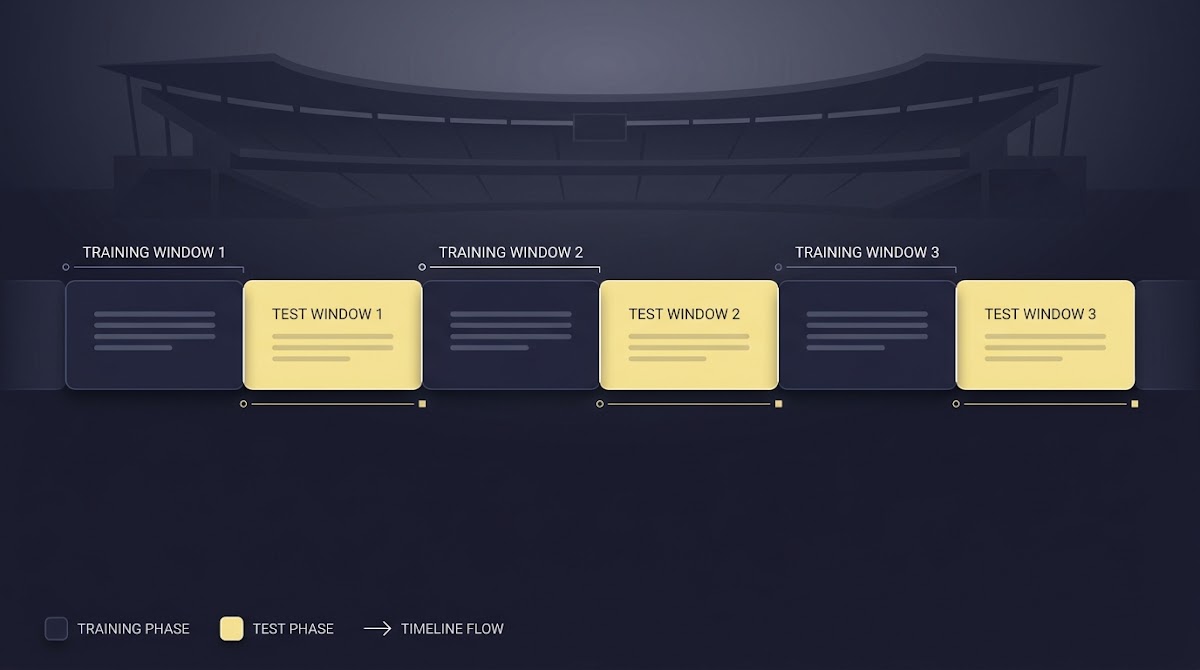
Walk-Forward Testing for Sports Strategies: What it is and why it matters
Definition and high-level motivation
Walk-forward testing, also known as rolling-origin evaluation, trains models on historical data and evaluates them on strictly later periods to reflect how a model would behave in real deployment. This chronological approach reduces the mismatch between test conditions and live use that shuffled validation creates, because it enforces a strict time ordering between training and test sets Time series cross-validation.
In practice, walk-forward testing runs multiple sequential folds where each test fold is strictly after all training data. Aggregating results across those folds provides a view of stability over time rather than a single-period snapshot, which matters for sports where schedules, player availability, and team form change from week to week. See an industry deep dive on walk-forward analysis from Interactive Brokers.
How walk-forward differs from random cross-validation
Random or shuffled cross-validation mixes observations from different dates into both training and test splits, which can leak future information into training when features or targets are time dependent. For time-series and sports forecasting, this leakage produces overoptimistic performance estimates and poor live results if the model has implicitly learned patterns that only appear when chronology is violated Data leakage.
Walk-forward testing enforces temporal ordering and so better mimics deployment, but it does not guarantee future success. It raises confidence by testing stability across multiple future periods, yet any reported performance still depends on the model, the data, and correct implementation.
Core split schemes: expanding-window and rolling-window explained
Expanding-window: mechanics and implications
In an expanding-window scheme the training set grows with each fold: you start with an initial training block, test on the following period, then add that test block to the training set before the next evaluation. This approach preserves all prior data when fitting successive models, which can improve learning when more history helps the model generalize.
Expanding windows tend to increase sample size over folds and reduce variance in parameter estimates, but they can also make the model slow to adapt if the data contains sharp regime changes. Tooling that supports time-aware splitting often includes expanding-window behavior as an option, which helps standardize implementations scikit-learn TimeSeriesSplit documentation.
Rolling-window: mechanics and implications
Rolling-window splits keep the training window size fixed and slide it forward in time; each fold uses the most recent slice of history for training and tests on the immediately following period. This makes the model focus on recent patterns and can be preferable when older data becomes less relevant because of rule changes, roster turnover, or other structural shifts in a sport.
Rolling windows trade off historical breadth for recency and can be more sensitive to short-term regime shifts. They can also reduce training time per fold compared with expanding windows because the dataset size per fit remains constant, which matters when you run many folds or expensive models Automated ML for time-series forecasting in Azure Machine Learning.
Choose expanding windows when accumulating more seasons or matches steadily improves the signal to noise ratio, for example in long-running league statistics where past performance remains informative. Prefer rolling windows when you expect fast drift in the underlying process, such as an in-season model reacting to injuries, coaching changes, or rule updates.
Both schemes are supported by mainstream libraries and cloud AutoML tooling; a practical choice often depends on the sport, the available history, and how quickly the target behavior shifts. See the blog for related discussions.
quick reference for choosing between expanding and rolling split schemes
Check library docs for API specifics
Implementing walk-forward testing step-by-step for sports models
Preparing timeline-aware datasets
Start by creating a clear time index that orders every observation, for example match date and kick-off time, and store it as a primary column in your dataset. Consistent, timezone-aware timestamps and a single canonical ordering remove ambiguity about what counts as past versus future for each fold.
When features derive from past events, apply a strict feature cutoff that ensures only data available before the test window is used. Construct and store those cutoffs explicitly so you can reproduce the exact train and test content for audits and challenge rules Data leakage.
Constructing folds and fold boundaries
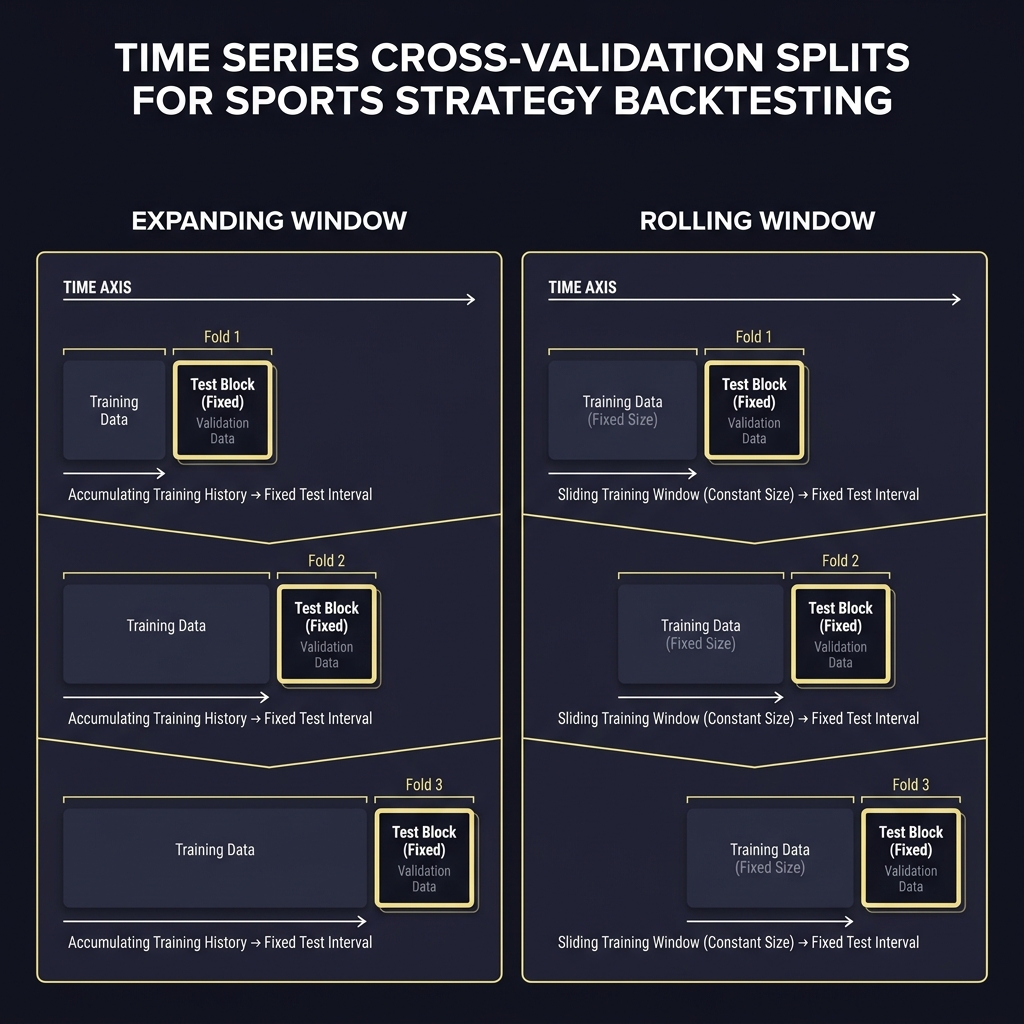
Decide on the initial training window and the length of each test window adapted to the sport lifecycle. For example, weekly test windows suit sports with regular matchdays, while monthly windows may fit less frequent competitions. Use multiple sequential folds rather than a single holdout to measure stability across time.
Log fold boundaries, the exact rows included in each split, and any resampling or holdback procedures. This logging supports reproducibility and makes it possible to audit whether a given result relied on inappropriate information.
High-level code and tooling pointers
Use a time-aware splitter from your ML library when available, and prefer tools that explicitly document purging or embargo functionality. Libraries like scikit-learn provide TimeSeriesSplit utilities and cloud providers document backtesting workflows, which you can adapt to your dataset and cadence scikit-learn TimeSeriesSplit documentation. See a practical comparison at Surmount.ai.
Keep experiments deterministic by fixing seeds where relevant, version-controlling dataset snapshots, and archiving the split definitions so challenge submissions can include the same evaluation protocol used during development.
Choosing evaluation metrics and aggregating results across windows
Common metrics for point and probabilistic forecasts
Select metrics that match your prediction target: mean absolute error (MAE) and root mean squared error (RMSE) are common for point forecasts, while mean absolute percentage error (MAPE) can be informative when scale varies across time. For probabilistic outputs, use proper scoring rules appropriate to the forecast type.
When reporting results for a challenge or internal review, document why a particular metric matters for the decision that follows, because different metrics emphasize different error behavior and can change model rankings.
How to aggregate metrics across folds
Aggregate fold-wise metrics using central tendency and dispersion measures: report the mean or median across folds plus a measure of spread such as standard deviation or interquartile range. This highlights both central performance and stability over time, which is essential in sports contexts where one strong test period can mask inconsistent behavior.
Prefer stability across folds to a single outstanding period. A model that performs consistently across many sequential windows usually generalizes better than one that excels in only one historical slice Backtesting forecasts.
Interpreting aggregated results
Look at fold-wise variance as a primary diagnostic: high variance suggests sensitivity to the test period and possible overfitting or regime shifts, while low variance with acceptable central error suggests robustness. Pair metric aggregates with diagnostic plots that show fold-by-fold values to make instability visible.
Look beyond average performance and emphasize the frequency and magnitude of underperformance, since a challenger or operational review will often penalize inconsistent behavior more than slightly lower median error.
If your evaluation combines probabilistic and point forecasts, use matching aggregation approaches and explain how each aggregated metric informs the decision to deploy, retrain, or refine features.
Get the fold-aggregation checklist from FundedPlays Challenges
Download or print a compact fold-aggregation checklist to standardize reporting and ensure reproducible summaries across teams and submissions.
Avoiding data leakage and look-ahead bias in sports backtests
Where leakage commonly occurs in sports features
Leakage appears when features unintentionally include information from after the prediction time, such as aggregated season stats that incorporate later matches or manually backfilled attributes that sourced post-match reports. These mistakes artificially inflate test performance because the model sees signals it could not have known in real time Data leakage.
Other common sources are derived statistics that use future outcomes to compute denominators or rolling averages that are improperly aligned with the test cutoff. Treat any derived feature as suspect until you confirm its construction only used prior data.
Concrete techniques to prevent leakage
Implement strict time-based feature cutoffs and compute features on a per-fold basis so that each fold's training features are generated only from permitted data. Use backfilling rules carefully and avoid global statistics computed across the entire dataset unless they are truly static and known ahead of time.
Automate checks that verify temporal ordering at multiple points in the pipeline, and enforce a discipline where feature engineering scripts accept a cutoff date parameter to produce a fold-safe feature set.
Audit steps to verify no-lookahead
Run simple audits such as comparing feature distributions between early and late folds, verifying that the most predictive features are not dominated by near-future indicators, and testing that a model trained on permuted labels does not show suspiciously high performance. Keep an audit log of these checks to support challenge submissions or peer review.
Hyperparameter tuning and time-aware validation strategies
Why standard shuffled CV misleads for time series
Shuffled cross-validation breaks temporal order and can leak information across folds during hyperparameter tuning, making parameters seem better than they will be in deployment. Time-aware validation preserves chronology during search and yields hyperparameters that generalize to strictly later data.
When tuning, avoid using random folds that mix dates. Instead, use validation that respects the temporal splits you will use for final evaluation so tuning does not exploit future information.
Nested and purged validation approaches
Nested or purged validation schemes reduce overfitting by isolating tuning folds from evaluation folds and applying embargo windows when needed to prevent leakage from closely adjacent timestamps. The financial machine learning literature describes purged and embargoed CV strategies as techniques to protect against subtle look-ahead contamination during search Advances in Financial Machine Learning.
Apply an embargo or purge around fold boundaries when features could leak short-term signals into adjacent folds, and favor nested setups where an inner time-aware CV tunes parameters and an outer walk-forward evaluates final performance.

Practical tuning workflow for sports models
Limit the search budget and constrain lookback windows during tuning to reduce the chance of overfitting. Use simpler models as baselines, then expand complexity only when time-aware validation supports the gains. Record the chosen validation protocol and hyperparameter ranges so reviewers can reproduce the tuning process.
Interpreting walk-forward results: stability, variance, and regime shifts
Signals of robustness versus overfitting
Consistent out-of-sample performance across many sequential folds signals robustness, while wide variance or occasional large gains followed by poor results indicate overfitting or that the model only exploits ephemeral patterns. Visualize fold-wise metrics and track dispersion measures to make these patterns clear Time series cross-validation. See the walk forward optimization article for an overview.
Look beyond average performance and emphasize the frequency and magnitude of underperformance, since a challenger or operational review will often penalize inconsistent behavior more than slightly lower median error.
Diagnosing regime shifts and structural breaks
When fold-wise performance changes abruptly, consider change-point detection and drift tests to see if the underlying process has shifted. Structural break diagnostics help determine whether retraining with more recent data or a different feature set is required.
Combine statistical change detection with contextual knowledge of the sport, such as rule changes, transfer windows, or schedule disruptions, when interpreting why a shift occurred.
Reporting results for challenge submission or deployment
Document the split scheme, fold boundaries, metric definitions, and any purging or embargo rules used. Clear documentation and reproducible code reduce disputes in challenge settings and help teammates trust the evaluation (see how Funded Plays evaluations work).
Practical deployment: retraining schedules and operational workflow for sports strategies
Choosing a retrain cadence
Pick a retraining cadence that aligns with the sport calendar and the speed of data drift: after each matchday for fast-moving in-season models, or weekly to monthly for slower seasonal effects. The cadence should balance freshness of the model against the operational cost of retraining and validating new versions Backtesting forecasts.
Decide whether your production policy is expanding or rolling retrain. Expanding retrains incorporate all past data into new fits, while rolling retrains keep a fixed recent window. Each policy has trade-offs in stability and responsiveness to recent changes.
Use walk-forward testing that trains on past data and evaluates on strictly future windows, prevent data leakage through strict cutoffs, aggregate metrics across sequential folds, and monitor live performance to trigger retraining.
Operational checklist for production backtests
Before promoting a model, run the full walk-forward evaluation, confirm there is no leakage, validate metrics across folds, and archive the exact training data and code used. Include monitoring hooks so you can compare live performance to the historical fold distribution.
Automate deployment gates that prevent promotion if recent fold performance falls outside pre-agreed thresholds, and ensure deployment playbooks include rollback steps and reproducible retrain pipelines.
Monitoring and alerts
Monitor live performance against the aggregated fold baselines and set alerts for sustained drift or sudden metric deterioration. Use both statistical detectors and domain checks such as abnormal feature distributions to catch issues early.
Define retrain triggers that combine drift signals, scheduled cadence, and business constraints so retraining happens for data-driven reasons and not only on calendar timers.
Common mistakes and pitfalls in sports walk-forward testing
Overreliance on a single holdout
Relying on one holdout period can mask instability. Use multiple sequential folds to measure variance and avoid making decisions based on a lucky or unlucky test window Time series cross-validation.
Hidden leakage and feature mistakes
Hidden leakage often lives in derived features, backfilled records, and externally merged data where time alignment was overlooked. Treat every new feature as a potential leakage vector and validate its temporal properties across folds Data leakage.
Misinterpreting fold variance
High variance across folds is not proof of failure but a signal to investigate: check for regime shifts, label instability, or structural sources of variance before throwing out a model. Report variance alongside central metrics so consumers understand the uncertainty in the evaluation.
Use a short checklist to validate your walk-forward pipeline before trusting results: multiple folds, explicit cutoffs, ledgered splits, aggregated metrics, and leakage audits.
Examples and scenarios: case outlines and checklist for a sports prediction backtest
In-season football model: weekly retrain example
Scenario: a model predicts match outcomes for a domestic league with weekly fixtures. Set weekly test windows aligned to matchdays, choose a rolling or short expanding training window to include recent form, and run enough sequential folds to cover multiple weeks across the season.
Document the exact cutoff used for player availability and injury reports so no post-match information leaks into the features that feed each fold.
Seasonal league model: expanding-window example
Scenario: a seasonal ranking model for a league where historical seasons provide stable signals. Use expanding-window folds that add completed seasons to the training set and test on the next season, which helps capture long-term trends while still measuring out-of-sample stability.
Maintain clear notes about roster turnover, rule changes, and any season boundaries that affected how features were computed from year to year.
Checklist to run before submitting results to a challenge
Compact pre-submission checklist: confirm time index integrity, show fold boundaries, list metrics and aggregation method, run leakage audits, archive split definitions, and include reproducible scripts for feature generation and evaluation. That documentation makes it straightforward for reviewers to rerun your walk-forward protocol and trust the results (see Funded Plays) Backtesting forecasts.
Conclusion and next steps: adopting walk-forward testing responsibly
Summary of key takeaways
Walk-forward testing suits sports strategies because it preserves chronology, reduces look-ahead bias, and measures stability across multiple future folds. Preventing leakage and choosing the right split scheme are core safeguards you must apply to make the evaluation meaningful Time series cross-validation.
Next steps for practice and monitoring
Start by selecting either an expanding or rolling split informed by your sport and available history, design a fold plan, run leakage audits, and adopt monitoring that triggers retraining when drift appears. Keep documentation and reproducible code so results are transparent for challenge rules and internal review.
Walk-forward testing trains on past data and evaluates on strictly later periods to mirror deployment, which reduces misleading results from shuffled validation.
Use strict time-based feature cutoffs, compute features per fold with a cutoff date, and run automated audits comparing distributions across folds.
Run multiple sequential folds that reflect the sport cadence; prefer more folds for stability but ensure each test window is large enough to be meaningful.
References
- https://otexts.com/fpp3/tscv.html
- https://developers.google.com/machine-learning/data-prep/construct/leakage
- https://scikit-learn.org/stable/modules/generated/sklearn.model_selection.TimeSeriesSplit.html
- https://learn.microsoft.com/en-us/azure/machine-learning/how-to-auto-train-forecast?view=azureml-api-2
- https://docs.aws.amazon.com/forecast/latest/dg/backtesting.html
- https://www.elsevier.com/books/advances-in-financial-machine-learning/lopez-de-prado/9780128102117
- https://www.fundedplays.com/challenges
- https://www.fundedplays.com
- https://www.fundedplays.com/blogs
- https://www.fundedplays.com/blogs/how-fundedplays-evaluations-work
- https://www.interactivebrokers.com/campus/ibkr-quant-news/the-future-of-backtesting-a-deep-dive-into-walk-forward-analysis/
- https://surmount.ai/walk-forward-analysis-vs-backtesting-pros-cons-best-practices
- https://en.wikipedia.org/wiki/Walk_forward_optimization