

Wager versus payout: a concise overview
The term wager calculator appears in many user tools because it clarifies the simple relationship between stake, payout, and profit: a stake is the amount risked on an outcome, total payout equals stake plus profit, and net profit equals payout minus stake. This definition and the phrasing used by regulators help keep consumer-facing tools consistent and transparent for users who want an immediate sense of return on a prediction Massachusetts Gaming Commission sports wagering 101
For practical clarity, many calculators label the user input as "stake" or "wager" to indicate the money placed at risk. Returning the stake plus any earned profit as "total payout" avoids confusion with net profit, which is the increment over the original stake; this naming convention is common on educational resources covering implied returns and payout math Investopedia implied probability
quick decimal payout check
Use for single-leg decimal odds
How a wager calculator works: core formulas
The easiest way to trust a wager calculator is to check the formulas it uses; when the calculator accepts a stake and decimal odds, it should compute total payout as stake times the decimal price and net profit as stake times decimal minus one. That straightforward calculation is the standard industry approach for decimal odds and is the foundation of most payout calculators Investopedia decimal odds
To support fractional and moneyline inputs the calculator maps those formats to the same outputs: fractional A/B yields profit equal to stake times A divided by B and return equal to stake plus that profit, while moneyline odds convert through signed formulas to implied probability and to payout ratios that feed the same stake times multiplier logic used for decimal odds Investopedia fractional odds
Odds formats and implied probability
Understanding implied probability is key when a wager calculator reports the chance behind a price; for decimal odds the implied probability is 1 divided by the decimal value, a direct inversion that shows how price maps to chance Investopedia decimal odds
Try the FundedPlays challenge math with your calculator
Try the worked examples below to confirm the math and see how payout, profit and implied probability relate across formats.
Fractional odds A/B show the profit for each B staked, with implied probability equal to B divided by A plus B, which explains why fractional notation emphasizes the incremental profit rather than full return Investopedia fractional odds
Building the calculator: required inputs and outputs
A reliable wager calculator needs a minimal set of inputs: stake amount, odds format selection, and the odds value itself; optional inputs can include currency, multiple legs, or stake type such as risk or return. Clear input labels prevent the frequent mistakes between entering a stake versus the desired return Investopedia implied probability
Outputs should be explicit and measured: total payout reported in currency, net profit as currency, and implied probability as a percentage. Validation checks for numeric ranges, correct moneyline signs, and format parsing are simple but essential to avoid incorrect outputs Investopedia moneyline

Accounting for house margin and overround
Bookmakers embed a margin in posted prices; overround is computed by summing the implied probabilities of all mutually exclusive outcomes and subtracting 100 percent, which quantifies the built-in edge in a market Smarkets help on overround
A calculator can optionally display the overround value and a simple adjustment to show implied "fair" odds after removing the margin, helping users see how posted prices differ from neutral expectations; showing both numbers sets realistic expectations for decision making Investopedia implied probability

Using the calculator for bankroll and risk checks
A wager calculator is useful beyond one-off checks because its outputs feed into stake-sizing rules: net profit and implied probability together let a user estimate expected value when combining their own probability assessment with posted odds. Treat these outputs as inputs to disciplined staking rather than guarantees of outcome Investopedia implied probability
For participants in structured prediction programs, including skill-first challenge platforms, calculator results are practical tools to evaluate risk per play, measure variance over runs, and plan a consistent staking approach without relying on promises of returns Massachusetts Gaming Commission sports wagering 101
Common calculation mistakes and pitfalls
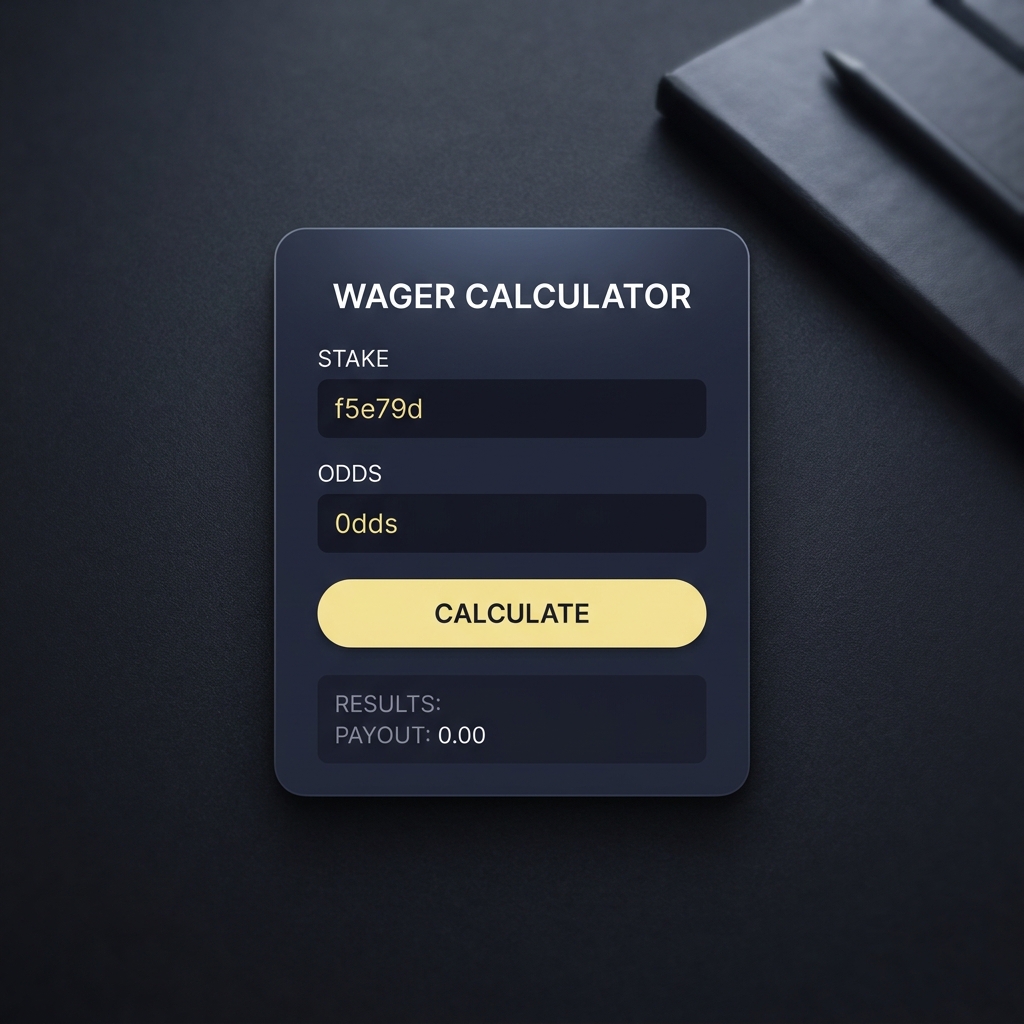
Many errors stem from parsing inputs: omitting the plus sign for a positive moneyline, misreading fractional notation, or entering a desired return in the stake field. Simple input validation and clear labels stop most user errors before calculation Investopedia moneyline
On the implementation side, avoid rounding too early, always handle pushes or voided legs explicitly, and make the handling of ties transparent. Also display overround when relevant so users do not read implied probability as an exact expected frequency Smarkets help on overround
Step-by-step examples: decimal, fractional and moneyline calculations
Decimal example: stake 10 at decimal 2.5 gives total payout 10 times 2.5 equals 25, so net profit is 25 minus 10 equals 15; implied probability is 1 divided by 2.5 equals 0.4 or 40 percent. That arithmetic is the basis of most bet payout calculators and matches standard decimal formulas Investopedia decimal odds
Fractional example: fractional 3/2 with a 10 stake yields profit 10 times 3 divided by 2 equals 15, return equals 10 plus 15 equals 25, and implied probability equals 2 divided by 3 plus 2 equals 40 percent; this aligns the fractional presentation to the same numeric outcomes as the decimal example when converted Investopedia fractional odds
Moneyline example: positive moneyline +150 with a 10 stake returns profit equal to 10 times 150 divided by 100 equals 15 and total payout equals 25; implied probability for +150 is 100 divided by 150 plus 100 equals 40 percent. For negative moneyline such as -150 the conversion uses the absolute value in the alternate formula to produce the same implied probability mapping Investopedia moneyline
Corner cases: pushes, split stakes and vig adjustments
When a leg is a push, standard convention is to return the stake for that leg and adjust the multi-leg payout accordingly; calculators should explicitly state whether pushes return stake only or reweight combined payouts. Clear rules prevent surprise differences between expected and actual returns Investopedia implied probability
A wager calculator applies standard formulas: decimal payout equals stake times decimal; fractional odds convert via A divided by B to profit and return; moneyline odds convert to implied probability using signed formulas, and all outputs can be presented as payout, net profit and implied probability.
For split stakes, where the same total risk is divided across outcomes, the calculator must compute each leg according to its own odds and then aggregate returns; this differs from betting identical total risk per leg and requires unambiguous input for how the user split the stake Investopedia decimal odds

How to test and validate a wager calculator
Unit tests should cover decimal payout, fractional parsing, moneyline sign cases, pushes, overround calculation, and multi-leg combinations. Writing representative tests that assert both numeric outputs and formatted strings helps catch parsing and rounding regressions early Investopedia implied probability
Cross-checking calculator outputs against authoritative examples from consumer education pages or manual calculations for common prices is a pragmatic validation step. Include tests for rounding behavior and for consistency between equivalent inputs in different formats, for example a fractional and the matching decimal price Investopedia fractional odds
Practical use cases: from casual checks to handicapping workflows
Casual users often need a quick bet payout calculator to confirm how much they get back from a small stake before placing a prediction; calculators let them compare simple returns and implied chances without building a model. Quick checks reduce entry errors for single predictions and make it easier to compare options on challenge platforms Massachusetts Gaming Commission sports wagering 101
Advanced users and handicappers feed implied probability into expected value calculations and model pipelines, using calculator outputs as a standard numeric interface between human assessments and automated staking rules. These outputs are inputs to disciplined processes rather than signals that guarantee results Investopedia implied probability
Compliance, consumer education and trusted references
Regulatory consumer pages provide stable definitions for stake, payout and implied probability and are useful primary resources to link from educational tools. Linking to impartial, authoritative explanations helps users verify formulas and understand how a calculator reached its numbers Massachusetts Gaming Commission sports wagering 101
Authoritative third-party explainers of odds formats and implied probability are helpful cross-checks; many educational sites describe the same formulas used here and are appropriate references when a calculator shows how inputs map to outputs Investopedia implied probability
Checklist: what to verify before trusting calculator outputs
Quick pre-use checks include verifying odds format parsing, confirming moneyline sign handling, and making sure the input is stake rather than desired return; a concise checklist prevents common misinterpretations and keeps results consistent Investopedia moneyline
Developer checks should include unit tests for formula correctness, push handling, rounding rules, and a review that overround is either shown or documented when relevant. A visible source note for the formulas reassures users that outputs follow standard definitions Smarkets help on overround
Summary and next steps
Core formulas for a wager calculator are consistent across formats: decimal payout equals stake times decimal, fractional odds convert to the same totals via A divided by B, and moneyline uses signed conversions to implied probability and payout ratios. Presenting these outputs together helps users move from single checks to disciplined staking approaches Investopedia implied probability
Next steps are practical: try the worked examples, validate outputs against manual calculations, and consult regulator and educational pages for definitions if anything seems unclear. Treat calculators as educational tools that aid decision making without promising outcomes Massachusetts Gaming Commission sports wagering 101
A wager calculator typically returns total payout, net profit, and the implied probability of the odds based on the chosen format.
Positive moneyline P = 100 divided by X plus 100 for +X; negative moneyline P = |X| divided by |X| plus 100 for -X.
Some calculators display overround and optionally show adjusted 'fair' odds, but not all tools remove the margin by default.
References
- https://massgaming.com/sports-wagering/sports-wagering-101/
- https://www.investopedia.com/terms/i/implied-probability.asp
- https://www.fundedplays.com/blogs/how-fundedplays-evaluations-work
- https://www.investopedia.com/terms/d/decimal-odds.asp
- https://www.aceodds.com/bet-calculator/odds-converter.html
- https://www.investopedia.com/terms/f/fractional-odds.asp
- https://help.smarkets.com/hc/en-gb/articles/115003781145-Understanding-overround
- https://www.investopedia.com/terms/m/moneyline.asp
- https://www.fundedplays.com/challenges
- https://www.actionnetwork.com/betting-calculators/betting-odds-calculator
- https://oddsjam.com/betting-calculators/odds-converter
- https://www.fundedplays.com
- https://www.fundedplays.com/blogs