

vikings super bowl odds explained: definition and quick context
Futures odds are the market prices that express a team’s long-term chance to win the Super Bowl, quoted in sportsbook formats rather than a single-game line. These prices can be converted into an implied probability to create a common-sense benchmark for model building and comparison; that conversion process is the same fundamental idea described in the implied probability guide for bettors and analysts Investopedia implied probability.
In late 2025 legal U.S. sportsbook markets generally treated the Minnesota Vikings as outside the top contender tier, which is why many observers labeled the team a long shot entering the 2026 window. That market signal is one starting input for any honest assessment of the team’s Super Bowl chances Super Bowl Odds: Futures to win Super Bowl 60.
convert common futures formats into a simple implied probability number
Use Decimal Odds when available
Markets bundle bookmaker margin into prices, so a single implied number is a useful comparand but not a perfect read of true underlying probability. Use the implied-probability conversion as a transparent checkpoint for your own model rather than a definitive forecast.
Short answer: Are the vikings super bowl odds realistic right now?
Short answer: yes and no, depending on your timeframe. Markets priced Minnesota as a long shot entering 2026, which is a realistic baseline given the team’s open questions at quarterback and the long-term nature of futures prices Super Bowl Odds: Futures to win Super Bowl 60.
That market view is tempered by two roster facts that point to upside. First, Justin Jefferson’s multi-year extension provides an elite receiving centerpiece that stabilizes offensive planning and creates a clear target for a developing quarterback Vikings, Justin Jefferson agree to record multi-year extension. Second, Minnesota drafted J.J. McCarthy with the 10th overall pick in 2024, making his Year 2-3 growth the single most important variable for whether those market prices should be materially adjusted Vikings select J.J. McCarthy with No. 10 pick in 2024 NFL Draft.
Read this verdict as conditional, not definitive: futures prices reflect current information and sentiment, and clear on-field improvements would justify upward revisions to the implied probability benchmark used by modelers and bettors.
Key roster pillars that shape vikings super bowl odds
Two roster pillars most directly shape Minnesota’s ceiling: an elite receiving weapon in Justin Jefferson and the team’s quarterback situation centered on J.J. McCarthy. Jefferson’s contract continuity through 2028 gives offensive planners an anchor, which narrows variance around play design and target share when he is available and healthy Vikings, Justin Jefferson agree to record multi-year extension.
Track milestones with FundedPlays challenge insights
Sign up for updates or follow team coverage to track measurable milestones that matter for long-term odds without relying on short-term hype.
At the same time, McCarthy’s development curve is the main wild card. As the 10th overall pick, he sits on a timeline where Year 2-3 improvement is the most likely window for the team’s true playoff ceiling to emerge Vikings select J.J. McCarthy with No. 10 pick in 2024 NFL Draft.
Framing these pillars as conditional helps avoid overstating certainty: Jefferson reduces one axis of roster risk, while McCarthy’s progression determines whether that stability translates into enough wins to make Minnesota a genuine Super Bowl threat.
How quarterback development will decide the vikings super bowl odds

Observable checkpoints include consistent improvement in intermediate accuracy, lower interception and turnover rates, and clearer pre-snap reads that shorten processing time. Those are the metrics that realistically move a long-term implied probability number enough to change market classification from long shot to plausible contender.
When you watch film or box scores, focus on repeatable tendencies rather than single-game flashes. A handful of big plays is encouraging, but sustained change across a month-long sample is what signals a durable trajectory.
Offense and weapons: why Justin Jefferson stabilizes the ceiling
Justin Jefferson’s multi-year extension through 2028 secures an elite receiving option and therefore shortens the pathway for a quarterback to convert development into wins. Having a reliable, high-usage target reduces the variables a young QB must overcome to produce efficient scoring drives Vikings, Justin Jefferson agree to record multi-year extension.
Yes, but only under clear conditions: meaningful Year 2-3 development from J.J. McCarthy, sustained elite production and health from Justin Jefferson, and consistent defensive play combined with a manageable schedule.
For McCarthy specifically, Jefferson’s presence means play designers can prioritize timing concepts and clear progressions rather than relying on the QB to create off-schedule gains on every play. That can accelerate the translation of improved accuracy and decision-making into actual wins.
That said, receiving help, offensive line health, and scheme fit remain important complementary factors. Jefferson stabilizes the ceiling but does not guarantee the team will reach it; the QB’s execution and surrounding pieces determine how much of that ceiling becomes reality.
Defensive outlook and its role in improving vikings super bowl odds
Defense matters because a strong unit can offset growing pains on offense and improve single-season win totals, which in turn raises a team’s chances in playoff-style single-elimination tournaments. In practical terms, a pass rush that consistently pressures opposing quarterbacks and a reliable back seven that limits explosive plays are two defensive elements correlated with deeper postseason runs.
Trackable defensive metrics to watch include pressure rate, yards allowed per play, and opponent third-down conversion rate. Improvements in those areas reduce variance week to week and make a team less dependent on the offense producing at an elite level every Sunday. In scenario modeling, a mid-tier offense plus a top-10 defense can outperform a top offense with a weak defense over a single season.
Schedule and strength-of-schedule: how the calendar changes vikings super bowl odds
Projected schedule difficulty is a direct input into seasonal win totals and therefore into Super Bowl probability. Sharp Football’s 2025 Strength of Schedule, which uses projected win totals to gauge calendar difficulty, is a useful baseline when constructing simple scenario models for 2026 2025 NFL Strength of Schedule.

In practice, an easier schedule can turn a marginal team into a playoff qualifier by adding one or two wins, while a heavy slate of strong opponents makes the margin for error much smaller. Modelers should update projected win totals after the official 2026 schedule release and again after major injury news.
When you build scenarios, treat the projected SOS as an adjustable prior: it helps set expectations, but actual on-field results and in-season injuries rapidly outweigh preseason projections.
How to convert vikings super bowl odds into implied probabilities (simple method)
The basic implied-probability formula is straightforward: for decimal odds, implied probability equals 1 divided by the decimal odds. That plain conversion gives a benchmark number you can compare to your own model’s forecast; Investopedia’s breakdown explains the mechanics and caveats of the method Investopedia implied probability.
For American odds, convert to decimal first, then apply the same 1/decimal formula. Remember to adjust for bookmaker margin; markets typically include an overround, so the raw implied numbers will sum to more than 100 percent across all outcomes. Treat market implied probability as a priced consensus rather than a pure, margin-free forecast.
A worked example helps: if a team’s decimal futures price is 25.0, the implied chance is 1/25.0, or 4 percent. If you believe the true probability is 6 percent based on roster and QB development, that gap is the actionable edge you would investigate further, accounting for margin and liquidity.
Modeling scenarios: three realistic paths that change vikings super bowl odds
Upside scenario. Trigger: J.J. McCarthy posts clear Year 2 gains in accuracy and decision-making while Jefferson stays healthy and influential. Under that path, market implied probability would rise as both model priors and public sentiment update to reflect a higher true chance. The combination of a stabilizing elite receiver and a developing franchise quarterback is the canonical route from long shot to contender.
Base scenario. Trigger: steady progress without breakout. The team improves modestly, contends for a wild-card spot, and markets nudge implied probability upward but keep Minnesota outside the tightest contender cluster. This scenario is consistent with many national power rankings that placed Minnesota in a middle tier entering 2025, reflecting a realistic, upward-mobile but volatile outlook NFL Power Rankings: Offseason edition (2025).
Downside scenario. Trigger: stagnation at quarterback or key injuries. If McCarthy’s development stalls or Jefferson is unavailable for a significant stretch, implied probability would fall and the market classification would harden around long-shot status. Each scenario should be tested against the same implied-probability benchmark so you can quantify how much each trigger moves the number.
Decision checklist: when to change your view on the vikings super bowl odds
Quantifiable milestones to watch include sustained improvement in advanced and basic QB metrics, such as a rising adjusted completion rate, lower turnover rate, and better third-down conversion when the offense is on the field. See those improvements across a multi-week sample before updating a long-term probability materially.
Market signals that matter include persistent movement in futures prices, not a one-week spike, and shifts in national power rankings that aggregate expert judgment over time. Both types of evidence should be sustained to justify moving your estimate rather than reacting to a single strong performance or brief injury absence Super Bowl Odds: Futures to win Super Bowl 60.
Use a checklist approach: confirm on-field metrics, check schedule and matchup context, and verify that futures movement is sustained before treating markets as new priors for your own model.
Common mistakes when reading vikings super bowl odds
Do not overreact to small samples. A two-game hot streak or a single dominant win can create noise that looks like signal. Overfitting to a short stretch leads to poor long-term updates and logical errors when comparing market prices to model forecasts Investopedia implied probability.
Do not confuse market price with true probability. Bookmakers price futures to balance action and to include margin, so the market number is a priced consensus rather than a pure measure of truth. Treat market implied probability as an input to be adjusted by carefully measured, reproducible evidence rather than as the final word Super Bowl Odds: Futures to win Super Bowl 60.
Practical walkthroughs: two scenario examples and how odds move
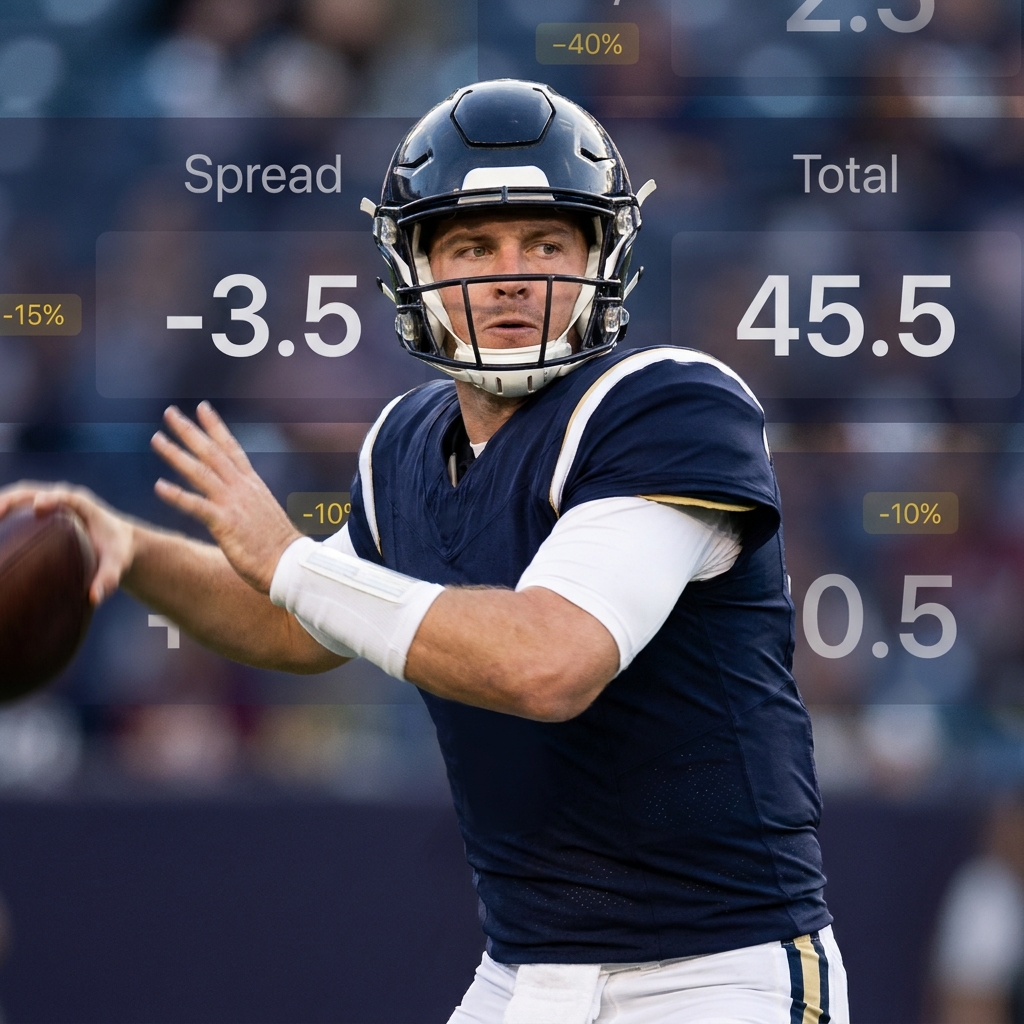
Example A: Clear upside. Suppose McCarthy posts a sustained month-long improvement in intermediate accuracy and reduces interceptions while Jefferson continues to dominate target share. Market reaction will be incremental at first and then accelerate as modelers and public bettors converge, lifting implied probability by a material margin over several weeks.
Example B: Mid-season injury. If Jefferson misses multiple games, the market will quickly reprice Minnesota’s futures downward as on-field scoring potential and matchup advantages decline. In both examples, you can recompute implied probability using the simple 1/decimal formula and observe how the market price shifts relative to your internal forecast.
In practice, update models in two steps: 1) change your forecasted true probability based on the new evidence, 2) check market prices and decide if there is a tradable gap after accounting for margin and liquidity.
Conclusion: realistic watchlist and final take on vikings super bowl odds
Markets priced Minnesota as a long shot entering 2026, which is a defensible baseline given the uncertainty at quarterback and the nature of futures pricing Super Bowl Odds: Futures to win Super Bowl 60. That baseline is not immutable; clear Year 2-3 growth from J.J. McCarthy, continued elite play and availability from Justin Jefferson, and manageable schedule and defensive performance are the three factors most likely to change the team’s classification.
Your watchlist. 1) Quarterback development: sustained accuracy and turnover improvements. 2) Jefferson health and usage. 3) Schedule difficulty and defensive consistency as measured by pressure rate and yards per play. Use those indicators to update an implied-probability benchmark rather than to chase single-game noise.

Keep a balanced, evidence-driven stance: futures markets offer a transparent, priced snapshot of sentiment. Use simple conversions and measurable milestones to decide when the Vikings move from a market long shot to a credible Super Bowl contender.
Convert decimal odds by calculating 1 divided by the decimal number, then adjust for bookmaker margin; for American odds convert to decimal first.
Sustained Year 2-3 quarterback improvement, Justin Jefferson staying healthy and influential, and consistent defensive performance are the key signs.
No, use market implied probability as a benchmark and update it with sustained on-field evidence and model-based adjustments.