

What stop rules are and why they matter
Using Stop Rules to Prevent Emotional Decisions starts with a simple idea: make a choice about when you will stop before emotion can change your behavior. A stop rule is a pre-commitment mechanism that sets a clear boundary, for example a session loss cap or a maximum number of consecutive picks, so that an emotional response, like frustration after losses, cannot override your plan. Framing these limits ahead of time turns reactive impulses into a predictable default, which preserves decision quality during stretched sessions.
In everyday terms, a stop rule can be as small as promising yourself to take a five-minute break after two losing picks, or as formal as stopping when a virtual bankroll drops by a set percent. The power of the rule is that it is placed before emotions escalate. When a losing streak or sudden overconfidence appears, the stop rule moves the decision from a moment of impulse to an operational check you can follow without debating whether you feel lucky or desperate.

Applied to skill-based prediction challenges, a stop rule helps protect the objective you care about, such as maintaining a required drawdown threshold for an evaluation program. Because many challenges use virtual bankrolls and defined evaluation objectives, setting stop rules that align with those objectives reduces the chance that a single emotional session ruins a longer-term plan. Think of a stop rule as the guardrail that keeps disciplined forecasting on track.
Simple definition and everyday examples
At its heart a stop rule is a pre-commitment: a decision you make now about future behavior to avoid making worse choices under stress. Examples include a session cap of five picks, a 5 percent drawdown stop, or a mandatory cooling-off period after three straight losses. These are not complicated to set, and they work best when written down and visible before you begin a session.
How they protect decision quality
By limiting the scope of what you can do once the rule triggers, stop rules reduce the chance you will escalate your stakes, increase pick frequency, or chase marginal ideas simply to recover losses. They create a simple operational response you can follow even when feelings push in other directions, which keeps your forecast process consistent and measurable.
When to introduce a stop rule in a session
Introduce a stop rule before you start a session and review it during a short pre-session checklist. If you notice early emotion signals, apply the rule immediately rather than waiting until a big loss forces a reaction. A pre-declared rule reduces the mental friction of stopping later and makes adherence easier.
Why emotions derail good forecasting
Emotions influence choices more than most people expect, and sports prediction is fertile ground for them. Losing streaks, sudden wins that inflate confidence, and the fear of missing out on a perceived opportunity can all nudge a normally disciplined forecaster toward riskier behavior. Recognizing the common triggers helps you avoid automatic reactions and maintain an analytical stance instead of an emotional one.
Common emotional triggers in sports prediction
Typical triggers include a short losing streak that feels unfair, a single big win that makes you feel invincible, or pressure to recover losses quickly during an evaluation period. These states can prompt changes in stake size or the frequency of picks that are not supported by your original edge or testing plan.

The escalation of commitment and chasing losses
Escalation of commitment appears when you double down on a failing idea because you have already invested time or virtual bankroll into it. Chasing losses is similar, and it often comes from a desire to return to even quickly. Both behaviors increase variance and can turn recoverable drawdowns into failures of the evaluation objective.
Signs your decisions are emotion-driven
Practical signals include making picks outside your model or comfort zone, increasing unit sizes without a documented reason, or skipping your usual review steps to act faster. Noticing these signs early is the first defense against a session going off-plan.
Core types of stop rules for sports prediction
There are three practical categories of stop rules readers commonly use. Each type suits different goals and account sizes, and combining them often yields better protection than relying on one single rule.
Drawdown limits and session loss caps
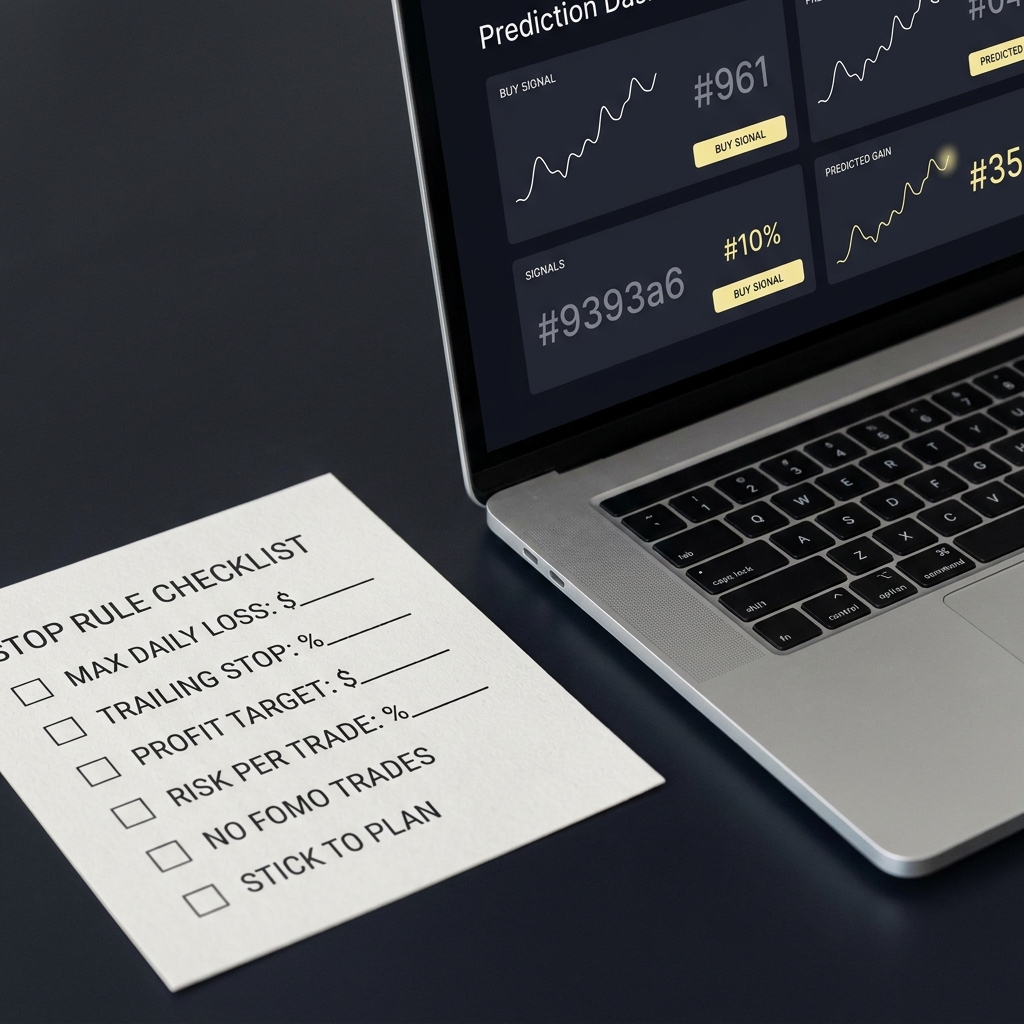
Drawdown limits stop activity after a set loss amount or percent decline in your virtual bankroll. A session loss cap limits losses for a single session regardless of the overall balance. Both rules are straightforward and protect against sudden deterioration in performance during high-stress periods.
Time-based and frequency limits
Time-based stops limit how long you trade in one sitting, such as a maximum of 90 minutes, while frequency limits stop after a fixed number of picks. These rules help when fatigue or decision overload starts to reduce decision quality, since longer sessions often introduce errors that shorter bursts do not.
Behavioral rules: cooling-off and forced breaks
Behavioral stops are simple routines you follow when a trigger occurs. A cooling-off period, like stepping away for 15 minutes after three losses, is a behavioral rule. These rules change the immediate decision environment so emotions have less sway over the next choice.
Quick stop rule tracker for a session
Use this to record and review triggers
Pros and cons
Drawdown limits are simple to enforce but may feel restrictive for small, aggressive strategies. Time and frequency limits help avoid fatigue, yet they do not directly limit monetary drawdown. Behavioral rules are flexible and easy to follow, though they rely on self-honesty to implement. Combining one rule from each category, for example a drawdown limit plus a short cooling-off period, often balances safety with opportunity.
How to design stop rules that fit your challenge
Match rules to account size and challenge objectives
Start by reviewing the rules of your evaluation challenge, the virtual bankroll size, and the target performance metrics. A stop rule should be compatible with the evaluation timeframe and the required drawdown thresholds. For example, a smaller virtual bankroll usually needs tighter absolute loss limits expressed in units or percent rather than large absolute amounts.
Balancing safety with opportunity for recovery
Design rules that protect you while leaving room to recover from normal variance. If your stop is so tight that a single streak wipes out opportunity to continue testing, it may be unnecessarily conservative. Conversely, a very loose rule may let emotional decisions accumulate. Aim for a balance where protective limits reduce catastrophic outcomes but do not prevent sensible follow-up when momentum returns.
Adjusting rules for different sports or prop types
Different sports and prop types have different variance profiles. High-variance props may need larger percent-based drawdown limits or lower unit sizes, while lower-variance league bets can tolerate tighter session caps. Adjust unit sizing and rule thresholds to reflect the typical volatility of the markets you predict.
Mini worked example
For a 1,000 unit virtual bankroll in a short evaluation window, you might set a session cap of 30 units, a total drawdown stop of 8 percent, and a cooling-off period of 30 minutes after three losing picks. This combination protects the overall challenge objective while allowing limited recovery within rules.
A step-by-step framework to create your stop rules
Assess personal risk profile and objectives
Start by clarifying your tolerance for drawdown and the objectives of the evaluation. Are you trying to preserve capital through an evaluation or maximize short-term returns? Your answer guides how conservative your stop rule should be. Write down your risk profile and the session goal before planning rules.
Define measurable stop criteria
Choose specific, measurable triggers like percent drawdown, consecutive losses, or pick count. Make sure each rule has a clear action attached: stop for a break, reduce unit size, or end the session. Documentation is key so you can follow the rule without debate when emotions rise.
Document a stop rule today to protect your session discipline
Document one stop rule you will use this week, write the trigger and the action, and place it where you will see it before each session.
Test, track, and revise
Run your rules for a trial period and track when they trigger. Use a simple log to note the context and whether the rule helped preserve decision quality. After a set period, review results and adjust thresholds if you find the rule too tight or too lenient.
Checklist-friendly steps
Make the three-step framework checklist-friendly: 1 Assess risk and objectives, 2 Define measurable stop criteria, 3 Test and revise. Each checklist item should have concrete deliverables, for example a percent drawdown figure or a set number of consecutive losses that trigger a break.
Common mistakes when using stop rules
Setting rules too tight or too loose
Too-tight rules can remove the chance to recover from ordinary variance and cause premature session endings. Too-loose rules offer no real protection and become a token gesture. Choose thresholds that align with your evaluation period and unit size.
Ignoring the rule after a few wins or losses
Rule bypass is common. After a few wins people may relax and stop following rules, or after a string of losses they may quietly disable a rule to chase recovery. Both behaviors erode discipline. Keep rules visible and treat them as part of the operational process, not optional choices.
Confusing discipline with avoidance
Some people confuse strict stops with avoiding work on their process. There is a difference between refusing to engage and applying a rule that protects long-term goals. If rules force you to step back and review process, that is disciplined behavior rather than avoidance.
Quick interventions to stop emotional escalation
Micro-rules to pause decision-making
Micro-rules are simple, immediate actions such as a mandatory five-minute wait after a loss, or a one-decision pause where you must review your model before making a next pick. These rules are easy to implement and can interrupt emotional reactions.
Simple cooling-off routines
Cooling-off periods can be as short as a walk around the block or a 15-minute break away from screens. A structured routine could be step-away, review last three decisions, then re-evaluate before returning. The routine encourages reflection and reduces the influence of acute emotion on the next pick.
Accountability setups
Accountability can be a simple accountability log, a peer who reviews your triggers, or automated reminders on your phone. Recording why you stopped and what you learned makes it easier to keep to the rule in future sessions and builds a habit of objective review.
How to measure whether your stop rules work
Key metrics to track
Start with a small set of metrics: frequency of rule triggers, win rate after a trigger, change in drawdown volatility, and the average session outcome when rules were followed versus bypassed. These metrics show whether rules reduce emotional decision patterns and whether they improve durability across sessions.
Recording rule triggers and outcomes
Stop rules set pre-commitments that convert emotional impulses into predefined actions, which reduces impulse trading, enforces breaks after triggers, and preserves decision quality during evaluation periods.
Keep a trigger log with the date, the trigger condition, the action taken, and a simple outcome note. Over time the log becomes a dataset you can review to determine if a rule is protecting performance or unnecessarily constraining it.
When to iterate or retire a rule
If a rule triggers very frequently and prevents you from executing a well-tested edge, it may be too strict. If a rule rarely ever triggers and you still make emotion-driven errors, it may be too loose or not well-aligned with your decision points. Iterate with disciplined trials and only change one parameter at a time so you can learn what matters.
Integrating stop rules into daily routines
Pre-session checklists
Make a short pre-session checklist that includes current stop rules, unit size, and a reminder to record triggers. A visible checklist reduces the chance you start a session without clear constraints and makes it easier to follow rules under stress.
Post-session reviews
End each session with a short review noting whether rules were followed, whether any emotional states appeared, and what adjustments, if any, you will make. A consistent post-session habit helps turn rules from theoretical ideas into practiced routines.
Weekly and monthly rule reviews
Set a cadence for review. Weekly reviews can focus on triggers and immediate adjustments, while monthly reviews can examine whether the rules align with your broader objectives and the evaluation timeframe. Put these reviews on your calendar so they happen consistently.
Case scenarios: applying stop rules in common situations
Small virtual account with tight limits
For a small virtual bankroll, choose percentage-based drawdown stops and lower unit sizes. For example, a 500 unit account might use a 5 percent drawdown stop and a session cap expressed in units rather than dollars. The aim is to stay in the challenge and protect the chance to demonstrate consistent forecasting.
Mid-size evaluation challenge under time pressure
When time is limited, frequency rules and micro cooling-off steps are useful. Limit the number of picks per hour and require a brief review after each pick block. This helps avoid rushed decisions driven by the ticking clock.
Late-session fatigue and back-to-back picks
Late-session fatigue often shows as reduced attention and second-guessing. Put in a hard time-based stop, such as ending a session after 90 minutes, and schedule a short recovery routine if you need to continue. Logging how often fatigue rules trigger will help you adjust session length over time.
Tools and simple templates to implement stop rules
Templates for documenting your rules
Use a one-page template that lists your stop rules, the trigger for each rule, and the action required. Keep it visible during sessions. This template becomes your single source of truth when feelings are strong and debate is costly.
Simple tracking spreadsheet layout
Create a spreadsheet with columns for date, session, trigger type, action taken, outcome, and notes. This structure makes it quick to log triggers and simple to analyze trends over weeks. Focus on a few key columns so logging stays low friction.

Automation and reminder options
Automation ideas include phone timers for enforced breaks, calendar blocks that lock out additional session time, or recurring reminders to complete a post-session review. These low-tech tools are often enough to enforce behavioral rules without complicated software.
When stop rules alone are not enough
Signs you need broader behavioral change
If you find yourself repeatedly bypassing rules, changing thresholds mid-session, or rationalizing exceptions, stop rules alone are not solving the underlying issue. These behaviors indicate deeper patterns that require reflection, education, or accountability beyond simple limits.
Combining rules with education and peer accountability
Complement stop rules with learning and a peer review process. Regularly reviewing recorded triggers with a peer or mentor sheds light on blind spots and helps return decision-making to a disciplined process rather than reactive responses.
When to seek structured training or mentorship
If discipline problems persist, consider more formal training in decision processes, or a structured practice routine where rules are tested in low-stakes settings before being used in formal evaluations. Stop rules help, but they are most effective when combined with ongoing skills development.
Summary and next steps to protect your decision quality
Key takeaways
Clarity, measurement, and iteration are the three principles to protect decision quality. Be clear about triggers and actions, measure whether rules change outcomes, and iterate rather than freeze rules in place forever. Treat stop rules as tools to support better forecasting, not as guarantees of success.
A simple start plan
For this week, pick one measurable rule such as a 5 percent total drawdown stop or a session cap of five picks, document it, run it for seven sessions, and log any triggers. Use the results to make small adjustments rather than broad changes.
Encouragement to iterate
Stop rules are living tools. Keep them visible, review them regularly, and refine them based on simple metrics. Over time they become a reliable backstop that preserves discipline and helps you demonstrate consistent forecasting in evaluation challenges.
Implement a simple, measurable stop rule before your next session, test it for several sessions, and adjust based on observed triggers and outcomes.
Properly set stop rules balance protection with recovery, preserving the opportunity to recover while preventing impulsive escalation that increases risk.
Keep rules visible, log triggers, and consider peer accountability or simple automation like reminders to maintain adherence.
References
- https://www.fundedplays.com
- https://www.fundedplays.com/blogs
- https://www.fundedplays.com/blogs/how-fundedplays-evaluations-work
- https://www.fundedplays.com/challenges
- https://www.nytimes.com/athletic/7075799/2026/03/09/prediction-markets-sports-betting-legal-battles/
- https://www.wsj.com/finance/regulation/lawmakers-to-introduce-bipartisan-bill-banning-sports-bets-on-prediction-markets-17d2e272
- https://www.sportico.com/business/sports-betting/2026/cftc-prediction-market-rule-proposal-explain-1234902902/