
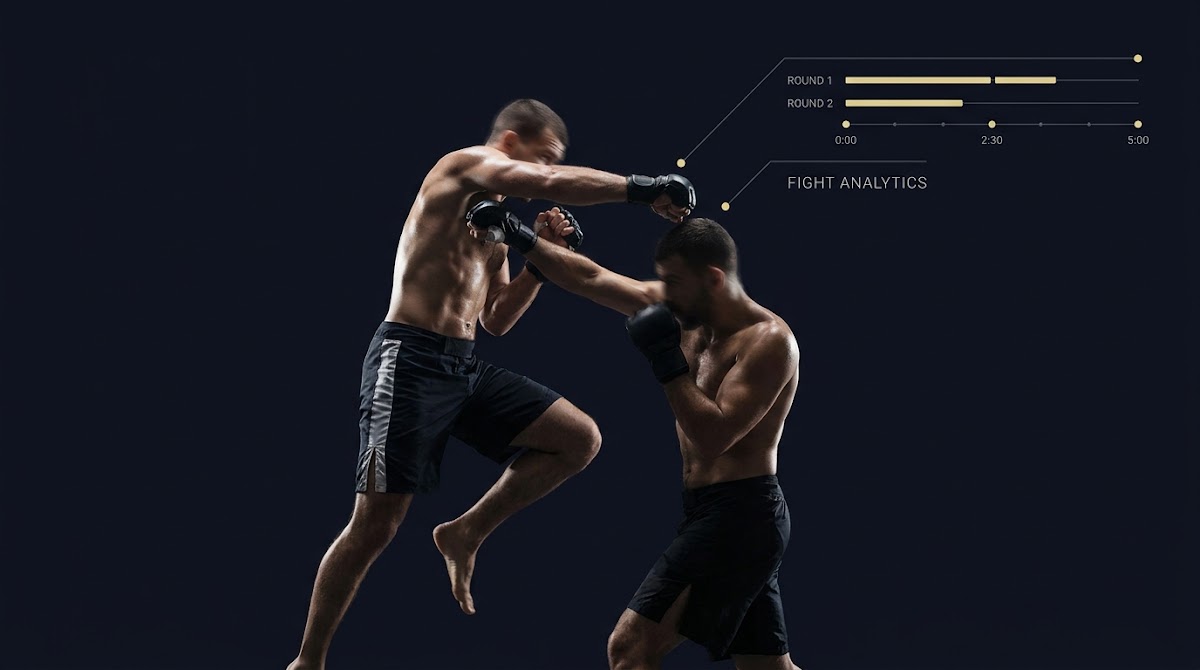
What fight pace means in MMA
At its simplest, fight pace describes how quickly fighters exchange actions inside the cage over time. It is a shorthand for a combination of measurable activity rates, such as how often strikes are attempted, how long fighters spend clinching, and how frequently takedown attempts occur. Using Fight Pace in MMA Projections is useful language for modelers who want a single concept to capture these related signals.
Fight pace is distinct from related terms such as activity rate or tempo because it is intended to be an empirical, multi-dimensional signal rather than a subjective impression. Activity rate often refers to a single measurable count, for example strikes attempted per minute. Pace folds several of those counts together and emphasizes their temporal pattern across rounds.
Try your projections in a structured challenge
Try a short pace checklist: note strikes attempted, clinch time, and takedown attempts for the most recent three fights, then compare per-minute rates across opponents.
Observable indicators of pace include counts and durations. Examples are strikes thrown per minute, how much time fighters spend in clinch exchanges, and the frequency of takedown attempts. You can observe pace from live event logs, round summaries, or detailed event timelines that list timestamps for discrete events. In all cases, think of pace as a profile that can change by round and by opponent rather than a fixed attribute.
Why pace matters for forecasting outcomes is straightforward in principle: higher sustained activity tends to increase the rate of measurable damage accumulation and can expose cardio differences as fights extend. At the same time, pace interacts with scoring dynamics and finish probabilities, so modelers typically treat it as a contextual feature rather than an absolute predictor.

Why fight pace matters for projections
Pace affects projections through several intuitive paths. First, activity drives damage accumulation. A fighter who consistently applies pressure with higher activity can create more scoring opportunities and cumulative effects that matter late in fights. Second, pace reveals cardio and endurance differentials: sustained high tempo can degrade performance for one fighter faster than the other, shifting win probabilities as rounds progress.
It is important to recognize that pace alone is noisy. A single high-activity fight may reflect opponent style, a short early finish, or one exceptional round rather than a reliable trait. Still, when used alongside other features, pace often improves a model's ability to separate situations where late stoppages or decision wins are more or less likely. Treat pace as a predictive feature that adds context to, not a replacement for, technical and positional metrics.
Key metrics to measure fight pace
Event-level and round-level metrics
Primary, easy-to-compute metrics include strikes per minute and significant strikes per minute, measured per round and averaged over recent fights. Round-level metrics let you see how pace evolves as a fight progresses, which is critical for in-fight modeling and live updates.
Derived rate metrics and normalizing for time
Total activity per round, such as total attempts or contact events, is useful but must be normalized to time on task. For example, strikes per minute or attempts per minute make comparisons fair between fights that end early and those that go the distance. Control-related metrics complement pace measures: clinch time per round, time on ground, and octagon control provide context about the type of activity behind raw counts.
Treat pace as a normalized, opponent-adjusted, and time-aware feature set; engineer recent-weighted and round-level metrics, validate with chronological backtests, and scale stakes by signal confidence.
When choosing which metric to trust most, ask whether you need event timing, type of action, or control context for your prediction task.
Key metrics to measure fight pace
Event-level and round-level metrics
Primary, easy-to-compute metrics include strikes per minute and significant strikes per minute, measured per round and averaged over recent fights. Round-level metrics let you see how pace evolves as a fight progresses, which is critical for in-fight modeling and live updates.
Derived rate metrics and normalizing for time
Total activity per round, such as total attempts or contact events, is useful but must be normalized to time on task. For example, strikes per minute or attempts per minute make comparisons fair between fights that end early and those that go the distance. Control-related metrics complement pace measures: clinch time per round, time on ground, and octagon control provide context about the type of activity behind raw counts.
How to collect and clean pace-related data
Start by identifying event data sources that provide either timestamped event logs or round summaries, including public collections such as the UFC dataset on Kaggle.
Basic cleaning steps should handle missing rounds, inconsistent timestamps, and outlier events. For missing rounds, determine whether a fight ended early or if the data provider omitted a round; tag those cases explicitly so your feature calculations can account for reduced time. For timestamps that jump or are inconsistent, normalize to a common clock per fight before computing per-minute rates.
basic cleaning and alignment of fight event logs
run checks in this order
Align fighter histories by creating a canonical fighter identifier and joining event-level data to fighter-level metadata such as weight class and primary stance. When you extract history for a given fighter, include opponent context for each past fight so you can later compute opponent-adjusted metrics. Keep raw data immutable and perform cleaning steps in a reproducible script or worksheet so you can audit feature derivation later.
Incorporating pace into projection models
Feature engineering approaches: Using Fight Pace in MMA Projections
Convert raw counts into features that reflect recent behavior and matchup context. Examples include a weighted recent pace that emphasizes the last three fights, a pace differential versus the upcoming opponent, and round-weighted pace features that give later rounds a larger role for endurance-aware predictions.
Handle multicollinearity by checking correlations between pace-derived features and other volume metrics. If several features are strongly correlated, either combine them into a single composite feature or use regularized models that penalize redundant predictors. Decide whether pace should be a main predictor or a contextual modifier based on cross-validation results and out-of-sample improvements.

In practical workflows, feature engineering for pace typically sits between data cleaning and model training. A common platform workflow extracts event logs, computes per-round and per-fight pace metrics, stores those features in a time-stamped feature store, and serves them to a training pipeline that respects fight chronology.
Simple rule-based methods
Rule-based tactics are often the quickest way to test whether pace adds value. A defensible rule example is to favor the fighter with the higher recent activity profile when the matchup shows similar technical profiles and neither fighter has a known cardio issue. Keep rules simple and transparent so you can audit them easily.
To set thresholds without overfitting, base them on robust percentiles from your historical dataset rather than extreme samples. For instance, use interquartile ranges to define what counts as high, medium, and low pace. Always log the sample size that produced a threshold; if the threshold comes from a small group of fights, treat it as provisional and reduce stake exposure accordingly.
Statistical and machine learning approaches
Good model choices for including pace are logistic regression with regularization and tree-based models that handle nonlinear interactions, as seen in academic studies of MMA outcomes.
When integrating time-varying pace features, use rolling windows or exponential decay to emphasize recent fights while retaining longer-term tendencies. Always validate with train/test splits that respect chronological order so you do not leak future information into past predictions. Simple backtesting can reveal whether adding pace improves calibration or discriminative power.
Adjusting for opponent interaction and styles
Raw pace often reflects opponent forcing rather than intrinsic fighter tendency. An aggressive opponent can inflate a measured pace if the measured fighter responds with more defensive output. For that reason, build opponent-adjusted metrics that compare a fighter's observed pace to an expected pace given the opponent's style profile.
A practical opponent-adjusted approach is pace differential: compute the difference between observed pace and the opponent-expected pace derived from opponents with similar styles. Encoding opponent style can be as simple as clustering past opponents by average activity and control metrics, then using that cluster label as a conditioning variable in your feature calculations.
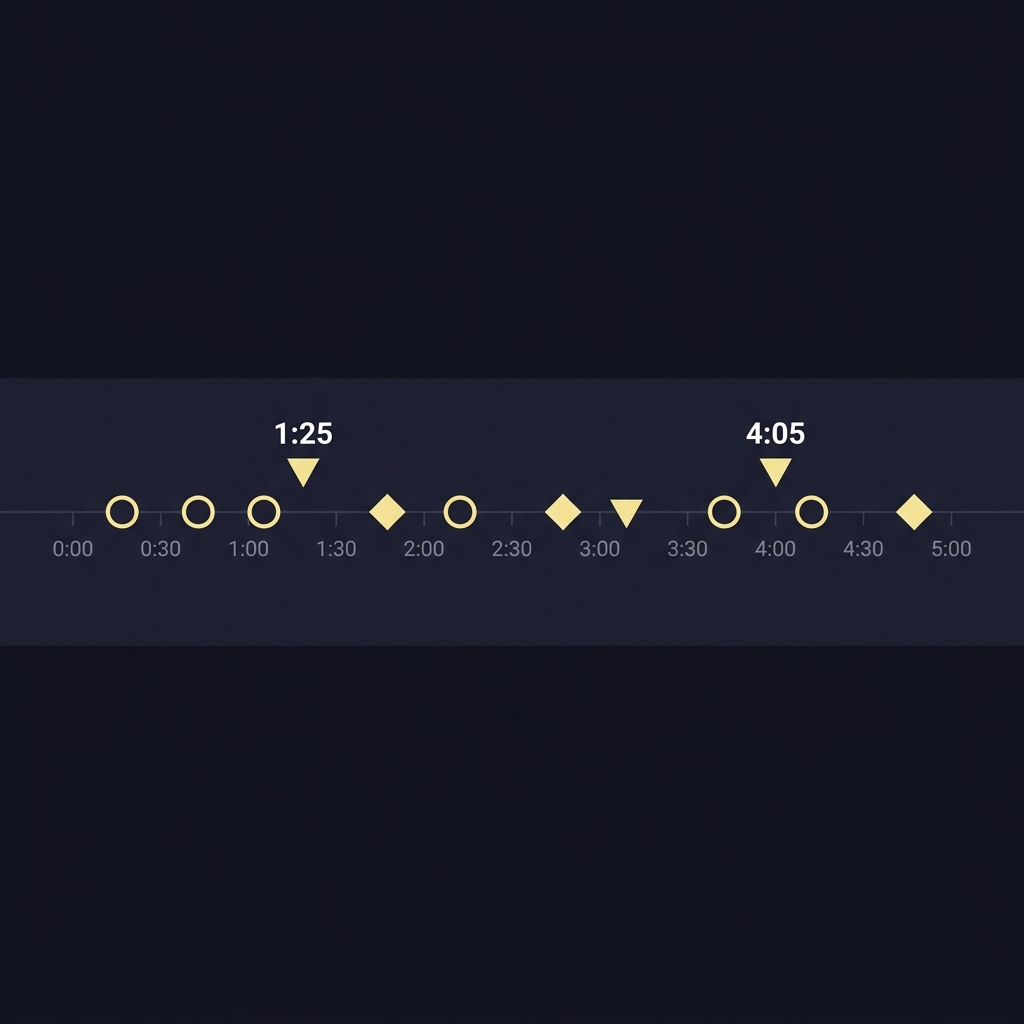
Round granularity matters because pacing effects often compound across rounds. Full-fight aggregates can hide whether a fighter starts fast and fades or builds momentum late. Round-level features allow models to capture these dynamics and to update live probabilities after each round.
Round-by-round modeling and in-fight dynamics
Simple in-fight updating strategies use prior probabilities from pre-fight models as a baseline and then adjust those probabilities using observed round-level pace metrics. For example, if a fighter expected to be low-activity suddenly sustains a higher-than-expected pace in round one, increase the live estimate that they will outscore the opponent in subsequent rounds while also factoring in fatigue risk.
Bankroll and staking considerations for pace-based signals
Treat pace-based signals as one input among many when sizing stakes. Because pace can be noisy and context-dependent, scale stake sizes by signal confidence and by the sample size used to compute the signal. Conservative stake sizing reduces the harm of false positives that stem from small-sample quirks.
Practical rules include reducing exposure when the relevant historical sample for a fighter-pace comparison is small, and increasing exposure only after the signal has a consistent track record in your backtests. Always track performance by signal bucket so you can see whether pace-derived edges persist over time.
Common mistakes and how to avoid them
Common errors include using raw counts without normalization, ignoring opponent effects, and overfitting thresholds to small datasets. A typical measurement mistake is comparing strikes per fight without accounting for shortened fights; normalized per-minute rates prevent that specific pitfall.
To avoid overfitting and cherry-picking, rely on cross-validation and keep a clear, versioned record of assumptions. Document how features are computed, the dates of the data used for thresholds, and the size of the historical sample so you can revisit decisions objectively if outcomes differ from expectations.
Practical example: building a pace feature step-by-step
Step 1, extract events: pull timestamped strike attempts, takedown attempts, and clinch events from your event logs for the last N fights per fighter. Step 2, compute per-minute rates: for each fight and round, compute attempts divided by round duration in minutes to get per-minute rates. Step 3, compute a recent weighted average: for the last three fights, weight the most recent fight heavier, then compute a weighted mean to produce a single recent-pace feature.
Address edge cases by handling fights that end early: when a fight ends in round two, record the actual elapsed time and compute a per-minute rate based on that elapsed time rather than assuming full-round duration. For missing rounds or incomplete logs, flag the instance and exclude it from weighted averages unless you can reliably impute the missing data.
Evaluating model performance and backtesting
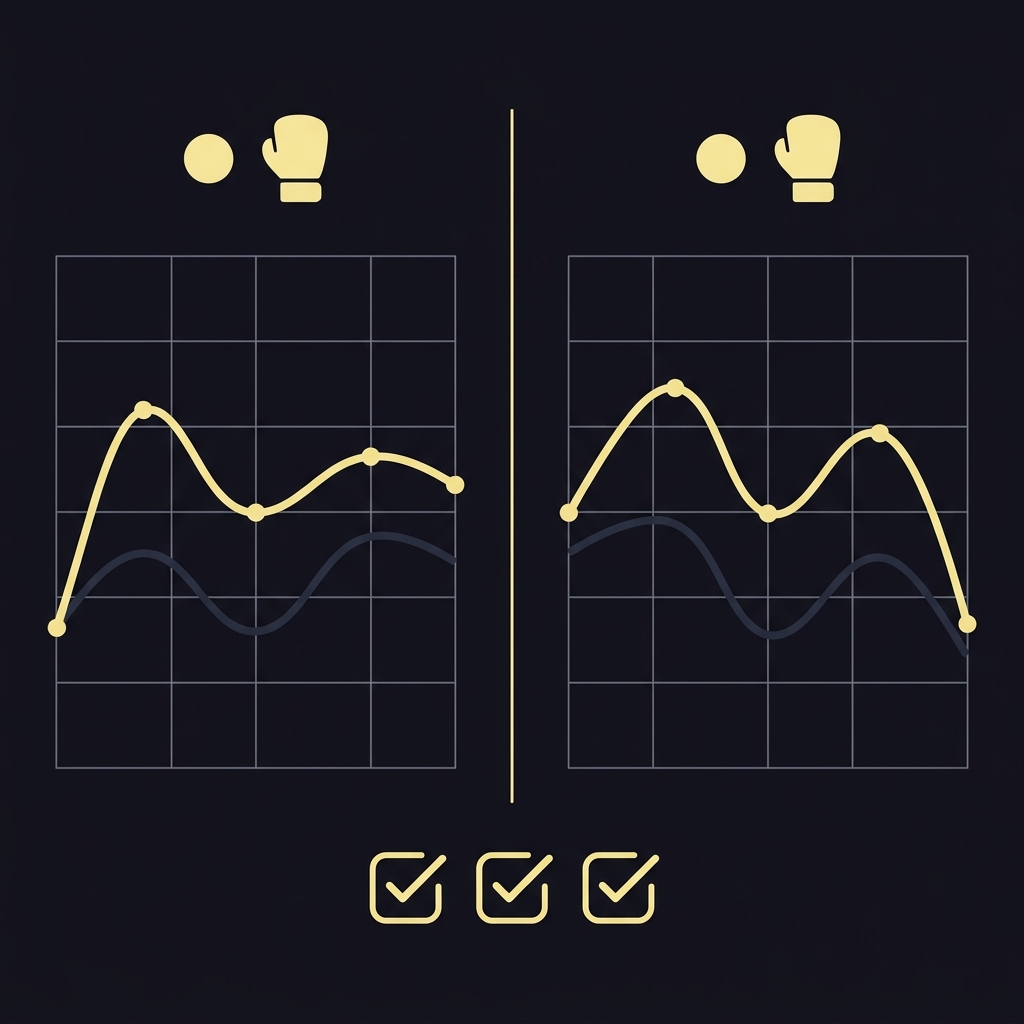
Use standard binary outcome metrics such as log loss and area under the ROC curve to assess discrimination, and include calibration checks so predicted probabilities align with empirical results. Time-aware backtests should use chronological train/test splits to avoid lookahead bias and to mimic deployment conditions. Example public datasets and formats can be found in collections like the UFC fight data on Hugging Face.
Perform simple ablation tests by removing pace features from the model and comparing performance. If a model with pace features consistently improves calibration or discrimination on holdout fights, that indicates the feature is contributing useful information beyond correlated volume metrics.
Putting it together: actionable workflow and next steps
Checklist for implementation: 1) gather event-level and round-level data, 2) clean and normalize into per-minute metrics, 3) engineer opponent-adjusted and rolling-window features, 4) validate with time-respecting backtests, and 5) deploy conservatively with stake sizing tied to signal confidence. Iterate and track results. See the Funded Plays blog for related posts.
Further experiments to try include testing alternative decay rates for rolling windows, exploring opponent-adjusted pace via clustering, and building simple live-update rules based on round-level surprises. Remember that measured improvements in backtest environments do not guarantee future success; continuous monitoring and conservative risk management are essential.
Strikes per minute is a single measure of activity; fight pace is a broader, multi-dimensional concept that combines strikes, clinch and ground time, and temporal patterns across rounds.
No. Pace can be informative but noisy; it works best combined with opponent context, efficiency metrics, and proper validation.
Compute per-minute rates using the actual elapsed time and flag short fights so they are not mixed unfairly with full-distance bouts.
References
- https://www.fundedplays.com
- https://www.fundedplays.com/blogs
- https://www.fundedplays.com/blogs/how-fundedplays-evaluations-work
- https://www.fundedplays.com/challenges
- https://www.kaggle.com/datasets/rajaisrarkiani/ufc-fights-and-fighter-stats-dataset
- https://www.diva-portal.org/smash/get/diva2:1894679/FULLTEXT01.pdf
- https://huggingface.co/datasets/xtinkarpiu/ufc-fight-data