
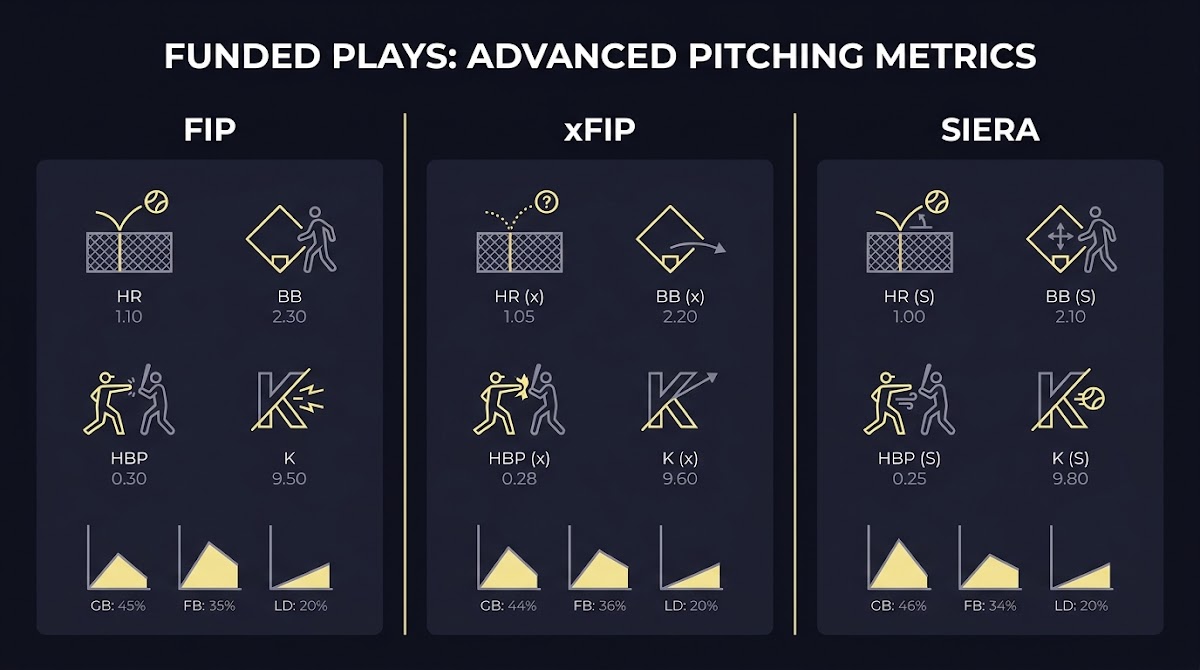
Using Fielding-Independent Pitching Metrics: definition and why they matter
Fielding-independent pitching metrics were developed to separate events a pitcher largely controls from those influenced by defense, ballpark, or sequencing. By focusing on home runs, walks, hit batters, and strikeouts, these estimators aim to give a clearer view of a pitcher’s underlying run prevention without the noise that inflates or deflates ERA in the short term, and the basic mechanics of this approach are explained in the FanGraphs FIP library FanGraphs FIP library and MLB's glossary Fielding Independent Pitching.
At their core, FIP, xFIP, and SIERA are all attempts to estimate future run prevention more reliably than raw ERA by leaning on events less shaped by the fielders behind the pitcher. The defensive-independent pitching idea dates to formal DIPS research and has been refined into practical formulas analysts use today, with the original DIPS discussion and its logic summarized in long-standing analyses Pitching and Defense: How Much Control Do Hurlers Have, and a general overview is available on Wikipedia Fielding independent pitching.
What fielding-independent metrics try to remove
These metrics remove or reduce the influence of two main factors that can distort ERA over short windows: the quality of the defense in front of the pitcher and sequence-driven runs that arise from clustering of hits. Removing those elements produces a statistic that is more stable and often more predictive of future ERA than the raw ERA itself, as demonstrated by the DIPS framework Pitching and Defense: How Much Control Do Hurlers Have.

Brief history: from DIPS to FIP, xFIP, SIERA
FIP was formulated to mirror ERA but using only the events pitchers most directly influence, with a scaling constant that places FIP on the familiar ERA scale; the FanGraphs library documents the components and rationale for that conversion FanGraphs FIP library.
FIP uses actual home runs along with walks, hit batters, and strikeouts to estimate pitcher-run prevention, while xFIP replaces home runs with an expected value based on fly balls and a league HR/FB rate to reduce variance.
Prefer SIERA when you have larger samples and batted-ball data, and you need a model that accounts for interactions among strikeouts, grounders, and fly balls for longer-term projections.
Use the seasonal FIP constant for each year and apply park adjustments before comparing FIP values across different seasons or venues.