
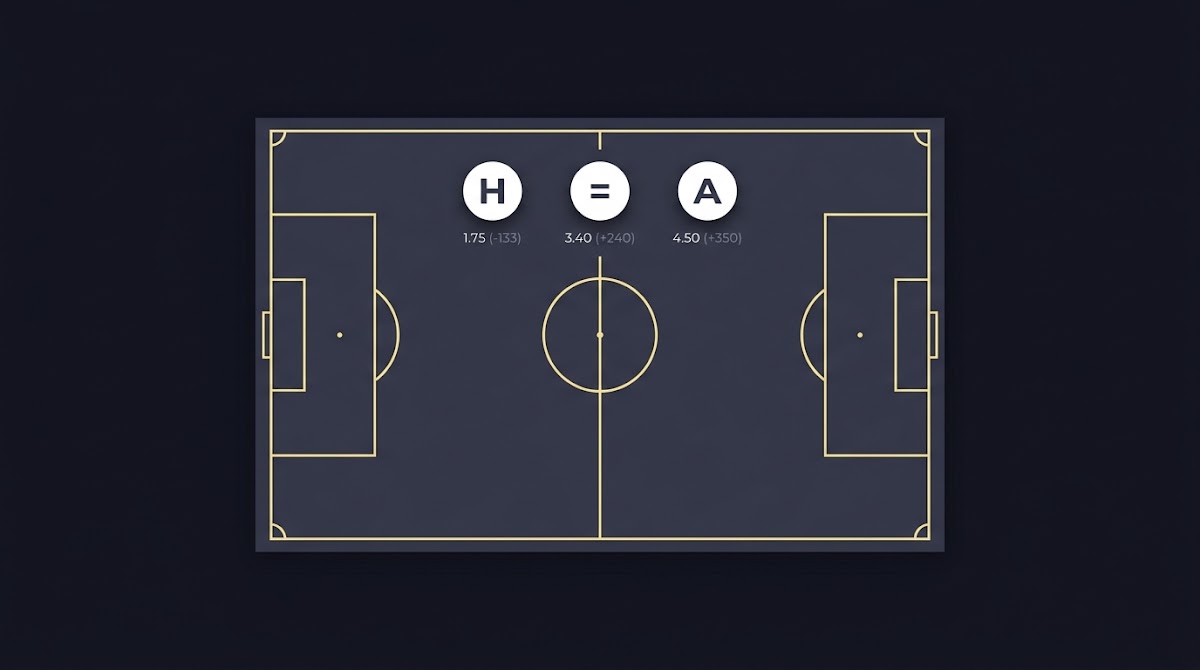
Understanding the Three-Way Moneyline: definition and quick context
The term Understanding the Three-Way Moneyline refers to the 1X2 market where three distinct outcomes are quoted: home win (1), draw (X) and away win (2). This framing treats a draw as a standalone result rather than a secondary outcome, which changes how pre-match choices are priced and quantified for comparisons.
In practice, three-way markets are the standard for soccer because matches can finish level at full time, and the market explicitly prices that possibility. The laws that define match length make the 90-minute settlement point the default for many pre-match markets, which helps explain why 1X2 is the common framing in league and group-stage play Law 7 - The Duration of the Match.
For readers new to odds, think of 1X2 as a simple three-outcome probability problem: instead of two possible results, the draw is a distinct outcome you must model. Later sections show how to convert odds into implied probabilities so you can compare the three quoted prices on the same scale and assess whether your forecast offers value.

The defining difference between a three-way market and two-way alternatives is the treatment of the draw. In 1X2 the draw is its own market outcome; in two-way variants the draw is removed or the market has rules that return stakes or refund in case of a draw. That structural difference matters for strategy and settlement.
Common two-way products include draw-no-bet, which effectively refunds or removes the draw from settlement so a match ending level returns stakes to selections in many operator terms. Another two-way approach is void-on-draw where the market is cancelled if the game ends level; these differences change the risk and return calculus compared with 1X2.
Operational rules and help-centre clarifications make these distinctions explicit for users and can affect whether a selection stands or is voided in specific circumstances, so always check the market product details when choosing between a three-way and a two-way option Football rules.
How three-way markets are settled: regulation time, extra time and penalties
When a 1X2 market states standard settlement, it nearly always means the match is settled on regulation time, commonly expressed as 90 minutes plus stoppage. That means extra time or penalty shootouts do not affect the quoted 1X2 result unless the operator explicitly states otherwise, as explained in DraftKings' settlement guide.
See FundedPlays challenge rules and settlement details
Check operator settlement rules before you predict to confirm whether a market settles at 90 minutes or includes extra time and penalties.
Because most pre-match soccer markets follow the regulation-time convention, a prediction framed as home, draw or away should be interpreted according to that settlement window. If a competition or specific market includes extra time or penalties for settlement, that will be stated in the market rules and will alter how the outcomes are defined Football betting rules and regulations. Further guidance on 90-minute settlement conventions can be found in FanDuel's soccer guide How to Bet on Soccer.
Exceptions such as abandoned, postponed or replayed matches are governed by operator clauses and can result in voids or alternative settlement decisions; those clauses vary, so check the exchange or operator help pages before placing significant selections.
Converting odds to implied probability: formulas and examples
To compare the three outcomes you must express prices as implied probabilities. For decimal odds the conversion is straightforward: implied probability equals 1 divided by the decimal odds, so a 2.50 decimal quote implies 1 / 2.50 = 0.40 or 40 percent.
American odds require two complementary formulas. For positive American odds the implied probability is 100 / (odds + 100); for negative American odds it is |odds| / (|odds| + 100). For example, +150 implies 100 / (150 + 100) = 0.40 or 40 percent, while −120 implies 120 / (120 + 100) = 0.545 or 54.5 percent Implied Probability.
The three-way moneyline quotes three distinct outcomes (home, draw, away) and most pre-match soccer 1X2 markets are settled at the end of regulation time, excluding extra time and penalties unless the operator states otherwise.
Converting both American and decimal formats to implied probabilities lets you treat the three quotes as comparable percentages and therefore directly comparable to your model or forecast probabilities. Use the conversions routinely before deciding whether any suggested edge exists.
Accounting for bookmaker margin and overround
Bookmakers build a margin into prices so that the sum of the three implied probabilities typically exceeds 100 percent; this excess is called the overround. The presence of an overround means raw implied probabilities from market quotes do not represent a fair 100 percent book, so you must adjust them before comparing to your model.
A simple normalization method divides each implied probability by the sum of the three implied probabilities, producing de-overrounded probabilities that sum to 100 percent. That normalized comparison is the proper benchmark for checking whether your forecast offers positive expected value What is overround? Understanding bookmakers’ margins.

After normalization, a model-derived probability must exceed the adjusted market probability by a margin that accounts for model uncertainty and staking costs before a selection becomes attractive. Treat the de-overrounded probabilities as the market-implied baseline for any EV calculation.
Evaluating value: how to decide if a 1X2 price is worth taking
Deciding if a 1X2 price is worth taking starts with a simple comparison: compute the normalized implied probability for the market outcome and compare it to your model probability for the same outcome. If your model probability is larger by a margin that covers uncertainty, the selection has positive expected value in principle.
A concise decision rule is practical: 1) convert the quoted price to implied probability and normalize for overround, 2) compare the normalized market probability to your model probability, and 3) take the selection if your model probability comfortably exceeds the market probability. Comfortably typically means your expected edge is meaningful relative to model variance and record-keeping constraints.
Also factor in sample-size risk and the limits of single-event decisions. Small edges can be real but fragile; when model uncertainty or data limitations are large, rely on stricter thresholds for taking positions to avoid chasing noise in the short term Implied Probability.
Payout conventions and reading American vs decimal odds
Reading payout quotes correctly avoids simple calculation mistakes. For American odds, a positive number indicates the profit from a $100 stake, while a negative number indicates the stake you must risk to win $100. Decimal odds show the total return, stake included, and the payout equals stake multiplied by the decimal odds Moneyline Bet Definition.
Convert stake and decimal odds into payout
Use for quick return checks
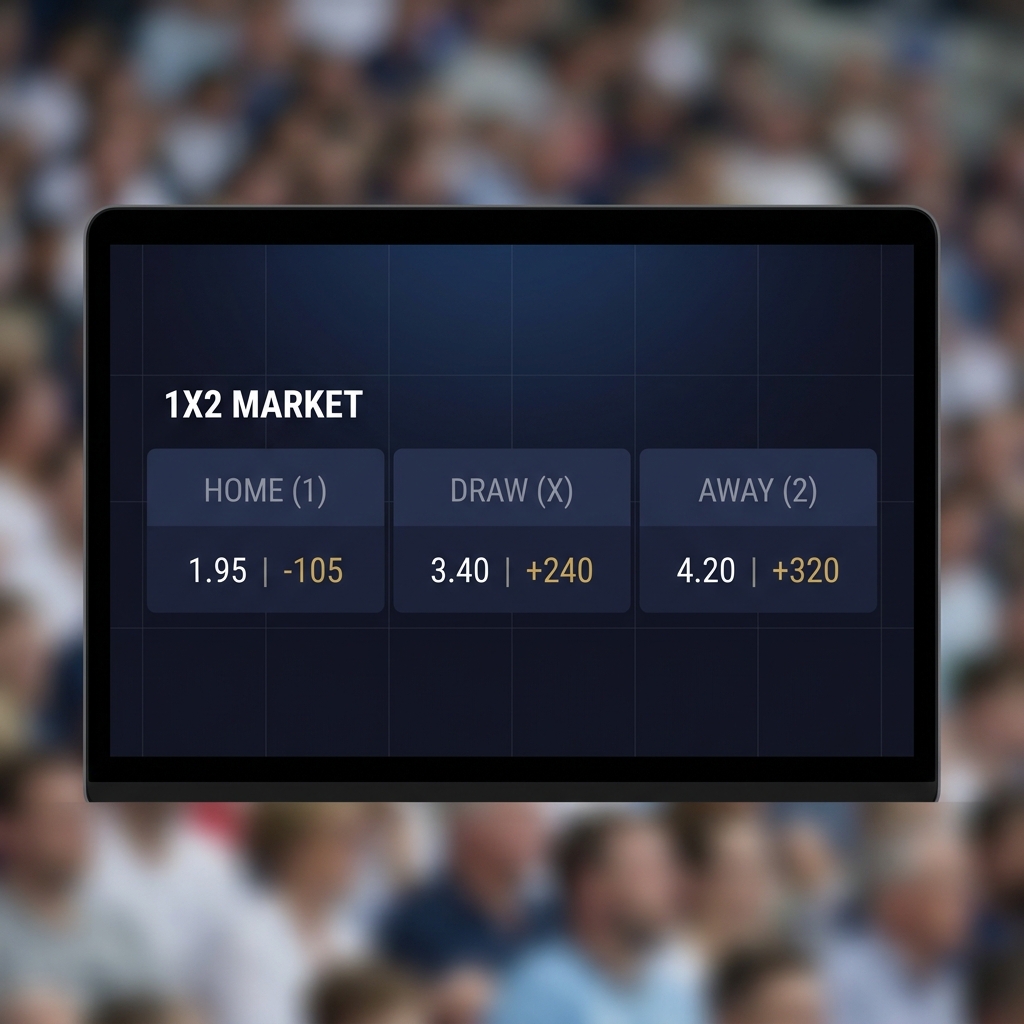
For example, a decimal 3.20 with a $50 stake returns 50 × 3.20 = $160 total, which is $110 profit. In American terms that decimal equals +220 approximately, indicating $220 profit on a $100 stake in the same framing, but always confirm conversions with the formulas provided earlier rather than rounding heuristics.
Understanding these payout conventions helps you compare potential returns across the three outcomes and plan stake sizes or virtual-account experiments in prediction challenges without miscalculating expected returns.
Typical mistakes and pitfalls when using 1X2 markets
A common error is assuming every three-way market includes extra time or penalties; many pre-match 1X2 markets settle at the 90-minute mark, so that assumption can lead to unexpected voids or losses when matches go to extra time. Verify settlement windows in the operator rules before placing selections Football betting rules and regulations. You can also consult Matchbook's sports rules for another operator perspective Matchbook sports rules.
Another frequent pitfall is treating raw implied probabilities as fair probabilities without removing the overround. Failing to de-overround can overstate the market's implied chance for your selection and lead to incorrect value calculations. Always normalize before direct model comparison.
Also avoid over-interpreting tiny EV differences when model uncertainty is material. A small edge can vanish under realistic variance, so maintain conservative thresholds for taking positions when using a prediction or funded-challenge approach.
Worked examples: converting odds, normalizing probabilities and checking value
Example 1, simple favorite: suppose a home win is quoted at decimal 1.80, draw 3.50, away 4.50. Convert to implied probabilities: home 1/1.80 = 55.56 percent; draw 28.57 percent; away 22.22 percent. The sum is 106.35 percent, so the overround is 6.35 percent and normalization is required.
Normalize by dividing each implied probability by 1.0635: normalized home = 55.56 / 106.35 = 52.26 percent, draw = 26.86 percent, away = 20.88 percent. If your model estimates the home probability at 56 percent, you have an apparent edge because 56 > 52.26, but check that model error margins make this difference meaningful before taking action Implied Probability.
Example 2, long-shot away: an away quote of decimal 7.00 implies 14.29 percent. If the book's three implied probabilities sum to 120 percent due to a heavy margin, the de-overrounded share for the away entry will be 14.29 / 120 = 11.91 percent. A model that estimates 15 percent for that away team would therefore see a positive EV opportunity, provided the model's uncertainty does not erase the 3.09 percentage-point gap.

How match context influences three-way pricing: leagues, cups and group stages
Context matters for 1X2 pricing because the intrinsic likelihood of a draw depends on incentives and competition format. League and group-stage fixtures frequently use standard 1X2 framing because draws are valid outcomes in the standings and affect long-run strategies for teams.
By contrast cup ties that mandate extra time or penalties for progression may be described in market terms that alter settlement conventions. When a market includes extra time or penalties, the implied probabilities and valuations should incorporate that extended settlement window, which can reduce the practical draw probability in match calculations Law 7 - The Duration of the Match.
Team styles, importance of the fixture and incentive structures (for example, one team needing only a draw to advance) also change pricing. Modelers should incorporate contextual signals such as tactic, lineup news and competition incentives when deriving probabilities for 1X2 markets.
Operator-specific rules to check before placing a 1X2 selection
Before placing selections, verify operator rules on settlement period, abandoned matches, postponed fixtures and replays. Those clauses govern whether a market will be voided, settled on an alternative basis or delayed until a rescheduled fixture, and the exact wording matters for outcome risk management.
Search operator terms for phrases like settlement, abandonment, and postponement to find the exact clause that applies to your market. Some operators explicitly state "settled at 90 minutes" while others provide statements that include or exclude extra time and penalties; confirm language before committing to a selection Football rules.
Also check procedures for late kick-off or fixture cancellation. If the market rules allow voiding or moving the settlement to a later match date, recording these possibilities in your tracking log will help you reconcile outcomes and maintain accurate performance records.
Prediction platforms and funded challenge formats often present 1X2 as a standard pre-match choice because it mirrors the common structure of soccer results at the end of regulation. When using simulated or funded accounts, document the market quote, implied probabilities, normalized probabilities and your model probability for each selection you make.
Track outcomes and stakes in a simple spreadsheet so you can compute realized return on virtual bankrolls and monitor whether your method shows consistent edges over time. In challenge settings remember that platform rules govern qualification and reward eligibility, so recording the underlying data and reasoning for each pick helps when reviewing performance against challenge objectives. See how Funded Plays evaluations work for an example process.
Finally, maintain responsible participation: treat funded challenges as skill-focused evaluations, not guaranteed income sources, and align your staking and record-keeping with the platform's rules and the limits of your prediction model.
Quick checklist and closing takeaways
Checklist: confirm settlement window, convert quoted odds to implied probabilities, normalize for overround, compare to your model probability, and account for model uncertainty before taking a selection. These steps provide a repeatable routine for pre-match 1X2 evaluations.
In short, Understanding the Three-Way Moneyline means recognizing the draw as an independent outcome, settling most pre-match markets at 90 minutes, converting quotes to probabilities, removing bookmaker margin and applying a disciplined decision rule for value. Practice conversions and keep detailed records to judge whether your approach finds sustainable edges.
Next steps: practice the conversions in the calculator specification provided earlier, start tracking a small number of selections in a spreadsheet, and check operator settlement clauses when in doubt. For more resources see the blog.
Most pre-match three-way markets are settled at the end of regulation time, commonly 90 minutes plus stoppage; check operator rules for exceptions.
For positive American odds use 100/(odds+100); for negative odds use |odds|/(|odds|+100). Convert decimal odds with 1/decimal odds.
Overround is the bookmaker margin that makes the sum of implied probabilities exceed 100 percent; normalize probabilities to compare fairly with your model.
References
- https://www.theifab.com/laws/latest/the-duration-of-the-match-7/
- https://help.smarkets.com/hc/en-gb/articles/214201985-Football-rules
- https://support.draftkings.com/dk/en-us/how-are-soccer-bets-settled?id=kb_article_view&sysparm_article=KB0010834
- https://www.betfair.com/exchange/plus/en/football-betting-rules-and-regulations
- https://www.fanduel.com/sports-betting-guide/how-to-bet-on-soccer
- https://www.investopedia.com/terms/i/implied-probability.asp
- https://betting.betfair.com/education/what-is-overround/
- https://www.fundedplays.com/challenges
- https://www.investopedia.com/terms/m/moneyline.asp
- https://www.matchbook.com/page/rules_and_regulations/sports-rules
- https://www.fundedplays.com
- https://www.fundedplays.com/blogs
- https://www.fundedplays.com/blogs/how-fundedplays-evaluations-work