
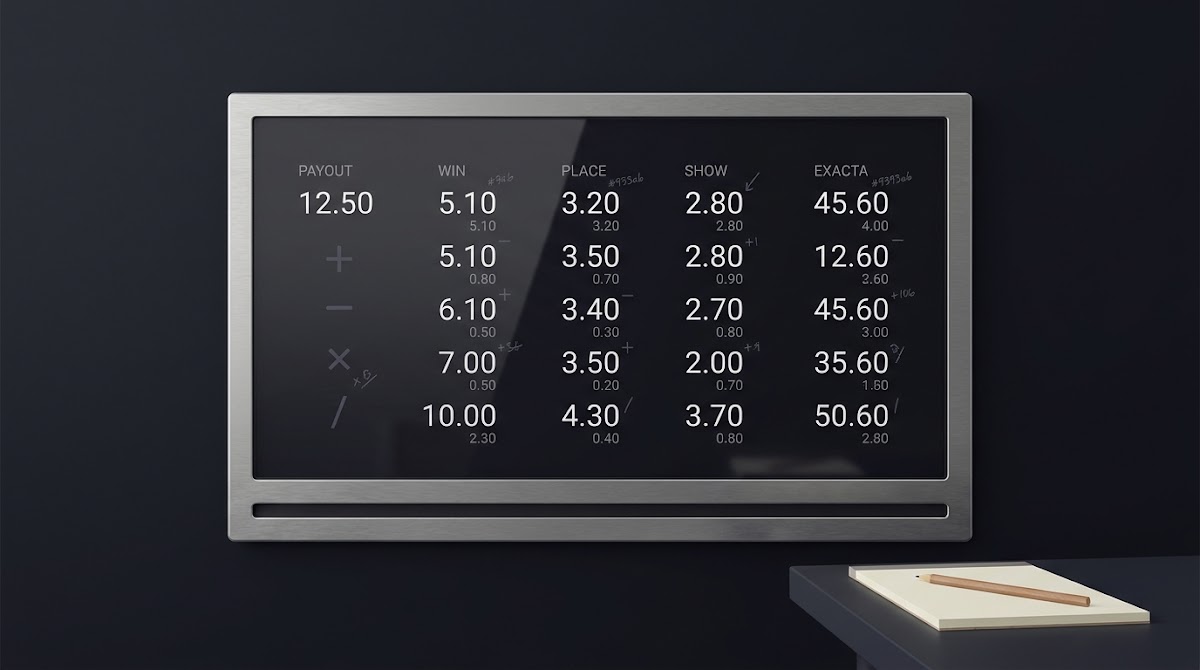
What a trifecta payout is and when this calculation applies
Definition of a trifecta wager
A trifecta payout is the amount posted to winning tickets when a bettor correctly selects the first, second and third finishers in exact order. The payout for a trifecta comes from the trifecta pool that collects all wagers of that type for the race.
In U.S. racing the posted payoff for a trifecta is not a fixed odds price set by a bookmaker. Instead, state pari-mutuel rules require a net-pool pricing method that turns the pooled money into a per-unit payoff after deductions and rounding rules are applied. This regulatory framework determines the official posted price on race results WAC 260-48-800 payoff calculation.
Estimate a posted per-unit trifecta price from pool inputs
Use official takeout and breakage to match posted price
When pari-mutuel rules govern the payoff
When a race is settled under pari-mutuel rules, the track or racing commission applies the net-pool method to exotics such as the trifecta. That means regulators and track accounting, not a fixed-odds board, produce the posted payoff after statutory deductions and rounding. For a clear example of the regulatory approach consult a state payoff method rule 16 TAC 321.505 calculation of payoffs.
How pari-mutuel net-pool pricing works: the core framework
Overview of net pool, takeout, and winning share

The net-pool method follows a predictable sequence: collect the total trifecta pool, subtract mandatory takeout and deductions, compute the net pool, divide that net by the number of winning units, then apply the jurisdictional rounding rule called breakage to produce a posted per-unit price. State rules codify this sequence for exotics so the same basic steps apply across jurisdictions N.J.A.C. 13:74A payout provisions.
How the net pool becomes a per-unit price
In practice, officials calculate the net pool by applying the statutory takeout rate to the collected pool, then remove any additional authorized deductions. The remaining money is the net pool to be allocated to winning units. The per-unit price is the net pool divided by the total number of winning units for that combination, then adjusted by breakage to match the allowed increment. The role of winning units is central because more winning units produce a smaller per-unit payout WAC 260-48-800 payoff calculation.
Step 1 - Deducting takeout and required statutory deductions
What 'takeout' includes and why it matters
Takeout is the mandated deduction from the total pool before any payouts. It typically covers state distributions, track fees, and other authorized allocations. Because takeout is removed before division among winners, it directly reduces the pool available to pay winning tickets and therefore materially affects the posted trifecta payoff. State rules and commission filings specify the components that make up takeout in that jurisdiction 16 TAC 321.505 calculation of payoffs.
Before using a calculator, confirm the correct takeout rate for the track and date you are estimating. Different states and even different event types can have distinct rates, and using the wrong percentage will produce an inaccurate net pool estimate 205 CMR 10.00 pari-mutuel rules.
Estimate trifecta payoffs with official inputs on FundedPlays
Try the calculator with the track's posted takeout and breakage values to produce an estimate; use official inputs to improve the match with posted payoffs.
Where to find the applicable rates
Official takeout rates and deductions are published by state racing commissions or in the code sections governing pari-mutuel operations. Track programs and commission websites typically show the effective rates, so a reliable calculator should accept a takeout field where you enter that jurisdictional number. For a model of how regulations specify these steps see a state code that lays out payoff computation 205 CMR 10.00 pari-mutuel rules.
Step 2 - Determining winners, winning combinations and dividing the net pool
What counts as a winning trifecta combination
A winning trifecta combination is any ticket that lists the race finishers in the exact first, second and third order that the official result records. Each distinct combination constitutes a unit when the net pool is divided. That means a single correct combination can be represented by many separate tickets, and each ticket increases the winning units for that combination and reduces the per-unit payoff.
Officials tally the number of winning units for each distinct combination before computing a per-unit price. The net pool that goes to that combination is the pot allocated for all tickets that match exactly, then divided by the winning units and adjusted by breakage to yield the posted price WAC 260-48-800 payoff calculation.
How winning units are tallied
Tracks count each base-dollar unit on winning tickets when tabulating winners. For example, if the posted base denomination is one dollar, each $1 unit on a winning ticket counts as one unit. The total units for a winning combination equals the sum of base units across all winning tickets that specify that exact order. That total is critical because the net pool for that combination is divided by the units to compute a per-unit payout 16 TAC 321.505 calculation of payoffs.

Dead heats and how profit-split scenarios are settled
What a dead heat means for trifecta calculations
A dead heat occurs when two or more horses finish in positions that create overlapping outcomes relevant to a trifecta. When that happens, the result produces multiple distinct winning combinations and the net pool must be allocated across them before division. Regulations direct how to treat those scenarios so settlement is consistent with pari-mutuel principles WAC 260-48-800 payoff calculation.
A trifecta payout is calculated by deducting statutory takeout from the total trifecta pool to get a net pool, allocating that net pool across any winning combinations, dividing each allocation by the number of winning units, applying jurisdictional breakage rounding, and scaling the posted per-unit price to the bettors stake using the base denomination.
Typical profit-split methods used in rules
The usual approach is a profit-split or equivalent allocation. Officials divide the net pool among each distinct winning combination that the dead heat creates, then compute a per-unit price for each allocated portion by dividing by the number of units for that combination. That sequential allocation and division ensures each actual winning combination receives its share of the net pool before per-unit rounding is applied 16 TAC 321.505 calculation of payoffs.
Breakage: how rounding rules change the posted payoff
What breakage is and common state increments
Breakage is the regulatory rounding rule that adjusts a computed per-unit price to a permissible posted increment, typically by rounding down each dollar to a set amount. Because breakage is applied after the net pool is divided, the final posted price can be noticeably lower than the raw division result. Different states use different increments and the rule is set in regulation or commission practice Minnesota Rules 7877.0170 net pool pricing.
Why two identical pools can post different payoffs
Two races with identical pools, identical takeout, and the same number of winners can still show different posted prices if their jurisdictions use different breakage increments or rounding methods. Because breakage typically rounds down to the nearest allowed increment, a larger rounding increment or stricter breakage rule reduces the posted price more. A calculator must include the correct breakage increment to produce a posted price that matches the official result 16 TAC 321.505 calculation of payoffs.
Base wager denominations and scaling posted prices to your stake
Common base units ($1, $2) explained
Posted per-unit prices are normally reported against a base wager denomination established by regulation or track practice, such as a $1 or $2 base. That base determines how the posted per-unit price is expressed and how bettors scale the price to their actual stake.

To compute a ticket's return, bettors scale the posted price by their stake relative to the base denomination. The standard formula is: ticket return equals posted price multiplied by the ratio of your stake to the base denomination. Regulations commonly specify the acceptable base denominations and how posted prices should be scaled for bettors 205 CMR 10.00 pari-mutuel rules.
How to scale a posted price to your actual bet size
For example, if a posted price is reported per $1 and you placed a $2 ticket, you double the posted price to estimate your return. Likewise, if the posted price is reported per $2 and you bet $1, you use half of the posted price. Always confirm the base denomination used in the posted result before scaling, because a wrong base assumption causes incorrect payout calculations 16 TAC 321.505 calculation of payoffs.
Refunds, no-contest rules and special settlement scenarios
When payouts can be voided or altered
Certain race-day events can alter or void standard payout procedures. Examples include races declared no-contest, races with insufficient finishers for the wager type, or other special conditions spelled out by the commission. In these cases refund or special settlement provisions in the code can change how or whether a trifecta payout is made 11VAC10-47-160 computation of pari-mutuel payoffs.
Examples of state-specified special conditions
Regulations typically list the conditions that require special handling and specify the settlement approach for each. When an unusual situation occurs, consult the relevant state rule or the track's official statement to determine whether standard net-pool settlement applies or whether a refund or adjusted settlement will be issued 11VAC10-47-160 computation of pari-mutuel payoffs.
Worked example 1 - Simple clean win: step-by-step calculation
Walkthrough: pool to posted per-unit price
Start with a total trifecta pool, subtract the jurisdictional takeout to produce the net pool, then divide the net pool by the number of winning units for that combination. After that division, apply the state breakage rule to round the per-unit amount to the allowed posting increment. This sequence mirrors the regulatory steps used to publish an official posted price and is the process a trifecta winnings calculator should implement WAC 260-48-800 payoff calculation.
Scaling the posted price to a typical $1 or $2 bet
Once the posted per-unit price is determined, scale it by your stake relative to the base denomination. If the base is $1 and you bet $2, multiply the posted price by two. If the base is $2 and you bet $1, divide the posted price in half. Remember that posted prices are already rounded for breakage, so scaling uses the final published price rather than the raw division result 205 CMR 10.00 pari-mutuel rules.
Worked example 2 - Dead heat and profit-split in practice
How the net pool is allocated across multiple winning combinations
When a finish creates multiple distinct trifecta combinations, officials first allocate portions of the net pool across the separate combinations created by the shared finish positions. The allocation method may follow a formula specified in rule, and after allocation each portion is treated as an independent net pool for the purposes of dividing by winning units and applying breakage 16 TAC 321.505 calculation of payoffs.
How per-unit payoff changes after the split
After allocation, each allocated portion is divided by the winning units for that specific combination. Because the net pool is split across multiple combinations, each allocated share is smaller than the original whole, and therefore the per-unit price for each combination will generally be reduced compared to a single clean outcome. Breakage is then applied to each per-unit result before posting WAC 260-48-800 payoff calculation.
Worked example 3 - How different breakage and takeout rules change the posted price
Compare the same pool under different state rules
Take the same total pool and winners, then apply two different jurisdictional rule sets. First apply one states takeout and breakage, calculate the net pool and per-unit price, and record the posted price after rounding. Then repeat using the second states takeout and breakage. The two posted prices will often differ because both takeout and breakage directly reduce the money that becomes the posted per-unit price Minnesota Rules 7877.0170 net pool pricing.
Show the resulting difference in posted payouts
When breakage increments or takeout rates differ, the final posted price can change noticeably despite identical pools and winners. This illustrates why a reliable trifecta payout calculator must accept both the takeout rate and the breakage increment as user inputs if it aims to reproduce official posted payoffs in different jurisdictions 205 CMR 10.00 pari-mutuel rules.
Using a trifecta winnings calculator: inputs, limits and what it cannot predict
Required inputs for an accurate calculator
A practical trifecta winnings calculator needs the following inputs: the total trifecta pool, the jurisdictional takeout percentage, the number of winning units for the exact combination, the breakage increment, and the base denomination used for posting. With these fields the tool can follow the same net-pool steps regulators use to produce an estimated posted price. This is what a well-built trifecta winnings calculator captures and why the focus on correct inputs matters for accuracy 16 TAC 321.505 calculation of payoffs.
Known limitations and why exact matching to posted prices can fail
One inherent limitation is that bettors usually cannot know the final number of winning units until the pool closes and tickets are tallied. That unknown makes any pre-close calculator estimate provisional. Other causes of mismatch include using the wrong takeout rate, failing to apply the jurisdictional breakage increment, or not accounting for dead-heat allocations or special settlement instructions that can alter net-pool allocation WAC 260-48-800 payoff calculation.
Common mistakes, troubleshooting and what to check if numbers don't match
Frequent calculation errors
Typical errors include assuming the wrong base denomination, omitting breakage rounding, entering an incorrect takeout percentage, or overlooking a dead heat or refund condition. Each of those mistakes changes the computed net pool or the per-unit division and can cause a calculator to diverge from the official posted price 205 CMR 10.00 pari-mutuel rules.

How to verify and reconcile differences with posted payoffs
Use a short reconciliation checklist: confirm the correct takeout rate for the event, confirm the breakage increment used by the jurisdiction, verify the base denomination reported for posted prices, and check whether any dead heats or special settlement notes were published for the race. When posted payoffs still differ, consult the track or the commission statement to see the official calculation details 16 TAC 321.505 calculation of payoffs.
Summary and how to answer 'how much did the trifecta pay' with confidence
Key takeaways
To determine how much a trifecta paid, follow the regulatory net-pool steps: start with the total pool, deduct the jurisdictional takeout and other authorized amounts, allocate the net pool across any multiple winning combinations, divide each allocated portion by the number of winning units, apply breakage rounding, and then scale the posted per-unit price to your stake by the base denomination. These steps reflect how official posted prices are produced under state pari-mutuel rules WAC 260-48-800 payoff calculation.
Practical next steps for using a calculator and checking posted results
Gather state-specific inputs before using a calculator: the official takeout rate, the breakage increment, and the posted base denomination. Because the number of winning units is often unknown until settlement, treat pre-close results as estimates and verify against the official posted payoff after close. Using accurate regulatory inputs will help a trifecta winnings calculator produce estimates that closely match posted prices 205 CMR 10.00 pari-mutuel rules.
A calculator needs the total trifecta pool, the takeout percentage, the number of winning units, the breakage increment, and the base denomination to estimate a posted price.
Not always; exact matching can fail because the final number of winning units and any special settlements are only known after the pool closes and tickets are tallied.
Differences in state takeout rates and breakage rounding increments alter the net pool and the rounded posted price, so identical pools can post different payoffs across jurisdictions.
References
- https://www.amwager.com/what-is-trifecta-bet/
- https://app.leg.wa.gov/wac/default.aspx?cite=260-48-800
- https://texreg.sos.state.tx.us/public/readtac$ext.TacPage?sl=R&app=9&p_dir=&p_rloc=118124&p_tloc=&p_ploc=&pg=1&p_tac=&ti=16&pt=8&ch=321&rl=505
- https://www.nj.gov/oag/racing/rules/NJAC_13_74A.pdf
- https://www.mass.gov/doc/205-cmr-10-pari-mutuel-rules/download
- https://www.revisor.mn.gov/rules/7877.0170/
- https://law.lis.virginia.gov/admincode/title11/agency10/chapter47/section160/
- https://www.fundedplays.com/challenges
- https://www.fundedplays.com
- https://www.fundedplays.com/blogs
- https://www.fundedplays.com/blogs/how-fundedplays-evaluations-work
- https://www.twinspires.com/wager-types/
- https://gamblingcalc.com/tote-pool/trifecta/