

What trading short-priced favourites actually means
Definitions: short odds, favourite, implied probability
Trading Soccer Favorites at Short Odds is the practice of taking positions on teams that are strongly favoured to win, typically when market prices imply a high probability of victory. The phrase covers both pre-match and in-play positions, and it focuses on entries where the posted price is low enough that expected return per unit stake is small unless the trader identifies a margin of value.
Trade short-priced favorites only after removing bookmaker margin, confirming a conservative margin-adjusted edge, ensuring sufficient liquidity and mapping venue settlement rules; avoid small edges late in matches without strict exit plans.
In market terms, a short odds selection is one where the implied probability, derived by converting decimal or fractional odds into a percentage, is substantially above the midrange of market outcomes for similar fixtures. Traders convert prices to implied probabilities as the first step in valuation and then remove bookmaker margin to estimate a fair chance. The economic literature on the favourite longshot bias helps explain why favorites can sometimes be underpriced relative to longshots, and why value may nevertheless be slim for short-priced sides; this background shapes prior expectations when assessing any candidate trade Journal of Economic Perspectives article on the favourite longshot bias.
Why this topic matters to traders is simple: short odds trades look safe but carry concentrated settlement risk in the final minutes of a match, and small misestimates can wipe out expected profit. The IFAB 2024/25 clarifications on added time extend the window during which late-match events can change the settlement outcome, so traders should treat the late-match period as an active exposure window rather than a predictable end state IFAB Changes and Clarifications 2024/25.

How bookmaker odds and overround change the picture
What overround is and why it matters
Bookmakers build margin into quoted prices so the sum of implied probabilities exceeds 100 percent; this surplus is called the overround or bookmaker margin. That margin inflates every implied probability and can make a short-priced favorite look better on the surface than it is once the house edge is removed. Understanding overround is the essential first filter before considering whether any short-priced selection might be tradable.
Converting market prices to fair probabilities
To judge value you must convert posted odds into fair probabilities by removing the bookmaker margin. A practical approach is to compute raw implied probabilities from the quoted prices, sum them to find the market overround, and then divide each raw probability by that sum to get margin-adjusted probabilities. This step is straightforward and should be automated in any pre-trade template; doing it by hand is error-prone, but the principle is simple and necessary to avoid overstating an edge Pinnacle resource on overround.
Market frictions beyond overround matter too. Liquidity, bet limits and expected slippage reduce the realized advantage of any small margin-adjusted edge. In fast-moving in-play markets the price you see may not be the price you obtain, so convert the available depth and likely slippage into an execution cost before committing capital.
Valuation framework: removing margin and estimating your edge
Step-by-step: from posted price to estimated edge
Start each candidate trade with a short template: convert posted odds to implied probability, remove the market margin to obtain a fair probability, compare that fair probability to your own model probability, and compute the raw edge. That checklist keeps valuation disciplined and repeatable. Where your model shows a higher likelihood than the margin-adjusted market probability, you have a potential edge; if your probability is lower, the trade is unattractive.
Get the pre-trade checklist and practice template
Use the pre-trade checklist in this section to record margin-adjusted probabilities, conservative edge estimates and a planned exit rule before you place a trade.
Practical rules for conservative edge estimates matter because typical favourites display only small apparent edges once margins and execution costs are accounted for. When your model implies a small advantage, treat it as fragile: reduce the effective edge significantly to allow for estimation error, slippage and settlement uncertainty, and then use a conservative stake sizing rule to set position size. The Kelly principle provides a theoretical baseline for sizing once you have an edge estimate, but fractional Kelly is commonly chosen to reduce drawdowns in practice Springer resource on the Kelly criterion.
How exchange and settlement rules change your exposure
Common exchange rules that affect settlement
Different trading venues and sportsbooks settle bets under specific rules that determine how events like VAR decisions, abandoned matches and added time are treated. These settlement rules can flip an apparent winner into a voided market or into a late reversal, so traders must read and record the exchange rules that govern any market they plan to use Betfair football rules and regulations.
Mapping settlement outcomes to trade scenarios
Before entering the market, map how each plausible match event would affect your profit and loss under the venue rules. For example, a VAR reversal that changes a late goal to offside may restore a favourite's lead or erase it depending on timing and the exchange's settlement policy. Documenting those scenarios reduces surprise and ensures your exit rules and contingency plans are aligned with actual settlement outcomes rather than naive expectations.
Timing matters: goal distributions and late-match risk
What the data say about when goals happen
Empirical goal-timing analyses show that goals are often concentrated in later phases of matches, which increases the chance that a late change will affect the settled result and a trader's exposure. That concentration means short-priced favourites holding a lead late in the game retain non-trivial risk until the match is fully over, especially during stoppage and added time Opta Analyst guide on when goals are scored.

How IFAB's clarified approach to accounting for lost time changes things is practical: extended added time increases the literal minutes during which an in-play position may be exposed. Traders should therefore treat the end of the 90 minutes as a process rather than an instant and adjust time-based exits and stop-loss placement accordingly IFAB Changes and Clarifications 2024/25. See Reuters coverage for reporting on the package of measures.
Risk management and stake sizing: applying Kelly conservatively
Why Kelly works as a reference
The Kelly criterion ties stake size to the estimated edge and odds, offering a theoretical optimum for bankroll growth under repeated independent bets. It is useful as a reference point because it makes explicit how position size should rise with estimated edge and shrink as odds get shorter, but it depends crucially on the accuracy of the edge estimate and other assumptions about independence and payoff structure Springer resource on the Kelly criterion.
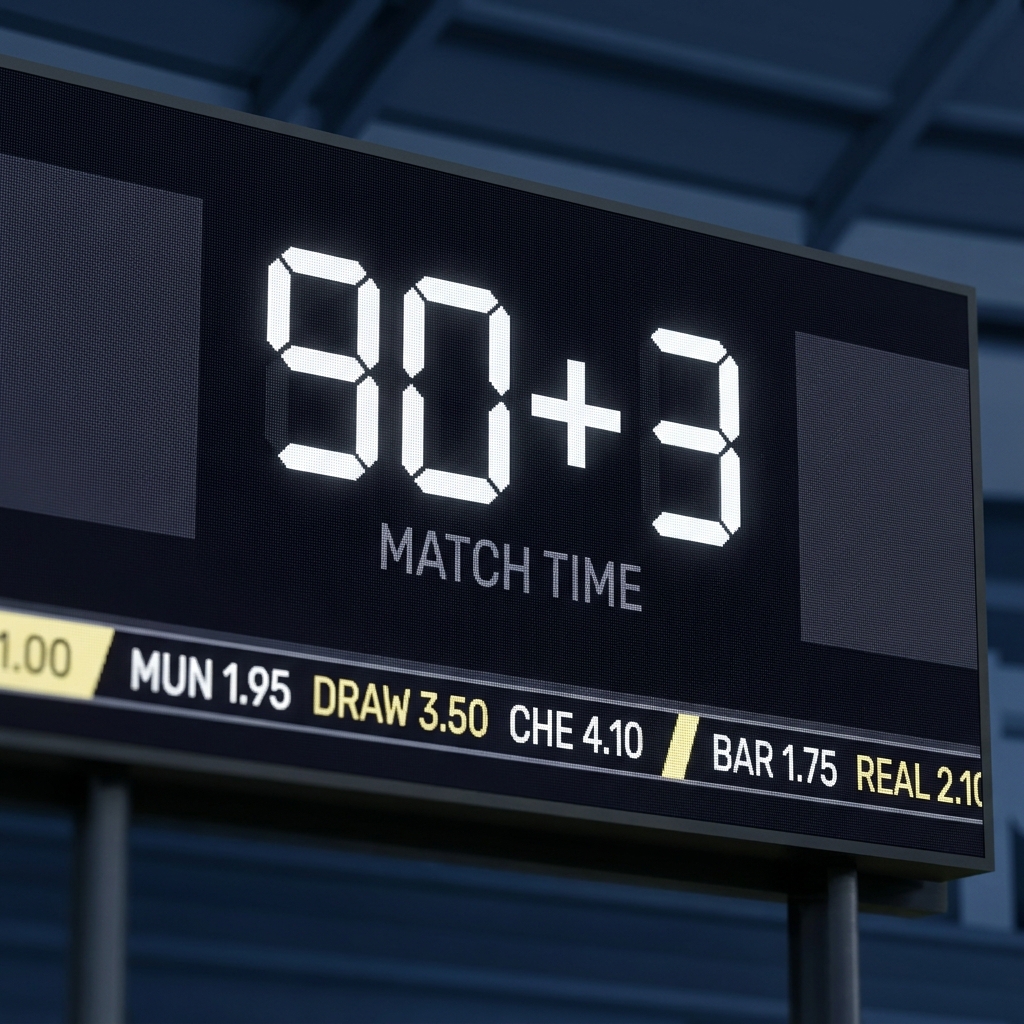
Because edge estimates are noisy and settlement risk in soccer is high, many practitioners scale Kelly down, often to a quarter or half of the full Kelly stake, to limit drawdowns and reduce the chance of ruin. With short odds and small edges, fractional Kelly reduces volatility while preserving compound-growth sensibility compared with flat fixed-stake approaches.
Practical guidance: when your margin-adjusted edge is small, treat the Kelly output conservatively and consider an additional safety multiplier for late-match exposure where IFAB clarifications or exchange quirks increase uncertainty. In short, use Kelly to inform sizing but adopt significant downscaling when estimation or settlement uncertainty is material.
Pre-trade checklist: rules, liquidity and execution steps
Mandatory checks before taking a short-odds position
Before taking a position, verify these items: margin-adjusted edge from your model, current market liquidity at the price levels you expect to trade, the venue's settlement rules for late-match events, and your planned stake computed under a conservative sizing rule. If any of these checks fail, do not enter the trade.
Execution order: sizing, triggers, and contingency plans
Execution should flow from sizing to triggers to contingency plans: pick a conservative stake, place your entry with a pre-defined trigger or limit, and document exit conditions and emergency actions. Pre-commitment removes emotional reaction to late swings and helps preserve long-term performance.
minute-level match-timer and settlement-rule checklist for in-play execution
Use during live matches to update decisions
Confirming liquidity and expected slippage typically requires a quick depth check and, where possible, small test orders to validate execution assumptions. Where liquidity is thin, either reduce stake or avoid entry because slippage can convert a fragile edge into a losing proposition before any settlement quirks are applied Pinnacle resource on overround.
Decision criteria: when to pass or take the trade
Minimum edge thresholds and practical filters
Set a conservative minimum margin-adjusted edge threshold for consideration. Because top-tier soccer markets are generally efficient, small raw advantages are often illusory after fees and slippage. Treat the minimum as a moving filter: increase it when liquidity is low, when match timing shows elevated late-goal risk, or when settlement rules add uncertainty.
How to factor late-game risk into the decision
Factor time remaining and the distribution of likely goal timing into your decision. For matches entering heavy added time or with recent momentum shifts that raise the chance of late goals, require a larger margin-adjusted edge before entering, or prefer scaled-down fractional stakes. Remember that long-run profitability depends on surviving these high-variance endings.
Decide whether you will rely on price triggers, time thresholds, or a hybrid. Price-based exits capture risk around expected value deterioration, while time-based exits prevent exposure to extended added time and unusual stoppage. For short-priced favourites a common approach is to use both: a conservative price stop and a strict time stop that shortens exposure as the match approaches full time.

Define emergency actions for cases where VAR or abandonment affects settlement. If an exchange rule can void the market or delay settlement, set an emergency checklist that includes immediate position reduction, manual hedging where possible, or documented acceptance of the venue-specific settlement outcome. Practicing these actions beforehand reduces the chance of reactive errors.
First, ignoring overround and failing to convert to fair probabilities is a common and costly mistake; always remove margin before judging an edge. Second, neglecting settlement rules, especially around late-match incidents like VAR or abandonment, leaves traders exposed to surprises that change profit and loss. Third, poor stake sizing driven by overconfidence or misunderstanding of small edges creates outsized drawdowns relative to the expected edge Pinnacle resource on overround.
Behavioural biases include overtrading favourites because they feel safe, anchoring to pre-match prices and failing to revalue after tactical changes, and reluctance to accept small losses late in matches. Recognize these patterns and enforce the checklist rules and pre-defined exits to reduce their impact.
Practical examples and minute-by-minute scenarios
Hypothetical trade where the favourite is winning late
Imagine a short-priced favourite leading late in the second half. A trader who entered earlier at a small margin-adjusted edge now faces added time and an increasing chance of a late equalizer. The practical response is to follow the pre-committed exit: either tighten the price stop to lock in a portion of the profit or implement a hard time-based exit that reduces exposure as stoppage time approaches. Doing so concretely links valuation to timing risk and prevents an otherwise rational edge from being eroded by a single late event.
Example where settlement rules change the outcome
Consider a late goal subject to VAR review. Depending on the venue, VAR reversal may be treated as part of normal settlement or, in some cases, may delay or alter the endpoint for markets, changing the P&L compared with naive expectations. Traders who mapped these outcomes beforehand will know whether to hedge, accept the venue settlement, or close positions earlier to avoid the risk. (See Sky Sports coverage on VAR powers.)
In both examples, slippage and liquidity matter: a theoretically profitable exit that cannot be executed at the assumed price becomes a losing trade practically. Always include an execution buffer in your pre-trade math to reflect realistic fills and liquidity depth Betfair football rules and regulations.
Backtesting, tracking and measuring performance
How to build realistic backtests for short-odds strategies
Build backtests using historical prices adjusted for bookmaker margin and realistic execution costs. Include minute-level timing so that a goal at 90+3 can be represented as a late event that impacts settlement, and ensure your simulation respects the exchange settlement rules that applied historically. Without these adjustments, tests will overstate an edge.
Key metrics to track and why
Track realized edge after fees and slippage, drawdown, hit rate and time-in-market for each trade. These metrics reveal whether your margin-adjusted model predictions hold up when subjected to real execution friction and settlement quirks. Pay special attention to performance in the final ten minutes of matches where outcomes often diverge from pre-match expectations.
Monitoring, post-trade review and continuous improvement
What to record after each trade
Record pre-trade margin-adjusted edge, model probability, planned stake, executed fills, exit reason, slippage and settlement notes. This record lets you audit whether the decision process worked as intended or whether a breakdown in execution, estimation or rule mapping occurred.
How to iterate on your edge estimates
Review batch performance regularly and update your model calibration if realized edge systematically differs from expectations. Small persistent gaps imply either a model bias or unaccounted friction such as overround, slippage or settlement rules that were misunderstood. Use controlled experiments and paper trading to test changes before deploying larger stakes.
Conclusion: disciplined steps to trade favourites at short odds
Key takeaways
Trading short-priced favourites requires a disciplined sequence: remove bookmaker margin, estimate edge conservatively, size positions with a downscaled Kelly approach, and pre-commit to exits that reflect late-match and settlement risk. Remember that top-tier soccer markets are efficient and that small edges are fragile once fees and slippage are applied.
Practical next steps to practice and validate a strategy
Start by paper trading or using simulated challenges to practice the checklist and settlement mapping, backtest with margin-removed historical prices, and document every trade so you can iterate on the model and execution rules. A disciplined approach, regular review and conservative sizing are the practical path to managing short-odds exposure responsibly.
Convert quoted odds into implied probabilities, sum them to find the market overround, then divide each implied probability by the sum to obtain margin-adjusted probabilities.
No, full Kelly assumes precise edge estimates; practitioners commonly use fractional Kelly to reduce drawdown and account for estimation error and settlement uncertainty.
Yes, clarified added time rules increase the minutes during which late events can alter settlement, so treat late-match exposure as extended and plan exits accordingly.
References
- https://www.aeaweb.org/articles?id=10.1257/jep.23.2.153
- https://www.theifab.com/laws/latest/changes-and-clarifications/
- https://www.pinnacle.com/en/betting-resources/betting-tools/what-is-overround/
- https://link.springer.com/book/10.1007/978-981-4566-12-3
- https://support.betfair.com/app/answers/detail/a_id/405/~/football-rules-and-regulations
- https://theanalyst.com/eu/2023/08/when-are-goals-scored-football/
- https://www.fundedplays.com/challenges
- https://www.theifab.com/law-changes/latest/
- https://www.reuters.com/sports/soccer/ifab-approves-new-rules-curb-time-wasting-will-be-effect-2026-world-cup-2026-02-28/
- https://www.skysports.com/football/news/12098/13549645/world-cup-ifab-confirm-new-var-powers-10-second-substitutions-and-tactical-timeout-ban-in-major-rule-changes
- https://www.fundedplays.com
- https://www.fundedplays.com/blogs
- https://www.fundedplays.com/blogs/how-fundedplays-evaluations-work