

Trading NFL Division Games: what makes these matchups unique
Quick definition and why divisional games matter
Trading NFL Division Games refers to identifying tradable edges specifically in intra-division matchups where teams face familiar opponents, where standings and tiebreakers change marginal incentives, and where scheduling often concentrates attention late in the season. Under the current 17-game format, each NFL team plays six divisional games per season and Week 18 is commonly used to stage divisional matchups to raise competitive implications and broadcast value, which alters market attention and late-season incentives NFL schedule page.
Divisional contests tend to compress informational variance: teams see each other frequently, schematics are known, and coach familiarity can shift in-game play-calling away from typical season norms. That compression can reduce variance for certain predictive models, while heightening the importance of marginal inputs such as player availability and exact game state in the closing minutes. Traders who treat these features as a structural input can adjust position sizing and hedge plans accordingly.

Where divisional games sit in the 17-game schedule
Week placement matters for traders. Because six divisional games are built into each team schedule, the calendar creates recurring windows where divisions will decide playoff seeding and relative positioning. Flexible scheduling practices often cluster the most consequential divisional games into later weeks and national windows, amplifying liquidity and faster price discovery when markets react to late information NFL flexible scheduling policy.
For a trader, that means some division games will reliably draw deeper books and more efficient lines while others - early season or regional afternoon slots - can still present local mispricings. Identifying which divisional games will be in a high-liquidity window is part of a pregame scan that separates routine matchups from tradable showdowns.

Flexible scheduling and national windows further shorten the mispricing window for late-season matchups by moving high-interest games into prime-time slots.
How schedule and seeding rules change incentives in divisional games
Tiebreakers that alter team motivation
Formal tiebreaking procedures prioritize head-to-head outcomes and division record before broader criteria, so a single divisional win or loss can have outsized downstream effects on playoff seeding and wild-card qualification; understanding that order helps traders anticipate when a coach or front office might treat a game as strategically critical NFL tiebreaking procedures.
When division record and head-to-head are relevant, marginal incentives change. Teams chasing a division crown may accept short-term risks late in games to secure a head-to-head edge, while teams locked into a slot may play conservatively. Those shifts in incentive influence pregame lines and live market reactions, so traders should mark teams whose season math makes every divisional game a high-leverage outcome.
Week 18 and late-season scheduling effects
Week 18’s divisional focus concentrates decision value because outcomes interact directly with seeding mechanics and the tiebreaker order, increasing coaching urgency and public attention. That collective focus tends to increase market liquidity and compress windows where simple public lines stray from fair value, making reactive trading faster but often smaller in absolute edge NFL schedule page and reporting on Week 18 schedules Week 18 schedule updates.
Flexible scheduling and national windows further shorten the mispricing window for these late-season matchups by moving high-interest games into prime-time slots. Traders should expect quicker price discovery and plan for faster execution or layered entries when taking positions in these showcase division games Flexible Scheduling Procedures.
Pregame edges: reading injury reports, line moves, and motivation
Standardized injury reporting and timing
One of the most reliable pregame signals is player availability, because the league maintains standardized injury reporting and publishes season injury data that inform availability assumptions; tracking the timing and phrasing of entries can identify late information gaps that public markets may not have fully absorbed NFL injury data.
When a division opponent loses a starter on a short-week or misses a key positional contributor, the expected matchup balance shifts more than in unfamiliar contests because coaching staffs have limited hidden schematics to disguise personnel losses. Traders should build an injury checklist that flags practice participation trends, game-day designations, and any late movement that could force a league update.
See how structured challenges work
Before placing pregame exposure, confirm official injury designations and whether a last-minute practice report or day-of-game change will meaningfully alter your view of coach incentives and matchup balance.
Late-week line movement patterns to watch
Late-week line moves in divisional games often reflect two overlapping forces: new availability information and shifts in perceived motivation tied to tiebreaker math. Because head-to-head outcomes and division record matter more for final standings, late public and sharp money can be directional and larger than equivalent moves in non-divisional contests.
Practical checks: compare the timing of the move to the timing of injury updates, check whether the move coincides with announced lineup changes, and measure liquidity changes that accompany the move. If a line adjusts without a clear roster or motivation trigger, that can indicate a market imbalance worth probing, keeping in mind that flexible-scheduled showcase games will usually adjust faster due to deeper books NFL flexible scheduling policy.
In-play framework: win probability, game state, and market reaction
Core win-probability inputs and how markets track them
When trading NFL division matchups live, a compact model of game state is essential. Mainstream win-probability models incorporate time remaining, score differential, timeouts, field position, and pregame strength, which map closely to how live markets move during possessions and end-game sequences ESPN analytics update.
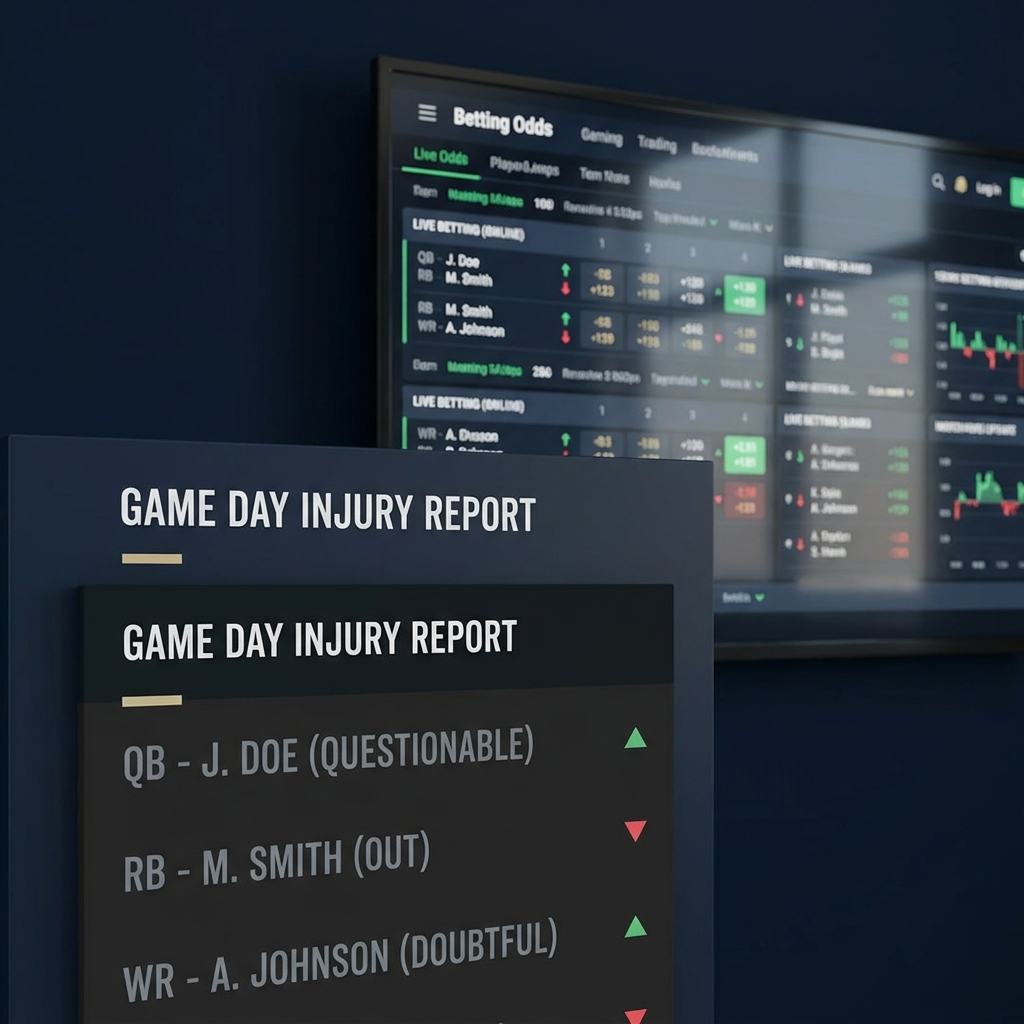
Traders should align their dashboards so those variables are clearly visible and updated each play. Because divisional opponents may run more predictable sequences from known formations, win-probability swings for a given event can be smaller than in unfamiliar matchups; that compressed variance means signals require higher conviction or cleaner execution to be profitable.
Translating WP shifts into trading signals
Translate WP shifts into tradable actions by setting rules: a sustained WP move against public sentiment after a meaningful championship of objective inputs - such as sudden turnover or confirmed injury - can justify layering a hedge or adding to a live position. Always cross-check whether the event is idiosyncratic to known division tendencies or a broader indicator of team form.
For example, when a possession-ending turnover shifts WP dramatically but time, timeouts, and field position still favor the original side, a measured hedge can lock value while preserving upside. Because division familiarity may mute large swings, favor trading signals that combine WP move magnitude with contextual checks like timeout counts and distance to goal.
Managing end-game hedges: clock management, timeouts, and overtime rules
Rulebook mechanics that change hedge sizing
Rules about clock management, timeouts, and overtime define plausible end-game scenarios and therefore affect hedge sizing. Traders must internalize which rules most often change the probability path in a final drive and adjust hedge stakes to reflect those constraints 2024 NFL rulebook.
Key checks include remaining time, timeout inventory, the current down-and-distance, and whether overtime is a realistic outcome. Those mechanics directly influence whether a coach will run out the clock, attempt a high-variance play, or use timeouts to set a field-goal opportunity. Each outcome demands a different hedge sizing approach.
Late injury-report timing or a day-of roster designation tends to be the single most impactful change because it can shift matchup balance, coach incentives, and market pricing in a compressed informational window.
When tiebreakers make the divisional result important, coaches may change conventional end-game choices. If a team needs a win to clinch a division or secure a seeding advantage, expect less conservative clock management and more aggressive fourth-down or timeout usage than usual, which will shift the hedge calculus in favor of preserving optionality rather than locking a small guaranteed return NFL tiebreaking procedures.
Before executing a late hedge, run a rapid checklist: confirm timeouts, estimate drive length with current clock and timeouts, verify kicker availability, and consider opponent tendencies in identical clock scenarios. Hedging aggressively without checking these items is a common execution failure.
Market liquidity and price discovery during divisional showdowns
How flexible scheduling shapes liquidity
Flexible scheduling and the placement of division showdowns in national windows concentrate viewer attention and participant liquidity, which typically causes market prices to move more quickly and with less lingering mispricing. In those slots, speed and execution quality matter more than waiting for a larger mean edge NFL flexible scheduling policy.
Conversely, lower-liquidity divisional games - early afternoon regional slots or snowed-out markets - can still provide local mispricings. Traders who can size appropriately and manage execution slippage may find these fringe windows more forgiving for larger position attempts.
When deep books compress mispricing
Deeper books reduce the duration and magnitude of mispricing because more capital flows into the name and public information is arbitraged faster. Expect smaller windows to capture an edge and design entries that use layered orders, limit fills, or split sizing to combat rapid price discovery in televised divisional contests.
A good rule is to treat nationally televised, late-season division games as execution-focused opportunities and regional, lower-liquidity division games as selection-focused opportunities, altering size and aggression accordingly.
Decision criteria: a pre-trade checklist for divisional games
Hard yes/no filters
Hard filters should be decisive: reliable injury information for affected positions, an identifiable tiebreaker-driven motivation for one or both teams, and sufficient market liquidity to enter and exit without large slippage. If a matchup fails these hard checks, decline the trade.
Soft considerations include matchup familiarity, recent intra-division form, and how flex scheduling will affect attention. Use soft checks to modulate position sizing rather than as a basis for forced entry.
- Hard filter: Confirm official injury designations for starters and rotation players
- Hard filter: Verify division or head-to-head stakes that materially affect incentives
- Hard filter: Ensure available liquidity supports desired size
- Soft filter: Evaluate recent intra-division tendencies and coaching matchups
- Soft filter: Consider rest, travel, and short-week effects
- Position sizing: Scale down when uncertainty remains about late injury status or market noise
live pre-trade readiness check
Use before committing capital
Common mistakes and traps when trading divisional matchups
Behavioral and informational errors
Common behavioral errors include over-weighting familiarity as predictive parity and under-weighting the concrete tiebreaker incentives that change coach and player behavior. Traders who assume division opponents always cancel out each other can miss asymmetric motivation shifts that widen or close an edge NFL tiebreaking procedures.
Informational traps include treating partial or ambiguous injury reports as definitive evidence. Because the league’s standardized reports are the baseline, fill gaps with cautious sizing rather than aggressive inference when clarity is absent NFL injury data.
Execution and hedge failures
Poor execution often stems from ignoring rule constraints like timeouts or overtime structure. Traders who hedge without confirming end-game mechanics expose themselves to avoidable slippage and missed opportunity; always verify timeout counts, kicker status, and current drive context before closing an end-game hedge 2024 NFL rulebook.
Another trap is failing to scale positions to liquidity. Even a correct read can be ruined by price impact, so size to expected execution quality and use layering techniques to reduce slippage in televised division games.
Practical scenarios: pregame and live trade examples without specific odds
Pregame example structured around injury timing
Scenario: a divisional matchup is scheduled for Week 15, a late-week practice report lists a key starter as limited, and on game morning the designation moves to out. A trader who pre-committed without verifying the game-day update may be left with an exposure that materially overstates their edge.
Action: instead of committing full size before the day-of report, use a staged entry plan. Confirm the official roster designation, compare how the team’s rotation will change with the absence, and only increase size after the league-level designation is published and the market has partially reacted.
Live-trade example using win-probability shifts
Scenario: a divisional game sees a sudden turnover that produces a large WP swing, but two timeouts remain for the team now trailing and field position still favors the original side. Because division familiarity compresses variance, immediately locking a full hedge may reduce expected value.
Action: layer a partial hedge that protects downside while preserving some upside, and re-evaluate after the next possession. Combine WP movement with timeout counts and down-and-distance before committing further capital, and prefer smaller, controlled hedges in division rematches.
Data sources and tools to monitor for division trading
Official league feeds and standardized reports
Primary sources should include the league’s standardized injury reports and season injury data as the baseline for availability. Those feeds are the authoritative starting point for pregame decisions and reduce tail risk from speculative roster noise NFL injury data.
Complement official feeds with reliable live win-probability trackers and public market pricing dashboards so you can triangulate whether a WP move corresponds to price action or to a lone informational event. Using models that align with mainstream WP inputs helps identify when markets lag or overshoot ESPN analytics update.
Finally, monitor scheduling notices and flexible-scheduling updates to anticipate where liquidity will cluster late in the year and adjust travel or attention plans accordingly NFL schedule page.
Backtesting, record-keeping, and measuring edge on divisional games
Key metrics to track
Track PnL per trade, realized edge against a baseline model, trade frequency by game type, and drawdown by scenario. These metrics reveal whether a divisional-specific approach provides persistent value or simply capitalizes on transient conditions. Maintain a standardized trade log that records the reason for each entry and the data inputs consulted.
How to set a realistic backtest framework
Design backtests that acknowledge small-sample limitations: divisional game counts per season are fixed, seasons evolve with scheduling and rule changes, and flexible scheduling changes the distribution of high-liquidity matchups. Use rolling windows, hazard checks for schedule shifts, and conservative confidence bounds when extrapolating results to future seasons.
Review performance on a regular cadence and adjust filters if you observe edge decay. A disciplined review routine will identify whether a signal is robust or has been arbitraged away by faster price discovery.
Regulatory, ethical, and platform considerations
Staying within platform rules and expectations
When using a challenge or simulation platform, follow posted rules, withdrawal conditions, and any restrictions on sharing or using proprietary data in public forums. Platforms have distinct formats and traders must operate within those definitions rather than assuming equivalence to other ecosystems 2024 NFL rulebook.
Responsible participation and claims
Be clear: outcomes depend on individual performance and no platform guarantees earnings, qualification, or future opportunities. Maintain transparent record-keeping and avoid making public claims about guaranteed results. Ethical use of shared data and respecting platform rules preserves access and the integrity of the market.
Conclusion and quick checklist for Trading NFL Division Games
One-paragraph recap
Trading NFL Division Games requires combining schedule awareness, tiebreaker-driven motivation, disciplined injury monitoring, and a compact in-play model that centers win probability, timeouts, and field position. Use these inputs to size entries conservatively in high-liquidity national windows and more aggressively when local mispricings offer room to maneuver, always respecting rule constraints and platform guidelines NFL schedule page and the NFL schedules overview NFL schedules.
Printable pre-trade checklist
- Confirm official injury designations for key positions
- Verify if head-to-head or division record affects incentives
- Check expected market liquidity and scheduling window
- Compare late-week line moves to roster updates
- Set position size based on uncertainty and liquidity
- Plan end-game hedge rules tied to timeouts and kicker status
Review trades weekly, track core metrics, and refine filters when edge decay appears.
Each NFL team plays six divisional games per regular season under the 17-game format.
Late-season divisional games often affect playoff seeding and tiebreakers, increasing coaching urgency and market liquidity which changes trading dynamics.
Confirm official injury designations and whether division or head-to-head stakes materially alter incentives before sizing a position.
References
- https://operations.nfl.com/the-game/creating-the-schedule/
- https://www.fundedplays.com/challenges
- https://nflcommunications.com/Pages/2024-Flexible-Scheduling-Policy-and-Procedures.aspx
- https://www.nfl.com/standings/tiebreaking-procedures
- https://www.nfl.com/player-health-and-safety/health-and-safety-data/injury-data/2024-injury-data
- https://espnpressroom.com/us/press-releases/2024/09/espn-analytics-updates-nfl-football-power-index-fpi-for-2024-season/
- https://www.fundedplays.com
- https://www.fundedplays.com/blogs
- https://www.fundedplays.com/blogs/how-fundedplays-evaluations-work
- https://www.cbssports.com/nfl/news/nfl-week-18-schedule-ravens-steelers-49ers-seahawks/
- https://www.nfl.com/legal/flexible-scheduling-procedures
- https://operations.nfl.com/the-rules/2024-nfl-rulebook/
- https://www.nfl.com/schedules