

Quick overview: what trading heavy favorites in MMA means
Trading Heavy Favorites in MMA refers to a rules-based approach that treats heavily favored fighters as tradable positions in both pre-fight and in-play markets rather than long-term one-way bets. The idea is to exploit predictable, event-driven price moves while protecting capital with strict stop-loss and hedging rules, not to seek guaranteed returns.
In live play, markets re-price quickly after visible events, and a trader who focuses on event-driven reaction can find short-term edges if they act according to pre-defined signals, not impulse. Research into in-play market microstructure shows that odds react rapidly to salient events such as knockdowns, which creates short windows of opportunity and also transient reversals Journal of Sports Economics on event-driven odds dynamics.
Practice the ruleset in a funded challenge-style environment
Copy the sample ruleset in the 'A sample ruleset checklist' section and paste it into a simulation or journal before testing live
Heavy favorites still lose at non-trivial rates, so any plan that trades them must include position limits, sizing caps, and explicit exit rules to manage tail risk. Treat favorites as conditional opportunities, not guarantees, and build your plan around measurable rules and rehearsal rather than intuition.
This article focuses on how MMA scoring, observable performance indicators, and fast in-play re-pricing combine to create disciplined trade signals. It walks through pre-fight filters, event triggers, sizing and risk controls, dashboard elements, and two scenario walkthroughs you can test in simulation.

How MMA is scored and why visible damage matters
The standard scoring model in professional MMA is the 10-Point Must System, which asks judges to award each round to the fighter who shows more effective striking and grappling, then to factor in control, aggression, and defense. Because judges prioritize clear, visible damage and effective control, events that visibly alter the opponent's state tend to carry outsized weight on scorecards Unified Rules of Mixed Martial Arts.
For a trader, the takeaway is simple: visible damage, knockdowns, and unmistakable control time create clearer signals for both judges and markets than subtle statistical edges. That makes the observable, narratable events in a fight more useful for live trading than detailed per-minute metrics you cannot verify in real time. Always remember that local commissions or promotion-specific guidance can vary and traders should confirm rules that apply to the card they are trading.
Pre-fight screening: which favorites are worth trading
Good pre-fight screening reduces false positives. Prioritize favorites with strong, observable performance indicators: positive striking differential, history of knockdowns or stoppages, above-average takedown control rates, and demonstrable grappling success. Systematic reviews associate these metrics with higher win probability in elite MMA, so they are a sensible starting point for a watchlist Frontiers in Psychology review of technical-tactical indicators. (See forecasting research: A Markov chain model for forecasting results of mixed martial arts)
Start with a short, numbered pre-trade checklist you can apply quickly to every favorite you consider. Keep sample-size and matchup context in mind: a good raw stat in isolation can mislead if the opponent profile or recency differs. Practice filters in simulation before sizing real positions.
Trade heavy favorites when a clear, observable event aligns with pre-defined triggers and you can enforce a conservative sizing and exit plan; otherwise avoid one-way full-fight holds.
Here are example screening items you can run in sequence: 1) Striking differential positive across recent fights, 2) Knockdown or finish record consistent with opponent durability, 3) Takedown defense better than opponent's takedown success, 4) No clear stylistic mismatch that neutralizes the favorite's strengths. Use relative thresholds rather than absolute claims when sample sizes are small.
Red flags worth avoiding include favorites with limited striking power but high cardio vulnerability, or those with small sample sizes against mismatched competition. If you cannot explain why a favorite should both win and do so visibly, downgrade position size or remove them from the live watchlist.
Event-driven in-play triggers: when to enter and when to pause
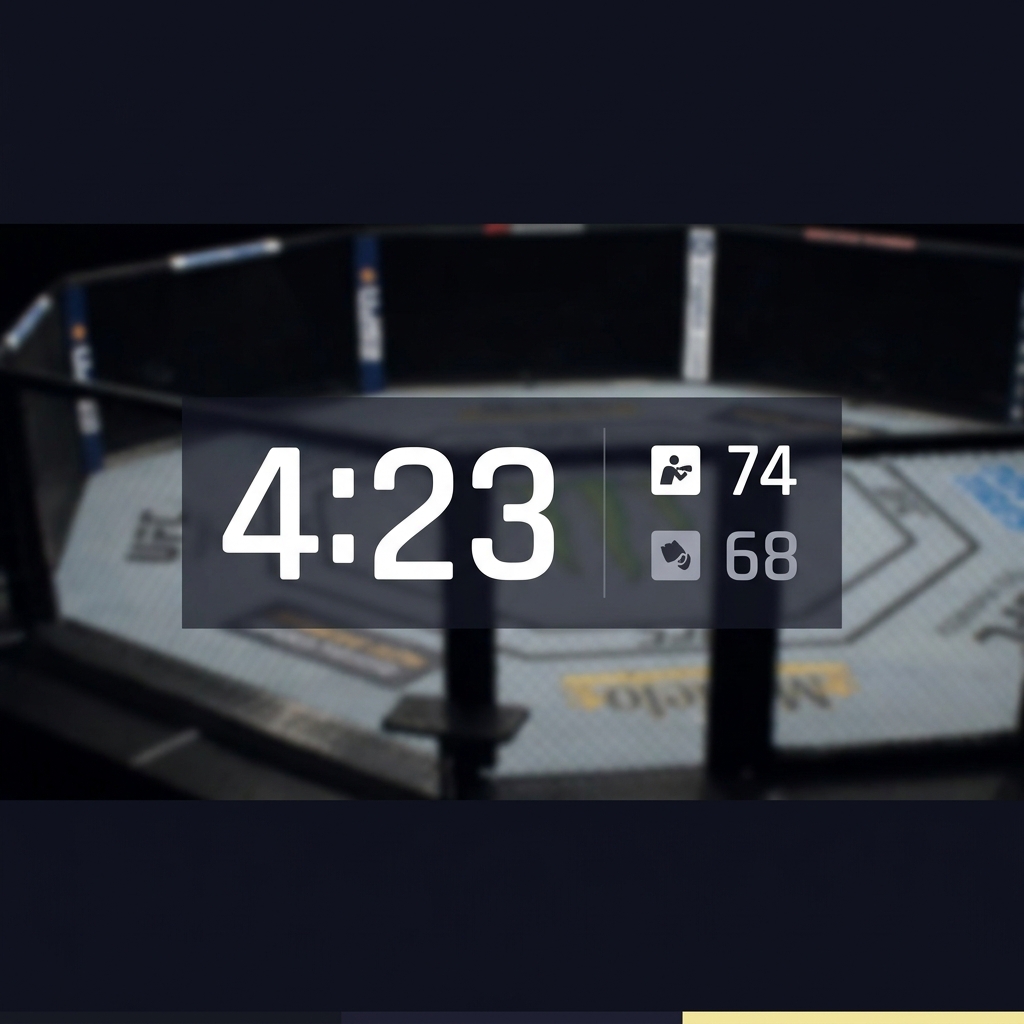
In-play prices move sharply after salient events. Knockdowns, visible cuts, near-submissions, or extended ground control that visibly changes the narrative typically produce the fastest odds adjustments. Because these moves tend to be rapid and sometimes transient, entry rules should be explicit and event-tied rather than emotional or time-based Journal of Sports Economics on event-driven odds dynamics.
Design triggers with simple if-then language. Example triggers: If favorite scores a knockdown and the live implied probability increases by at least X points within Y seconds, then enter a scaled position. If the favorite shows clear visible damage but the opponent rallies, pause new entries until a short confirmation window expires.
Avoid chasing immediate re-prices after a single event without confirmation. Use micro-hedges or tiny protective offsets for large positions taken on early events, and prefer entries after a short delay or confirmation signal if your execution latency is slow.
Rules-based entries, exits, and managing swing rounds
Entries and exits must be mechanical. A few template rules to start from: entry on event-confirmed knockdown with defined fraction of normal stake, stop-loss if implied chance falls below a set threshold, and a profit-taking ladder as odds move in your favor. Tie stop-losses to odds moves or event counts rather than subjective judgement.

Swing rounds and close rounds create outsized decision risk because judges can award marginal rounds unpredictably, and aggregation across rounds can flip the outcome. Empirical analyses show that round-by-round variability and final aggregation increase tails in decision outcomes, which makes hedging or reducing exposure around close rounds sensible Journal of Quantitative Analysis in Sports on round scoring variance.
Practical templates: reduce position size by a fixed fraction at the end of any round you label as 'swing' or close on your watchlist, and consider partial hedges into the opponent when aggregated scoring risk rises. Use concrete triggers to mark a round as swing, for example: both fighters landing within a small strike-differential window and no knockdowns occurred.
Sizing positions and risk controls for heavy favorites
Position sizing should be conservative. Apply fractional Kelly-style staking principles to convert an edge estimate into stake size, then shrink that fraction for path-dependent and volatile events like MMA. Fractional Kelly gives a reasoned framework for size, but in practice traders often use a small fraction because outcomes are noisy and market estimates are uncertain Springer on the Kelly criterion.
Practical sizing rules include absolute position limits (for example no more than X percent of an account on any single live position), session drawdown limits, and a maximum number of concurrent open positions. Plan worst-case scenarios: know the loss if the favorite suffers a quick upset and enforce hard stops that prevent emotional doubling to recover losses.
Examples to copy: use 1-2% of account per standard live stake for favorites, reduce that to 0.25-0.5% when entering immediately post-event without confirmation, and cap total exposure to favorites at a set portfolio percentage per event or session.
A practical toolset: indicators, timers, and dashboards
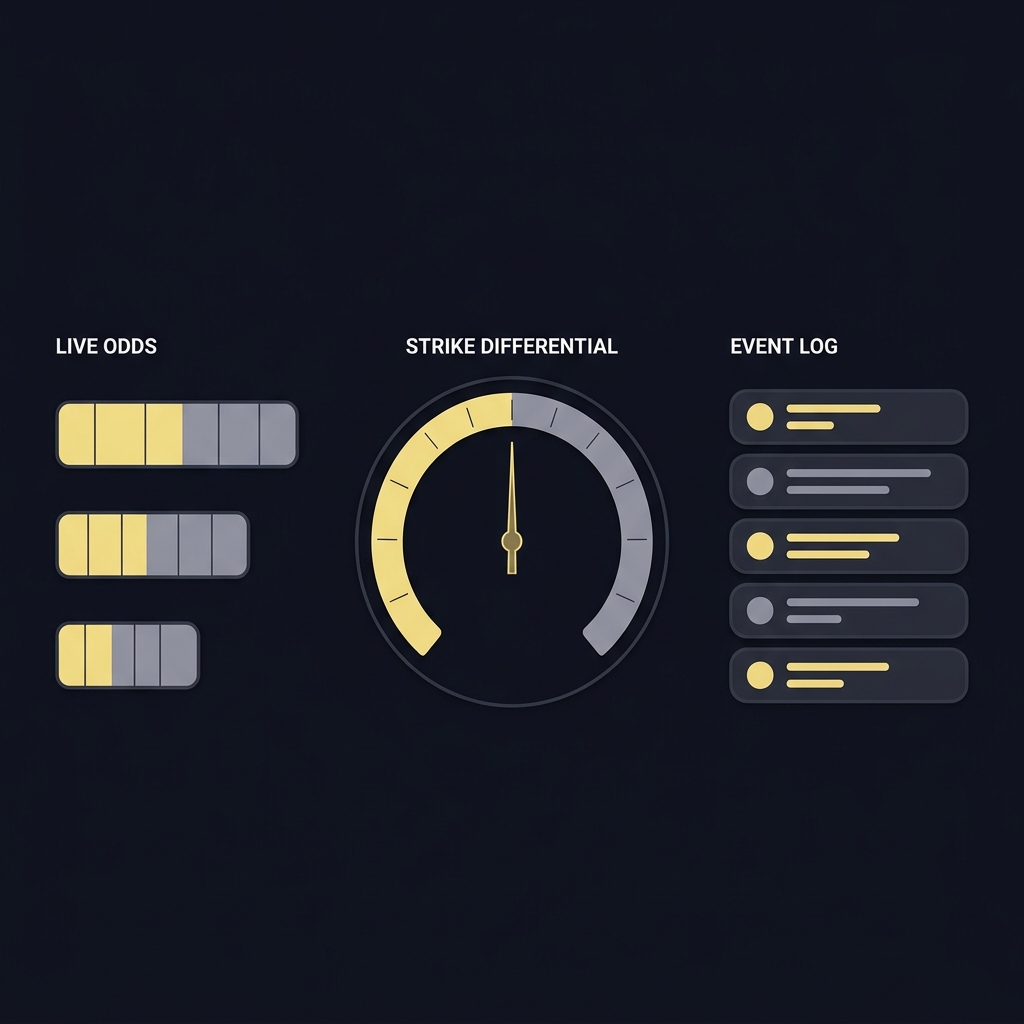
For live execution, keep low-friction indicators front and center: a clean odds feed, a running strike-differential display, visible control-time indicator, and a dedicated fight clock. Simplicity beats complexity in live environments because too many metrics slow decisions.
Minimal live tools a trader should have open
Keep layout low-friction
Configure alerts that highlight trigger events and stop-loss thresholds so you can act without constant manual scanning. A simple dashboard layout places the live odds, a one-line event log, a strike-differential gauge, and a round timer in a single visible row, with alert badges for defined trigger conditions.
How judging variability and round aggregation create tail risk
Judging variability and the way round scores aggregate mean that favorites who dominate statistically can still lose decisions if rounds are close or if damage is unevenly distributed across the fight. Research on round-by-round scoring variance shows that marginal rounds and aggregate scoring drive many surprising decision outcomes, which is directly relevant to trading heavy favorites who do not finish opponents Journal of Quantitative Analysis in Sports on round scoring variance.
To reduce judge-dependent tails, prefer trades that close quickly on clear events or scale down exposure on fights likely to go to decision because of stylistic profiles. When you expect a long fight with subtle scoring differentials, lean toward smaller sizes or avoid full-fight holds entirely.
Common mistakes traders make with heavy favorites
Top errors include emotional sizing, chasing re-prices after a sudden event, and ignoring judging or matchup nuance. These mistakes are common because event-driven odds moves feel informative, but without rules they invite over-trading and large drawdowns. Empirical reviews of performance metrics and outcomes show that casual overrides of pre-defined rules increase tail risk PLOS ONE review of MMA performance determinants.
Quick corrective rules: fix stake sizes before the event, require a confirmation window after salient events, and document every deviation in a post-trade review. Over time, this discipline reduces the odds of repeating costly mistakes and helps build reliable data on what works.
Two practical scenarios: early-finish favorite and decision risk on long fights
Scenario A: favorite drops opponent early then odds swing. Event: favorite scores a first-round knockdown and live implied probability jumps. Sample rule: if the knockdown meets your visible-damage threshold and implied probability moves by at least your entry delta within Y seconds, enter with a small scaled stake and set an aggressive profit ladder. If odds revert by Z points on the first minute without further damage, reduce position by a set fraction or hedge with a small bet on the opponent continuing to survive the round Journal of Sports Economics on event-driven odds dynamics.
Decision points in Scenario A: entry threshold, initial stake fraction, profit target tiers, and a reversion stop. Example: entry at 20% of normal stake, take 50% of position off after X favorable move, and use a micro-hedge if odds revert by Y before the end of the round. These parameters are testable in simulation and are conservative when favorites have non-trivial upset risk.
Scenario B: favorite controls but does not finish, judges decide. Event: favorite dominates position time and landing volume but causes no clear damage. Risk: judges may favor late control or value different actions than your expectations. Template rule: reduce starting size for full-fight holds, and consider scaling down further after any round you label as close. If the fight goes into the championship distances, consider partial exits before the final rounds to lock in gains and avoid aggregation swings Journal of Quantitative Analysis in Sports on round scoring variance.
Decision points in Scenario B: starting size, round-by-round scale-down triggers, and a hedging plan that activates when a fight remains a decision candidate after mid-fight. Simulate several variants and keep metrics on how often your hedges and partial exits reduce drawdown versus costing edge.
A sample ruleset checklist you can follow
Pre-fight filters and watchlist rules to copy: 1) Striking differential positive in last three fights, 2) At least one professional knockdown or stoppage in last four fights, 3) Takedown defense above league median relative to opponent, 4) No recent weight-cut or medical red flags identified. Use relative benchmarks rather than absolute thresholds to avoid small-sample biases Unified Rules of Mixed Martial Arts.
Live trade checklist and post-trade review items to paste into a journal: Entry trigger, Confirmation delay, Initial stake fraction, Stop-loss (odds or event count), Profit ladder, Hedge rule, Notes for post-trade review. After each trade record timestamp, odds, event, action taken, and rationale so you can analyze what worked and what did not. Close each review with a single learning action to test next.
Case study templates to test your rules in simulation
How to log events and label outcomes: maintain a simple event log with columns for timestamp, event description, pre-event odds, post-event odds, action taken, outcome, and brief notes. This minimal structure makes it easy to aggregate results across many trials and compare outcomes by event type and trigger.
Metrics to compare during backtest: edge by event type, win rate after trigger, average profit per occurrence, and drawdown frequency. Run many trials because MMA outcomes are path-dependent and small sample sizes can be misleading. Use simulation to separate structural edge from randomness before increasing live sizes Frontiers in Psychology review of technical-tactical indicators. Simulate several variants and keep metrics on how often your hedges and partial exits reduce drawdown versus costing edge.
Integrating lessons into a reproducible MMA trading plan
Daily routine and preparation checklist: morning pre-fight screen with the pre-trade filters, build a watchlist with position sizes and stop-losses, confirm tools and alerts are functioning, and rehearse the most likely in-play triggers you expect for the session. Consistency in routine reduces decision fatigue and keeps execution mechanical.
How to evolve rules: record performance metrics, avoid overfitting to short runs, and make conservative, incremental adjustments based on statistically meaningful changes. Use fractional sizing increases only after a sustained improvement in edge metrics and keep hard drawdown limits to preserve capital during learning curves Springer on the Kelly criterion.
Conclusion: disciplined edges, not guarantees
Trading Heavy Favorites in MMA relies on linking scoring fundamentals and observable performance indicators to event-driven, rules-based entries and exits. The aim is to manage risk while exploiting rapid market re-pricing on clear events rather than to promise reliable profits.
Next steps: adopt the sample ruleset, test it extensively in simulation or funded challenges, record results, and iterate conservatively. Also verify local commission rules and event-specific guidance before live execution so you understand the exact scoring framework you are trading against.
Heavy favorites lose with measurable frequency; outcomes depend on fight events, judging variability, and matchup specifics, which is why disciplined risk controls are necessary.
Yes, fractional Kelly is a sensible starting framework, but conservative fractions are recommended because MMA is volatile and path-dependent.
In live trading, visible damage and clear control signals usually drive judges and markets more reliably than subtle statistics that are hard to verify in real time.
References
- https://journals.sagepub.com/doi/10.1177/1527002525000000
- https://www.abcboxing.com/unified-rules-mma/
- https://www.frontiersin.org/articles/10.3389/fpsyg.2024.00000/full
- https://www.fundedplays.com/challenges
- https://www.degruyter.com/document/doi/10.1515/jqas-2024-0000/html
- https://link.springer.com/book/10.1007/978-981-13-0570-9
- https://journals.plos.org/plosone/article?id=10.1371/journal.pone.0000000
- https://pmc.ncbi.nlm.nih.gov/articles/PMC9227211/
- https://www.sciencedirect.com/science/article/pii/S0169207022000073
- https://www.fightful.com/boxing/how-does-draftkings-work-for-mma-betting-odds-and-fight-markets-explained/
- https://www.fundedplays.com
- https://www.fundedplays.com/blogs
- https://www.fundedplays.com/blogs/how-fundedplays-evaluations-work