
Quick overview: why golfer head-to-head matchups matter for skilled traders
What a head-to-head matchup is in plain terms: Trading Head-to-Head Golfer Matchups
Trading Head-to-Head Golfer Matchups means focusing a prediction or trade on the direct comparison between two golfers rather than forecasting an entire leaderboard. The format isolates two competitors so a trader can express a relative preference without having to model the full field.
Head-to-head matchups reduce the variables you need to track at once, which makes them useful for demonstrating consistent forecasting skill in a practice environment. They often have a different variance profile than outright markets, and that clarity helps you evaluate decision rules and manage a simulated bankroll.
In matchup trading you are choosing which of two golfers will finish ahead of the other, not who will win the tournament or what score they will post. That pairwise comparison removes many of the interdependencies caused by large fields and allows traders to focus on relative strengths and weaknesses.
Because matchups are binary at the trade level, outcomes are easier to categorize for performance review, which suits platforms that require measurable, repeatable results in a challenge or evaluation setting.
Matchup trading fits naturally into virtual-funded challenge workflows because it supports smaller, more frequent decisions and clearer record keeping. A trader can run many matchups across a week, track accuracy and return per position, and refine sizing rules against a virtual bankroll.
For participants who want a practice environment that emphasizes discipline and measurable improvement, working matchups is a constructive way to build a track record without taking on the complexity of full-field forecasts.
Definition and context: market mechanics and where to find matchups
Common venues and formats for H2H matchups
Matchup markets appear in a few common venues, including sports prediction platforms, contest formats, and some betting exchanges. They can be presented as a listed pair with a favorite and an underdog, or as a priced comparison where each golfer has a quoted price or implied probability.
Common formats include straight head-to-head pairings for one round, aggregate matchups across multiple rounds, and editorial matchup lines offered for specific tee times or groups. Understanding the format matters because it changes which factors will determine the likely winner.
Matchup prices are usually shown in one of three ways: as decimal or fractional prices, as American style odds, or as an implied probability percent. Reading a price as an implied probability helps you compare your own estimated chance with the market's view.
Mini-example 1: if a market implies a 60 percent chance for Golfer A versus Golfer B, you would need a belief that Golfer A is better than 60 percent likely to finish ahead to consider a value entry. Mini-example 2: if the market shows a small price differential, that often signals the market sees the pair as closely matched and your edges must be concentrated to justify a trade.

Unlike props that focus on specific statistics or outright markets that identify a single overall winner, a matchup simply settles on which of two golfers finishes in a better position. That narrower question changes where predictive effort is most effective.
For traders, the narrower scope can lower variance in the short run and make it easier to calibrate models or simple signal blends, since only relative performance between two players matters.
Practice matchups in a virtual-funded challenge
Try matchup practice within a virtual-funded challenge to test sizing rules and record keeping without risking real money.
Core framework: a step-by-step approach to trading matchups
Step 1: pre-tournament research and model tuning
Start each event with focused pre-tournament research. Create a short checklist that covers recent form, course fit, and any known physical or schedule issues for the two golfers you are comparing. Keep your research narrow so it is repeatable and time efficient.
Calibrate any quantitative signals on recent, relevant windows rather than long historical spans, and make small, documented adjustments when you change a tuning parameter. Keep a version note so you can trace performance changes back to model updates.
Step 2: sizing and risk limits for single-matchup trades
Define position sizing rules before you place your first trade for the event. Use a percentage of your virtual bankroll or a fixed unit system that is consistent across matchups. The key is that sizing should reflect the confidence band you assign to the trade, and it should respect the maximum exposure allowed by any challenge rules you follow.
Record the rationale for each size decision in your trade log so you can review whether larger sizes were justified by extra conviction or were a result of behavioral bias.
Build a simple research checklist, combine a few reliable signals into a comparative score, enforce pre-defined sizing and exit rules tied to a virtual bankroll, and track every trade in a concise journal to measure and refine your approach.
Step 3: intraday adjustments and exit rules
Set clear entry and exit rules before you place a matchup trade. Decide whether you will allow intraday hedges, partial cash-outs, or re-entries and define the market signals that would trigger each action. Common exits include a change in weather that materially alters course playability, a withdrawal or late injury report, or a pre-defined stop loss tied to a percentage of bankroll.
Keep intraday adjustments disciplined. If you allow exits, require objective reasons documented in your journal so that over time you can measure whether such adjustments improve results or introduce noise.
Preparing to trade: data, signals and building a matchup edge
Which stats and situational factors to prioritize
Prioritize a short list of inputs that typically move relative outcomes. Useful items include recent form measured over the last few starts, course fit indicators such as historical performance at similar venues, and strokes gained facets where available for the aspects most relevant to the course setup.
Other situational factors to watch are tee time, pairing, and any travel or schedule anomalies that may affect a golfer's readiness. Prioritizing these inputs keeps your process manageable and repeatable.
Simple modeling approaches and signal combinations
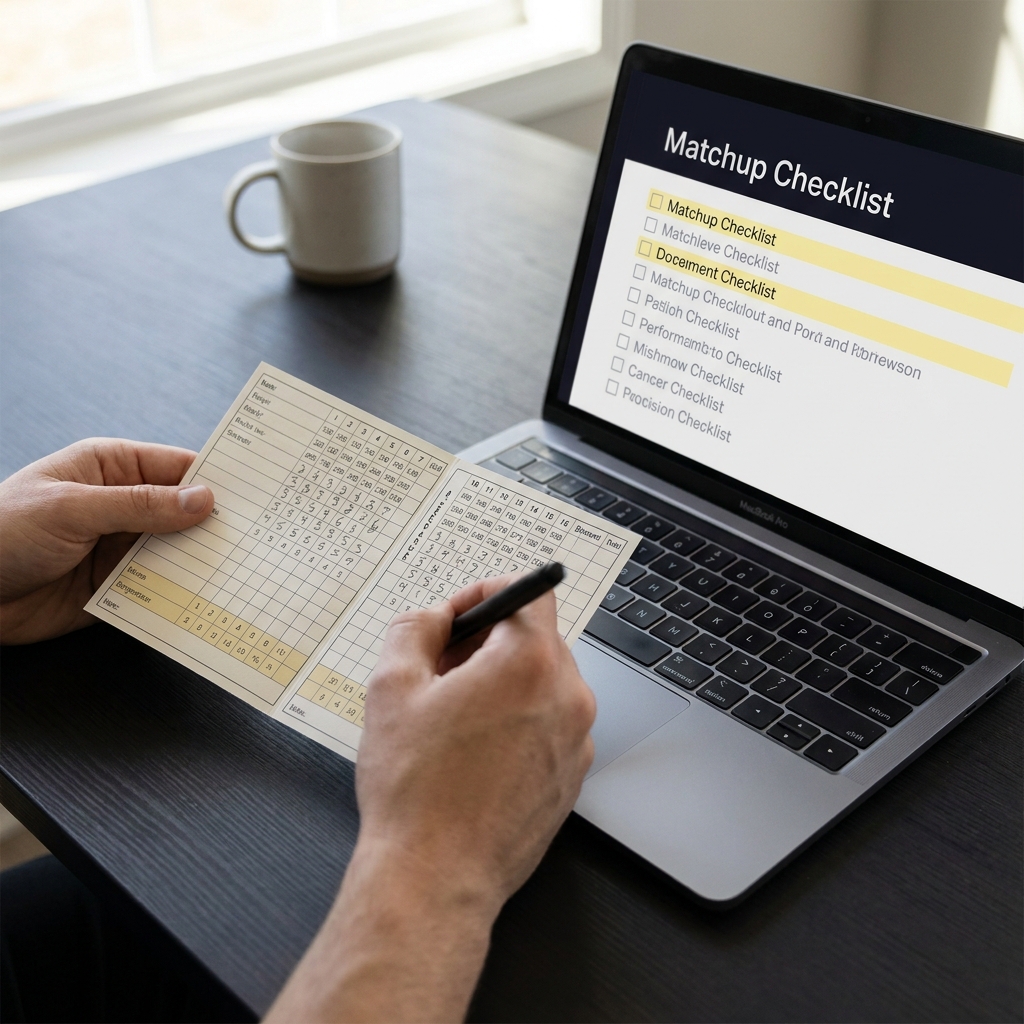
Combine signals into a simple comparative score to rank the two golfers in a matchup. For example, assign small weights to recent form, course fit, and relevant strokes gained categories, then compute the difference between the two players' scores to produce a matchup differential.
Keep the model intentionally simple when you start. That makes it easier to backtest on recent events and to understand which inputs contribute most to correct predictions.
How to adjust for course, weather and recent form
Translate course and weather observations into directional adjustments for your score. If a course favors accuracy over distance, upweight approach game and short game signals. If rain is expected and historically slows scoring, adjust your confidence bands to reflect higher variance and consider reducing position sizes.
Document how each external factor changes your probability estimate and keep the adjustments consistent across similar situations so your edge can be measured over time.
Decision criteria: when to take a matchup and when to pass
Minimum edge thresholds and confidence bands
Set a minimum edge threshold before entering a trade. This could be a simple rule such as only taking matchups where your model shows a clear differential or where qualitative factors add to your confidence beyond a baseline level. The goal is to avoid making trades out of boredom or pressure to be active.
Create a confidence band for each trade and translate it into position size. If your band is narrow, reduce size or pass; if it is wide, a larger but still capped size is reasonable. The same discipline applies within a virtual-funded challenge where drawdown rules matter.
Trade-offs between conviction and diversification
Decide whether to concentrate on a few high-conviction matchups or diversify across many lower-conviction pairs. Concentration can amplify returns when you are right but increases the risk of larger drawdowns, while diversification smooths outcomes but may dilute upside. Align your choice with your documented risk appetite and the constraints of any challenge rules you follow.
Keep diversification intentional. If you diversify, track correlation across your matchups and avoid repeating the same exposure through different pairs that effectively bet on the same outcome.
In-challenge constraints: drawdown and max position rules
Read and respect any formal rules in the challenge you are using to practice, including drawdown limits and maximum position sizes. These constraints should be hard constraints, not flexible guidelines; violating them can invalidate your performance and harm longer term progress.
Design your matchup workflow so that regulatory or challenge constraints are enforced automatically by your sizing rules or by pre-trade checks in your workflow.
Typical mistakes and how to avoid them
Overreacting to short-term noise
Many traders react too quickly to a single poor outcome or a short run of bad results. Remedy this by sticking to pre-defined review windows and waiting for a meaningful sample before changing proven rules.
If an outcome should cause an adjustment, document why and what specific parameter you will change so that adjustments remain controlled rather than emotional.
Poor bankroll sizing and emotional betting
Oversized positions and chasing losses are common operational mistakes. Use fixed sizing rules tied to your virtual bankroll and set absolute stop limits so that one or two bad trades cannot derail your challenge progress.
Make position sizes small enough that you can take several trades per week and learn from the outcomes without exposing yourself to large, emotional swings.

Failing to read platform rules can invalidate otherwise solid performance. Always confirm how the platform treats cancellations, withdrawals, or scoring nuances for matchups and adjust your practice accordingly.
When in doubt, document the rule interpretation and how you will act to keep your practice results clean and auditable.
Practical examples and scenarios you can practice
Walkthrough: comparing two players with different strengths
Imagine two golfers where one has slightly better recent form but the other has a stronger course fit. Walk through your checklist: recent finishes, approach and putting strengths relative to course demands, and any timing or travel notes. Translate those observations into your comparative score and note whether qualitative factors change your confidence band.
Write a short trade journal entry documenting why you chose one player over the other, the position size, and the exit rules you planned to follow. That entry is the material you will review after the event to learn whether your signals predicted the relative outcome reliably.
When weather changes late, re-evaluate the matchup quickly. If rain or wind arrives and the two golfers are teeing off at different times, consider whether the conditions advantage one player. If the change meaningfully alters course playability or scoring variance, follow your pre-defined adjustment rules rather than improvising.
If your rules call for reducing size or avoiding re-entry under weather uncertainty, apply them consistently and record the reason for the action in your journal so the decision can be reviewed later.
Use a simple template for each matchup entry: event and date, the two golfers, your comparative score and confidence band, position size, planned exit triggers, and post-event notes. Keep entries short and factual so they are quick to fill and simple to review.

Practice these scenarios in a virtual-funded account or a simulated spreadsheet so you can test sizing rules, exit discipline, and how well your signal combinations perform without risking cash.
Conclusion: building consistency and next steps
How to turn practice into measurable improvement
Measure accuracy, return per unit risk, and consistency across similar matchup types. Use those metrics to decide which signals to keep and which to drop. Focus on incremental refinements and avoid wholesale system changes after a short sample.
Maintain a clear version history for any change you make so that performance shifts can be traced to specific adjustments in your process.
Suggested routine for ongoing review
Adopt a regular review cadence that covers weekly trade logs, monthly signal performance, and a quarterly strategy review. Look for persistent biases or repeated operational errors and address them with small, controlled experiments.
Keep your routine practical so it becomes a habit rather than an occasional audit.
Simple trade journal template for matchup entries
Keep entries concise and factual
A head-to-head matchup compares two golfers and settles on which one finishes ahead of the other, letting you focus on relative performance instead of a full-field forecast.
Use consistent sizing tied to your virtual bankroll or fixed units and adjust size by your confidence band; avoid oversized positions that risk large drawdowns.
Yes. Simulated or virtual-funded challenge environments let you test sizing, exits, and record keeping without risking cash.
References
- https://www.oddsshopper.com/articles/betting-101/golf-matchup-betting-explained
- https://www.fundedplays.com
- https://www.cbssports.com/betting/news/golf/
- https://www.golfstats.com/headtohead/
- https://www.fundedplays.com/blogs/how-fundedplays-evaluations-work
- https://www.fundedplays.com/blogs
- https://www.fundedplays.com/challenges