

What are First-Round Leader Markets and why they matter
First-round leader markets pay out on the player who posts the lowest 18-hole aggregate after Round 1. Settlement depends on the operator, and ties are commonly resolved by dead-heat rules set in the operator terms; understanding those settlement mechanics is essential before taking a position, since they materially affect realized payouts Action Network guide to first-round leader bets. See PGA TOUR betting guide.
These markets attract traders and modelers who favor short-horizon signals and are comfortable with high variance. Because a single round can swing on changing conditions, participants tend to be pragmatic about position sizing and expect frequent low-odds outcomes alongside occasional outsized wins.
Practice strategies with FundedPlays Challenges
Try a challenge-based simulated practice or subscribe to a short newsletter that delivers model-ready datasets and weekly screening notes so you can test strategies in a controlled, simulated environment.
How FRL markets settle: dead-heat rules and operator differences
Operators use a small range of settlement approaches when two or more players tie after Round 1. The most common method divides the stake proportionally using dead-heat rules, but wording and rounding conventions vary, so it is important to confirm the operator terms for each market Pinnacle explanation of first-round leader betting.
For example, if a dead-heat rule divides payouts equally among tied players, an otherwise identical stake returns a smaller net win than a solo leader result. That difference changes how to size positions and whether to include players who have slightly higher tie risk. Always check the operator settlement wording before placing any FRL position.
Why tee time and AM/PM wave splits are core FRL signals

Analyses from recent seasons show that AM versus PM tee-time waves can create systematic scoring splits. When wind, temperature, or other conditions change over the day, morning and afternoon groups often face different playing conditions; these wave effects have been measured and used as a primary screening variable in practical FRL work DataGolf analysis of tee-time wave splits and in a tee-time draw bias overview statz.ai.
The causal story is straightforward: a late-day wind increase or a morning calm can shift the expected scoring mean for an entire tee-time cohort. Traders treat tee time as a first-order filter, looking for players whose scheduled tee window aligns with the more favorable wave. See additional measurement work in The Fried Egg analysis.
Tee time cohorts often face materially different wind, temperature, or precipitation conditions, which shifts expected Round 1 scoring; modeling those AM/PM splits together with a PCC-style conditions adjustment helps isolate players whose scheduled tee windows align with more favorable scoring expectations.
To screen candidate lists, practitioners typically limit exposure to players teeing within a short, favorable window and deprioritize those in the disadvantaged wave. The screening window size depends on the course and forecast, but the principle is to tilt exposure toward groups that historically show lower Round 1 scoring when conditions differ.
Incorporating weather and Playing Conditions Calculation into one-round projections
The USGA update to the Playing Conditions Calculation in 2024 highlights how abnormal course and weather conditions change expected scoring and should be included in short-horizon forecasts; the PCC framework formalizes the idea that a single-day adjustment can shift scoring expectations materially USGA Playing Conditions Calculation update.
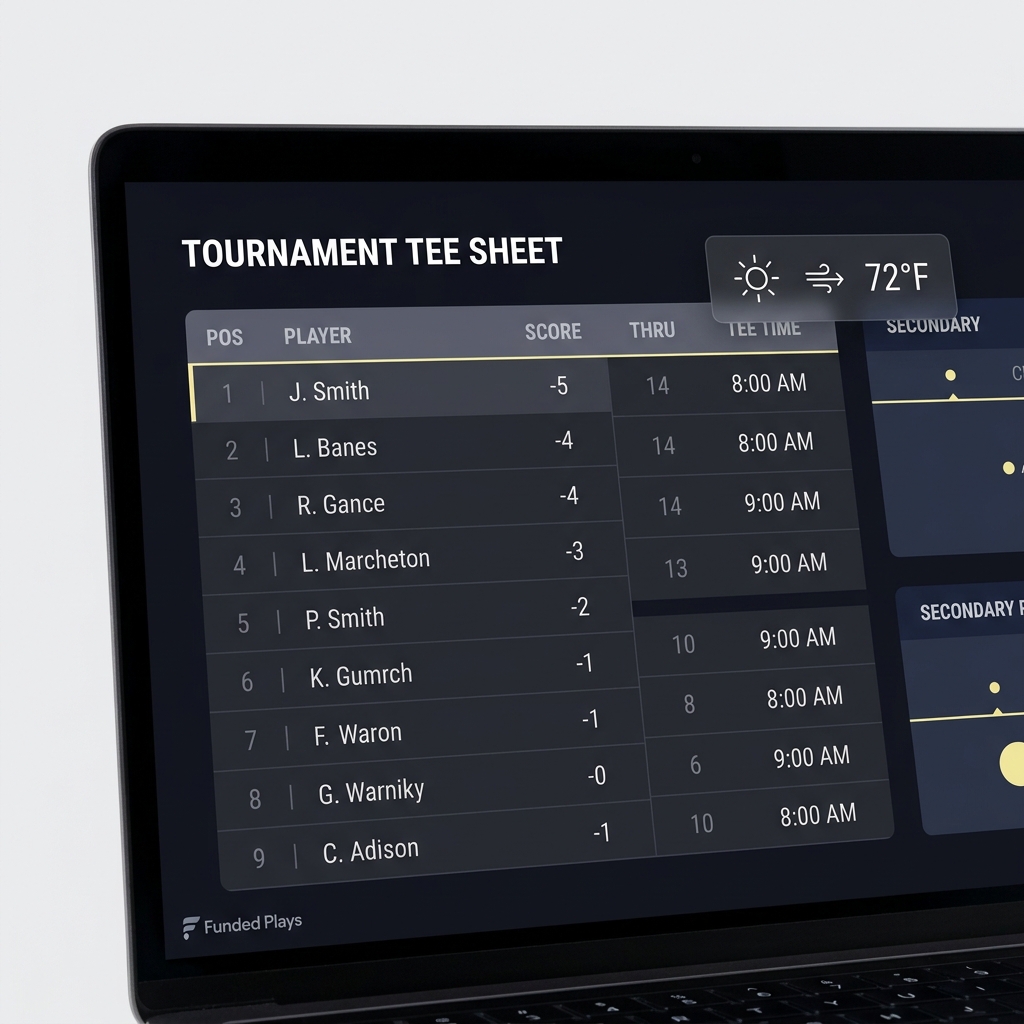
For practical models, the weather inputs that matter most for Round 1 are wind speed and direction, precipitation, and temperature. These variables influence shot shape, club selection, and course firmness and therefore interact strongly with tee-time wave effects when conditions are changing during the day.
A simple way to fold a PCC-style signal into a score projection is to compute a baseline expected Round 1 score and add or subtract a small adjustment factor driven by forecasted wind and precipitation. Calibrate the adjustment using historical rounds with similar PCC deviations, and keep the factor conservative to avoid overreaction to noisy forecasts.
Identifying FRL candidates: Round 1 form and strokes-gained inputs
Round 1 scoring averages from the 2024-25 Tour season help identify players who consistently start rounds strongly; using these metrics to build an initial candidate list improves hit rate for short-horizon strategies PGA TOUR Round 1 scoring averages.
Combine those round-specific averages with strokes-gained indicators that matter for a single round, such as strokes gained: approach and strokes gained: around the green for courses where recovery matters, or strokes gained: off-the-tee where driving plays a large role. Prioritize metrics aligned with the course profile and the expected conditions when narrowing the list.

Use recent starts to add a form overlay. A player with historically strong Round 1 numbers and a few positive recent rounds is often a better FRL candidate than one with volatile short-sample form but a strong lifetime average.
Data sources and statistics to collect for model building
For live screening and weekly experiments, assemble these core feeds: Round 1 scoring averages, tee-time sheets, hourly weather forecasts for the course location, and course setup notes from official tournament communications. Consult the Funded Plays blog for related weekly notes.
Structure a minimal feature table per player and per event: baseline Round 1 scoring average, recent 6-round form summary, tee-time wave indicator, wind adjustment factor, and a tie-risk flag if a player frequently ends in ties. Keep the table narrow to avoid overfitting in early experiments.
Runbook for weekly data pulls and quick feature refresh
Refresh hourly within three hours of first tee
Building a practical trading framework for First-Round Leader Markets
Start by constructing orthogonal signals: a tee-time wave score that captures expected AM/PM advantage, a form score using Round 1 scoring averages and recent starts, and a conditions score based on the PCC-style weather adjustment. Combine these into a single model score by weighting each signal according to backtest stability and domain judgment DataGolf tee-time research.

Map the model score to stake size with a simple nonlinear rule. For example, assign a base unit to the top decile of model scores and reduce stake size progressively for lower deciles, while enforcing a maximum exposure cap per event. Keep stakes modest because FRL outcomes are high variance and frequent drawdowns are normal.
Execution requires live monitoring. Recompute model inputs as tee times shift or forecasts update, and apply clear rules for scaling in or out. For instance, if a sudden wind increase changes the wave advantage, follow a predefined percentage reduction rather than subjective judgment. These execution rules should be automated where possible to reduce emotional adjustments in the final hours before play.
Backtesting, validation and avoiding overfitting
Design multi-season tests that include at least three full seasons where possible, and avoid tuning parameters to single standout events. Tee-time wave effects and form indicators can vary year-to-year, so prioritize signals that remain stable across seasonal splits and course types PGA TOUR Round 1 season stats.
Use out-of-time validation: train your model on earlier seasons and test on later ones, and check that top-ranked candidates continue to show improved hit rates versus random selection. Also run simple sanity checks, like ensuring your model does not consistently favor only the same few players regardless of course or conditions.
Risk management and position sizing for high-variance FRL trading
Because first-round leader markets are high variance, adopt modest stake sizes and strict exposure caps. That means limiting the number of simultaneous positions per event, setting a maximum fraction of bankroll per week, and defining per-day exposure limits to avoid correlated losses across multiple tournaments Action Network settlement and strategy advice.
Consider dead-heat rules when sizing positions. If an operator’s terms increase the probability of a smaller net return on tie outcomes, reduce nominal stake sizes for players with elevated tie likelihood or diversify across non-correlated candidates to lower effective tie exposure.
Set stop conditions: for example, a cap on cumulative loss per event or a rule to pause trading after a sequence of outsized drawdowns. Clear, rule-based limits keep high-variance strategies sustainable and protect your ability to gather more data and learn from experiments.
Common mistakes traders make with FRL markets and how to avoid them
One frequent error is overreacting to a single event or chasing last-minute market moves. Because FRL outcomes are noisy, chasing recent winners often reduces long-term edge and increases risk. Keep position sizing fixed and rely on pre-specified model signals to avoid reactive mistakes Pinnacle guide to FRL risk.
Another common mistake is neglecting settlement fine print. Failing to check dead-heat or refund rules can meaningfully change realized returns. Finally, underestimating AM/PM wave effects or ignoring weather volatility near tee time often leads to poorly timed positions; always re-check the forecast and start sheet close to first tee.
Practical scenarios: example trade walk-throughs without assuming proprietary odds
Scenario A: A player shows strong Round 1 scoring averages, is scheduled in the early AM window expected to be calm, and the forecast shows low wind. The stack is: prioritize the player by model score, assign a conservative stake unit based on decile mapping, and lock the position early while monitoring any start-sheet changes. If the player’s form and tee-time both point in the same direction, this is a clean signal to include on the shortlist PGA TOUR Round 1 stats for candidate selection.
Scenario B: The forecast shifts three hours before play, predicting a wind increase in the afternoon that flips the expected wave advantage. If you have a live rule to reduce stake by a fixed percentage when the conditions score moves beyond a threshold, apply that reduction rather than making a discretionary call. If the shift is large and worsens the candidate’s expected return, scale out or cancel the position per your pre-defined rules.
In both scenarios, the emphasis is on process: stack signals, map scores to stake sizes, and follow your live adjustment rules. The examples are process-focused and do not guarantee outcomes; they illustrate disciplined handling of changing information.
Quick checklist and decision flow for live trading on Round 1
Pre-week checklist: confirm the start-sheet, pull Round 1 scoring averages, retrieve hourly forecasts, and note any official course setup changes that could alter scoring expectations USGA PCC description.
Within three hours of first tee: refresh the weather feed, re-evaluate the tee-time wave indicator, verify operator dead-heat rules, and set final stake sizes according to your exposure caps. Lock positions according to your rules and avoid last-minute discretionary increases.
Conclusion: synthesizing the approach and next steps
Trading First-Round Leader Markets benefits from treating tee time, weather-adjusted PCC-style signals, and Round 1 form as the core inputs. Stack these signals conservatively, map model scores to modest stakes, and automate live adjustments where possible to avoid emotional errors DataGolf tee-time evidence. See the Funded Plays homepage for related resources.
Next steps are practical: assemble the minimal feature table described earlier, run multi-season backtests, and deploy small, disciplined live experiments to validate model stability before scaling exposure. See how Funded Plays evaluations work.
Most operators use dead-heat rules that divide payouts among tied players, but the exact method and rounding can vary, so always check the operator terms before trading.
Wind speed and direction, precipitation, and temperature are the primary weather inputs that shift single-round scoring expectations.
Use modest, rule-based stake sizes tied to model score deciles, enforce per-event and daily exposure caps, and reduce stakes for players with high tie risk.
References
- https://www.actionnetwork.com/golf/first-round-leader-bets-explained
- https://www.pgatour.com/article/news/betting-dfs/2024/12/17/betting-101-how-to-bet-first-round-leader-markets-golf
- https://www.pinnacle.com/en/betting-articles/Golf/first-round-leader-betting-explained/7J9
- https://datagolf.com/blog/wave-splits-tee-time-advantage
- https://statz.ai/golf/betting/tee-time-draw-bias
- https://www.thefriedegg.com/articles/open-championship-luck-draw
- https://www.usga.org/handicapping/whs-2024/playing-conditions-calculation.html
- https://www.pgatour.com/stats/detail/141?season=2025
- https://www.fundedplays.com/challenges
- https://www.fundedplays.com/blogs
- https://www.fundedplays.com
- https://www.fundedplays.com/blogs/how-fundedplays-evaluations-work