

What trading favorites means and why context matters
Definition of trading favorites in tournament play, Trading Favorites in Early Tournament Rounds
Trading favorites in tournament play means choosing the line that preserves chips and wins more often over many repetitions, rather than seeking a high-variance flip that wins a large pot rarely. In plain terms, it is the choice between a steady, lower-variance route that protects your tournament life and an aggressive, higher-variance play that can pay off big but also eliminates you. This distinction matters because tournament structure and stack depth change the currency of decisions from chips to payout equity, and readers need to see both views before acting; for a clear primer on how payout equity differs from raw chip value see the Upswing Poker explanation of the Independent Chip Model Upswing Poker explanation of the Independent Chip Model
Practice disciplined decisions with structured challenges
Use the checklist below and a short study routine to practice making chip-EV first decisions in deep-stack spots and ICM-aware calls when pay jumps are near.
At a basic level, chip-EV decisions maximize your expected chips and favor repeatable small edges, while payout-aware choices adjust those goals toward finishing position and prize distribution. Early in events, deep effective stacks and low blinds mean that raw chip accumulation usually improves your long-term tournament prospects more than the occasional double that costs many chips when it fails. Keep in mind these are frameworks to guide choices, not guarantees of outcomes, and you should pair them with disciplined bankroll and table strategies.
Why chip-EV usually wins in the early levels
Deep effective stacks and small blinds mute the Independent Chip Model pressure in earliest rounds, so maximizing chip-EV and minimizing unnecessary variance tends to be the superior approach. When stack depth is large relative to the pot, avoiding high-variance all-in flips preserves flexibility to exploit future spots, which is often more valuable than risking elimination for a short-term payoff; this pattern is outlined in practical early-stage strategy discussions PokerNews on early-stage tournament strategy
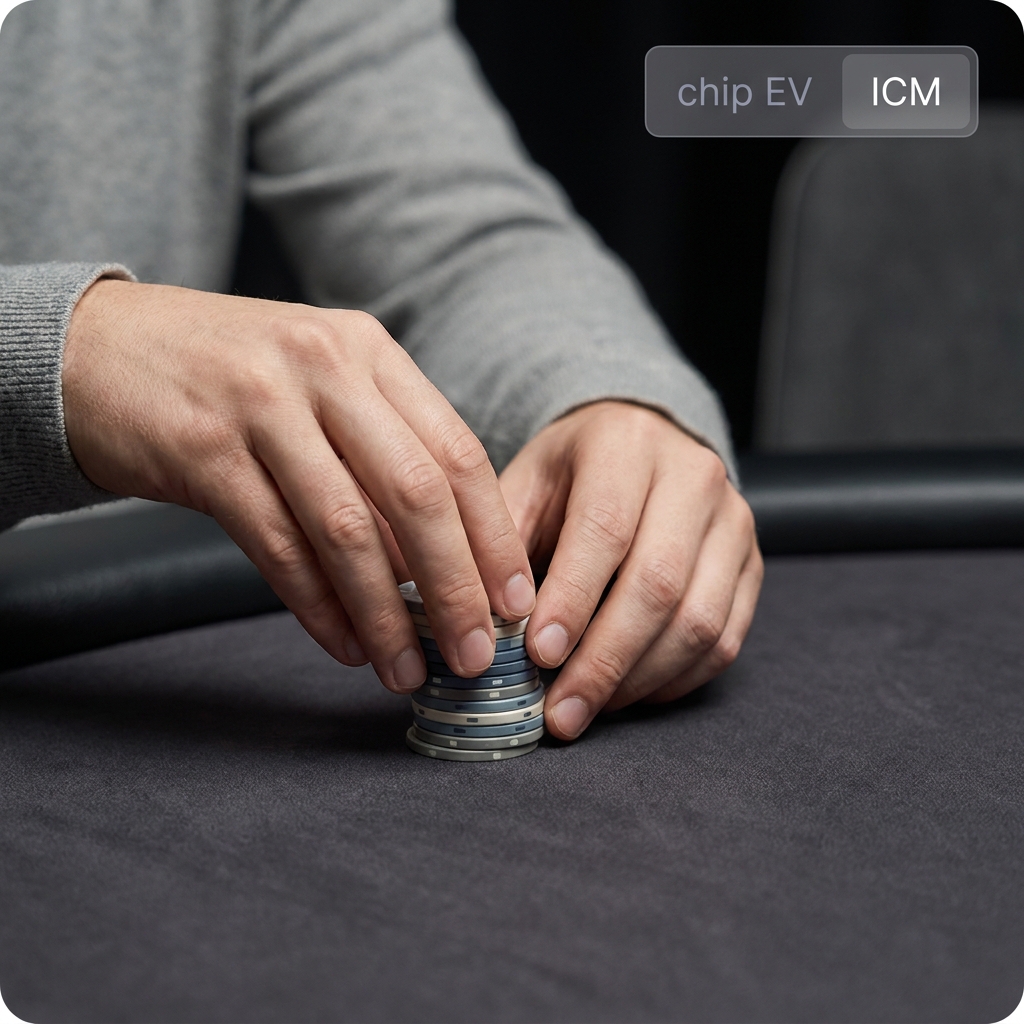
Practically, this means preferring lines that keep the pot manageable, using position to extract thin value, and folding speculative hands to larger bets rather than converting them into marginal all-in confrontations. Small, repeatable edges compound over time, and keeping fold equity and stack depth intact makes it easier to apply pressure later. For many players the best early strategy is conservative aggression, where you still raise and build pots in position but avoid coin-flip gambles without deep structural reason to risk your tournament life.
Here is a short illustrative contrast. Imagine you hold a pocket pair and face an isolation raise from a medium stack. In deep-stack early play you can choose to call and see a flop, control pot size, and try to extract value over multiple streets. A shove for a thin flip may win a big pot now but costs you the ability to maneuver postflop and exposes you to variance that is unnecessary at this stage. The general guidance is to act like you are playing for a long series of tournaments where survival and steady edge compounding beat one-time swings.
A step-by-step decision framework to decide when to trade
Follow a simple three-step framework at the table. Step 1: estimate effective stacks and the stack-to-pot ratio SPR, since these numbers change which lines are feasible and which are reckless. When stacks are deep SPR will often be high and postflop playability matters more, while low SPR pushes you into all-in or fold math quickly. For how ICM pressure rises as stages progress see the GTO Wizard discussion of ICM and risk premiums GTO Wizard discussion of ICM and risk premiums
Step 2: assess the payout structure and nearby pay jumps. Note whether the tournament is far from monetary thresholds or on the bubble because payout jumps increase ICM sensitivity. When pay jumps are many levels away you can default to chip-EV lines, but when a jump is imminent you should factor in the nonlinearity of finishing payouts and reduce marginal-risk plays.
Prioritize chip accumulation while effective stacks are deep and pay jumps are distant; shift to payout-aware caution as stacks fall toward push-fold thresholds or when bubbles or final-table pay jumps approach.
Step 3: compare chip-EV lines to ICM-adjusted risk premiums. Quantify your hand equity, approximate fold equity, and consider how each line influences your ability to play post hand. If stacks are shallow or a pay jump is close, use solver-backed charts or calculators to formalize profitable shoves and calls rather than relying on intuition alone. When in push-fold territory these tools help you turn qualitative concerns into actionable ranges and thresholds.
Quick application rule: default to chip-EV while stacks are deep and the payout landscape is distant, and switch to an ICM-aware stance as effective stacks fall toward push-fold thresholds or when the table approaches bubble or final-table situations.

The general threshold where push/fold logic becomes compelling is around 20 big blinds or below, because fold equity and range compression make all-in decisions cleaner and more decisive. At those depths, ICM risk premiums also tighten calling and shoving thresholds, so many profitable chip-EV shoves under deeper stacks become unfavorable under payout pressure; solver methodology explains why and provides defensible ranges in these zones HoldemResources explanation of ICM Nash and pushfold
Use solver-backed charts to quantify where a shove is profitable for your stack and position. Solvers and calculators produce push/fold thresholds and ICM Nash outputs that convert your qualitative read into a concrete action range. Study these charts away from the table, and in live play refer to them by habit so you avoid guesswork when the clock ticks down and emotions rise. Practical use also means adjusting theoretical ranges for table dynamics and specific opponent tendencies rather than following them blindly. See solver-backed features solver-backed charts for capabilities and outputs.
estimate shove inclination from a few stack and equity inputs
use as study aid
When adjusting charts for live play, remember that HUD silence or unusual table images should widen or tighten your practical ranges. A theoretical shove range assumes average opponent folds and neutral dynamics; if opponents fold more frequently you can shove slightly wider, and if they call more often tighten up. Keep a short list of in-game modifiers to apply to solver outputs so you translate study results to the felt reality accurately.
All-in equity baselines and how to integrate SPR and fold equity
Basic all-in equity baselines are useful heuristics. For example, pocket pairs versus two overcards are typically a common favorite scenario preflop, but that raw equity must be balanced with stack-to-pot ratio and fold equity to decide whether to force an all-in. The foundational mathematics remain a reliable guide for these comparisons; for readers wanting the full theoretical grounding the classic mathematics text remains relevant Two Plus Two foundational mathematics

Combine raw hand equity with SPR and opponent tendencies to make live decisions. A pocket pair with raw equity versus overcards may still be a poor shove if doing so destroys postflop playability for both you and your opponent, or if fold equity is low and a lost flip costs you significant ladder equity. Use hand equity baselines as a starting point then layer in stack dynamics and payout context.
How PKO and bounty formats change trading decisions
Progressive Knockout formats add bounty equity as a separate reward vector, which makes some shoves and calls more attractive because eliminating an opponent yields a direct bounty prize in addition to normal payout progression. The presence of bounty value alters effective thresholds and can compensate for what would otherwise be an unfavorable chip-EV play. Explaining how bounty equity augments decision math is an important adjustment for PKO players and is discussed in final table and format-specific guidance PokerStars Learn on deal and format effects
Practically, when facing a short stack in a PKO you should quantify whether the expected bounty gain meaningfully improves your net expected return. If the bounty makes the expected value of forcing a showdown positive even after ICM and ladder considerations, you may widen your shoving or calling ranges compared to a regular MTT. Keep conservative discipline early, but treat bounty-adjusted opportunities as legitimate tactical levers when the math supports them.
Deal-making: when trading becomes negotiating payouts
Deal-making should typically be a late-stage consideration, most often at final tables, because splitting prizes requires estimating payout equity rather than chopping by chips. An ICM-based split reflects true prize equity better than a raw chip-count division and helps ensure each player receives an equitable share of remaining prize pool expectations; guidance on formal deal negotiation and using ICM splits is widely recommended PokerStars Learn on final table deals and ICM splits
Practical negotiation steps are straightforward. Propose an ICM split, show the calculator output or chart to the table, and ask for consent before locking in the deal. Record the agreed split in chat or on a shared screenshot so the agreement is documented. Consider fees, tax implications, and platform rules when finalizing a deal and avoid pressuring players into premature deals if payouts are small or uncertain.
Common misperception to avoid: players often assume a chip majority equals a fair cash majority, but chips are not linearly equivalent to dollars in a prize ladder. Using payout-equity splits protects both short and big stacks and reduces resentment at the table when results are later compared to expectations.
Typical mistakes and how to avoid them
Players frequently overplay marginal edges early by converting thin advantages into high-variance all-ins that cost flexibility and future fold equity. Another recurring error is ignoring SPR and opponent tendencies, which can flip a superficially positive equity matchup into a losing decision under real game dynamics. Awareness of these common slips is the first step to correction and more disciplined play; practical early-stage rules help prevent repetition PokerNews early-stage rules and cautions
Corrective actions include using the step-by-step framework described earlier, practicing similar spots with solver tools, and tracking tournament outcomes to validate whether adjustments improved your long-term chip accumulation and finishing positions. Keep a short table checklist: estimate stacks and SPR, check payout context, and ask whether your proposed line preserves post-hand playability. Repeat that checklist before large flips.
Practical example spots and annotated decision walkthroughs
Example 1, deep-stack early-round favorite spot. Situation: 120 big blind effective stacks, you hold a medium pocket pair on a passive table. Choice: preserve chip-EV by calling and playing postflop rather than shoving for a marginal double. Reasoning: with deep stacks you gain more from extracting value across multiple hands than risking elimination in a single flip. The deep-stack preference for chip-EV over forced variance is consistent with early-stage strategy literature Upswing Poker ICM explanation
Example 2, short-stack near-bubble push/fold spot. Situation: 18 to 22 big blinds effective, bubble in sight, and you hold a hand that is a slight favorite in isolation but not far ahead in terms of equity. Choice: consult push/fold thresholds and solver-backed charts to determine shove profitability. Reasoning: around 20 big blinds ICM risk premiums tighten calling and shoving decisions, so use solver output to avoid making an otherwise chip-EV profitable shove that is actually $EV negative near the bubble HoldemResources on pushfold and ICM Nash
Example 3, PKO bounty example. Situation: medium stacks and a short opponent with a growing bounty. Choice: widen shoving range slightly to account for additional bounty equity but verify whether the adjusted expected value remains positive after ICM and ladder penalties. Reasoning: bounty value can offset some of the $EV cost of aggressive action, but you must measure that uplift explicitly before committing to risk because the bounty may still be insufficient to justify elimination of your tournament life for small long term gain.
Each example ends with a short table takeaway. Deep-stack takeaway: play to preserve maneuverability and compound small edges. Short-stack takeaway: use solver charts and respect ICM near pay jumps. PKO takeaway: quantify bounty equity then act if math supports it.
A concise checklist and closing advice
Quick table checklist: 1) estimate effective stacks and SPR, 2) check payout proximity and bubble status, 3) ask whether your line preserves post-hand playability, 4) consult push/fold charts if under 20 big blinds, and 5) account for bounty equity in PKO events. These steps help you decide when to prioritize chip-EV and when to apply ICM-aware caution Upswing Poker ICM primer
Where to learn more and practice: study solver outputs in off-table sessions, practice push/fold charts in short-stack drills, and track your decisions to see whether shifts toward chip-EV or ICM-aware play actually improve your results. Remember that no approach guarantees success; thoughtful application and disciplined practice lead to more consistent outcomes.
Default to chip-EV while stacks are deep and payout jumps are far. Favor low-variance, repeatable edges that preserve your ability to exploit later spots.
Push/fold logic commonly becomes relevant around 20 big blinds or below, when fold equity and range compression make all-in decisions clearer.
Bounties add a separate reward component, so widen ranges only when bounty equity meaningfully improves the net expected value after accounting for payout and ladder effects.
References
- https://upswingpoker.com/icm-poker-independent-chip-model/
- https://www.pokernews.com/strategy/early-stage-tournament-strategy-chip-evs-icm-2024.htm
- https://www.holdemresources.net/icm-nash-pushfold/
- https://www.gtowizard.com/blog/icm-in-poker-tournaments/
- https://www.icmizer.com/icmizer/icmizer-features/
- https://www.twoplustwo.com/books/the-mathematics-of-poker/
- https://www.fundedplays.com/challenges
- https://www.pokerstarslearn.com/articles/final-table-deals-and-icm-explained/
- https://www.trybluff.com/icm
- https://www.holdemresources.net/nashicm
- https://www.fundedplays.com
- https://www.fundedplays.com/blogs
- https://www.fundedplays.com/blogs/how-fundedplays-evaluations-work