

What this topic means and why it matters for trading
Trading Domestic Matches After European Competition
When a domestic fixture follows a midweek European tie within about 72 to 96 hours, traders face a distinct scenario: short-rest recovery, potential rotation and measurable performance variance. The phrase Trading Domestic Matches After European Competition will be used here to cover that situation and the typical timing windows traders should monitor.
For practical purposes, the key windows to watch are matches with 72 hours or less between the final whistle in Europe and kick-off at home, and the broader band up to 96 hours where small but meaningful effects on high-intensity outputs and technical execution have been recorded, which can alter expected on-field patterns and market prices. The evidence for those performance shifts is summarized in a recent systematic review in Sports Medicine - Open and will be referenced where it matters for trading choices Sports Medicine - Open systematic review.

Traders care about this scenario because reduced high-intensity actions, tactical simplification and rotation increase outcome variance; those changes can create opportunities if they are identified before markets fully adjust. At the same time, markets often react to clear lineup news faster than to subtle intensity declines, so successful position sizing and timing are essential.
Limitations matter: while sports science links short recovery to on-field performance and elevated soft-tissue injury risk, direct research connecting those effects to immediate odds moves or systematic market inefficiencies is limited, so any trading rules should treat price effects as probabilistic rather than deterministic. For more on the research gap and historical context see an analysis of the so-called European hangover The Analyst explanation.
How the 2024/25 competition and domestic calendar changed and what that increases
Since 2024/25, UEFA competitions moved to an expanded league-phase schedule which increases the number of midweek competitive matches for qualified clubs, creating more frequent short-recovery domestic fixtures for those squads. The format change raises the baseline fixture load traders must consider when assessing rotation risk and rest differentials for top clubs UEFA Champions League new format explained.
Check rest hours, travel, cumulative minutes and lineup signals; scale exposure down when multiple risk flags align and prefer smaller or hedged positions until starters are confirmed.
The domestic calendar has also compressed in several leagues; notably the Premier League removed its mid-season break for 2024/25, which tightens recovery windows across the season and increases the interaction effects between European midweeks and weekend league fixtures. This change raises the probability of back-to-back matches and fewer rest days for squads competing on multiple fronts Premier League announcement.
Workload monitoring evidence for 2024/25 shows more short-rest sequences and back-to-back matches for top players, which forces managers to make minute-management decisions more often and elevates rotation as a planned tactic rather than an occasional exception. Traders should treat workload monitoring as a structural signal about higher baseline rotation risk for clubs regularly in European competition FIFPRO 2024/25 workload report.
What sports science says: performance and injury risks after congested schedules
Sports science converges on the finding that congested scheduling, generally defined in the literature as rest windows of roughly 72 to 96 hours or less, produces measurable declines in high-intensity outputs and technical execution in professional male soccer. Those declines tend to be small to moderate in magnitude but consistent enough that teams and staff respond through rotation and minutes management in real competitions Systematic review in Sports Medicine - Open. See also long-term analysis.
Beyond performance, injury monitoring during congested periods points to higher soft-tissue injury incidence, which reinforces the managerial rationale for conservative rotation or protected minutes after European travel. UEFA's periodic injury findings emphasize that elevated soft-tissue risk is one practical reason clubs reduce load after series of close fixtures UEFA Elite Club Injury Study.
Get the rotation-risk checklist and strategy update
Download a concise checklist or sign up for a brief strategy update to help structure pre-match rotation checks and position sizing without committing capital before you confirm key signals.
Interpreting magnitude and trading relevance means treating performance declines as conditional signals: they make lower high-intensity distance and simplified tactics more likely, but the competitive effect depends on which players are rotated and the relative depth of both squads. For traders, that translates into watching starting XI probability and minutes profiles rather than assuming an across-the-board drop in quality.
How teams typically respond after European fixtures: rotation, minutes management and travel effects
Managers respond to congested schedules in predictable patterns: selective rotation of likely high-minute players, reducing full 90-minute demands for core starters, and an increased planned use of substitutions earlier in the second half to manage load. These patterns are more common when clubs face repeated short-rest sequences reported in recent workload monitoring FIFPRO workload report.
Which clubs rotate more often? Smaller-squad clubs, teams in their first extended European campaign and clubs with longer travel itineraries are likelier to make notable changes to their lineup. Historical analysis of domestic dips during European runs shows that non-elite clubs often experience clearer effects because depth is thinner and recovery resources are more constrained The Analyst discussion.
Practical pre-match signals that traders should scan include early team news, official or local training reports, travel timing and whether a manager has publicly signaled rotation. Those cues usually precede market moves and can be used to estimate starting XI probability and likely minutes for rotation-prone players without waiting for final confirmation.

Quick lineup and rest-hours pre-match checklist
Use this to score rotation risk
A useful operational habit is to treat manager statements and training pictures as higher-quality signals when they confirm what workload and fixture data already suggest. When you combine travel detail, cumulative minutes and visible lineup hints, you get a probabilistic sense of how much to reduce exposure or shift to alternative markets that are less sensitive to rotation.
A step-by-step trading framework for domestic matches after European ties
Step 1, pre-match checklist. Before risking capital, confirm the hours since the last competitive match, travel distance and time zones crossed, recent cumulative minutes for likely starters and any clear lineup leaks. Start with a simple numeric readout and then layer qualitative cues like manager comments and training reports. The systematic review evidence on congested scheduling justifies giving extra weight to short recovery windows when they coincide with heavy recent minutes Sports Medicine - Open systematic review. See also related review.
Step 2, quantify rotation risk. Convert the checklist into a score: for example, assign points for under 72 hours of rest, travel over a threshold, and high cumulative minutes in the prior 7 days. Use the sum to scale position size: when multiple risk flags align, reduce stake or exposure rather than eliminate it. Historical patterns suggest non-elite clubs show larger on-field dips, so adjust multipliers for squad depth accordingly The Analyst background.
Step 3, entry and timing rules. Prefer smaller pre-match positions when final lineups are unavailable. If a clear lineup release or trusted source confirms starters are rested, expect odds correction and consider trimming or exiting. Live triggers to widen or tighten positions include early substitution patterns and a visibly lower high-intensity tempo in the opening half; such signals warrant quicker exits or reduced upside targets.
Step 4, sizing rules. Use conservative multipliers: when one risk flag is present, consider reducing normal exposure by a modest percentage; when two or more flags align, reduce by a larger fraction. Treat these multipliers as starting guidelines to refine with tracked outcomes rather than fixed guarantees, and avoid overreacting to singular examples.
Decision criteria and key metrics to include in your model
Suggested quantitative thresholds to flag risk include hours since last match (under 72 high risk, 72 to 96 moderate risk), cumulative minutes in the prior 7 days (elevated when core starters exceed a typical workload baseline), travel kilometers and number of time zones crossed. These metrics convert qualitative concern into testable model inputs.
Contextual modifiers matter: competition priority, manager rotation history and squad depth should alter how the numeric thresholds are interpreted. A top club with deep rotation options will usually merit a smaller adjustment than a non-elite club facing the same rest differential, a pattern reflected in comparative analyses of domestic form during European campaigns The Analyst analysis.
Incorporate injury and rotation propensity by tracking recent soft-tissue concerns and official injury lists; UEFA injury findings link congested periods to higher soft-tissue incidence and that should feed conservative probability shifts when a squad reports muscle or hamstring concerns before kickoff UEFA Elite Club Injury Study.
Market signals, timing and evidence limits on pricing reactions
Common market behaviors to monitor include odds drift when expected starters are rested, sudden corrections after official opening lineup releases and lower liquidity in smaller markets that makes execution and sizing more difficult. Because direct pricing studies are sparse, traders should treat observed drift as a probabilistic rather than guaranteed edge, and lean on strict stake management when markets appear thin The Analyst on market patterns. Media coverage has also discussed fixture pile-ups report.
Why are direct pricing studies limited? Existing literature focuses on performance and injury links to congestion rather than immediate market pricing, so there is a research gap between documented on-field effects and how quickly and accurately markets price that information. That gap implies traders should be conservative and test rules against their own tracked outcomes rather than assuming consistent mispricing Sports Medicine - Open systematic review.
Practical heuristics: prefer smaller positions on low-liquidity matches, expect faster pricing of obvious absences (starters not named) than subtle intensity drops, and avoid large directional bets until lineups are confirmed if your model depends heavily on minutes distribution.
Common mistakes traders make and how to avoid them
One common error is overgeneralizing the European hangover and assuming uniform dips for all clubs. The evidence shows the effect varies by squad depth and context, so avoid blanket rules that penalize every club that played in Europe The Analyst review.
Another mistake is ignoring club-specific context such as travel details, recent rotation patterns and manager comments. Instead, encode those modifiers into your checklist so that each match receives a contextual adjustment rather than a one-size-fits-all reduction in exposure.
Finally, beware confirmation bias: it is easy to remember the few examples where a European tie preceded a surprise domestic loss and ignore the many times the expected starters performed as usual. Maintain disciplined stake sizing and track rolling outcomes to avoid overweighting anecdotes.
Practical scenarios and short case studies to practice the framework
Scenario A, elite club with deep squad after long travel. Pre-match checks show 72 hours rest, long-haul travel and a manager hinting at rotation. The suggested action is a modest reduction in exposure and a shift toward markets that pay more for underperformance rather than backing a single outcome; if final lineups show many first-choice players rested, trim further or seek alternatives. This scenario reflects workload pressures shown in monitoring reports and is typical for clubs with continental commitments FIFPRO workload monitoring.
Scenario B, non-elite club in first European campaign with a small squad. Here the same rest window often produces a larger practical impact; the model should increase the risk multiplier for reduced exposure because historical analysis finds smaller squads show clearer domestic dips when balancing European matches The Analyst context.
Scenario C, late-season congested run affecting a relegation fight. With cumulative minutes high and soft-tissue issues reported, the prudent move is to reduce outright exposure and focus on hedged positions or markets less dependent on full-intensity performance. UEFA injury findings on congested periods support treating soft-tissue flags as a reason to apply conservative size rules UEFA injury study.
Practical one-page checklist and closing takeaways

Pre-match checklist snapshot: hours since last match, travel distance and time zones, cumulative minutes for likely starters in the prior 7 days, visible lineup hints and manager comments, market liquidity and final lineup confirmation timing. Use those items to generate a simple rotation-risk score that scales position size.
Three quick takeaways: short-rest windows reliably depress high-intensity outputs enough to matter for traders, congested periods raise soft-tissue injury risk and justify conservative rotation assumptions, and existing research links performance to congestion but provides limited direct evidence on immediate pricing so treat market moves as probabilistic signals backed by disciplined sizing Systematic review.
Keep improving your approach by tracking outcomes against the rotation-risk score, refining numeric cutoffs for your markets and preserving stake discipline when evidence is ambiguous. Over time, a small, repeatable edge from disciplined pre-match checks can be more valuable than relying on ad hoc judgments.
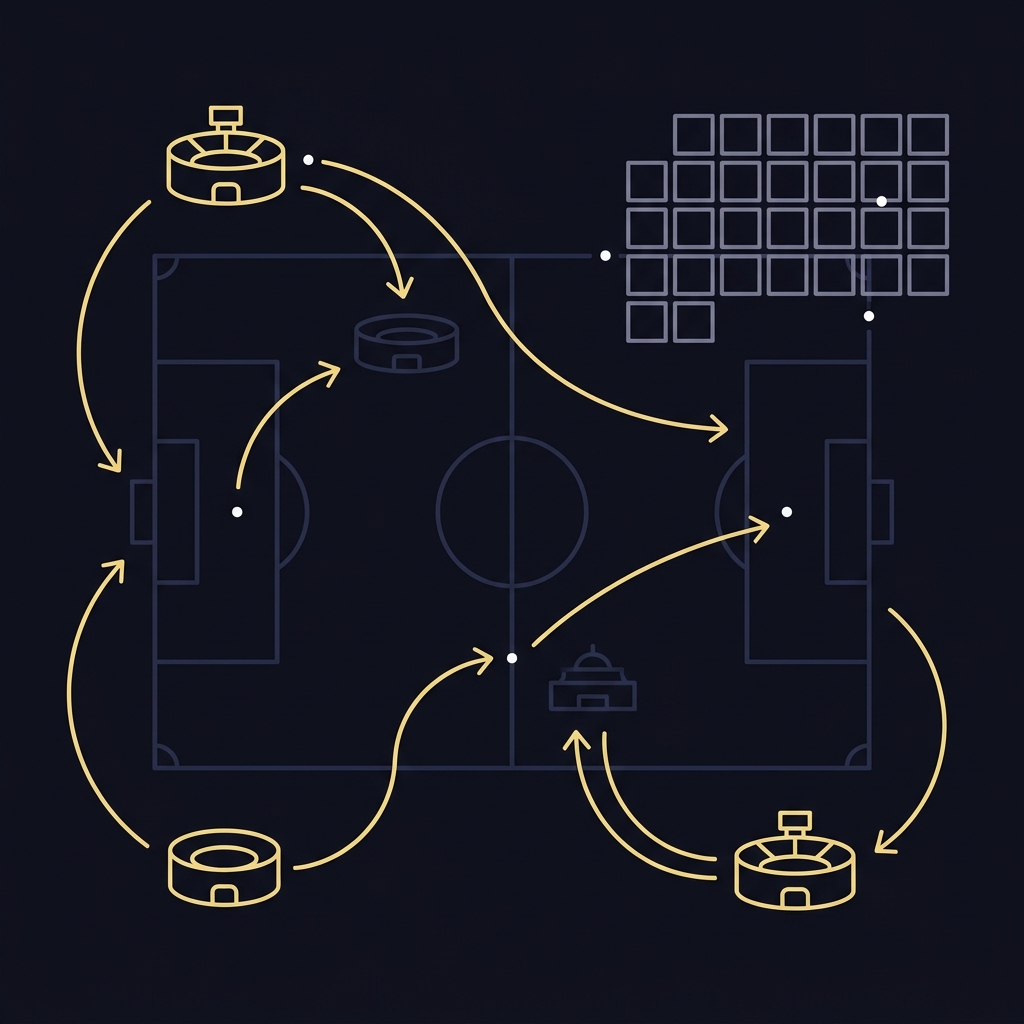
Treat matches within 72 hours as higher risk and the band up to 96 hours as moderately elevated; combine this with minutes and travel checks before adjusting exposure.
Clear training reports, manager comments, heavy cumulative minutes in the prior week and long travel itineraries are the best early indicators of rotation.
No. Markets often price obvious absences quickly. Use conservative sizing and test rules against tracked outcomes rather than assuming a consistent mispricing.
References
- https://sportsmedicine-open.springeropen.com/articles/10.1186/s40798-024-00705-9
- https://www.fundedplays.com/challenges
- https://theanalyst.com/eu/2024/08/european-hangover-do-european-adventures-harm-domestic-form/
- https://www.uefa.com/uefachampionsleague/news/0288-1a4f62d31d94-81b9d37383a3-1000--what-is-the-champions-league-new-format/
- https://www.premierleague.com/news/4152758
- https://fifpro.org/en/industry/workload/player-workload-monitoring/2024-25-men-s-player-workload-monitoring-report/
- https://www.uefa.com/insideuefa/news/028e-1a9a8b7d2fb5-6d7a7f0a2d2a-1000--elite-club-injury-study-2023-24/
- https://www.fundedplays.com
- https://www.fundedplays.com/blogs/how-fundedplays-evaluations-work
- https://www.kitmanlabs.com/blog/verheijen-20-year-study/
- https://pmc.ncbi.nlm.nih.gov/articles/PMC7846542/
- https://medicalxpress.com/news/2020-11-football-fixture-pile-ups-layers.html
- https://www.fundedplays.com/blogs