
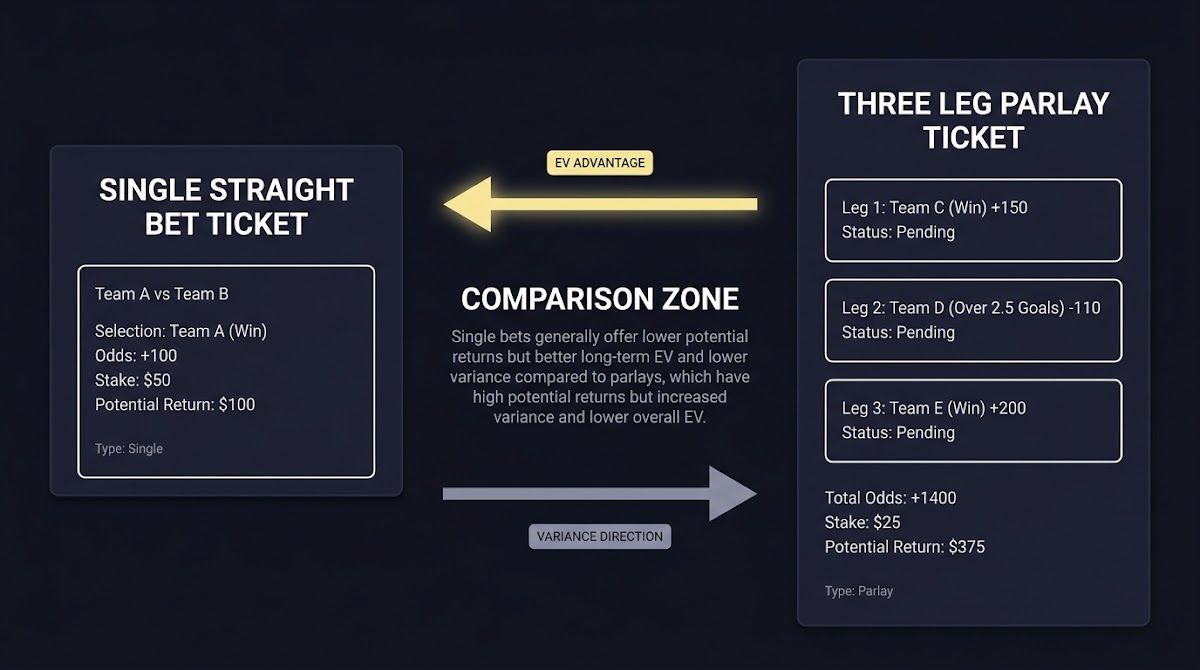
What straight bets are and why this question matters
A straight bet is a single-outcome wager settled quickly against a market price set by a bookmaker. Many bettors prefer single wagers because each ticket requires only one correct outcome to win, settlement is immediate, and the pricing is transparent compared with multi-leg products.
Asking whether straight bets are more profitable is not about short-term streaks. It is about expected value after the bookmaker margin, how variance affects your bankroll, and whether your estimated edge is sufficient to overcome vigorish over many trials. Clear definitions and simple math help separate perception from long-run reality.
Practice structured prediction with FundedPlays Challenges
Subscribe to receive deeper scenario spreadsheets and weekly strategy notes that show step-by-step EV checks and conservative staking templates.
For a recreational player or an analytical hobbyist, choosing a wager type affects drawdowns and the size of bets you should place. This article focuses on the mechanisms that change profitability, not on promising outcomes. It also provides practical checks you can apply to your record keeping and staking plan. (see the Funded Plays blog)
Quick overview of common wager types and how risk differs
Straight bets, parlays, proposition bets, and futures differ primarily by how many correct outcomes are needed and by when they settle. A straight bet requires one correct result, a parlay requires every leg to win, props focus on a specific event within a game, and futures resolve over a long horizon.
Because only one event must be correct, straight bets display lower variance compared with parlays or long-horizon futures. That lower variance produces smoother bankroll paths for the same average edge, which matters when you determine stake sizes and acceptable drawdown levels.

Same-game parlays sit between categories because they bundle multiple correlated outcomes from the same match. Correlation can inflate or reduce real probability compared with the independent-leg assumption, complicating both pricing and risk assessment.
How bookmakers price straight bets and the break-even math
Bookmakers build a margin into prices, commonly called vigorish or vig, which shifts the break-even win rate above a simple 50 percent benchmark. For many US point spread and total markets the standard listed price is -110, which implies a break-even win rate above 50 percent once the vig is accounted for.
At -110, the convert-to-implied-probability step shows the effect clearly. -110 corresponds roughly to 110 / (110 + 100) implied probability on the moneyline side, which leads to a break-even win rate near 52.38 percent, reflecting the vigorish reduction of expected value for the bettor Vigorish (Vig): What It Is, How It Works, and Example.
All else equal, straight bets usually offer higher expected value per unit of variance than parlays because vig compounds across parlay legs. Long-run profitability depends on a real edge, disciplined staking, and careful record keeping.
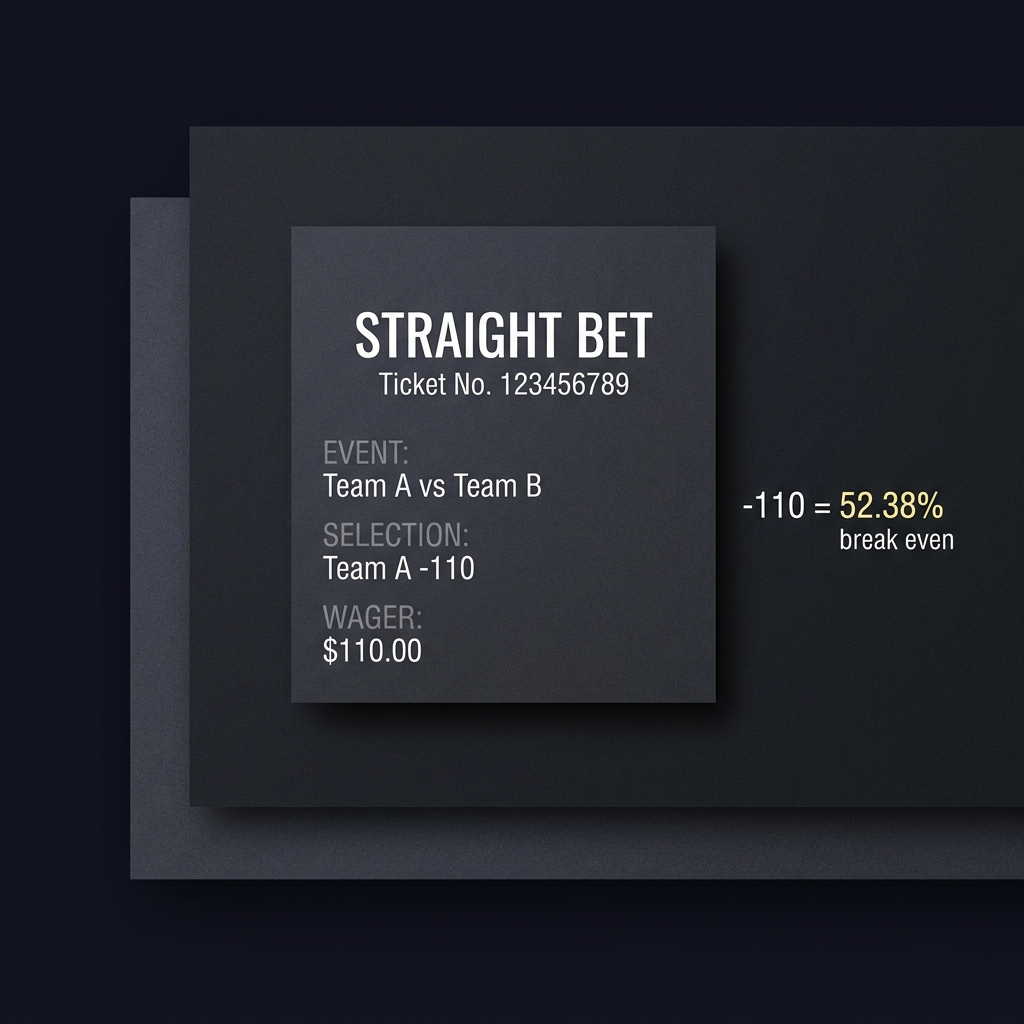
Practically, that break-even number means a bettor needs to win more than about 52.38 percent of identical -110 choices to expect to grow bankrolls in the long run, assuming stake sizing is stable and independent trials apply. Estimating your true win probability and comparing it with the implied break-even is the first quantitative test of whether a wager is profitable.
Expected value and variance: why parlays usually hurt EV
Parlays multiply outcomes so the bookmaker margin compounds across legs, which typically lowers the bet's expected value as legs are added. Each leg introduces another application of the vig, and unless you hold a genuine edge on every leg, the parlay's combined expected value falls relative to placing the legs individually.
Academic analysis of expected values and variances in football and similar betting contexts shows that multi-leg products raise variance substantially while expected value usually declines under standard pricing models Expected values and variances in football betting. That combination makes parlays attractive for short-term payoff potential but less efficient for steady EV accumulation.
There are narrow circumstances where parlays can be EV-positive: if a bettor truly has an edge on each leg that exceeds the compounded margin, the combined ticket can produce positive expectation. In practice this is hard to achieve consistently because the margin compounds and because estimating independent edges for several legs is more error prone than for a single market.
State data and industry context showing parlay hold is higher
Several state reports from 2024 and 2025 indicate parlays generate higher hold for operators compared with straight wagers. Higher operator hold on parlay products implies lower average expected value for bettors using those products under typical pricing and mixes December 2024 Sports Betting Proceeds Report.
Virginia and other reports show similar patterns where parlays account for a significant share of sportsbook revenue growth, reinforcing the view that product mix matters for average bettor returns FY 2024 Sports Wagering Annual Report.
Trade level summaries for 2025 also link the broader rise in sportsbook hold to increased uptake of parlays and multi-leg tickets, which helps explain why state-level aggregate returns moved as they did last year State of the States 2025: The AGA Survey of the Commercial Casino Industry, and national reporting highlights parlay popularity Parlays are becoming more popular and sportsbooks ....

Bankroll impact and optimal staking: applying the Kelly perspective
Higher variance reduces the optimal stake fraction under a Kelly-style framework. When outcome variance rises relative to edge, the mathematical Kelly result recommends a smaller fraction of the bankroll to maximize long-run growth without assuming unlimited risk tolerance.
The practical implication is clear: a multi-leg parlay, even when you believe you have positive expectation on each leg, often calls for much smaller wager fractions than a comparable single-leg bet because variance compounds across legs The Kelly Criterion in Blackjack, Sports Betting, and the Stock Market.
Translates estimated edge into a suggested stake fraction using a simplified Kelly-style approach
Use conservative half-Kelly in practice
To apply this idea in everyday staking, many bettors use half-Kelly or a capped fraction to reduce volatility. A smaller, consistent stake preserves capital during inevitable losing sequences and reflects the greater uncertainty in edge estimates for multi-leg products.
Decision framework: when straight bets are likely the better choice
Use a short checklist to choose between wagers: compute the implied break-even for listed prices, estimate your edge on the market, check whether legs are correlated, and size the stake relative to bankroll objectives. If the edge is marginal or correlation is unclear, the safer choice for steady EV is the straight bet. (consult the Funded Plays homepage)
Parlays or specific props may still make sense when you have strong, independent, demonstrable edges across each leg and you are willing to accept high variance for a potential one-ticket payoff. Even then, size those tickets conservatively and track outcomes.
Model your edge rather than assume an aspirational hit rate. When you run plausible probability ranges against listed prices, you can see whether the expected value tilt is meaningful enough to justify increased variance or different staking rules. (see how Funded Plays evaluations work)
Common mistakes and pitfalls bettors make with straight bets and parlays
Bettors commonly overstate their edge and misunderstand the effect of vigorish on implied probabilities. Ignoring the break-even lift from standard pricing leads to repeated losing runs even when the raw hit rate looks respectable.
Poor staking and emotional chasing compound the damage. Increasing stake size after losses or placing larger parlay tickets to recoup drawdowns boosts variance and accelerates bankroll depletion, reducing long-run expected value under real conditions Vigorish (Vig): What It Is, How It Works, and Example.
Corrective actions are simple: check implied break-even, keep conservative sizing rules, and track outcomes honestly. Record keeping helps you recalibrate edge estimates and avoid the common trap of mistaking luck for skill.
Practical examples and scenario calculations
Worked straight-bet example at -110. Step 1, convert -110 to implied probability. Step 2, compute break-even win rate near 52.38 percent. If you estimate your true win probability at 55 percent, your edge over break-even is about 2.62 percentage points, which translates into positive expected value over many trials Vigorish (Vig): What It Is, How It Works, and Example.
Worked 3-leg parlay example. Suppose each leg individually is priced at -110 and your subjective win probability on each leg is 55 percent. The parlay probability under independence would be 0.55 times 0.55 times 0.55. Because the bookmaker compounds margin across legs, the parlay's implied payout is compressed and the combined expected value typically falls below the combined expected value of placing the three straight bets separately Expected values and variances in football betting.
Interpretation for a bettor's bankroll: if you place the straight bets across many trials with consistent sizing, you should see smoother equity growth when the true edge exists and your sizing follows conservative rules. By contrast, the parlay path will show larger swings and lower expected growth unless every leg's edge is reliably larger than the compounded margin.
Conservative flat staking is a viable default: wager a modest fixed percentage of bankroll per qualifying straight bet, for example 0.5 percent to 1.5 percent depending on confidence. Flat stakes avoid large swings and simplify record keeping.
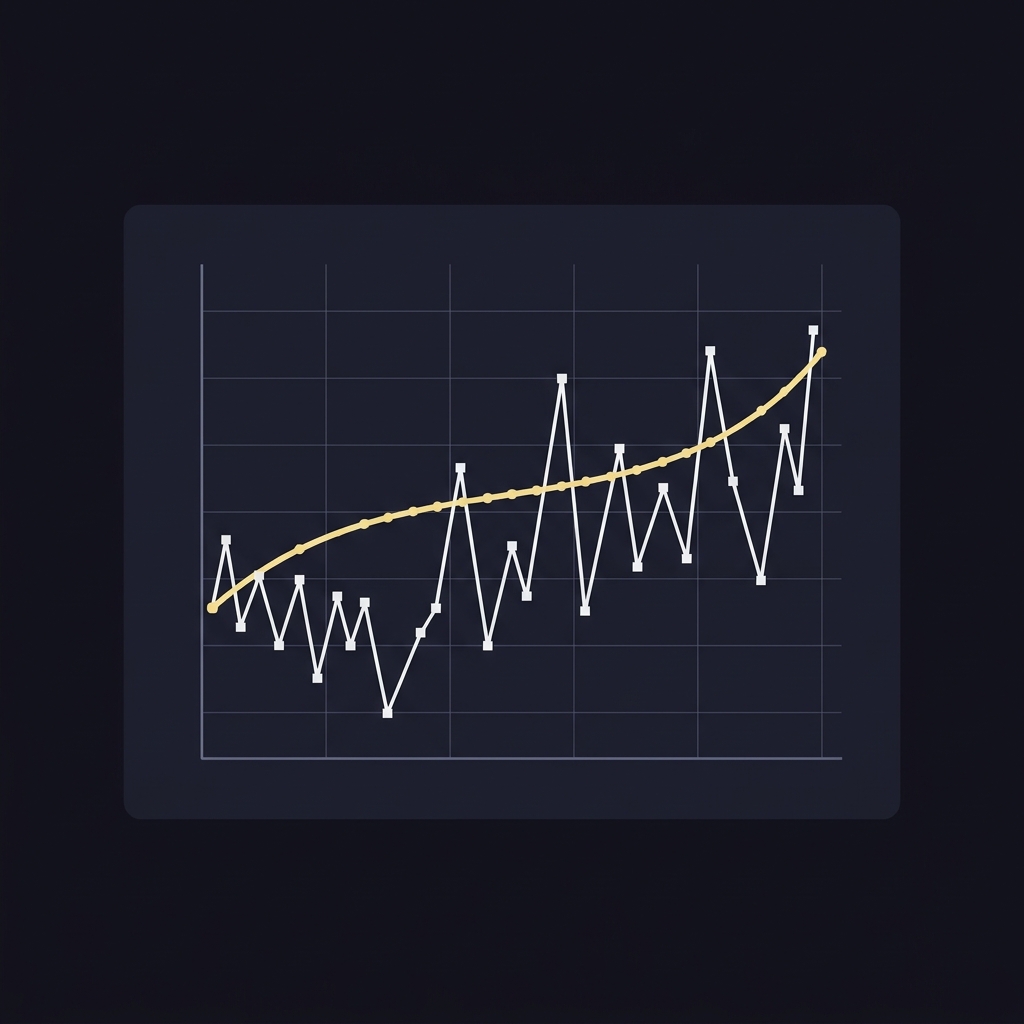
Proportional staking and Kelly-style adjustments can raise long-run growth if your edge estimates are stable and you accept greater volatility. Many practitioners use a fractional Kelly, such as half-Kelly, to balance growth and drawdown control, particularly when variance is elevated or edge estimates are uncertain The Kelly Criterion in Blackjack, Sports Betting, and the Stock Market.
Before increasing stakes, require a clear sample of tracked results and a repeatable edge estimate. Small, iterative increases tied to audited performance reduce the chance of overexposure to estimation error.
Same-game parlays and correlated legs: open questions in 2026
Same-game parlays (SGPs) introduce correlation issues because outcomes within one match are not independent. Correlation can change the true probability of a combined event and therefore alter whether the listed payout fairly compensates the bettor.
Operator pricing models for SGPs vary, and in 2026 the mechanics remain an open research area. Bettors can watch for inconsistent pricing versus the independent-leg baseline as a simple test and avoid tickets where correlation appears to compound bookmaker margin without commensurate payout.
Practical checks include comparing the implied probability of each leg aggregated under independence to the parlay payout, and tracking realized frequencies for similar correlated-ticket patterns in your own sample before allocating meaningful stake to SGPs.
Regulatory and market context that shapes bettor returns
State regulator reports provide useful aggregate snapshots of product-level hold and can reveal whether product mix shifts are changing average bettor returns. Colorado and Virginia reports from 2024 show parlays contributing a disproportionate share of operator hold, which matters for bettors choosing between product types December 2024 Sports Betting Proceeds Report and regulatory guides Sports Betting Regulations in the US 2026 | By State Guide.
Industry-level summaries also suggest that rising parlay uptake contributed to increased overall sportsbook hold in 2025, which reinforces the message that product selection affects average expected value across the market State of the States 2025: The AGA Survey of the Commercial Casino Industry, and policy analyses Sensible sports betting: A policy framework.
Keep in mind these are aggregate measures. Individual bettors may outperform or underperform the average depending on edge estimation, staking discipline, and record keeping.
A practical checklist to evaluate a bet before you place it
Compute the implied break-even for the listed price, and compare it with your estimated win probability. If your estimate exceeds the break-even by a meaningful margin, the bet is a candidate for positive EV.
Estimate whether legs are correlated and whether that correlation is adequately priced. Size your wager against a predefined bankroll rule, and record the ticket with the stated edge estimate so you can audit results later.
Recalibrate after a reasonable sample size and avoid increasing stakes based on short-term streaks. These quick quantitative and behavioral checks help preserve capital and reveal whether your system actually produces an edge over time.
Conclusion: balancing EV, variance, and your betting goals
In most typical pricing environments, straight bets offer lower variance and more transparent expected value mechanics than parlays or long-horizon futures. That makes straight bets a better fit for bettors prioritizing steady EV accumulation and manageable drawdowns.
Long-run profitability still requires a genuine edge, disciplined staking, and careful record keeping. Use the decision checklist, run simple EV tests, and apply conservative stake sizing while you build a reliable performance record.
At typical US -110 pricing the break-even win rate is about 52.38 percent, reflecting the effect of vigorish on expected value.
Parlays can be reasonable if you have demonstrable positive edges on every leg and accept much higher variance, but this is difficult to achieve consistently.
Use conservative defaults such as flat staking at 0.5 to 1.5 percent of bankroll or a fractional Kelly approach and increase only after audited positive results.
References
- https://www.investopedia.com/terms/v/vigorish.asp
- https://ubplj.org/index.php/jgbe/article/view/968
- https://sbg.colorado.gov/sites/sbg/files/documents/December%202024%20Sports%20Betting%20Proceeds%20Report.pdf
- https://www.valottery.com/-/media/documentarchive/sportswagering/fy2024-sports-wagering-annual-report.pdf
- https://www.americangaming.org/resources/state-of-the-states-2025/
- https://papers.ssrn.com/sol3/papers.cfm?abstract_id=1958842
- https://www.fundedplays.com/challenges
- https://www.fundedplays.com
- https://www.fundedplays.com/blogs
- https://www.fundedplays.com/blogs/how-fundedplays-evaluations-work
- https://www.washingtonpost.com/sports/interactive/2025/parlay-popularity-odds-sportsbooks/
- https://rg.org/guides/regulations
- https://aibm.org/policy/how-sports-betting-looks-in-america-and-where-policy-can-reduce-harms/