
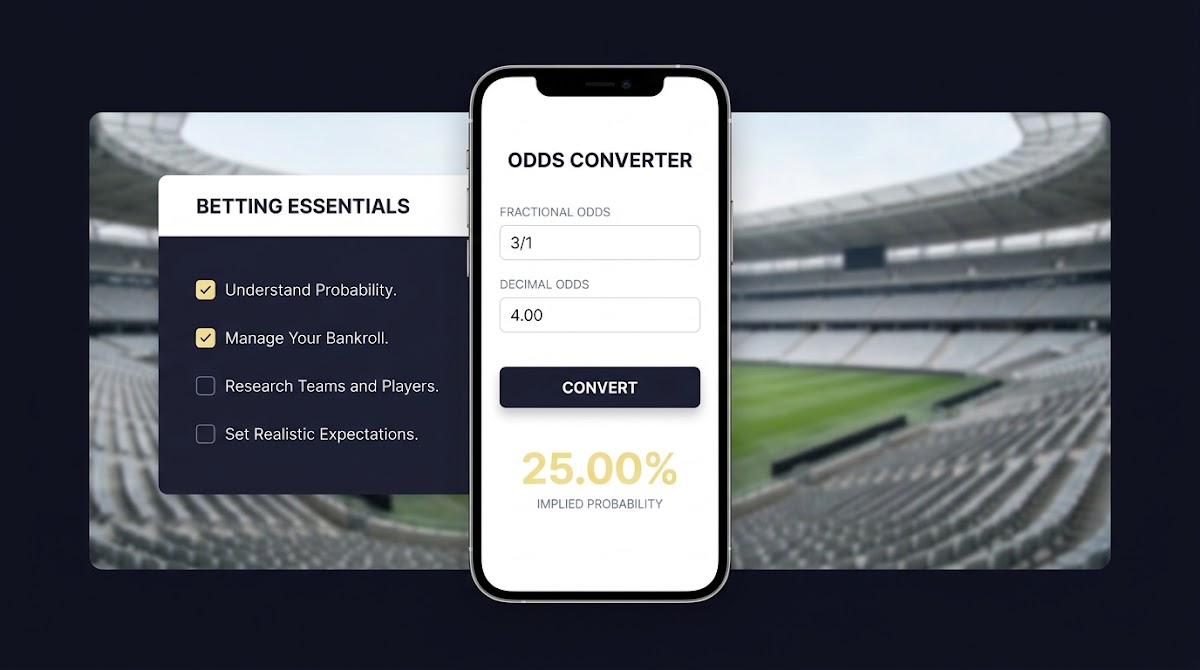
What are straight bets? Simple definition, common examples, and how settlement works
A straight bet is a single wager on one outcome, for example a moneyline, a point spread, or a total, with payout set by the posted odds; this simple definition is used across U.S. industry materials and helps separate single wagers from multi-leg tickets and parlays, so get clear on that before you act. American Gaming Association glossary
Common examples are easy to recognise. A moneyline is a bet on which team wins outright, a point spread assigns a margin that the favorite must clear to win the bet, and a total (or over/under) is a wager on the combined points scored by both teams. These forms use the same settlement logic: the posted odds determine payout once the event settles. American Gaming Association glossary
Try FundedPlays challenge formats for disciplined practice
Download the companion checklist to follow a repeatable routine before every straight bet.
Payouts for straight bets are shown as American odds at many U.S. platforms, which means positive and negative numbers describe different payout relationships for a standard stake. The listed odds are the operative payout terms used when the operator settles the wager.
Settlement can vary if a market is voided or considered no action under the operator or regulator rules, so always be aware that the posted odds and payout terms are only part of the process that determines whether you win, lose, or get refunded. Massachusetts Gaming Commission FAQ
How straight bets are graded: common house rules and 'no action' situations
Grading and refunds for straight bets follow the operator's house rules and applicable regulator guidance; these rules define when a market is settled, voided, or classed as no action, and they directly affect whether you keep a payout or receive a refund. Massachusetts Gaming Commission FAQ
Typical triggers for a voided market include event cancellations, postponements beyond a threshold in the operator rules, or market suspension caused by an error. Operators may also apply rules for incomplete games or unplayed innings that produce no action on affected wagers. Massachusetts Gaming Commission FAQ
Before staking money on a straight bet, check the operator's published FAQ or rules page to confirm how they treat late starts, cancellations, and statistical corrections; those details matter because identical market wording can be settled differently by different operators. Massachusetts Gaming Commission FAQ
Make this a habit: record the relevant rule link or screenshot it before placing a bet so you can review the precise settlement terms if a dispute arises. This small step removes ambiguity about a later refund or grading decision.
Reading American odds and converting to implied probability for straight bets
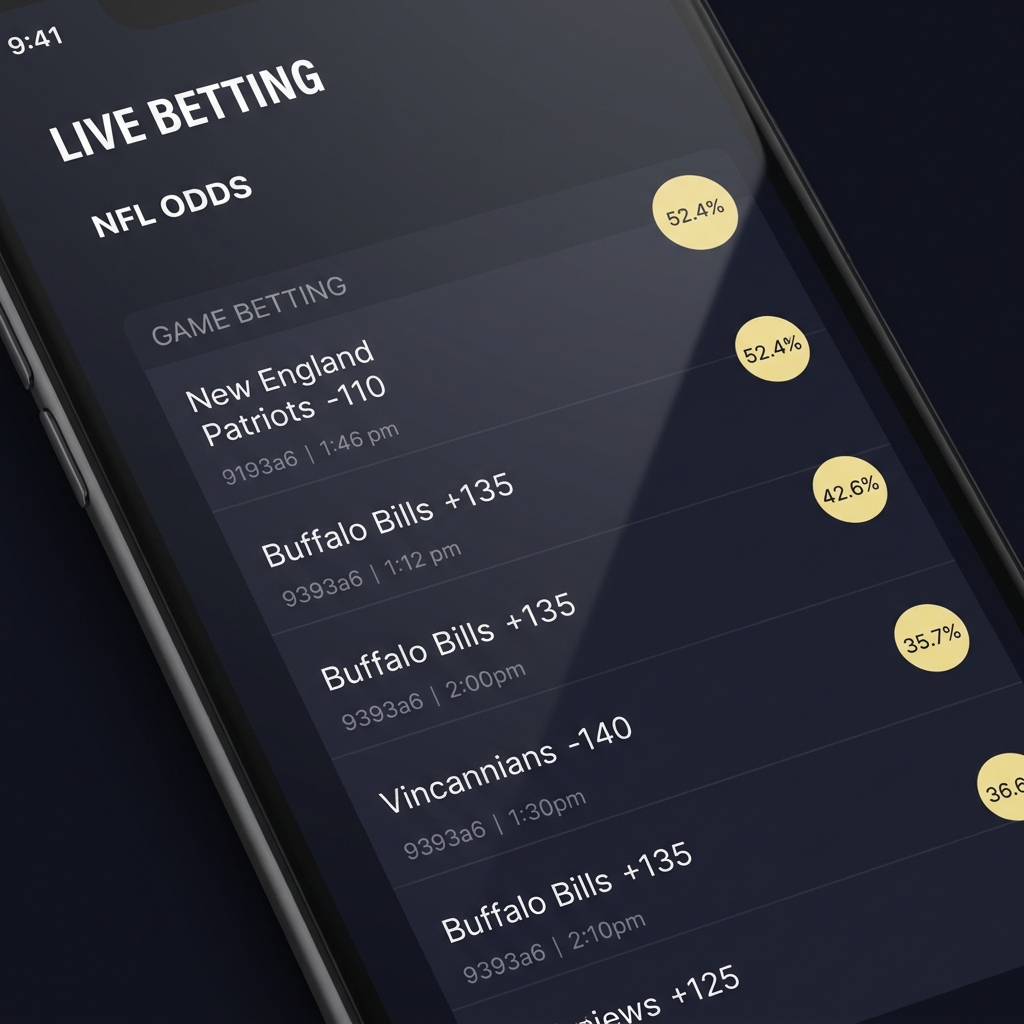
American odds are the common way U.S. operators quote payout, and they map to implied probability in two simple formulas, one for positive odds and one for negative odds, which you can use to compare the market's price to your estimate of the true chance of an outcome. Investopedia on American odds
Stepwise formulas: for positive odds (for example +150) implied probability = 100 / (odds + 100). For negative odds (for example -120) implied probability = -odds / (-odds + 100). These calculations produce the market's implied chance of the outcome, which you then compare to your own estimate to test for value. Investopedia on implied probability
Once you have implied probability, it is the break-even win rate for the quoted payout; hitting that rate on average returns zero net profit before considering fees or vig.
Consistent conversion of odds to implied probability, routine line shopping, disciplined stake sizing, and careful record-keeping help separate skill from noise and protect your bankroll.
Worked example: if an underdog shows +200, the implied probability is 100 / (200 + 100) = 0.333, or 33.3 percent. That means you must win roughly one in three such bets, on average, to break even on the quoted payout. Investopedia on implied probability
Keep a small calculator or a spreadsheet with these formulas so the conversion is fast and error free; consistent, quick conversions reduce mistakes and help you compare a lot of markets efficiently.
Finding value: expected value, edge estimation, and line shopping for straight bets

Expected value, or EV, for a single straight bet is computed from the stake, the payout if you win, and the market's implied probability; EV shows whether, on average, a bet is worth making when compared to your own probability estimate. Investopedia on implied probability
To detect value, estimate the true probability that an outcome will occur and subtract the market's implied probability; if your estimate is higher, the bet has positive expected value and is worth considering after accounting for risk and stake size. Investopedia on implied probability
Line shopping benefits this process because small changes in posted odds change both the payout and the implied probability; better odds lower the break-even win rate and increase expected value for the same estimated edge. Comparing two or three operators before you stake is a routine action that compounds over many bets. Investopedia on American odds
A practical line-shopping workflow: 1) identify the event and market you want, 2) convert the posted odds to implied probability for each operator, 3) compare payouts and implied probabilities, 4) pick the operator with the most favorable combination of price and settlement rules, 5) record the chosen line and why it was selected.
Quick EV check using probability difference
Positive result suggests value
Do this quickly and consistently. Line shopping does not guarantee profit on any single bet, but because small edges accumulate, choosing the better price regularly improves long-term expected returns.
Sizing your stakes: Kelly criterion, fractional Kelly and simple practical rules
The Kelly criterion gives an optimal stake fraction based on your edge and the odds: conceptually it maximizes long-run growth when your edge estimate is accurate, but it requires a stable and reliable estimate of that edge to work as intended. Springer book on the Kelly criterion

Full Kelly can produce large swings in bankroll; fractional Kelly (for example half Kelly or quarter Kelly) is a common compromise that reduces variance while preserving a portion of Kelly's growth properties, and many practitioners prefer flat staking when edge estimates are noisy. Springer book on the Kelly criterion
Simple decision rules: if you estimate edge consistently and have a long sample, consider a larger fraction; if your edge is uncertain, choose fractional Kelly or a flat percent of bankroll and keep bet sizes small so no single loss threatens your plan. Springer book on the Kelly criterion
Illustrative numeric example: suppose you find a bet where you estimate your true probability at 55 percent while the market implies 45 percent, and the payout corresponds to even-money after vig adjustments; a Kelly calculation would produce a stake fraction that reflects that 10-point edge, while half Kelly would halve that allocation to reduce volatility.

Bankroll management, record-keeping, and safer-play rules for straight bets
Bankroll management protects you from ruin and emotional decisions: set a firm bankroll for your straight-bet activity and express bet sizes as percentages of that bankroll so losses scale predictably and you can survive statistical variance. National Council on Problem Gambling safer gambling page
Minimum record fields to collect for every straight bet are: date, stake, posted odds, implied probability, your estimated probability, stake sizing method, result, and running ROI; these fields let you measure edge, variance, and whether your models are calibrated. Massachusetts Gaming Commission FAQ
Use simple tools like a spreadsheet or a lightweight database to log each wager. Regularly reviewing this ledger removes emotion from decisions, helps you spot systematic errors, and supports an objective scaling plan based on performance rather than intuition. National Council on Problem Gambling safer gambling page
Safer-play practices include setting loss limits, employing cooling-off periods if you feel pressure to chase losses, and using the operator's responsible-play tools where available. These steps protect your capital and make your evaluation of strategy performance more reliable. National Council on Problem Gambling safer gambling page
Common mistakes, cognitive biases, and practical examples to practice winning straight bets
Frequent errors include neglecting the vig embedded in posted odds, not converting odds to implied probability before comparing to your estimate, failing to shop lines, and incorrect stake sizing that ignores variance; each error reduces expected return and increases risk. Investopedia on American odds
Behavioral biases also matter: confirmation bias leads you to overweight evidence that supports your view, while overconfidence inflates your implied edge. Keeping a ledger and a pre-bet checklist helps expose these biases and forces calibration. National Council on Problem Gambling safer gambling page
Worked scenario 1: A market lists a favorite at -150. Convert this to implied probability using the negative-odds formula to see the market price. If your model estimates the true probability as higher, compute EV and apply your stake rule. Record all fields and review the result after settlement. Investopedia on American odds
Worked scenario 2: You find an underdog at +240 on one operator and +200 on another. Convert both odds to implied probability, compare the differences, estimate your edge, and choose the line that offers the better EV after checking settlement rules. Record the choice and the rationale for later review. Investopedia on implied probability
A repeatable workflow checklist to improve your straight bets over time
Use this seven-step workflow each time: 1) check the operator's house rules for settlement, 2) convert posted odds to implied probability, 3) estimate your true probability, 4) compute expected value, 5) shop lines across operators, 6) size the stake using your chosen rule, 7) record the result and rationale. This checklist turns evaluation into habit and reduces ad hoc errors. Massachusetts Gaming Commission FAQ
Monthly review routine: aggregate your recorded bets, compute realized win rate, average edge per bet, and ROI; compare those numbers to your expected values and variance to decide whether to scale stakes, change models, or pause for recalibration. Springer book on the Kelly criterion
When to scale: sustained positive edge and an improving calibration record support gradual scaling. When to step back: repeated losses that materially exceed model variance, breaches of your bankroll rules, or unclear settlement disputes are signals to reduce size and review process. National Council on Problem Gambling safer gambling page
Treat the playbook as an experiment framework. Run small, controlled tests, log the outcomes, and iterate. Over time, disciplined application of these steps helps you separate skill from noise and manage downside risk.
A straight bet is a single wager on one outcome, such as a moneyline, point spread, or total. The payout is determined by the posted odds and settled according to the operator's rules.
For positive odds use 100 / (odds + 100). For negative odds use -odds / (-odds + 100). These give the market's implied probability for the outcome.
Full Kelly maximizes long-term growth if your edge estimates are accurate, but fractional Kelly or flat staking is often recommended to reduce volatility and protect the bankroll.
References
- https://www.americangaming.org/resource/sports-betting-glossary/
- https://massgaming.com/sports-wagering/faqs/
- https://www.investopedia.com/terms/a/americanodds.asp
- https://www.investopedia.com/terms/i/implied-probability.asp
- https://www.fundedplays.com/challenges
- https://link.springer.com/book/10.1007/978-981-4335-23-8
- https://www.ncpgambling.org/our-work/safer-gambling/
- https://www.fundedplays.com/blogs
- https://www.fundedplays.com/blogs/how-fundedplays-evaluations-work
- https://www.fundedplays.com
- https://www.aceodds.com/bet-calculator/odds-converter.html
- https://oddsjam.com/betting-calculators/implied-probability
- https://www.omnicalculator.com/statistics/implied-probability