
Quick answer: states where online gambling is legal
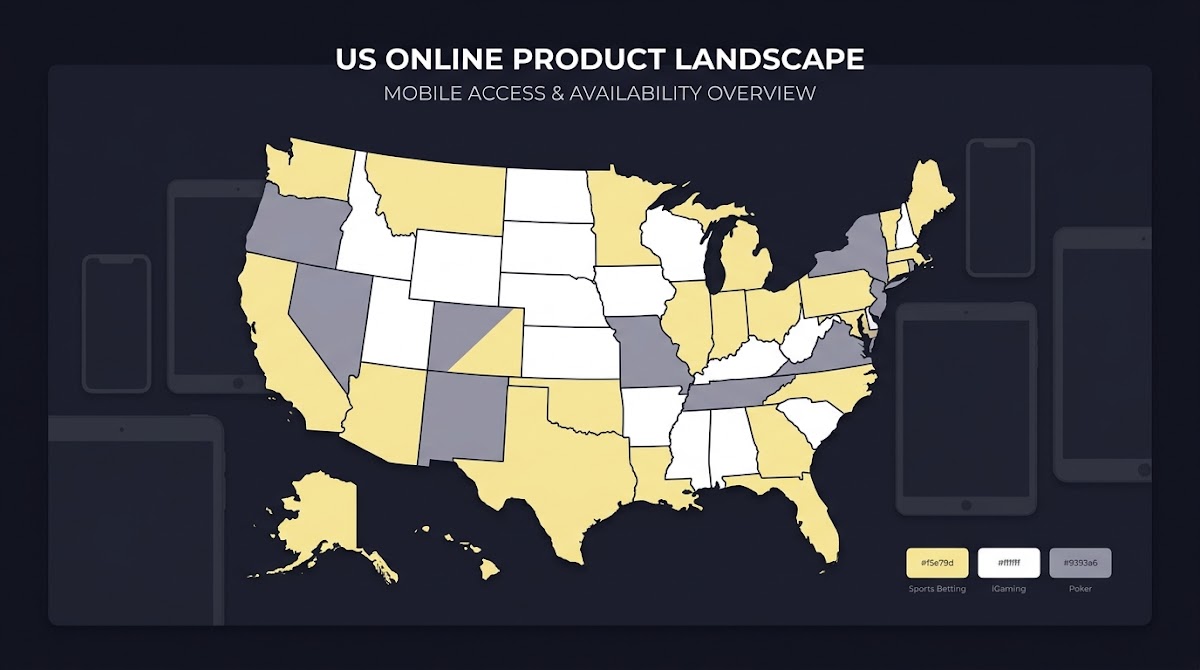
Shortly: the number depends on which form you mean. For online sports betting, legal markets had expanded to 38 U.S. states plus Washington, DC as of late February 2025, giving most U.S. sports fans access to regulated apps or mobile sites in many jurisdictions AGA State of Play.
By contrast, online casino gaming, commonly called iGaming, remained authorized in a much smaller group of states. Early 2025 trackers showed seven states with authorized iGaming markets, reflecting a very different rollout and policy pace compared with sports wagering AGA iGaming State of Play.
Online poker is even narrower in footprint and in practice, because interstate and shared liquidity depend on formal agreements between states and operators. That limited, multistate poker connectivity is governed by arrangements such as the Multi-State Internet Gaming Agreement and state-specific authorization rules MSIGA documentation.
Because these counts reflect separate product categories and ongoing state action, the short headline answer to states where online gambling is legal will vary by whether you mean sports betting, casino-style games, or poker. Use this guide to understand each form and how to confirm the rules where you live.
How U.S. state regulation works and why it matters
Authority over online gambling in the United States rests primarily with state governments, not the federal government. Different states set distinct licensing rules, permit retail-only operations, authorize online products, or use hybrid frameworks that require partnerships between retail licensees and online operators NCSL sports betting tracker and see the NCSL coverage on sports betting Sports Betting on the Rise.
That state primacy means the phrase states where online gambling is legal is not a single uniform fact. Lawmakers and regulators in each state decide which products are permitted, how operators must be licensed, and how consumer protections and taxation operate. Legislative sessions, ballot measures, and regulatory rulemaking can change a state status within months, so a list from one year may not be accurate the next AGA State of Play.
Practical examples clarify the point: some states allow retail sports wagering at a casino but prohibit mobile apps, while others permit both retail and online in the same law. Similarly, a state may approve sports betting but keep casino-style games off-limits. Those product-level differences shape any count of online-authorized states and explain why you should check product-by-product legality rather than relying on a single aggregated number NCSL sports betting tracker.
Compare AGA and NCSL trackers then confirm state regulator pages
Start with AGA for maps then verify with NCSL
Different forms explained: sports betting, iGaming, and online poker
Online sports betting covers wagers on sporting events placed via licensed mobile apps or online portals. That category typically includes single-game bets, parlays, futures, and prop markets offered by regulated sportsbooks when a state authorizes online products AGA State of Play.
Online casino gaming, or iGaming, refers to casino-style offerings such as digital slot games, table games, and often online versions of video poker; iGaming availability has followed a different policy track from sports betting and remains authorized in a limited set of states AGA iGaming State of Play.
Online poker is a third category with its own technical and legal issues. Even where single-state poker markets exist, wider player pools sometimes require interstate compacts or formal agreements to permit shared liquidity. The Multi-State Internet Gaming Agreement is an example of a framework that enables limited interstate poker play among members MSIGA documentation.
The totals vary by product: by early 2025 online sports betting was legal in 38 states plus DC, iGaming was authorized in seven states, and online poker availability depended on state rules and interstate agreements. State-by-state regulation and differing product definitions cause the variance.
Why a state might allow one form but not another is straightforward: different interest groups, tax priorities, and regulatory concerns produce distinct legislative outcomes. A state may view sports betting as easier to regulate through existing lottery or racing frameworks while treating casino games as a larger policy decision with different stakeholders and fiscal implications NCSL sports betting tracker.
Where online sports betting is legal right now
As of February 27, 2025, regulated online sports betting was available in 38 U.S. states plus Washington, DC. That expansion reflects several years of rapid legislative and ballot activity where states chose to permit mobile access in addition to retail sportsbooks AGA State of Play.

Legal sports betting in a state usually means licensed operators can offer mobile apps and online accounts to in-state customers, subject to geolocation checks, age verification, and compliance measures mandated by the state regulator. The exact mix of permitted bets, promotional rules, and tax rates varies by jurisdiction, so what a fan can do in one state may look different in another NCSL sports betting tracker.
Some states use hybrid models that require a physical licensee to sponsor or partner with an online operator, or they limit the number of online operator licenses. Those structural choices affect competition, available apps, and how quickly markets evolve after legalization NCSL sports betting tracker.
Which states allow online casinos (iGaming)?
By early 2025, seven states had authorized online casino gaming: Connecticut, Delaware, Michigan, New Jersey, Pennsylvania, Rhode Island, and West Virginia. Those jurisdictions passed statutes or implemented regulatory frameworks permitting licensed digital casino products to operate within state lines AGA iGaming State of Play.
Rhode Island’s March 2024 launch of state-authorized iGaming is a recent example of how the map can change and how a single state’s action can expand the pool of regulated markets AGA State of the States 2025.

Even within the seven authorized states, product offerings and the regulatory approach differ: some states emphasize browser-based play, others focus on mobile apps, and licensing requirements vary for operators and providers. That variability is why the simple question states where online gambling is legal requires a product-by-product check before you decide to play or register in a market NCSL internet gambling page.
Online poker: where it is permitted and how interstate play works
Online poker markets exist in a smaller number of states, and where multi-state liquidity is allowed it depends on formal arrangements and compatible regulatory frameworks. Single-state poker play can be legal without any interstate sharing, but larger player pools usually come from agreements between jurisdictions NCSL internet gambling page.
The Multi-State Internet Gaming Agreement enables select member states to share online poker liquidity, and members have included Delaware, Michigan, Nevada, New Jersey, and West Virginia. Where those agreements are active, players may find larger tournaments and ring games that cross state lines under the compact terms MSIGA documentation. For more detail on shared liquidity see the MSIGA materials at the Nevada Gaming Control Board MSIGA documentation.
How to verify legality where you live (step-by-step checklist)
Step 1, consult the AGA State of Play map to see which states authorize sports betting and iGaming products in a glance. That visual map is a quick starting point for product-level checks AGA State of Play.
Step 2, cross-check the NCSL trackers for legislative activity and policy summaries, which help you interpret whether a state has passed enabling laws, adopted rules, or is considering changes during a session NCSL sports betting tracker.
Step 3, visit your state gaming regulator or attorney general page for licensing lists, geolocation requirements, and operator FAQs. Regulators provide the most granular rules about age verification, account requirements, and permitted product types, which are decisive for what is truly available to local players.

Key decision criteria before participating online
Confirm the specific product you plan to use is authorized in your state. A site or app that offers sports betting in one state may not be licensed to offer online casino games or poker in the same jurisdiction, so checking product-level permissions matters AGA iGaming State of Play.
Verify age and identity requirements and whether the operator uses geolocation services to ensure play is limited to the licensed state. Operators typically require proof of age and identity as part of responsible gaming and anti-fraud controls, and those checks are often enforced by the state regulator NCSL sports betting tracker.
Consider whether the service is a skill-based sweepstakes or a regulated wagering operator, because the legal classification affects the protections that apply and how regulators view the activity. Platforms that emphasize skill and use virtual funded accounts can be structured differently from regulated sportsbooks, and that distinction can affect whether a product is permitted in a given state.
Common mistakes and legal pitfalls to avoid
One common error is relying on an outdated total or a memory of past state actions. Because state legislatures and regulators can change rules, a list saved from a prior year may not reflect present authorizations; always check live trackers before acting AGA State of Play.
Attempting to access a platform licensed in another state while physically located in a jurisdiction that forbids that product is a frequent pitfall. Using a VPN or other geo-spoofing method to bypass geolocation checks typically violates terms of service and may lead to account closure or legal exposure under state rules NCSL sports betting tracker.
Assuming that a state that permits one online form automatically allows others is another mistake. For example, a state might permit sports betting but not online casino games, so check product-level authorizations rather than relying on a single category label AGA iGaming State of Play.
Recent changes that shifted the map and what to watch in 2026
Rhode Island’s March 2024 iGaming launch is a recent example of how a single state action can expand the regulated iGaming map and change market dynamics reported in 2025 summaries AGA State of the States 2025.
Looking ahead to 2026, the most likely triggers for expanded online authorization are state legislative sessions, committee hearings, and high-profile bills that receive media attention. Tracking committee calendars and bill dockets in states you care about will show where policy attention may translate into legal change NCSL sports betting tracker.
Practical scenarios: what the rules mean for different players
Scenario A: sports-legal but no iGaming
If you live in a state that authorizes mobile sports betting but not iGaming, you can legally create accounts and place sports wagers through licensed apps or retail outlets in that state. You should not expect to access slots or table games online from the same operators unless and until the state authorizes iGaming AGA State of Play.
Confirm product legality and licensing before you play
Before using any platform, check the AGA and NCSL trackers and then confirm the operator is licensed by your state regulator and that geolocation is active where you are located.
Scenario B: resident in an MSIGA member state who travels
If you live in a state that participates in MSIGA or otherwise allows interstate poker liquidity, you may access larger player pools when you are physically inside a participating state. When you travel, however, your ability to play depends on the local state authorization and whether the operator is licensed to offer services in the jurisdiction where you are located MSIGA documentation.
Actions to take in either scenario are simple: consult the AGA and NCSL trackers for the headline status, check the state regulator page for licensing and geolocation rules, and read the operator terms before you register or deposit funds.
Resources and how to read them: AGA, NCSL, and MSIGA pages
The AGA State of Play maps are useful for quick visual checks of which markets permit sports betting or iGaming and for seeing recent changes reflected in a national overview AGA State of Play. The AGA gaming map is also available at AGA research state-of-play map. See related analysis on the Funded Plays blog.
The NCSL pages summarize legislation, committee activity, and policy differences that affect how states regulate online products. NCSL’s materials are helpful for understanding the legal steps states take and tracking pending bills NCSL sports betting tracker.
For online poker and interstate play, MSIGA documentation explains which states participate in shared liquidity arrangements and the terms under which player pools may be shared. Use MSIGA pages to check whether your state is a member and what that means for cross-state poker play MSIGA documentation.
How funded sports prediction platforms differ from regulated online gambling
Funded sports prediction platforms and skill-based sweepstakes operate under different legal and operational models than regulated sportsbooks or iGaming operators. These platforms often use virtual funded accounts, structured evaluation challenges, and performance-based progression rather than traditional wagering with real-money deposits.
That distinction matters because state regulators and statutes may treat skill-based sweepstakes differently from regulated gambling products. Users should verify how a platform is classified and whether that classification complies with state law before participating, and they should understand that outcomes depend on participant performance rather than guaranteed returns.
Conclusion: quick checklist and next steps
Recap: headline counts in early 2025 showed widespread legalization of online sports betting across 38 states plus Washington, DC, while iGaming remained limited to seven states and online poker had a constrained footprint dependent on interstate agreements AGA State of Play.
Immediate checklist: view the AGA State of Play map, cross-check the NCSL trackers for legislative activity, confirm licensing and geolocation details on your state regulator page, and read operator terms for age and identity rules. For practical guidance, see the Funded Plays homepage Funded Plays.
Responsible participation means confirming the product you intend to use is authorized in your state and understanding that legal authorization does not equal a guarantee of safety or outcomes. Use the trackers and regulator pages to stay current and protect your account and funds.
As of February 27, 2025, online sports betting was available in 38 U.S. states plus Washington, DC. Check AGA for live updates.
By early 2025, iGaming authorization existed in Connecticut, Delaware, Michigan, New Jersey, Pennsylvania, Rhode Island, and West Virginia.
Online poker is legal in select states, and interstate play is limited to states that participate in agreements such as MSIGA.
References
- https://www.americangaming.org/state-of-play/sports-betting/
- https://www.americangaming.org/state-of-play/igaming/
- https://gaming.nv.gov/index.aspx?page=267
- https://www.ncsl.org/technology-and-communication/sports-betting
- https://www.americangaming.org/resources/state-of-the-states-2025/
- https://www.ncsl.org/technology-and-communication/internet-gambling
- https://www.fundedplays.com/challenges
- https://www.fundedplays.com
- https://www.fundedplays.com/blogs
- https://www.fundedplays.com/blogs/how-fundedplays-evaluations-work
- https://www.americangaming.org/research/state-of-play-map/
- https://www.ncsl.org/resources/details/sports-betting-on-the-rise-as-states-let-gamblers-wager-online