
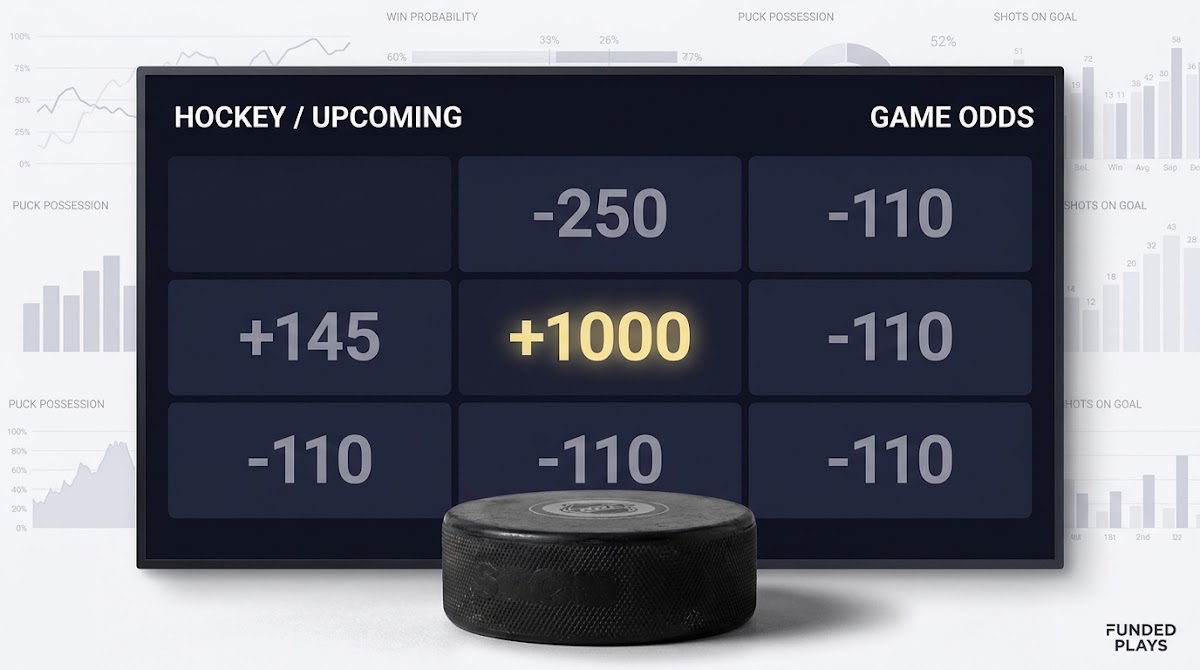
Quick answer: what +1000 means in moneyline odds (stanley cup betting odds example)
One-sentence definition
In American moneyline terms, +1000 means a $100 stake would profit $1,000 for a $1,100 total return if the wager wins, a relationship that scales proportionally with any stake and holds across sports and operators; see the Investopedia explanation for the moneyline concept Investopedia moneyline guide.
Practical shorthand: the plus sign marks a positive moneyline and the number shows how much profit a $100 stake produces, so +1000 equals ten times the stake in profit.
If you place a $50 ticket at +1000 you would calculate profit as $50 times 1000 divided by 100, which equals $500 profit and a $550 total payout if the pick wins; the same formula gives $5,000 profit on a $500 stake and $11,000 total on a $1,000 stake when scaled up.

The arithmetic shown above is a universal convention in modern odds notation and does not depend on sport, so the same rules apply to Stanley Cup futures as to single-game moneylines.
Start with the universal profit formula for positive American odds: profit = stake × (odds ÷ 100). For +1000 this becomes profit = stake × (1000 ÷ 100) = stake × 10, which yields a straightforward multiplier for profit amounts; Action Network outlines moneyline mechanics similarly for practical examples Action Network moneyline explanation. See SportsBettingDime's odds converter for another calculator reference.
To get total return add the original stake to profit, so total return = stake + profit. Because the profit multiplier for +1000 is 10, total return = stake + stake × 10 = stake × 11, which explains the decimal conversion discussed later.
Step 1: choose your stake. Step 2: compute profit using profit = stake × (odds ÷ 100). Step 3: compute total return by adding the stake back.
Example A, small speculative ticket: stake $50. Profit = 50 × (1000 ÷ 100) = 50 × 10 = $500. Total return = 50 + 500 = $550.
Example B, standard unit: stake $100. Profit = 100 × (1000 ÷ 100) = $1,000. Total return = 100 + 1,000 = $1,100.

Example C, larger but still illustrative: stake $500. Profit = 500 × 10 = $5,000. Total return = 500 + 5,000 = $5,500. These concrete lines show the proportional scaling of profit with stake under the same odds.
Operators sometimes impose minimum staking units or rounding rules on displayed payouts, so while the underlying math is universal the exact posted payout may vary slightly by site because of rounding or ticket rules.
To convert positive American odds into implied probability use the standard formula implied probability = 100 ÷ (odds + 100). Plugging +1000 into that formula gives 100 ÷ (1000 + 100) = 100 ÷ 1,100, which equals about 9.09 percent; Investopedia’s primer on implied probability presents the same formula and rationale Investopedia implied probability guide.
That implied probability is a mathematical representation of the market price, not a definitive prediction of the actual outcome; bettors compare this market-implied number to their own probability estimates to identify potential value.
In practice you treat implied probability as the market's estimate of chance implied by the odds. If your independent model or judgment assigns a higher chance of the outcome than 9.09 percent for a +1000 quote, the ticket may have positive expected value; if your estimate is lower, the market price implies a negative expectation.
Remember that the implied probability does not account for vig or margin built into the market, and professionals often adjust for that when comparing estimates to displayed odds.
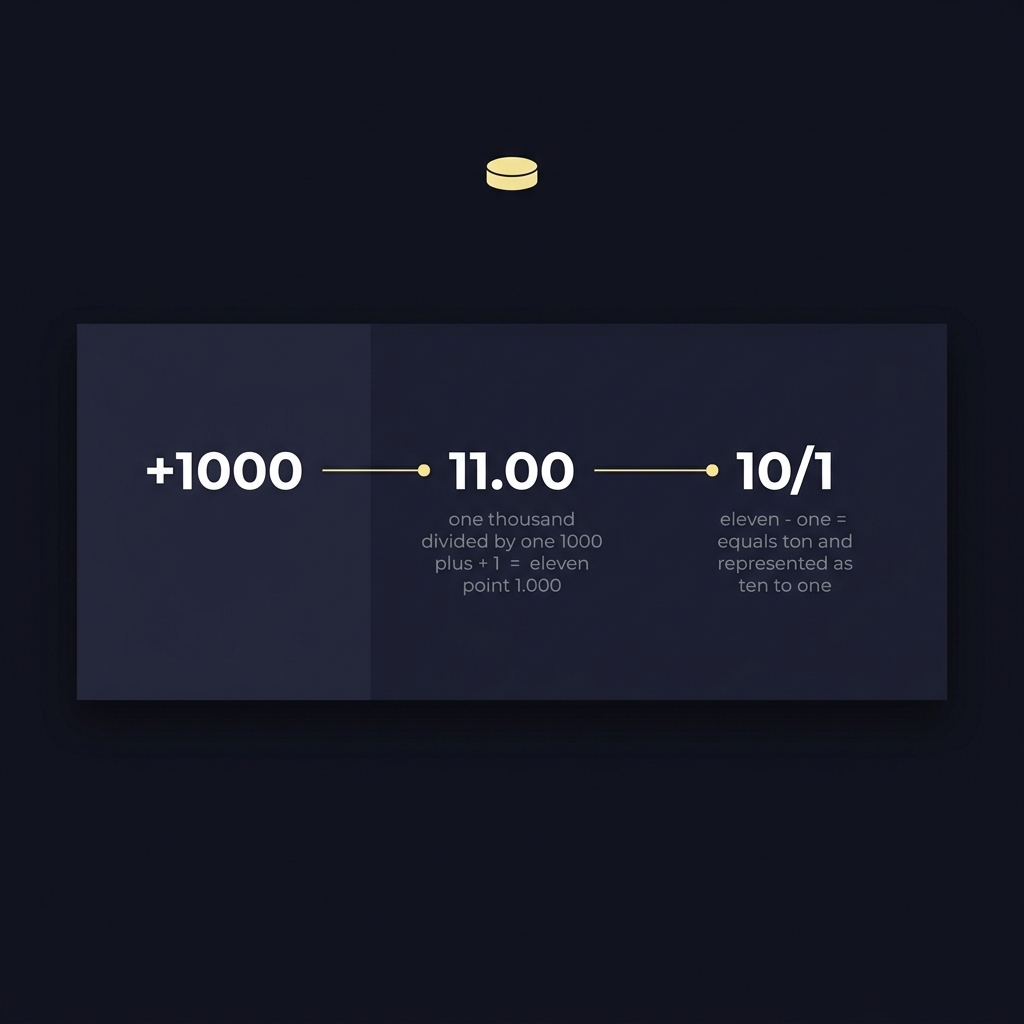
The decimal odds equivalent of American +1000 is 11.00, because decimal odds equal 1 plus the profit multiplier and total return on a $1 stake; since +1000 yields $11 total on a $1 stake, that maps to decimal 11.00, a standard conversion noted in odds reference material Odds (gambling) reference.
Use decimal odds when you want the total return per unit stake expressed directly: decimal 11.00 means every $1 wagered returns $11 if successful, including the original stake.
Fractional odds express profit relative to stake. For +1000 the fractional form is 10/1, which means you win 10 units for each 1 unit staked. Fractional representation and decimal representation are equivalent ways to see the same underlying payout.
Conversion formulas: from American positive odds to decimal, decimal = 1 + (odds ÷ 100). From American positive to fractional, fractional = (odds ÷ 100) expressed as a ratio, so +1000 becomes 10/1. These conversions do not alter implied probability or payout math.
As a futures price, +1000 implies roughly a 9 percent chance of winning the Stanley Cup and places a club within a realistic contender tier rather than an extreme longshot in some recent markets; several preseason futures lists in 2025-26 showed teams in the roughly +800 to +1200 band, which situates +1000 squarely within that range VegasInsider stanley cup odds.
In American moneyline notation +1000 means a $100 stake profits $1,000 for a $1,100 total return; convert to implied probability with 100 ÷ (odds + 100) to get about 9.09 percent, and use that number to compare against your independent estimate before sizing a futures ticket.
Futures market positioning matters because the time horizon, injuries, and roster moves can change the market price dramatically between preseason and the playoffs, and bookmakers update futures quotes to reflect those developments.
Interpreting +1000 depends on context: in a deep competitive season a +1000 club might be a secondary contender with plausible paths to success, while in a weaker field the same price could indicate one of the top teams; the numerical implied probability stays the same but the practical takeaway for a bettor changes with market depth and timing.
Because futures bets lock in a long time horizon, typical considerations include whether you accept the liquidity trade-off, how the price might improve or worsen over months, and whether you expect news flow that changes the market view.
Skilled predictors include implied probability as a single input in a broader model that accounts for team quality, variance, schedule, injuries, and other signals. They rarely place a bet solely because an implied probability looks low; instead they compare their model's estimated probability to the market-implied number and stake only when there is a calculated edge.
Practice futures pricing with structured challenges
Use a disciplined checklist and a simulated challenge to practice estimating value on futures prices without risking real stakes.
Conservative bankroll rules for occasional +1000 tickets typically limit each speculative futures position to a small percentage of total capital, because even fair-value long odds lose most of the time; this keeps variance manageable while preserving capacity to exploit edges when they occur.
When integrating long-shot futures into a portfolio, professionals view them like a high variance class that should be sized relative to expected value and correlation with other holdings, rather than as standalone, high-frequency plays.
Bookmakers create lines using model projections and market exposure goals, then adjust prices as money moves to balance risk and embed vig. The moneyline mechanics and examples in education pieces show why small differences in displayed odds across operators are common even though the underlying math of payout and implied probability is stable Action Network moneyline explanation.
For a bettor, the implication is simple: the same +1000 quote means the same profit multiplier, but the practical edge can change if an operator adds or subtracts margin differently than another operator.
Shopping the market is straightforward: confirm the operator’s rules for maximum stakes and ticket settlement before committing, and use aggregator snapshots to identify the best listed number for the same event.
Quick profit and total return calculator for positive American odds
Enter odds as positive whole numbers without plus sign
Shopping the market is straightforward: confirm the operator’s rules for maximum stakes and ticket settlement before committing, and use aggregator snapshots to identify the best listed number for the same event.
Core criteria: ensure your independent probability estimate exceeds the implied probability, confirm the stake is affordable within your bankroll plan, check for likely news that could change the price, and assess liquidity and settlement rules for the futures instrument.
Ask specific questions before you bet: can I tolerate a long drawdown if the ticket loses, does the potential payout justify the time horizon, and do I have a repeatable method for estimating long-run probabilities?
Futures offer large upside at low cost, but they tie up capital and are subject to roster and injury volatility. If you value optionality and liquidity, consider smaller sizes or staged entries rather than one large all-in ticket.
Value in futures comes from disciplined edge recognition and careful sizing, not optimism. If the market implied probability is lower than your model’s estimate by a meaningful margin, that is when a considered stake may be appropriate.
One frequent error is confusing profit with total return; reading +1000 as a $1,100 profit rather than a $1,000 profit plus stake leads to systematic overestimation of returns. Clear examples and definitions of profit and total return help prevent this mistake Investopedia moneyline guide.
Another conversion error arises when moving between American, decimal, and fractional formats; practice a few conversions to build fluency so you do not accidentally misprice a ticket.
Because long odds pay well when they hit, bettors sometimes overweight these tickets emotionally. The corrective is simple: size positions against a stated bankroll rule and only increase size when the math shows an edge, not when sentiment is high.
Finally, neglecting vig and operator rules can turn a superficially attractive number into a poor value ticket, so always account for margin and confirm payout calculations with the operator before confirming a stake.
Scenario A: a $50 speculative ticket at +1000. Implied probability is 9.09 percent and expected profit depends on your own estimate. If your model estimates the true chance at 12 percent, that implies an edge. Concrete math: profit = 50 × (1000 ÷ 100) = $500, total return = $550, and the ticket occupies a small fraction of bankroll by design.
Use small speculative tickets to learn about long-horizon variance without exposing large capital to repeated long-shot losses.
Scenario B: a $200 ticket where your model assigns a 15 percent chance. Compute expected value by multiplying the profit ($2,000) by your model probability and subtracting the expected lose rate times stake; this exercise quantifies whether the ticket is mathematically justified before risking funds.
Document the rationale and outcome so you can refine your model over time; disciplined record keeping separates skill from luck in long-term performance assessments.
Scenario C: allocate a fixed fraction of your speculative allocation across several futures tickets at similar expected value. Diversifying across multiple +1000-level tickets reduces idiosyncratic risk and can smooth outcomes compared with concentrating on a single name.
Portfolio sizing should cap exposure and treat each futures ticket as a small, independent bet inside an overarching bankroll plan rather than a core holding.
Use online odds converters and implied probability calculators to verify numbers quickly and avoid manual conversion errors; reference summaries of odds formats provide the conversion logic you need when checking decimal and fractional equivalence Odds (gambling) reference. For an online converter try Covers' odds converter.
Simple calculators let you type a stake and an American price and see projected profit and total return in seconds, which is particularly useful when comparing multiple operators.
Aggregator snapshots and sportsbook futures pages give a time-stamped view of available quotes so you can compare who lists +1000 for the Stanley Cup at any given moment; tracking several aggregator feeds reduced the friction of shopping for the best price in 2025-26 markets VegasInsider stanley cup odds.

Always confirm stake limits and settlement rules with the operator because aggregation may not show special conditions that affect payout timing or eligibility.
Quick pre-bet items: confirm conversion math, compare implied probability to your independent estimate, set stake relative to bankroll, check operator ticket and liquidity rules, and note potential news catalysts that could move the price soon.
Also set an explicit reason for the bet and log the expected value calculation so you can learn from outcomes over time.
After placing a futures wager, track roster developments and market movement, and log why you placed the bet and how it performs against your estimates; review logged decisions periodically to identify systematic biases.
Treat each recorded outcome as a data point for model refinement rather than a final judgment on your ability.
Summary points: +1000 means a $100 stake profits $1,000 for a $1,100 total return, profit uses profit = stake × (odds ÷ 100), implied probability uses 100 ÷ (odds + 100) and equals about 9.09 percent for +1000, and conversions yield decimal 11.00 and fractional 10/1; these identities are standard across markets and operators Action Network moneyline explanation.
Use the math to compare the market-implied chance against your independent estimate and size tickets according to a disciplined bankroll plan rather than hunches.
First steps: practice the payout and implied probability calculations, use an odds converter to verify numbers before committing, and keep concise records of each futures decision to support long-term learning.
When you are ready to practice in a structured way, consider skill-based challenge platforms that let you test prediction processes under rules that mirror real-world futures pricing without conflating the experience with guaranteed returns.
A $100 bet at +1000 produces $1,000 profit and a total return of $1,100 if it wins.
Use 100 ÷ (1000 + 100); +1000 implies about a 9.09 percent chance.
Yes, +1000 converts to decimal 11.00 and fractional 10/1, representing the same payout.
References
- https://www.investopedia.com/terms/m/moneyline-bet.asp
- https://www.fundedplays.com/challenges
- https://www.actionnetwork.com/education/how-moneyline-odds-work
- https://www.sportsbettingdime.com/tools/odds-converter/
- https://www.investopedia.com/terms/i/implied-probability.asp
- https://en.wikipedia.org/wiki/Odds_(gambling)
- https://www.vegasinsider.com/nhl/odds/stanley-cup/
- https://www.fundedplays.com/blogs
- https://www.fundedplays.com/blogs/how-fundedplays-evaluations-work
- https://www.fundedplays.com
- https://www.covers.com/tools/odds-converter
- https://therundown.io/betting-calculators/implied-probability-calculator
- https://www.oddschecker.com/us/hockey/nhl/stanley-cup/winner