
What the spread means in an NFL game
Basic definition
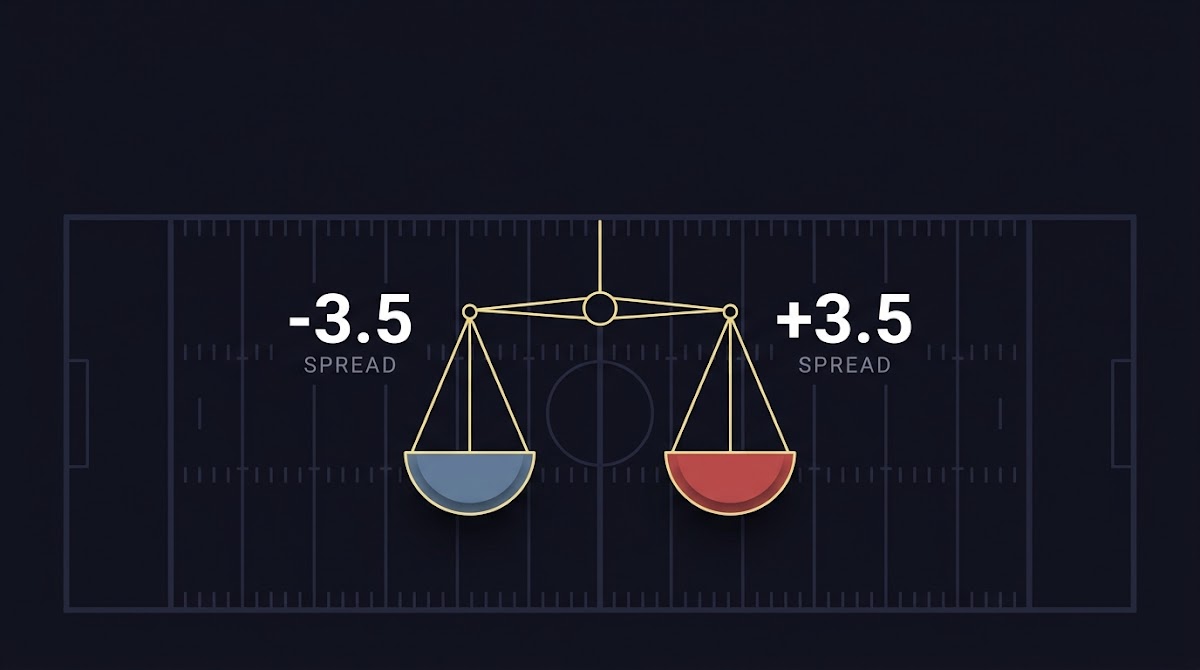
The point spread is a sportsbook-set handicap where the favorite is listed with a negative number and the underdog with a positive number, and a bet wins if that side covers the spread; understanding this lets you read a posted number correctly, for example Favorite -6.5 or Underdog +6.5.
For a concise consumer explanation of how spreads work and how cover is determined, see the Investopedia point spread explainer Investopedia point spread explainer and the ESPN FAQ ESPN FAQ.
Why sportsbooks use a spread
Sportsbooks use spreads to present a balanced contest on paper so bettors can wager on the margin of victory rather than only the winner, which creates more even wagering interest and clearer pricing choices.
Regulated markets treat spread wagers as a standard bet type and require operators to publish grading and settlement rules that explain how ties and pushes are handled, as shown in state wagering catalogs Massachusetts sports wagering catalog.
Explore FundedPlays challenge rules and options
Before placing a spread wager, pause to confirm the posted point value, the price per side, and your operator's grading rules so you know whether a tie returns your stake.
How sportsbooks set the NFL point spread
Power ratings and expected margin
Oddsmakers typically start with power ratings and an estimated scoring margin to produce an opening spread; those ratings combine team performance, matchup factors, and historical adjustments to produce a projected margin.
For a useful overview of how operators and industry guides describe pricing inputs and power ratings, see the American Gaming Association glossary and basics AGA sports betting basics.

Adjusting lines for information and profit
After an opening number, sportsbooks update spreads for injuries, weather, roster news, and betting action; academic research also notes that books may set prices to maximise expected profit rather than purely to balance action, so line movement can reflect both information and revenue strategy.
Foundational literature on market organisation explores why gambling markets move differently from financial markets and why professional action can shift lines, see the economic journal analysis analysis of gambling market organisation.
Reading the line on game day
Favorite, underdog, and juice
When you look at a game line, identify the favourite and underdog, the point value, and the price or juice attached to each side; typical spread prices sit near -110 per side, so understanding implied probability helps you judge value. Fox Sports explains.
Consumer guides note that pricing around -110 implies a break-even win-rate near 52.38 percent under that price structure Investopedia point spread explainer.
The spread is a point-handicap assigned by an operator that determines whether the favourite or underdog covers a set margin; settlement depends on the final margin and the operator's published grading rules, including how pushes are handled.
Practical checks before you wager include confirming who is favoured, the exact point spread, the price (juice), recent line movement, and the operator's published grading policy.
Practical checklist before you wager
Make a short checklist: 1) confirm the favourite and underdog, 2) note the point margin, 3) note the price or juice, 4) check recent line movement, and 5) review the house rules for pushes and settlement.
Regulators expect operators to publish these rules so bettors can compare treatments and avoid surprises on settlement Colorado sports betting catalog.
Odds and pricing: what -110 means for you
Vig and break-even percentage
Odds listed as -110 mean you must wager 110 to win 100, and with symmetrical -110 pricing the implied break-even probability is roughly 52.38 percent; that figure shows the additional win rate a bettor needs to overcome the vig. See CircaSports Sports Betting 101 CircaSports.
Consumer-facing explainers outline how -110 pricing translates into required win rates and why the vig increases the threshold for profitability AGA sports betting basics.
Why prices vary by operator
Different operators may list slightly different prices or offer alternative spreads with varied odds; these differences change the break-even requirement so comparing prices where legal can matter for long-term results.
Markets and operator strategies change depending on the book's internal pricing model and the mix of customers, which affects the displayed vig and odds.
Pushes, half-points, and house rules
When a bet is a push
A push happens when the final margin equals the posted spread; in many regulated markets the common treatment is to refund stakes on a push, but exact actions depend on the operator's house rules, which regulators require to be published.
State catalogs and regulator FAQs describe mandated disclosures and typical grading treatments so bettors can see whether a push returns a stake or is handled differently Ohio sports gaming FAQ.

How half-points reduce pushes
Half-point lines remove the possibility of an exact tie by making spreads non-integer (for example -3.5), which avoids pushes in many cases but also changes pricing and potential payout math.
Alternate spreads, where you buy or sell points for different odds, also change push probability and payout; check operator menus to see which options are available in your jurisdiction.
Alternate spreads and buying points
How buying or selling points works
An alternate spread lets you move the line in exchange for worse or better odds; buying half a point to move -3.5 to -3.0 may reduce the risk of a push but usually requires accepting a worse price.
Explainers show how the trade-off between reduced push risk and degraded pricing affects the break-even threshold and expected value Investopedia point spread explainer.
When alternate lines are useful
Alternate lines can be useful when you want to avoid small margins that frequently produce pushes, or when a small point change meaningfully changes your chance to win relative to the cost in price.
Availability and exact pricing for alternates differ by operator and jurisdiction, so check the operator menu before committing funds.
Why NFL spreads move before kickoff
Sources of movement: injuries, weather, sharp money
Lines move for many reasons: injury reports, late roster news, weather forecasts, public betting patterns, and professional or sharp action can all shift a spread before kickoff.
Books update lines as new information arrives and as their models react to market action; research in market structure explains why these updates may reflect both new facts and profit optimisation by the book analysis of gambling market organisation.
track key drivers of pregame line movement
Update before kickoff
Interpreting early versus late movement
Early movement can reflect sharp or informed action while late movement often reflects injury updates and public flows; the closing line tends to incorporate the most information available by kickoff, which is why some bettors use closing-line value as a benchmark.
While line motion is informative, remember books may alter prices to manage profit exposure rather than strictly to equalise bets, so movement is not a perfect signal of value.
Using the spread to measure your edge
Tracking against the spread (ATS)
Keeping an ATS record is the standard way to measure performance: record each spread wager, the line you took, the closing line, and the result so you can calculate win-rate, ROI, and variance over time.
Serious trackers include the closing line in their record because many bettors use beating the closing line as evidence of an informational edge or superior prediction skill academic commentary on market signals.
Beating the closing line as a benchmark
Closing-line value is a common benchmark since markets generally aggregate public and professional information up to kickoff, but it is also subject to variance and sample-size effects, so use it alongside other performance measures.
Use consistent record keeping and resist over-interpreting short streaks; treat closing-line performance as one piece of evidence rather than definitive proof of lasting edge.
Strategy basics for spread bettors
Bankroll and staking
Adopt disciplined bankroll management and fixed staking plans to avoid chasing losses; consistent unit sizing helps isolate skill from variance when tracking results against the spread.

Set a maximum percentage of your active betting bank per wager and stick to it so one loss does not distort long-term measurement and so you can compare performance objectively AGA sports betting basics.
Record keeping and review
Keep a simple ledger of date, event, line taken, closing line, stake and result; review performance monthly to find strengths and weaknesses and to avoid repeating avoidable mistakes.
Focus reviews on sample-size adjusted performance and on whether you are consistently beating the closing line before increasing exposure.
Common mistakes bettors make with spreads
Misreading pushes and grading
One common error is not checking grading rules and assuming pushes always return stakes; regulator catalogs make clear that the operator's published house rules govern settlement and that bettors should verify them before betting Massachusetts sports wagering catalog.
Save or screenshot the operator's grading page for your records so you can document settlement if an issue arises.
Overreacting to early news
Another common mistake is overreacting to early market moves or single injury reports; a measured approach checks multiple sources and considers whether movement reflects sharp money or public bias.
Quick corrective actions include setting clear staking rules, avoiding impulse changes to unit size, and re-checking the house rules for settlements and voids Ohio sports gaming FAQ.
Examples: how a spread bet resolves
Hypothetical game walkthrough
Example 1, with a favourite listed at -3.5: if the final score difference is 4 points in favour of the favourite, the favourite covers and a bettor on the favourite wins; if the favourite wins by 3, they fail to cover and a bettor on the underdog wins.
To see how regulators and consumer explainers show the arithmetic of coverage and margin, consult industry guides for examples and standard definitions Investopedia point spread explainer.
Cover, push, and loss scenarios
Example 2, with a favourite at -3.0 (an integer): if the final margin is exactly 3, that creates a push and the operator's house rules determine whether stakes are refunded or handled otherwise; check the operator's published grading policy for the precise outcome.
These step-by-step examples show why half-point lines and alternates are popular: they remove integer ties and thus reduce push frequency, but they also change the price and break-even math.
How to check house rules and where to find them
Operator menus and state catalogs
Operators must publish house rules in regulated states and many regulators maintain public wagering catalogs; examples include the Massachusetts and Colorado catalogs where settlement and grading provisions are listed for operators licensed in those states Massachusetts sports wagering catalog.
Find the operator's terms or rules page, then cross-check the state catalog if you want the regulator's summary of permitted bet types and required disclosures.
Key clauses to read
Read the clauses on grading policy for pushes, cancellation and postponement treatment, and settlement timing; these are the items most likely to affect whether a bet is voided or refunded.
Save or screenshot the relevant pages at the time you place a bet so you have a record of the operator's published position.
Comparing spread bets to other options and skill-based platforms
Spread versus moneyline and totals
Spread bets focus on margin of victory, moneyline bets focus on who wins outright, and totals (over/under) focus on combined points; each market has different variance and payout characteristics that affect how you manage risk and bankroll.
Spreads typically reduce variance compared with moneylines for lopsided matches because they allow you to bet on competitive margins rather than outright winners.
Skill-focused alternatives and evaluation challenges
Skill-focused platforms and funded challenge models let users practise prediction and measure consistency using structured evaluation rules and virtual bankrolls rather than wagering at a sportsbook; these platforms are an alternative testing ground for refining forecasting skills, under clear rules.
Mentioning FundedPlays once as a factual example: FundedPlays operates evaluation challenges where users can practise prediction consistency within defined rules and virtual funded accounts without implying guaranteed earnings.
Key takeaways and next steps
Summary checklist
Quick takeaways: understand that the spread is a sportsbook handicap, always check house rules for pushes and grading, and use disciplined bankroll and record keeping when measuring ATS results.
As a next step, check the operator's published grading rules, keep a consistent ATS ledger, and avoid changing stake sizes impulsively after short sequences of wins or losses AGA sports betting basics.
When the final margin equals the spread it is often treated as a push; the operator's published house rules determine whether stakes are refunded or handled otherwise, so check those rules before placing a wager.
Lines move due to injury updates, weather, public betting, and professional or sharp action; sportsbooks also adjust prices based on risk and expected profit, so movement may reflect both information and operator strategy.
-110 means you must wager 110 to win 100; with symmetrical -110 pricing the approximate break-even win-rate is about 52.38 percent, which accounts for the bookmaker's vig.
References
- https://www.investopedia.com/terms/p/pointspread.asp
- https://www.espn.com/chalk/story/_/id/23220534/chalk-basics-sports-betting-faq
- https://massgaming.com/sports-wagering/sports-wagering-catalog/
- https://www.americangaming.org/resource/sports-betting-101/
- https://academic.oup.com/ej/article/114/495/223/5089850
- https://sbg.colorado.gov/sports-betting-catalog
- https://www.casinocontrol.ohio.gov/Sports-Gaming/Frequently-Asked-Questions
- https://www.fundedplays.com/challenges
- https://www.foxsports.com/stories/betting/what-is-point-spread
- https://www.circasports.com/sports-betting-101
- https://www.fundedplays.com
- https://www.fundedplays.com/blogs
- https://www.fundedplays.com/blogs/how-fundedplays-evaluations-work