
Quick answer: what +200 means
One-line conversion
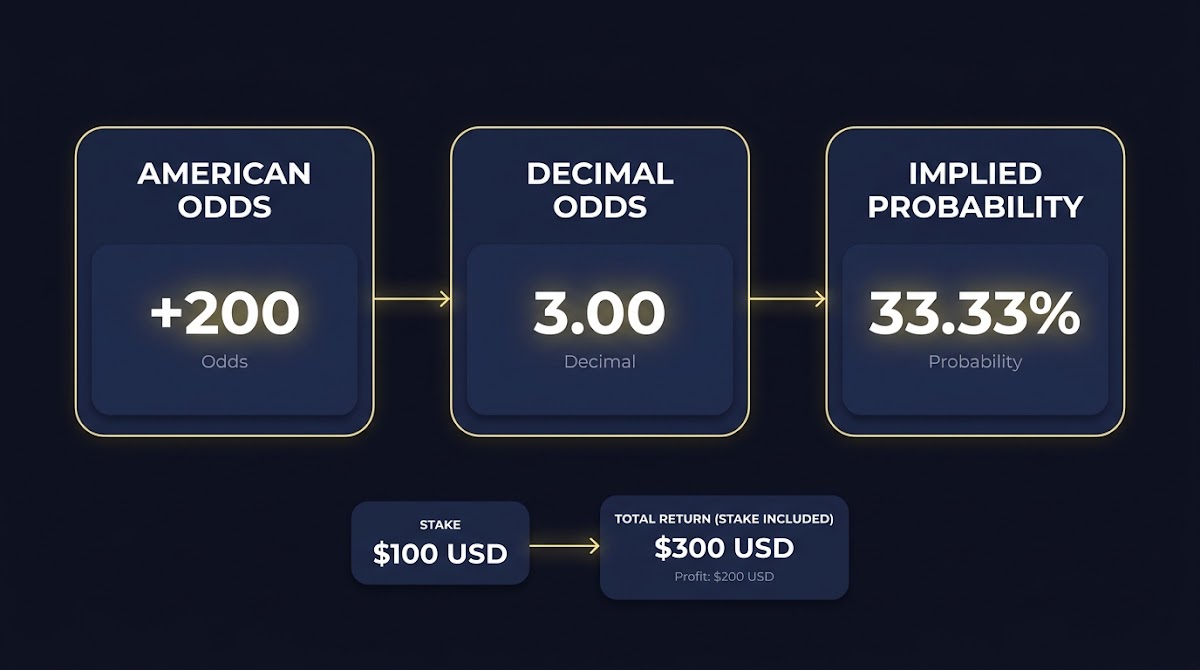
+200 American moneyline odds convert to decimal odds of 3.00 using the positive-odds formula decimal = 1 + (odds/100), and the implied probability formula 100/(odds+100) gives 33.33 percent before accounting for bookmaker margin.
That means a $100 stake at +200 yields $200 profit and a $300 total payout; profit scales linearly with stake.
Learn more about structured evaluation challenges
Continue through this guide for worked examples, quick checks, and a short checklist you can use when converting odds.
Immediate takeaway for bettors
If you want a quick converter, typing +200 into most calculators will return decimal 3.00 and an implied probability of 33.33 percent, which is a convenient one-in-three intuition for betting decisions.
Using these conversions helps you compare market prices across formats and to spot where your model differs from market expectations.
How American moneyline odds work and the $100 base unit
Why sportsbooks quote positive and negative differently
American moneyline odds use a $100 base unit as a convention: positive numbers show the profit on a $100 stake, while negative numbers show the stake needed to win $100. This distinction explains why the signs matter and why different formulas apply for positive versus negative odds; the base convention is a long-standing market habit used to express relative returns.
Explaining the $100 convention helps avoid confusion when reading lines and when switching formats for comparison or model input.
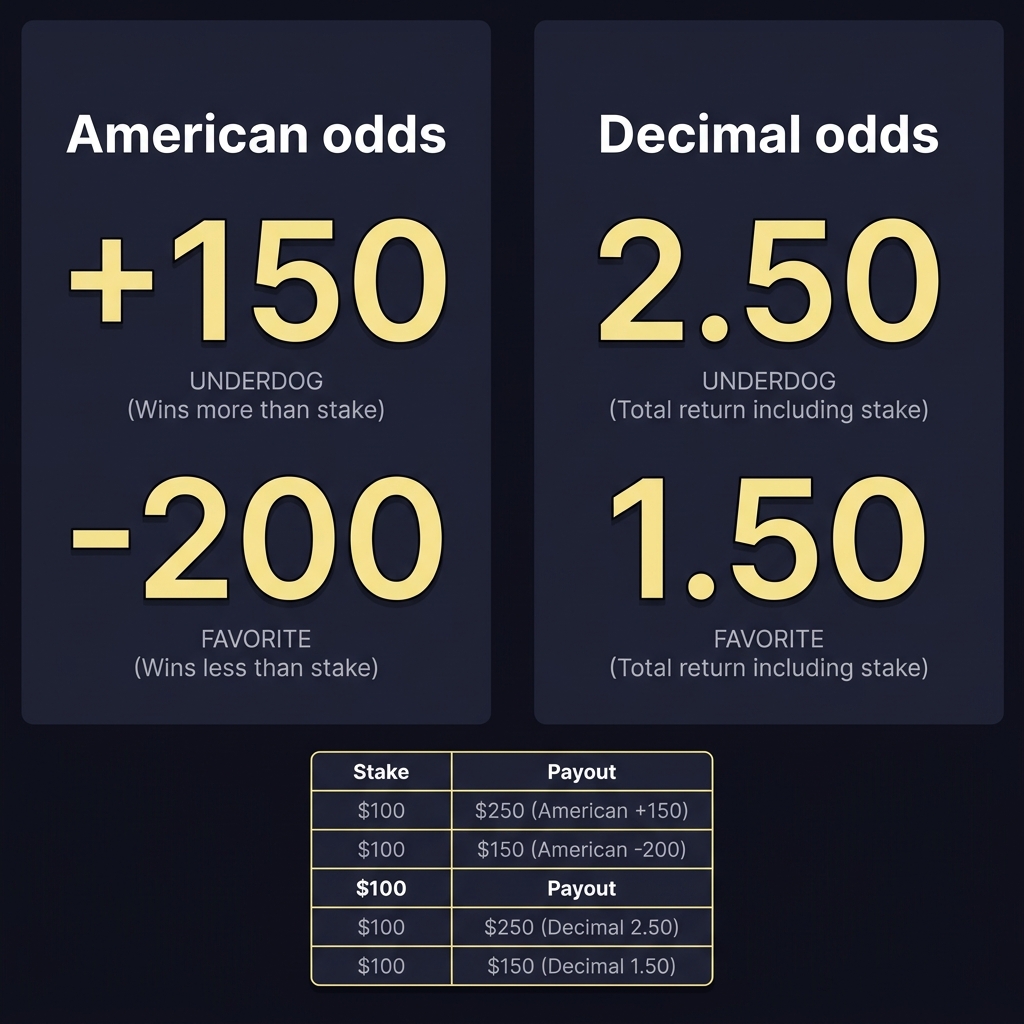
For positive American odds the standard formula comes directly from that $100 reference: decimal odds for a positive moneyline are calculated as 1 plus the moneyline divided by 100, because the quoted figure is the profit on a $100 stake. For context and reference on these standard formulas consult industry resources that document the conversion methods.
Understanding the $100 base unit makes the mapping between American and decimal odds intuitive: decimal odds state the total return including the original stake, while American positive odds state only the profit portion relative to a $100 baseline, which is why the arithmetic lines up so cleanly.
Step-by-step conversion: converting +200 to decimal odds and implied probability
Decimal conversion formula for positive odds
Start with the decimal conversion formula for positive American odds: decimal = 1 + (odds/100). Apply that to +200: decimal = 1 + (200/100) = 1 + 2 = 3.00, so +200 corresponds to decimal 3.00. For a reference explanation of the decimal format and how it includes the stake, see a primer on decimal odds.
#ERROR! (Formula parse error.)
Implied probability formula and interpretation
The implied probability for positive moneyline odds uses the formula implied probability = 100 / (odds + 100). Applied to +200, that is 100 / (200 + 100) = 100 / 300 = 0.3333, or 33.33 percent, which you can read as roughly one in three before bookmaker margin is considered.
Interpreting implied probability this way helps you compare a market quote to your own model estimate of an event's chance, but remember the raw implied probability does not yet remove the bookmaker margin.
How to calculate profit and total payout for any stake
Profit formula for positive American odds
The profit formula for positive American odds is profit = stake × (odds / 100). With +200, profit on a $100 stake is $100 × (200 / 100) = $200 profit. The total payout is the stake plus profit, so $100 + $200 = $300 total return. These formulas are the direct operational definition of how American positive odds relate to cash outcomes.
Because profit scales linearly with stake, the same ratio applies to any stake size. For a $10 stake at +200 the profit is $10 × 2 = $20 and the total return is $30. For a $250 stake the profit is $250 × 2 = $500, and the total return is $750. This linear scaling means you can calculate outcomes mentally for many common stake sizes once you understand the multiplier implied by the odds.
When you prefer an alternate route, multiplying the decimal odds by stake gives the same total payout because decimal odds include the stake; for +200 the decimal multiplier is 3.00, so stake × 3.00 = total payout.
Why decimal odds include the stake and American odds quote profit
Conceptual difference between formats
Decimal odds quote total return, including the original stake, which makes them directly usable to compute total payout by multiplying stake by the decimal figure; this format is common in many international markets and in analytics because it simplifies payout math. For a formal description of decimal odds and how they quote total return, refer to a standard explanation of decimal odds.

Why the two formats map cleanly
Because American positive odds state profit relative to a $100 base, and decimal odds state total return including stake, the mapping is arithmetic: +200 becomes 1 + 200/100 = 3.00 in decimal. That single-line example explains why conversions are lossless between formats when done correctly and why decimal is convenient for payout calculations.
Keeping the formats straight avoids mixing profit and total return when evaluating opportunities or when entering lines into a model or spreadsheet.
Negative American odds: the complementary formulas
Converting negative odds to decimal and probability
Negative American odds use complementary formulas because they indicate the stake required to win $100. For negative odds the decimal conversion is decimal = 1 + (100 / |odds|). The profit formula becomes profit = stake × (100 / |odds|), and the implied probability is |odds| / (|odds| + 100). These formulas let you convert any negative moneyline line into decimal odds and a raw probability estimate.
When to apply these formulas
Apply the negative-odds formulas any time the moneyline carries a minus sign. Using the absolute value of the odds keeps the algebra straightforward: treat the listed figure without its sign in the denominators where required, and remember that the probability and payout interpretations remain consistent with the way decimal odds quote total return.
These complementary formulas are the standard approach used in industry resources that cover American to decimal conversions and implied probabilities.
Implied probability versus bookmaker margin: overround and what it means for odds
Why summed implied probabilities exceed 100 percent
When you convert every market outcome to implied probability and add them, the total often exceeds 100 percent because bookmakers build in an overround or vigorish to cover costs and ensure a margin; this is why raw implied probabilities are commonly called pre-margin estimates rather than 'true' probabilities.
Understanding that the summed implied probabilities include margin helps you interpret the market quote more realistically and explains why adjustments are common before comparing market probabilities to your own model.
Compare summed implied probabilities for up to three outcomes
Use percentages like 33.33 when entering values
How to adjust for margin in simple terms
A simple, intuitive margin adjustment divides each implied probability by the total implied probability across the mutually exclusive outcomes to scale them down to sum to 100 percent. This proportional scaling gives a quick estimate of 'true' chances after removing overround, and practitioners often use that method as a baseline adjustment before applying more sophisticated margin models.
For more detailed discussions on margin and adjustment methods, betting resources document common approaches used by analysts and traders.
Common mistakes and pitfalls when converting odds
Confusing profit and total return
One frequent error is mixing profit with total payout. For example, interpreting +200 as returning $200 total instead of $300 total confuses profit and payout and will produce incorrect bankroll math. Always be explicit whether you are computing profit or total return before finalizing a calculation.
Rounding and precision errors
Rounding can introduce small distortions in implied probability, especially when converting many lines and summing probabilities; a few tenths of a percent per line can accumulate. Use reasonable decimal precision when converting and only round at the final reporting stage to avoid compounding small errors.
Other common mistakes include applying the positive-odds formula to negative odds and forgetting to use absolute values where needed; double-check formulas and run an example to confirm correctness when in doubt.
Practical examples: converting +200 at different stake sizes
Small-stake example
At +200, a $10 stake yields a profit of $10 × (200 / 100) = $20, and a total payout of $30; the decimal route gives the same result because 3.00 × $10 = $30.
Large-stake example and proportional scaling
At +200, a $50 stake returns $100 profit and $150 total payout. For a $250 stake the profit is $500 and the total payout is $750. Each example follows the same profit = stake × (odds / 100) rule and shows the linear scaling property of American positive odds.
Using the decimal multiplier is often the fastest mental path for total payout: multiply the stake by 3.00 to get the total return at +200, and subtract the stake if you need the profit only.
When to use a sports odds converter tool and its limitations
Benefits of a quick converter
A sports odds converter is useful when you need to switch formats quickly, verify multiple lines, or scale payouts across many stake sizes without manual arithmetic. Converters speed up basic workflow and reduce simple calculation errors when you are comparing lines across markets or preparing inputs for a model.
What a converter cannot tell you
Converters provide raw implied probabilities and format conversions but do not remove bookmaker margin or offer a definitive 'true' probability; they also do not replace judgment about market context, line movement, or model calibration. Use a converter for speed, and then apply margin adjustments or model checks as needed.
Remember that a sports odds converter is a tool for convenience, not a substitute for a margin-aware analysis when you are evaluating value or sizing stakes.
How bettors and analysts interpret implied probability in practice
Using implied probability for value spotting
Bettors compare their own model probabilities to the market's implied probability to identify potential value. If a model estimates a higher chance than the margin-adjusted market probability, that line could represent value to pursue under disciplined staking rules.
Practitioners typically do a margin adjustment before directly comparing model outputs to market implied probabilities, since raw implied probabilities are inflated by overround and may misrepresent market-implied chances.
Why adjustments matter for model building
When building or testing models, accounting for bookmaker margin prevents systematic overestimation of the market's generosity and leads to fairer backtests. Historical and educational resources outline margin effects and common adjustment techniques that analysts use to align market probabilities with model outputs.
Quick checklist: convert +200 accurately every time
1) Identify the sign: if positive, use decimal = 1 + (odds/100); if negative, use decimal = 1 + (100 / |odds|).
2) Compute implied probability: for positive odds use 100 / (odds + 100); for negative use |odds| / (|odds| + 100).
3) Calculate profit and payout: profit = stake × (odds / 100) for positive lines, payout = stake + profit or payout = stake × decimal.
4) When comparing multiple outcomes, sum implied probabilities and check for overround; apply a proportional scaling to estimate margin-adjusted probabilities if needed.
What this means for skill-based platforms and simulations like FundedPlays
Applying conversions in simulated challenges
Understanding how to convert odds and compute implied probabilities helps participants in simulated environments compare market expectations to their own forecasts in simulated environments, where the objective is disciplined, reproducible performance rather than wagering real funds.
Why understanding raw probability matters for disciplined play
Knowing raw implied probability and how margin affects it allows participants to calibrate models, test strategies, and make more informed decisions during evaluation challenges, while keeping in mind that platform rules and account progression depend on consistent performance and following platform rules.
Skill-focused platforms provide structured challenges for evaluating forecasting ability, and converting odds correctly is a basic competency for advanced evaluation work.
Conclusion: read and convert odds with confidence
Key takeaways
+200 equals decimal 3.00 and implies a raw probability of 33.33 percent before margin; a $100 stake at +200 returns $200 profit and $300 total payout, and profit scales linearly with stake. Keep the difference between profit and total return clear and account for bookmaker margin when comparing probabilities to your model.
Next steps for practice
Practice conversions with a trusted calculator, use the checklist above when you work through lines, and apply simple margin adjustments when comparing market-implied probabilities to your internal estimates.

#ERROR! (Formula parse error.)
For negative odds use decimal = 1 + (100 / |odds|), profit = stake × (100 / |odds|), and implied probability = |odds| / (|odds| + 100).
Not exactly; raw implied probabilities are pre-margin and commonly add to more than 100 percent, so analysts adjust them to estimate true chances.
References
- https://www.aceodds.com/bet-calculator/odds-converter.html
- https://sports-statistics.com/odds-converter/
- https://oddsjam.com/betting-calculators/implied-probability
- https://www.fundedplays.com/blogs/how-fundedplays-evaluations-work
- https://www.fundedplays.com/blogs
- https://www.fundedplays.com
- https://www.fundedplays.com/challenges