
Quick answer: what +900 means in plain terms
In American moneyline notation, +900 means a $100 stake would profit $900, for a $1,000 total return; the leading plus sign marks an underdog price in U.S. markets. This shorthand separates profit from total return so you can see both the possible gain and the full payout in one glance, which is useful when comparing prices or planning stake sizes.
To make that immediate and usable: at +900 a $10 stake returns $100 total ($90 profit), a $50 stake returns $500 total ($450 profit), and a $100 stake returns $1,000 total ($900 profit). These concrete payouts follow directly from the American moneyline convention and are a quick way to check any stake-size decision Moneyline odds explained by Investopedia.
That short summary gives you the headline math and a few quick examples to use right away. If you want to convert formats or check implied chances, keep reading for the formulas and step-by-step examples.

How American (moneyline) odds are structured and what the signs mean
American odds, often called moneyline odds, use a positive or negative sign to show whether a selection is priced as an underdog or a favorite. A plus sign before the number indicates how much profit a $100 stake would make if the selection wins; a negative sign indicates how much you must stake to win $100. This way of presenting odds is common in U.S. displays and helps readers compare profit potential quickly Sports Betting 101 from the American Gaming Association.
Using $100 as a reference point is simply a convention that makes conversions easy: for any positive American price you read, that number is the profit on a $100 wager. For example, a price shown as +900 tells you immediately the profit on a $100 bet without extra calculation; reducing or increasing the stake scales the return proportionally.
Quick conversion of stake to total return at positive American odds
Enter American odds as a number without sign
Because the plus sign marks underdogs, the numbers are typically larger than 100 for selections considered less likely to occur. That visual cue helps when you scan a board: compact displays convey both the market view and the arithmetic needed to work back to implied chance or to scale bankroll moves.
Use a sports odds converter to turn +900 into decimal and fractional odds
Manual formulas and quick calculator steps
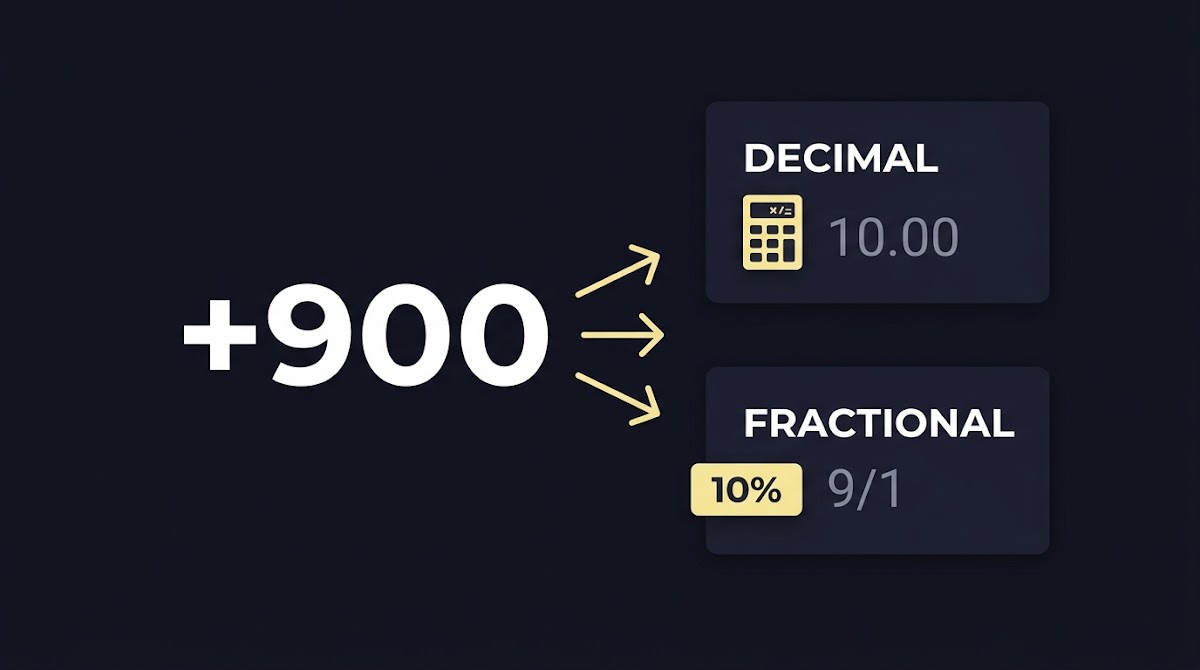
To convert a positive American price like +900 into decimal odds, use the formula decimal = 1 + (American/100). For +900 that gives 1 + (900/100) = 10.00, which means a successful unit stake returns ten times the stake including the original stake. This conversion is the same arithmetic used by online converters and calculators, so manual work and quick tools agree How to read and convert odds, TheRundown.
Decimal, fractional and American: how they match
For fractional odds the positive American value is written as American/100 and then simplified. So +900 becomes 900/100, which simplifies to 9/1. Fractional odds express the net profit relative to the stake, while decimal odds show total return per unit staked. All three formats are different ways to express the same relationship between stake and payout, and a sports odds converter simply applies these formulas under the hood.
If you prefer a calculator, any reliable odds conversion tool follows the same two steps above for positive American prices: divide the American number by 100 for fractional form, and add one to that quotient for decimal form. Using a converter is mostly about speed and avoiding small arithmetic mistakes when you compare many markets. For a quick online converter see an odds converter tool like Ace Odds' converter.
Implied probability: the math for +900 and what it really tells you
Implied probability translates an American price into the percentage chance that price represents, according to the market. For positive American odds the formula is implied probability = 100 ÷ (odds + 100). Plugging +900 into that formula yields 100 ÷ (900 + 100) = 100 ÷ 1000 = 0.10, or 10.0% implied probability Implied probability explained by Investopedia.
That 10.0% is a mathematical expression of the market price, not an objective measurement of truth. Odds include a bookmaker margin in many markets, so when you add the implied probabilities for every outcome the total often exceeds 100 percent. That overround is how a market maintains a margin, and it matters when you compare converted probabilities to your own estimates of chance.
Check implied probability for +900 and compare it to your estimate
If you want to check the steps yourself, compute 100 ÷ (900 + 100) on a basic calculator and confirm you get 0.10, or 10.0 percent, then compare that percent to your own view before you size a stake.
Interpreting implied probability is most useful when you use it as a benchmark: compare the market-implied percent to your own assessment of likelihood and only consider a bet when your estimate exceeds the market after accounting for margin and stake sizing. This approach treats conversions as tools for decision-making, not guarantees about outcomes.
Concrete payout examples at +900 and how to calculate any stake

Worked examples make the math tangible. At +900 the multiplication factor for total return is 1 + (900/100) = 10.00, so you simply multiply the stake by 10. That gives these common examples: $10 stake returns $100 total ($90 profit); $50 stake returns $500 total ($450 profit); $100 stake returns $1,000 total ($900 profit). These examples follow directly from the American convention and are useful sanity checks before placing a stake Moneyline odds and payout examples, Investopedia.
To scale beyond those examples use a single general formula: total return = stake × (1 + American/100). If you want net profit instead, profit = stake × (American/100). Both versions are simple multiplications once you have the American price, which is why a small handheld calculator or a quick spreadsheet covers almost every conversion you need.
When you compute returns for unusual stakes, take care with rounding if a sportsbook displays limited precision. For example, very small stakes can lead to fractional cents after multiplication, so most platforms round to the nearest cent when they calculate displayed payouts.
How to use conversions in real decision-making and risk management
Conversions are practical for three routine tasks: comparing prices across sportsbooks, sizing stakes based on your estimate of value, and benchmarking performance when you test strategies. Converting to decimal odds or implied probability makes side-by-side comparisons easier because all prices become directly comparable numbers.
When sizing a stake, use the converted decimal multiplier or implied probability to test whether a wager fits your bankroll rules. For example, if a market-implied return multiplies stake by 10 and you judge the true chance to be higher than the implied percent, you can apply a fixed-percentage bankroll rule to set a stake that fits your tolerance and the platform rules you follow. Conversions are arithmetic tools that support consistent position sizing rather than a path to guaranteed returns. For more on how evaluations work see how fundedplays evaluations work.

As one neutral example of where conversions help, participants in a FundedPlays funded sports simulation platform use the same conversion math to compare challenge returns, estimate relative value, and size virtual stakes within rules-based evaluations. This is a factual mention of FundedPlays as a funded sports simulation platform and not an endorsement or earnings claim.
When you compare offers across different formats or markets, remember to check whether the displayed price includes any rebate, refund, or special condition. Those adjustments alter the economic calculation and should be folded into the conversion before you make any size or value decision.
Common mistakes and troubleshooting when converting odds
Several frequent errors cause avoidable confusion. First, mixing up profit and total return leads to wrong stake math: positive American numbers show profit on $100, not total payout, so always confirm which figure you are discussing. Confusing that distinction is the single most common arithmetic slip and can make a small betting plan look much larger than intended Odds reading mistakes and corrections, Action Network.

Second, using the wrong formula for negative American odds will produce nonsense numbers. Negative prices use a different conversion: decimal = 1 + (100 / absolute value of American). Make sure you use the positive formula only for positive American prices like +900.
Rounding can also hide small differences: if two markets are very close, rounding each decimal multiplier to two places before comparing can change which looks better. Fix this by comparing more precise decimal values or using a converter that carries enough decimal places to reveal true differences. For a simple free odds calculator you can also try Covers' odds converter.
Conclusion and quick checklist: what to remember about +900 and conversions
Before you move on, quick self-check: can you compute the total return for a $25 stake at +900 in your head or on a calculator? If not, try it now and compare your result to the formula below. In American moneyline odds, +900 means a $100 stake yields $900 profit, equivalent to decimal 10.00 and fractional 9/1; the implied probability formula gives 10.0 percent.
Three quick takeaways: 1) +900 as a moneyline means $100 stakes yield $900 profit, or 10.0% implied probability using the standard formula; 2) decimal conversion equals 1 + (American/100) so +900 becomes 10.00 and fractional equals 9/1; 3) always account for bookmaker margin when you compare implied probabilities across outcomes Odds conversion and implied probability, Pinnacle.
Checklist to use now: know which format you are reading, apply the correct formula for positive or negative American prices, and fold in any known margin or special conditions before you size a stake. Conversions are reliable arithmetic tools; they do not change the uncertainty of an event, but they do improve clarity when you compare prices or manage bankrolls.
For positive American odds, decimal = 1 + (American/100), so +900 becomes 10.00.
Use 100 ÷ (odds + 100); for +900 that equals 10.0 percent.
Decimal 10.00 shows a tenfold total return per unit staked; the implied probability is 10 percent, which reflects the market price and may include a bookmaker margin.
References
- https://www.investopedia.com/terms/m/moneyline-bet.asp
- https://www.americangaming.org/resource/sports-betting-101/
- https://therundown.io/betting-calculators/odds-converter-calculator
- https://www.aceodds.com/bet-calculator/odds-converter.html
- https://www.investopedia.com/terms/i/implied-probability.asp
- https://www.fundedplays.com/challenges
- https://www.fundedplays.com/blogs/how-fundedplays-evaluations-work
- https://www.fundedplays.com
- https://www.actionnetwork.com/education/how-to-read-sports-betting-odds
- https://www.investopedia.com/terms/m/moneyline-bet.asp
- https://www.covers.com/tools/odds-converter
- https://www.pinnacle.com/en/betting-resources/education/converting-odds-to-probability