
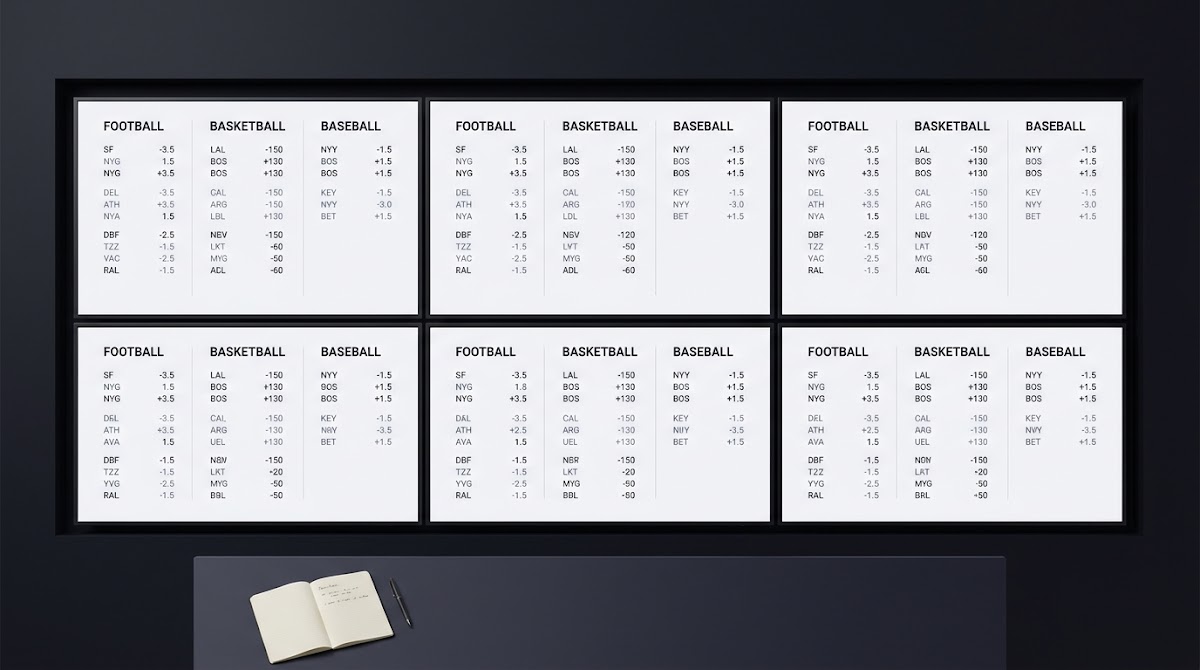
What "sports betting lines today" actually means
The phrase sports betting lines today refers to the current posted odds and price expressions bookmakers and betting markets use to show who is expected to have the advantage in an upcoming contest. Readers check sports betting lines today to compare market views, track changes, and find the clearest signal about which side the market is favoring.
At its simplest, a betting line is a compact summary of expectation and pricing. The three most common line types you will see are the point spread, the moneyline, and totals, sometimes called over and under. Each presents favoritism differently: spreads adjust the expected score margin, moneylines price an outright win, and totals estimate combined scoring.
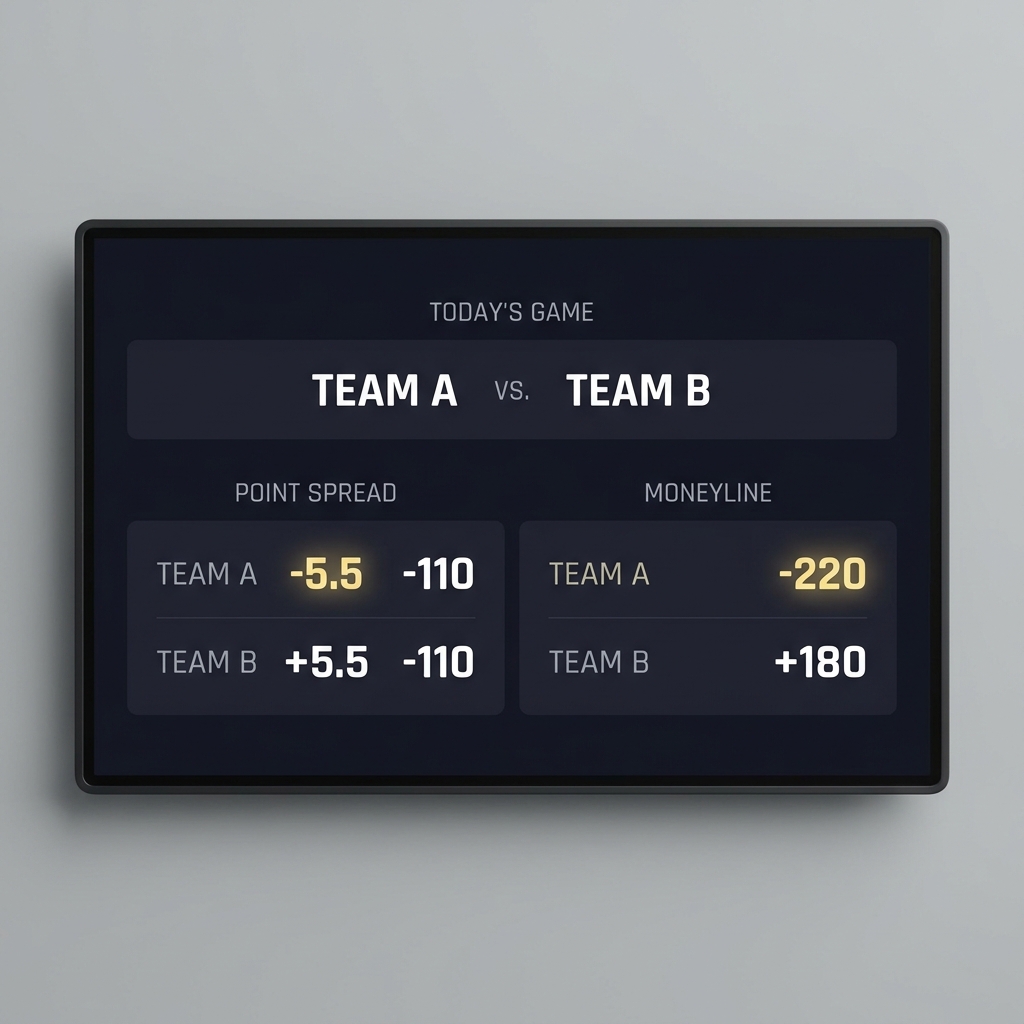
Point spread explained, in plain terms, means the favorite gives points and the underdog receives them. For example, if a team is -7 on the spread, that team is treated as the seven-point favorite. Moneyline favorites, by contrast, show up as shorter prices that pay less per dollar staked because the market sees them as more likely to win. Totals indicate how many combined points or runs the market expects, and a substantial move in totals can signal confidence that one side will control tempo or pace.
Lines are snapshots of market consensus at a moment in time. They are not guarantees of outcomes, but they are useful because they reflect aggregated judgments about team strength, injuries, situational factors, and how much money or tickets have been placed on each side.
Practice reading lines with simulated challenges
Try a free simulated challenge or sign up for a short newsletter to practice reading lines without risking real money.
How bookmakers set opening lines and why those lines matter today
Bookmakers open lines by combining model projections, scouting information, and market expectations. Inputs often include team and player performance metrics, recent form, matchup context, travel, and public sentiment. Because opening lines represent the start of a market conversation, they matter as the reference point from which movement is measured.
Odds compilers use both quantitative models and qualitative knowledge to set an opening line. They consider injury reports, public tendencies, and the likely distribution of bets so the opening number balances a realistic expectation with the book's need to manage exposure. This balance helps the bookmaker attract bets on both sides while protecting against outsize losses.

Opening lines are not fixed forecasts. Once published, they will move in response to new information or betting patterns. Early moves can indicate where influential players or sharp bettors are placing money, while later moves often show how the public is reacting to the evolving market picture.
Reading who is favored in sports betting lines today
Favorites show up in two main ways: a negative spread number or a shorter moneyline price. When you see a spread like -6.5, the team with that mark is the favorite by that margin. A moneyline favorite might be listed at -200 or similar, meaning the market views that side as more likely to win outright.
Spread size and moneyline price together give a quick read of how much the market favors one side. A larger spread usually implies a clearer expected margin. A shorter moneyline suggests a higher probability of an outright win. Neither signal removes uncertainty, but combined they form the basic shorthand for favoritism.
Look at the spread and moneyline to identify the favored side, check when and why the line moved, confirm injuries or context, and use a checklist with disciplined bankroll rules before acting.
Keep in mind that favorites lose sometimes; being favored simply records the market expectation, not a certainty. Also pay attention to the implicit probabilities behind prices, since the same margin can carry different expectations based on sport, matchup, and venue.
How lines move during the day and what movement tells you
Line movement means the change in the posted number from opening to the current or closing line. Movement can be caused by breaking news, injury updates, or shifts in the amount of money placed on each side. Watching when and why a line moves gives context about which signals are driving the market.
Different types of movement have different implications. Early movement often reflects sharp bettors acting on perceived edges, while late movement frequently shows where public money landed. Large, sudden moves away from the opening line can indicate high-confidence action or important new information.
Track opening, current, and closing lines to judge movement
Update after each market change
To interpret movement magnitude, compare the move against typical volatility for that sport and matchup. A half-point shift in one sport may be routine, while in another it could be notable. Timing matters too; moves near close time can be driven by last-minute news, while persistent movement over hours may reflect sustained demand on one side.
Common indicators beyond the number that show favoritism
Two useful complements to raw lines are betting percentages and money distribution, sometimes called handle. Betting percentage counts the proportion of wagers, while handle measures the dollar volume. These two can tell different stories: a large number of small bets can produce a high ticket percentage but low handle, while a few large bets can swing handle without a matching ticket count.
Injury news, lineup changes, and weather can all change who is favored, often quickly. Confirmed injuries to starters or late scratches usually shift lines and can flip favoritism, especially when they affect key positions. Weather that affects scoring tends to move totals and can also shift which side the market favors.
Be mindful that a consensus market view is different from a sharp signal. Consensus shows where the general betting market leans, while a sharp signal is typically based on significant dollar action by experienced bettors. Both are informative when used together.
A simple framework to decide which side to trust today
Use a short checklist before committing to a side: confirm the current line, check recent movement and timing, review injury reports, compare betting split and handle, and consider matchup context. This structured approach keeps decisions evidence based rather than emotional.
When to act versus wait depends on what you find. If the line you want appears early and moves further in your favor after sharp activity, that can be a reason to act. If a line drifts away or late movement introduces new uncertainty, patience may be wiser. Always align any decision with disciplined bankroll management to limit downside.
Emphasize process over one-off wins. Following a concise checklist helps prevent chasing brief trends and supports steady improvement in reading which side the market favors.
Mistakes and traps when interpreting sports betting lines today
Common errors include treating favorites as safe bets and overreacting to a single signal like a headline or a dramatic line move. Confirmation bias leads readers to favor information that supports a chosen side, and recency bias makes fresh events feel more decisive than they sometimes are.
Chasing line movement can be costly. If you follow movement without checking why it occurred, you may end up on the wrong side of a market where the heavy action came from a streak or a mistaken data point. Avoid this by pausing to verify the cause of major shifts and by keeping your stake sizes controlled.
Practical ways to avoid these traps include using the checklist, keeping a clear staking plan, and requiring more than one strong signal before increasing exposure. Discipline and consistent logging of decisions reduce the chance that cognitive biases drive action.
How to use lines today as a testing ground for your prediction skills
Testing your read on favoritism is best done with a simulated bankroll or a practice challenge. Document every pick, the line taken, why you chose that side, and the relevant signals you used. Over time, that log reveals whether your interpretation of favoritism produces a replicable edge.
A platform-style practice environment lets you take risk-free positions, measure outcomes, and experiment with timeframes and markets. For readers who want a structured simulation with defined objectives and virtual funded accounts, Funded Plays Challenges offers an option to practice and track performance in a challenge format:

Track simple metrics: hit rate, average line taken, and return on the lines you choose. Use these to assess whether your reading of who is favored aligns with repeatable success, and adjust your process rather than chasing single results.
Examples and scenarios: reading lines for football, basketball, and baseball
Football spread example: if a team is -10 on the spread, the market treats that team as a clear favorite to win by multiple scores. In evaluating that line, consider injuries, motivation, and matchup specifics before interpreting favoritism as actionable.
Basketball moneyline and totals example: a short moneyline with a pushed total may indicate the favorite is expected to control possession and pace. Home court effect often narrows spreads, so consider venue when deciding which signal to trust.
Baseball run line and price nuances: the run line, often -1.5 for favorites, pairs with moneyline pricing to show how heavy a favorite is. Because scoring can be low and pitching matchups decisive, small price gaps can carry meaningful implications about favoritism in baseball.
When to be skeptical of who is favored in a line
Certain situations frequently mislead the market. Examples include a public overreaction to hype, manipulated lines driven by coordinated ticket patterns, or outsized public money after a viral story. In these cases, the apparent favorite may not represent underlying strength.
When you see unusual moves, check the line history, confirm injury reports from team sources, and seek corroboration from trusted analysis. Suspicion is useful when paired with disciplined evidence gathering instead of reflexive abandonment of a process.
A responsible close: using lines as information, not certainty
Recap the main signals that show who is favored: spread size, moneyline price, timing of movement, and supporting context like injuries and weather. Use these as inputs to a decision framework rather than as guarantees.

Next steps for readers: keep a log, practice on simulations, and set clear bankroll rules before acting. Treat lines as tools to inform disciplined decisions, not as certainties that remove risk.
Appendix: quick reference glossary for lines today
Spread. The margin by which the favorite must win for a bet on that side to succeed.
Moneyline. The price paid for an outright winner, expressed as shorter numbers for favorites and longer numbers for underdogs.
Totals. The market estimate of combined scoring, shown as an over or under that bettors choose between.
Juice. The commission or fee built into a market price that ensures the bookmaker manages risk.
Closing line. The final posted price before the contest starts, useful as a reference for where the market settled.
Handle. The total dollar volume wagered on a market, distinct from betting percentage which counts tickets.
Further reading and practice tasks
Exercise 1. Compare opening and closing lines for five games this week and note which direction movement went, then ask what signal produced that move.
Exercise 2. Track three simulations over a month, recording line taken, time of bet, and result to see if your read of favoritism correlates with outcomes.
Exercise 3. Pick a sport and follow injury reports and weather for a week, watching how those factors change lines to build intuition on causal links.
Disclaimer and how FundedPlays fits into practicing prediction skills
FundedPlays is a platform offering structured prediction challenges and simulated funded accounts that let users practice decision making and document performance. It is not a sportsbook or an investment service, and participation does not guarantee earnings or qualification for rewards.
Before using any platform, review the rules carefully, practice disciplined bankroll management, and treat simulated or challenge formats as training environments to build consistent, responsible skills at reading lines and judging who is favored.
Check the point spread and moneyline: a negative spread or a shorter moneyline price indicates the favored side. Also review recent movement and injury notes before deciding.
No. Line movement shows where money or information moved the market, not a guarantee of outcome. Use it as one signal among others when making a choice.
Yes. Use simulated bankrolls, practice challenges, or documentation of hypothetical picks to test your ability to read lines without financial risk.
References
- https://oddsjam.com/betting-education/betting-line-movement
- https://www.circalasvegas.com/blog/sportsbook/from-the-experts/article/why-betting-lines-move-a-bookmakers-perspective/
- https://www.covers.com/guides/what-line-moves-can-tell-us
- https://www.fundedplays.com
- https://www.fundedplays.com/blogs
- https://www.fundedplays.com/blogs/how-fundedplays-evaluations-work
- https://www.fundedplays.com/challenges