

What is a sports betting bot and how common are they in 2026?
Short definition - sports betting bot
A sports betting bot is software that automates prediction or execution tasks for sports wagers. In practice the term covers systems that generate probabilities or recommendations, and systems that place or manage orders automatically; the phrase sports betting bot is used here to mean either a prediction engine, an execution layer, or both working together.
By 2026 AI-driven tools that support prediction and automated execution exist and commonly fall into three categories: prediction models that output probabilities or price lines, execution automation that places orders where allowed, and social or copy-betting systems that replicate picks. Many of the programmatic capabilities used by these systems are documented in developer program materials for betting exchanges Betfair API overview. See the Betfair developers site for additional developer program information.
Try a paper-trial before live deployment on FundedPlays Challenges
Before attempting any live use, run a controlled paper-trial that mirrors real market conditions and checks model calibration, slippage and compliance.
Availability does not mean permissibility. Operator technical standards and jurisdictional rules often restrict or regulate automated access to betting systems, so the presence of tools does not imply allowed use in every market.
How sports betting bots work: prediction models, signals and automation
Prediction engines and ML models
At the core of many systems sits a machine learning model trained to forecast outcomes or to produce implied prices. These models range from simple logistic regressions to ensemble methods and deep learning architectures. Academic reviews note that machine learning can reach strong historical accuracy in some sports but emphasize the need for robust evaluation beyond in-sample results IEEE systematic review.
Signal generation and odds comparison
A practical pipeline turns model outputs into trading signals by converting predicted probabilities into implied fair odds and comparing those to market odds to identify potential edges. Common evaluation metrics for calibration and discrimination include Brier score and log loss, which let practitioners measure how well predicted probabilities match outcomes over time. Using these metrics helps avoid overconfidence in backtests.
Execution layers and automation
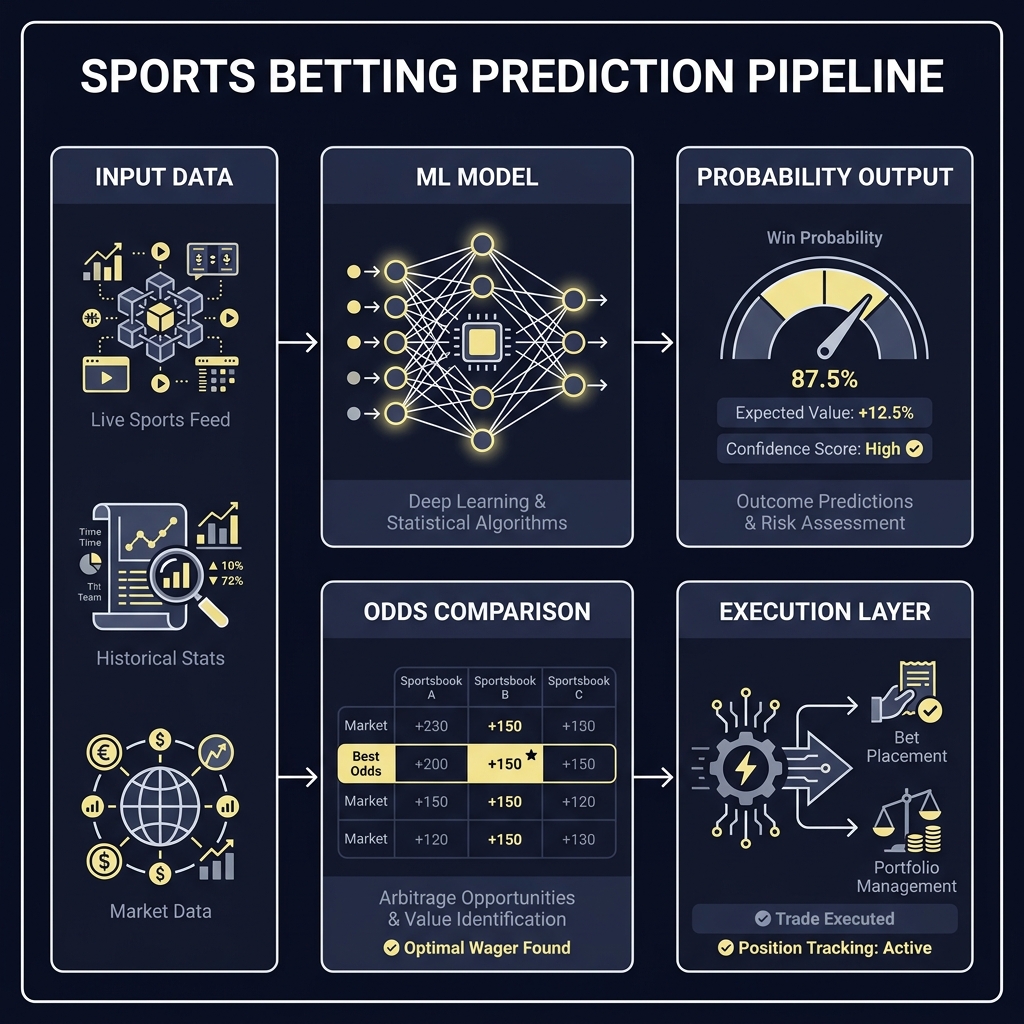
The prediction layer is often separate from the execution layer. Where programmatic access is permitted, an execution layer will monitor market odds, manage stake sizing and place orders according to predefined rules. Whether that layer can act autonomously depends on the API and operator rules that govern access and allowed behavior Betfair API overview.
Types of sports betting bot: prediction-only, execution-enabled, and copy-betting
Prediction-only systems
Prediction-only systems provide probabilities, expected value estimates or ranked picks without placing bets for the user. These tools are common as analytics aids because they separate insight from execution and are typically treated as informational products rather than automated trading agents.
Prediction-only services can be used alongside a manual workflow to test ideas and decision criteria without touching operator execution controls.

AI-driven sports betting tools exist and usually take the form of prediction engines, execution automation or copy-betting systems, but their permitted use depends on operator developer terms and local regulatory standards; validate any system with a controlled paper-trial before live deployment.
Automated execution bots
Execution-enabled bots place and manage bets programmatically. Their capabilities include auto-sizing stakes, implementing risk limits and adjusting or canceling orders as markets move. Programmatic execution often requires integration with an approved exchange API or the express permission of the operator, and many operators publish developer rules that define allowed behavior Betfair API overview.
Copy-betting and social mirroring
Copy-betting systems replicate picks from other users or signal providers automatically. While this can scale a strategy, it raises ethical and policy questions about transparency and potential market impact, and some operators limit or monitor mirroring activity to manage integrity risk.
Regulatory and operator technical standards that affect bots
Regulators and technical standards
Regulators publish remote gambling and sports-wagering technical standards that require licensed operators to demonstrate security, fairness and auditability in their systems. These standards often include provisions that control automated access and require operators to maintain auditable logs and controls UK Gambling Commission technical standards.
Operator monitoring and banned activity
Operators implement monitoring systems and access controls to detect bot-like activity and may block accounts or interfaces that violate developer terms. Local technical standards and operator rules together shape which automated practices are permitted on a given platform New Jersey technical standards.
What the academic evidence says about AI accuracy and profitability
Systematic reviews and performance caveats
Systematic reviews from 2024 and 2025 find that machine learning can achieve strong historical accuracy in particular sports and contexts, but they consistently counsel caution when moving from backtest to live deployment. Strong in-sample accuracy does not guarantee that a model will retain an edge in production IEEE systematic review.
Why historical accuracy does not equal live profits
Several factors reduce the gap between historical accuracy and live profit potential. Bookmaker margins, transaction costs, execution slippage and market movement all erode expected returns. Reviews point out that without rigorous out-of-sample and live testing, apparent backtest gains can vanish under real market conditions arXiv systematic review.
APIs, exchanges and where automation is explicitly allowed
Approved exchange APIs
Some exchanges publish developer programs and documented APIs that explicitly allow programmatic betting under defined terms, rate limits and monitoring. These approved APIs are the primary route for legitimate automated execution when available Betfair API overview. See the Betfair Exchange API documentation for details.
Operator developer terms and limits
Even where APIs exist, developer terms commonly include rate limits, permitted use cases and rules about data use and redistribution. Inspecting the developer documentation and terms of service is essential before attempting automated execution.
A step-by-step evaluation workflow to test any sports betting bot safely
Designing a paper trial
Begin with a controlled paper-trial that mirrors the live decision path: record the model probability, capture the contemporaneous market odds, decide the simulated stake using your staking rules, and log the simulated order outcome. The goal is to compare model-expressed fair value to the real market across a meaningful sample without risking funds, so you can learn about calibration and practical constraints.
Use a reproducible paper-trial template to log model and market data
Run at least 1000 simulated bets for statistical stability
Track timestamps and slippage explicitly so you can measure whether the theoretical edge survives realistic delays between signal generation and order execution. This step highlights execution risk before any live API access is attempted.
Metrics to measure: calibration and slippage
Measure model calibration with Brier score or log loss to quantify how predicted probabilities align with observed outcomes. Separately, record slippage as the difference between intended and executed odds or the cost of partial fills; slippage directly reduces theoretical profit margins and must be included in any performance estimate IEEE systematic review.
Compliance and operator checks
Before any live run, verify that the intended execution method complies with operator terms, developer rules and local regulations. Confirm rate limits, acceptable use policies and any required disclosures, and be prepared to stop if an operator requests clarification or imposes constraints UK Gambling Commission technical standards.
How to choose or build a sports betting bot: decision criteria
Model performance and robustness
Prioritize models with validated out-of-sample performance, clear metrics and reproducible training procedures. Ask for or produce documentation of calibration statistics, walk-forward tests and sensitivity analyses to rule out overfitting.
Execution and API compatibility
Operational criteria should include support for approved APIs, acceptable latency for your sport and market, and predictable slippage behavior. Verify developer terms, error handling and rate limits in sandbox or developer environments before connecting to production endpoints Betfair API overview.
Compliance and transparency
Choose systems that provide auditable logs, clear decision trails and an ability to pause or limit automated activity. Transparent systems make it easier to show compliance and to investigate anomalies.
Execution risks: slippage, latency, and market movement
What is slippage and why it matters
Slippage is the gap between the odds you expect and the odds you actually get when an order fills. Even small slippage can remove thin edges after bookmaker margins are considered, so measuring slippage under live conditions is essential before claiming a strategy is profitable Betfair API overview.
Latency and order rejection
Latency creates a window during which odds can move and orders can be rejected or partially filled; high enough latency relative to market speed will turn a theoretical advantage into a practical loss. Rate-limit rejections and API errors are operational realities to plan for.
Odds movement and partial fills
Fast-moving markets can systematically remove edges between signal generation and execution. Partial fills complicate stake sizing and require rules that adjust exposure automatically to prevent uncontrolled risk.
Compliance, integrity and ethical considerations
Integrity monitoring and suspicious alerts
Integrity bodies continue to report suspicious-betting alerts tied to unusual automated patterns, which highlights the need for conservative, ethical deployments and for operators to be able to audit activity when concerns arise IBIA Integrity Report 2024.
Ethical deployment and transparency
Design automation with transparency in mind: retain detailed logs, avoid manipulative patterns and disclose automated behavior where operator rules require it. Responsible design reduces legal and reputational risk.
Common mistakes people make when evaluating or using bots
Overfitting and look-ahead bias
One common error is overfitting to historical data and failing to remove look-ahead bias, which creates the illusion of predictive skill that does not hold up in new data. Use strict out-of-sample and walk-forward testing to reduce this risk IEEE systematic review.
Ignoring transaction costs
Many evaluations forget to account for bookmaker margin, fees and slippage. Always include these costs in expected value calculations to avoid overstating performance.
Assuming regulator permission
Do not assume any operator or jurisdiction permits automated execution. Check developer terms and local rules before integrating automation into live workflows New Jersey technical standards.
Practical example scenarios and trial templates
Template: 1,000-hand paper trial
Run a 1,000-hand paper trial that logs an event timestamp, model probability, market odds at signal time, chosen stake, and simulated outcome. Analyze calibration metrics and win rate across probability bands to see whether predicted edges survive realistic sampling variation.
Template: API-only execution sandbox
In a sandbox, test order submission, error handling and rate-limit behavior. Log intended odds and executed odds for every request so you can compute slippage and partial fill rates during a simulation that mirrors your live staking rules Betfair API overview. Integration guides such as OpticOdds also describe Betfair API usage.
How to report and interpret results
Report Brier score, average slippage and net expected value after margins and costs. Use stopping rules such as persistent negative slippage, unexplained variance, or operator pushback as criteria for pausing or retiring a model.
How platforms that use skill-based challenges fit into the picture
Skill-based sweepstakes and funded accounts
Skill-based platforms operate evaluation challenges using simulated funded accounts and structured rules rather than conventional wagering. These platforms emphasize consistent performance and disciplined bankroll management under defined challenge rules.
If you plan to test automation or algorithmic decision rules on a skill-based challenge platform, follow the platform rules and validate your approach with a paper-trial; automation does not guarantee qualification or rewards and may be restricted by platform policy.

If you plan to test automation or algorithmic decision rules on a skill-based challenge platform, follow the platform rules and validate your approach with a paper-trial; automation does not guarantee qualification or rewards and may be restricted by platform policy.
Final checklist and next steps if you want to explore a sports betting bot
Pre-deployment checklist
Before any live deployment confirm the following: a passed paper-trial with calibration and slippage documented, reviewed API terms of service, compliance checks for your jurisdiction, and detailed logging enabled for every decision and order. See Funded Plays for more about hosted challenges and policy.
When to stop and reassess
Use stopping rules such as sustained negative live slippage, unexplained deviation from expected calibration, or any operator request to pause activity. Favor conservative, test-first experimentation and seek operator clarification when in doubt IEEE systematic review.
Legality depends on the operator terms and local regulations. Check developer policies and jurisdictional rules before using automation.
No. Historical accuracy does not guarantee live profitability because of margins, slippage and market movement.
Start with a controlled paper-trial that logs model outputs, market odds and slippage, then validate with out-of-sample tests before any live run.
References
- https://docs.developer.betfair.com/display/AD/Overview
- https://ieeexplore.ieee.org/document/10600000
- https://www.gamblingcommission.gov.uk/for-gambling-businesses/technical-standards/remote-gambling-and-software-technical-standards
- https://www.njoag.gov/about/divisions-and-offices/division-of-gaming-enforcement-home/technical-standards/
- https://arxiv.org/abs/2502.01234
- https://www.fundedplays.com/challenges
- https://ibia.bet/annual-report-2024/
- https://www.fundedplays.com
- https://www.fundedplays.com/blogs
- https://www.fundedplays.com/blogs/how-fundedplays-evaluations-work
- https://developer.betfair.com/
- https://developer.betfair.com/exchange-api/
- https://opticodds.com/sportsbooks/betfairapi