
Quick answer: can ChatGPT help with sports betting?
Yes, ChatGPT can help as a research and workflow assistant, but it should not be trusted for unverified raw outcome predictions or autonomous staking. Use the model to clarify concepts, draft reproducible steps, and create checklists, then verify every money-affecting item before you act.
Where ChatGPT adds clear value are tasks like translating odds formats, drafting scouting notes, outlining hypotheses for backtesting, and suggesting features for specialist models. These uses play to the model's strengths in language, explanation, and idea synthesis rather than numeric forecasting.
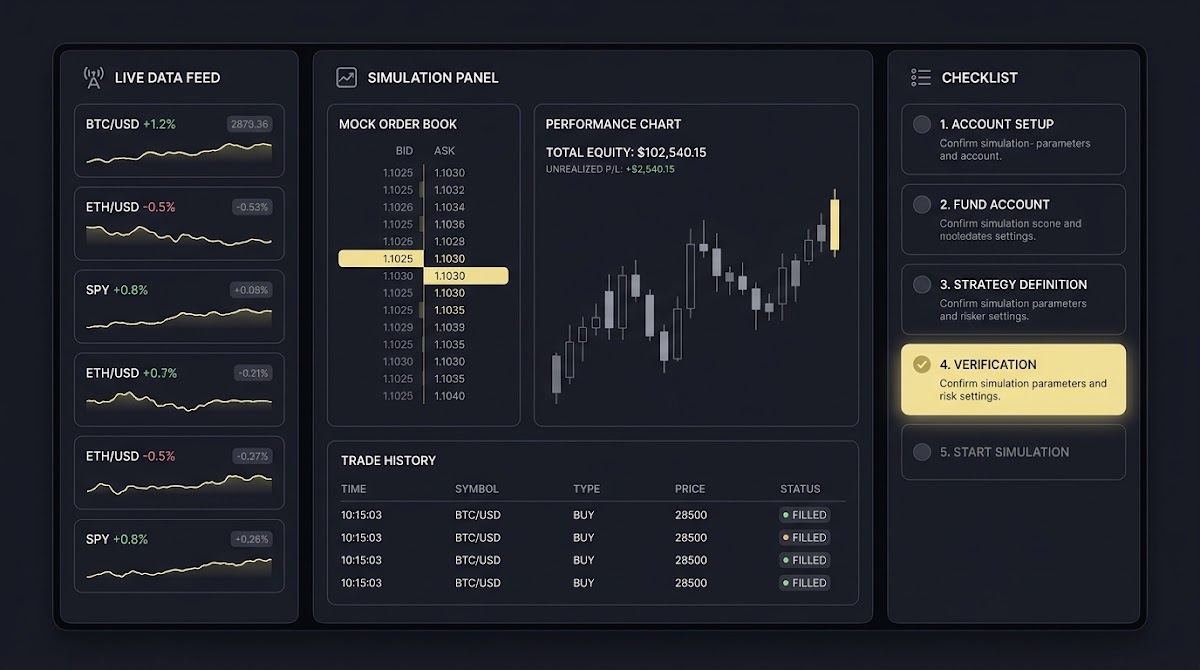
a short paper-trading simulator checklist to run verification-first pilots
Use with manual approvals
Always remember that large models can make mistakes or invent details, so outputs used for financial decisions must be independently verified, including live data and injury reports. See the OpenAI system card for guidance on model limitations and verification best practices: OpenAI system card.
What we mean by a sports betting bot: definitions and types
The term sports betting bot covers a range of systems, from simple helpers that convert odds or summarize news to complex stacks that ingest data, score edges, and place bets under automated rules. For clarity, this article treats the phrase sports betting bot as an umbrella for both research assistants and execution-capable automation layers.
At a high level a complete system has four components. First, data inputs collect feeds such as odds, rosters, injuries, and historical results. Second, models or algorithms estimate value or edge. Third, decision rules translate model outputs into stakes. Fourth, an execution layer places bets or simulates placements. Each component has different technical and regulatory implications.
Research assistant vs automated staker
A research assistant, often LLM-based, helps generate ideas, explain terminology, and prepare reproducible steps for backtesting. An automated staker handles money-moving actions and thus carries higher operational and legal risk. Many LLM-based assistants are best used as advisors rather than as fully autonomous wagering engines, because they need verified data and explicit human gates before funds move.

How ChatGPT can help: practical tasks and workflows
ChatGPT excels at research and summarization tasks that reduce grunt work. Use it to convert odds formats, summarize injury reports into concise scouting notes, and draft step-by-step procedures for backtesting a hypothesis. The model speeds writing and helps you produce reproducible instructions that a human or a specialist system can follow.
ChatGPT is also useful for feature ideation and hypothesis generation. When you need candidate predictors or transformations to test in a time-series model, an LLM can propose features to try and explain why they might matter. Treat these proposals as starting points to be validated by statistical testing and out-of-sample evaluation. Surveys of foundation models show they can aid feature ideation but are not a substitute for specialized forecasting methods: Foundation Models for Time Series Analysis: A Tutorial and Survey.
ChatGPT can assist with research, explanations, and workflow drafting, but it should not be relied on for raw outcome predictions or autonomous staking without verification and human approval.
For odds and market matters, ChatGPT can explain the difference between American, decimal, and fractional formats and provide code or formulas to convert them reliably. It can also draft checklists for verifying a feed, such as timestamps, source reliability, and known delays, so the downstream model receives clean inputs.
Make human-in-the-loop verification part of every workflow. For any recommendation that affects money, require cross-checks against primary feeds and an explicit human sign-off before placing bets.
What ChatGPT should not be used for: raw predictions and automated staking
Out-of-the-box LLMs typically underperform dedicated time-series or statistical forecasting approaches on quantitative prediction tasks unless they are carefully adapted and combined with domain data. That limits the reliability of raw outcome predictions from a general-purpose LLM alone, especially when stakes are real. The survey literature cautions that LLMs are stronger at reasoning and idea generation than numeric forecasting: Foundation Models for Time Series Analysis: A Tutorial and Survey.
Automating bet placement without robust, tested safeguards increases operational risk. Risks include executing on stale or incorrect signals, compounding errors through repeated staking, and violating platform or legal rules if the system lacks location or age checks. OpenAI documentation also emphasizes model fallibility and the need for verification before high-stakes use: OpenAI system card.
Regulatory and responsible-gambling rules to follow when using AI tools
U.S. industry guidance limits who can be targeted and how sports wagering is marketed. The American Gaming Association's Responsible Marketing Code stresses avoiding messaging directed at minors and other marketing standards that apply to AI-assisted content creation and distribution. When using AI to generate content or automation, align with these responsible-marketing principles: AGA Responsible Marketing Code for Sports Wagering (see rg.org guide).
Online platforms must also adopt core safer-gambling protections such as age and location verification, self-exclusion options, deposit limits, and clear responsible-gambling information. These controls are emphasized in the Internet Responsible Gambling Standards and should be baked into any workflow that augments or automates wagering processes: Internet Responsible Gambling Standards.
For readers in regulated markets outside the U.S., the UK Gambling Commission provides consumer-focused safer-gambling guidance that complements industry codes and informs what safeguards platforms should offer to users: UK Gambling Commission safer-gambling guidance. See also the Commission's approach to AI: the Commission's approach to Artificial Intelligence.
A safe sports betting bot workflow using ChatGPT: step-by-step framework

Begin every session with identity and location checks and a clear record of consent for AI assistance. These pre-checks reduce legal and ethical risk and align with online responsible-gambling standards. Also set player-controlled limits such as daily deposit caps and stake maximums before any AI provides recommendations.
Next, use automated validation gates for data: reject stale feeds, require timestamps, and flag missing fields. Keep a provenance log for each data element so you can trace a model's inputs back to source feeds. For any money-affecting decision introduce explicit human-in-the-loop decision gates. The OpenAI system card recommends validating model outputs before high-stakes use: OpenAI system card.
Design conservative automation. Do not allow fully autonomous wager placement. Instead route suggested stakes to a review queue that enforces throttles and cooldowns, and requires manual approval for orders above threshold amounts. Implement self-exclusion and immediate stop mechanisms that users can enable at any time.
CTA: try a verification-first AI workflow
Start a verification-first challenge with FundedPlays-style rules
Start with a paper-trading pilot and a simple verification checklist, and require manual approval for any suggested stakes during the trial period.
When running a pilot, measure both accuracy of signals and the safety controls. Track false positive alerts, missed market-moving events, and time to human sign-off. These metrics help you tune thresholds, cooling periods, and who is authorized to approve stakes. For model limits and verification best practices consult the OpenAI system card and industry standards noted above: OpenAI system card.
Bet sizing explained: the Kelly criterion and safer alternatives
The Kelly criterion is a mathematical approach that maximizes long-run growth when you know the true edge and odds. In theory it prescribes the fraction of your bankroll to stake to optimize geometric growth. However, its key assumption is accurate estimation of your edge.
Because edge estimates are noisy, full Kelly often produces large drawdowns if your estimated advantage is overoptimistic. A widely used mitigation is fractional Kelly staking, where you bet a fixed fraction, such as half or a quarter of the Kelly fraction, to reduce variance and avoid catastrophic drawdowns. The theoretical literature on Kelly discusses both its power and the risks of misestimation: The Kelly Capital Growth Investment Criterion: Theory and Practice.
Practical rules add caps and daily limits, and require running stress tests and simulated sequences to see how staking rules behave under losing runs. Track realized drawdowns and adjust staking rules based on observed volatility and model confidence, not only on point estimates of edge.
Integrating ChatGPT with specialized data and forecasting tools
Use ChatGPT for hypothesis generation, feature explanations, and drafting preprocessing steps, but rely on specialized time-series models for numeric forecasts and edge estimation. Surveys indicate that dedicated forecasting approaches generally outperform generic LLMs on quantitative prediction tasks unless the LLM is carefully adapted and combined with domain-specific pipelines: Foundation Models for Time Series Analysis: A Tutorial and Survey (see an industry overview: Intellias: AI in Sports Betting).
Build a robust data pipeline with timestamped feeds, provenance metadata, and automated validation. Sanitize inputs before they ever reach your forecasting models. The separation of responsibilities should be clear: LLM for ideation and explanation, specialized models for numeric prediction, and humans for final approval and compliance checks.
Common mistakes and how to avoid them
Do not treat an LLM's output as ground truth. One routine mistake is taking a generated summary or statistic at face value without checking the source. Always cross-reference important facts with primary feeds and keep an audit log of the model outputs and the verification steps that followed.
A second common error is neglecting responsible-gambling safeguards when automating parts of the workflow. Missing age or location checks, not offering self-exclusion, or failing to enforce deposit limits can create regulatory and ethical problems. Implement mandatory verification steps and maintain an audit trail of approvals and stake history to reduce these risks. The Internet Responsible Gambling Standards provide a good baseline for required protections: Internet Responsible Gambling Standards.
Practical examples and scenarios: three safe workflows
1. Paper trading with ChatGPT-assisted research
Run a paper-trading series before any real funds are used. Use ChatGPT to summarize team news, propose candidate features, and produce a reproducible backtest plan. Feed the backtest results into a specialist forecasting model and compare outcomes against the original hypotheses.
Steps: 1) Define the paper-trade goal and time horizon. 2) Use ChatGPT to list features and a testing plan (see our blog). 3) Run backtests with a time-series model. 4) Record results and iterate. Keep all approvals and decisions logged for audit and improvement.

2. Using ChatGPT to build a hypothesis to test with a model
Ask ChatGPT to explain why a particular metric might predict outcomes and to suggest ways to normalize or lag it. Turn those suggestions into testable features and run them through a proper validation pipeline. Use cross-validation and out-of-sample testing to measure real predictive value before trusting the signal.
Document the hypothesis, the feature engineering steps, and the statistical tests used. If a feature survives strict testing, move it into a decision rule that includes confidence thresholds for manual review. For additional detail, see how Funded Plays evaluations work.
3. Creating a verification-first staking routine
Set conservative default stake sizes and require manual sign-off for stakes above a low threshold. Use ChatGPT to format and present the rationale, and include linkable evidence lines in the review interface so approvers can quickly check injury reports or market moves.
Keep cooldowns that prevent rapid repeated bets based on a single misfired signal. Track performance and adjust stake rules based on realized volatility and drawdown experience.
Decision criteria: when to use ChatGPT, when to use specialist tools
Use this simple checklist to choose tools: does the task require high numeric accuracy, real-time execution, and tightly controlled latency? If yes, prefer specialized forecasting and execution stacks. If the task needs explainability, drafting, or ideation, a language model is an efficient choice.
Trade-offs include development time versus speed of prototyping. LLMs are fast for exploring ideas and writing reproducible steps, while specialist models take more time to build and validate but usually offer stronger numeric performance for live decisions.
Checklist before you act: minimum verifications and controls
Pre-bet checklist: confirm identity and location, verify data sources and timestamps, cross-check injury and roster feeds, and confirm stake limits and approval. These steps should be mandatory before any real funds are used.
Monitoring and logging: keep an audit trail of model outputs, human approvals, stake history, and outcome tracking. Use those logs to review failures and to tune thresholds, cooling rules, and staking fractions over time. If you or a user feels unsafe about activity, consult regulator guidance and help resources immediately.
Conclusion and next steps for a responsible approach
ChatGPT can support research, explanation, and workflow automation in a sports-betting context, but it is not a drop-in replacement for specialized forecasting models or human judgment. Always verify outputs, run paper-trading pilots, and enforce responsible-gambling safeguards before touching real funds.
Next steps: run a verification-first pilot, adopt fractional staking rules, require manual approvals for money-moving actions, and consult regulator resources and the OpenAI system card to stay current on best practices (Funded Plays homepage).
No. ChatGPT can help generate hypotheses and explain concepts, but it should not be used to place automated bets without human verification and safeguards.
At minimum include identity and location checks, deposit and stake limits, data source verification, and a manual approval step for any suggested stake.
No. ChatGPT is useful for ideation and explanation, but specialized time-series models are generally better for numeric predictions and live execution.
References
- https://openai.com/research/gpt-4-1-system-card
- https://www.cell.com/patterns/fulltext/S2666-3899(24)00126-2
- https://www.americangaming.org/code/responsible-marketing-code-for-sports-wagering/
- https://www.ncpgambling.org/programs-resources/internet-responsible-gambling-standards/
- https://www.gamblingcommission.gov.uk/public-and-players/safer-gambling
- https://www.worldscientific.com/worldscibooks/10.1142/5902
- https://www.fundedplays.com/challenges
- https://www.fundedplays.com
- https://www.fundedplays.com/blogs
- https://www.fundedplays.com/blogs/how-fundedplays-evaluations-work
- https://www.gamblingcommission.gov.uk/about-us/guide/page/the-commissions-approach-to-artificial-intelligence
- https://rg.org/guides/sportsbetting-guides/chatgpt-sports-betting
- https://intellias.com/ai-in-sports-betting/