

What people mean by a sports betting bot and where ChatGPT fits
Definitions: sports betting bot, AI assistant, autonomous tipster
When people say sports betting bot they usually mean software that automatically places wagers or produces ranked betting recommendations for execution with real money. That can range from simple automation that submits bets via an API to complex systems that generate and act on trading signals. By contrast, a general purpose LLM like ChatGPT is an AI assistant built to generate and shape text, not a licensed wagering operator. In practice, many users call any AI that helps with picks a sports betting bot even when it only assists with research and checklists.
A clear distinction helps: a true sports betting bot performs automated order placement and handles funds, while an AI assistant provides analysis, phrasing, or templates for a human to apply. This matters because regulation and app-store policies focus on how advice is presented and distributed, not only the underlying technology. For example, app distribution rules require different safeguards for software that enables real-money gambling than for a research tool that produces commentary, so the same underlying model can be treated differently depending on how it is deployed. Google Play developer policy on real-money gambling
Why that distinction matters for everyday users: if you use ChatGPT to summarize injury reports, compare trends or draft a checklist, you are in the assistant category. If you feed the model credentials and instruct it to place bets automatically, you have crossed into an autonomous tipster or betting bot. The difference affects legal exposure, app-store acceptance, and practical safety around account access and money handling.
Why the phrase triggers regulatory and platform checks
Calling something a sports betting bot is a trigger for platforms and regulators because it implies real-money functionality, automated decision-making, or marketing that can influence vulnerable audiences. App stores and regulators look for licensing, age gating, and jurisdictional controls when software integrates with wagering flows, and they treat general-purpose AI differently when it is used to deliver gambling-adjacent services. That focus on distribution and function is important for creators and users alike. Apple App Store Review Guidelines
Try a compliance-minded AI research template
Try an AI-assisted research template: ask the model to list reliable data sources, produce a concise pregame checklist, and highlight which items need human verification before any financial decision.
How large language models work and their limits for prediction tasks
What LLMs can and cannot reliably do for forecasting
Large language models are trained to predict the next piece of text given a prompt; they are powerful at pattern recognition across language and can summarize past data, surface plausible angles, and frame hypotheses. They are not prediction engines that access live market feeds or guaranteed outcomes. People often expect deterministic forecasts, but model outputs are probabilistic text generation that can be helpful for brainstorming and workflow automation rather than final decisions.
Benchmarks and independent analysis show that these models still hallucinate and can produce confident but incorrect assertions, which makes unverified AI betting tips unreliable for decision-making. When a model offers a specific recommendation without clear evidence, treat it as a hypothesis to test, not as a confirmed signal. AI Index report on model performance and limitations
Hallucination, data freshness, and uncertainty communication
Hallucination is when a model invents facts, like player injuries or a team's recent record, without a reliable source. Another common limit is data freshness: many deployed LLMs do not have live feeds and operate with a training cutoff, making anything time-sensitive unreliable unless you or the system provide up-to-date inputs. Because outputs are probabilistic, the responsible approach is to ask the model to state uncertainty, list sources it relied on, and flag items that need verification.

A simple analogy is to think of the model as a research assistant who can draft a memo from the documents you give it, but who should not be left alone to place a trade. Use the model to reduce routine work and to surface angles, then verify the facts with primary sources before acting. This approach preserves the efficiency benefits while guarding against automation bias and overtrust.
Legal, industry and app-store constraints on AI-generated betting advice
EU AI Act transparency and risk management duties
The EU's Artificial Intelligence Act establishes transparency and risk-management obligations for general-purpose AI that will govern how gambling-adjacent content is disclosed and controlled in the EU by 2026. Operators and deployers must assess and mitigate risks when their AI is used in contexts that could influence consumer choices, and they must disclose relevant information about the system's capabilities and limits. These duties change how providers present AI-generated advice and what safeguards must be in place. Regulation (EU) 2024/1689, the AI Act See the EU AI Act site at https://artificialintelligenceact.eu/ and the Commission's regulatory framework for AI at https://digital-strategy.ec.europa.eu/en/policies/regulatory-framework-ai for additional context.
The obligations under the AI Act mean that a tool sold or distributed in the EU as a betting assistant may need transparency documentation, human oversight measures, and risk-management records to comply. For users and developers, that translates into a practical requirement: document how the AI is used, what data it sees, and what human checks exist before any recommendation is relied on.
ChatGPT can assist with research and workflow automation, but due to hallucination risk, data freshness limits, and legal and app-store constraints, it should not be treated as an autonomous, reliable betting bot without robust human oversight and compliance measures.
American Gaming Association marketing rules
Industry standards also matter. The American Gaming Association updated its Responsible Marketing Code in 2024 to strengthen protections for younger adults and to prohibit messaging that implies gambling is a route to financial success. That affects how AI-generated promotional text or advice can be framed and distributed; marketing-style prompts that overpromise should be avoided. AGA update on responsible marketing rules
Google Play and Apple App Store requirements
App distribution policies require licensing, age gating, and geo-compliance for software offering real-money gambling features. Google Play explicitly requires developer accounts to demonstrate compliance for real-money gambling and to enforce age restrictions, while Apple enforces similar requirements through its review guidelines. These rules limit the distribution of autonomous sports betting bots and shape what kinds of AI features can be shipped in mobile apps. Google Play policies for gambling apps
For product teams and developers, the practical takeaway is straightforward: plan compliance early, separate offline research tools from any real-money execution flow, and make sure marketing messages comply with industry codes and local law before launch. That reduces the chance of rejection from app stores or regulatory scrutiny.
Practical roles for ChatGPT-style AI in a safe sports prediction workflow
Data organization, scenario framing, and checklist creation
Used correctly, ChatGPT-style AI is most valuable as an assistant for organizing research, framing scenarios, and producing checklists that humans use to make final calls. Concrete tasks include cleaning and normalizing datasets, drafting concise pregame checklists, summarizing injury reports, and generating hypothesis-driven angles to test. These tasks speed up analysis without transferring decision-making authority to the model.
Keep the separation clear: AI suggests or drafts; humans verify and decide. That pattern aligns with industry guidance that favors assisted workflows over autonomous recommendation engines and reduces legal and product risk when the AI is not the final arbiter. Apple App Store Review Guidelines
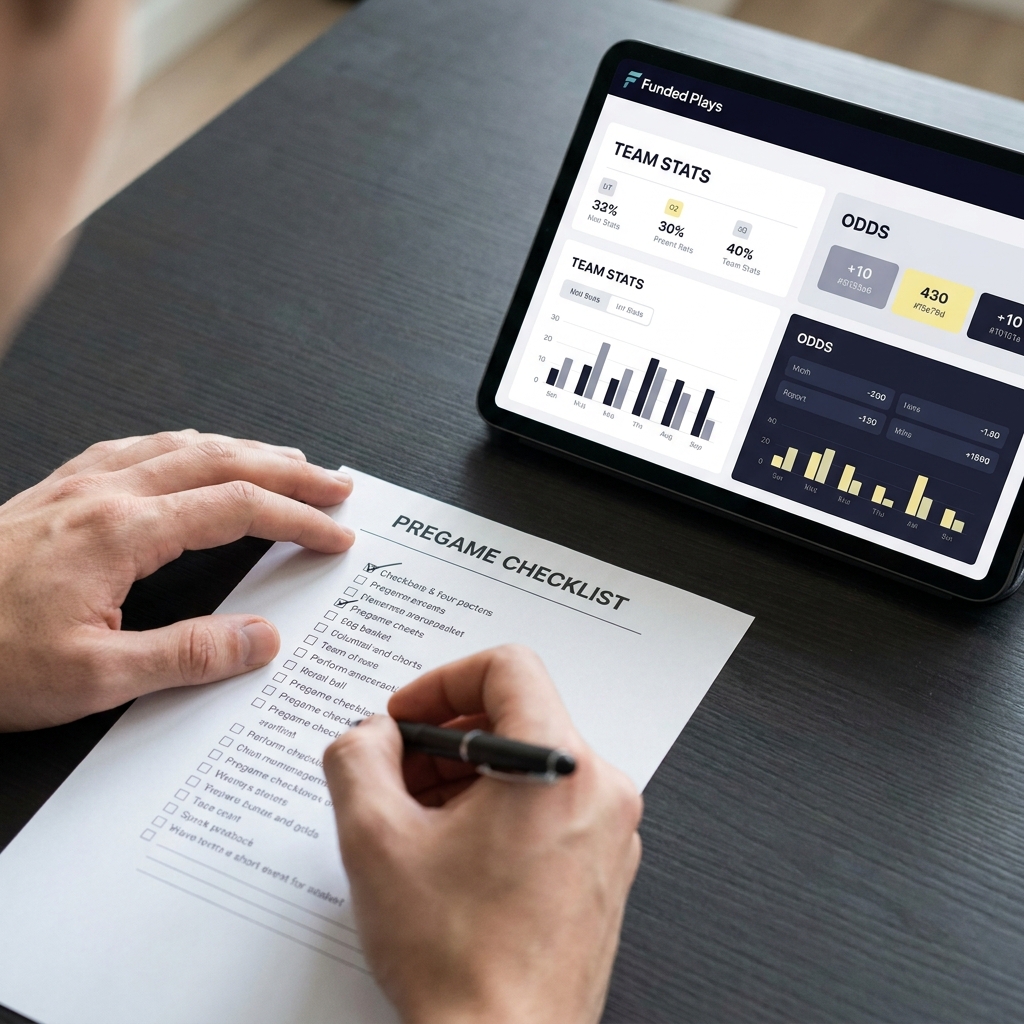
One practical use is asking the model to list missing data that would change a hypothesis, such as recent lineup confirmations, weather forecasts, or sharp market moves. The model can also draft a short verification checklist that a human can run through before acting. Treat these outputs as living templates that must be stamped as reviewed and dated in your records.
Using AI this way supports disciplined analysis and recordkeeping, and it helps teams scale research while preserving human oversight. For groups that run funded simulation challenges or practice comps, the approach lets participants focus on judgment rather than routine data wrangling.
Decision criteria: when to trust AI outputs and when to verify
Questions to ask about any AI-generated tip
Before acting on an AI-generated insight, ask: what sources did the model rely on, how recent is the data, does the output state uncertainty, and who will verify the core facts? These trust criteria help you decide whether the content is usable as-is or requires further checking. If the model cannot name reliable sources or is vague about dates, treat the output as a brainstorming draft, not a tradeable signal.
In practical terms, require the model to list sources and flag any items it inferred without data. Then perform a verification pass against primary sources and live odds. That verification step is central to a responsible AI sports prediction workflow and reduces the risk of making decisions based on hallucinated facts. AI Index report on model accuracy and limitations
Verification steps and responsible-play checks
Use this short verification checklist: 1) confirm roster and injury reports with official team sources; 2) cross-check odds with licensed exchanges or sportsbooks; 3) ensure any advice complies with your jurisdictional rules and age limits; 4) log the AI output, who verified it, and the verification date. This recordkeeping helps with both personal discipline and regulatory expectations.
Remember that no tipster or betting system can guarantee profits. Maintain responsible-play limits for bankroll sizing and avoid messaging or habits that imply betting is a path to financial success, in line with industry guidance on marketing and consumer protection.
Common mistakes and risks when people use AI as a tipster
Overtrust and automation bias
One common error is overtrusting AI because its output is fluent and confident. Automation bias can lead users to accept suggestions without enough scrutiny, particularly when the model uses persuasive language. Treat model output as a draft that needs explicit human verification and a checklist to guard against misplaced trust.
Examples include acting on an injury report the model invented or failing to spot a change in odds. Those mistakes happen because language fluency can mask factual gaps; build habits to verify any time-sensitive claim before acting.
Regulatory and app-distribution pitfalls
Another frequent pitfall is ignoring platform and regulatory constraints. Shipping a tool that automates real-money bets without the required licensing, age gating, and geo-restrictions risks app-store refusal and regulatory penalties. Keep research tools separate from execution mechanisms and document where human oversight is required to stay within compliance lanes. Google Play requirements for gambling functionality
Finally, remember that marketing content derived from AI must comply with industry codes that forbid suggesting gambling as a way to make money. Avoid prompts that ask the model to produce promotional material implying guaranteed returns or easy income.
A step-by-step safe workflow and examples for using AI in sports forecasting
Example scenario: preparing a pregame checklist for a football match
Below is a 6-step workflow you can adapt: 1) Input: provide the AI with dated, sourced data (injury lists, weather, last five matches); 2) Draft: ask the model to produce a concise pregame checklist and highlight assumptions; 3) Verify: cross-check each item with primary sources and live odds; 4) Decide: human reviewer records the final decision and rationale; 5) Log: save the AI output plus verification steps for audit; 6) Review: after the match, update records with outcomes to refine future prompts.
That workflow keeps the AI in an assisting role and creates an auditable trail that notes what was automated and what was confirmed manually. It reduces the chance that hallucinated content becomes a basis for action. Visit Funded Plays for context on evaluations and practice workflows.

generate a pregame verification checklist
Use as a human-reviewed template
Template: AI prompt, human verification, final decision matrix
Example prompt to the model: summarize the last five games for Team A, list confirmed starters, note weather factors, and produce three testable hypotheses that would change a betting stance. Then ask the model to output a one-paragraph uncertainty statement. After the model responds, have a human run the verification checklist and mark each line as confirmed, unconfirmed, or not applicable.
Two brief scenarios where this helps: first, a pregame research workflow where the AI rapidly surfaces angles and gaps for a human to verify; second, an in-play monitoring checklist where the AI flags changing factors but requires a human to act on any change in odds. In both cases, the human keeps final authority and documents decisions.
If you build or ship a sports betting bot: compliance and distribution checklist
Key technical and legal steps before launch
If your product will integrate with real-money betting flows, begin with legal advice and a licensing plan. Make sure you implement robust age verification, geo-blocking, and clear user disclosures about the AI's capabilities and limits. Under the EU AI Act, deployers should maintain risk assessments and human oversight logs when the AI is used in a decision-influencing context. Regulation (EU) 2024/1689, the AI Act See legal guides such as this DLA Piper article.
On the technical side, keep execution systems separate from research modules, and design clear fail-safes to prevent the AI from taking unauthorized actions. Use strong authentication and avoid storing payment credentials in places an AI can access automatically. These measures reduce both operational risk and the chance of violating app-store policies.
Transparency, age-gating and geo-restrictions
Implement explicit on-screen disclosures that explain the AI's role and its limitations, and require affirmative user consent for any automated features. Enforce age checks and jurisdictional restrictions before revealing content or enabling features that might be considered gambling functionality. Follow app-store guidance for real-money gambling apps to avoid distribution problems. Apple App Store Review Guidelines
Also align marketing materials with industry codes to avoid implying that participation will lead to financial success. That reduces reputational and regulatory risks at launch and during growth.
ChatGPT-style tools are most useful as workflow assistants for sports predictions, not as autonomous tipsters that place bets or promise outcomes. Use AI to organize data, draft checklists, and surface hypotheses, and always verify time-sensitive facts and odds with primary sources before acting. UK Gambling Commission guidance on betting tips and systems
Practical next steps: document your workflow, require human verification, keep an auditable record of AI outputs and checks, and make sure any product with real-money features follows app-store and regulatory rules. Treat every AI-generated suggestion with skepticism and use disciplined bankroll and responsible-play limits in all decision-making.

ChatGPT can provide informational analysis, but legal constraints depend on deployment and jurisdiction; tools that enable real-money wagering may need licensing and compliance.
No. LLM outputs can hallucinate and lack live data, so always verify time-sensitive facts and odds with primary sources before acting.
Only after legal review and ensuring app-store, age and geo-compliance; keep execution separate from research and require human oversight.
References
- https://support.google.com/googleplay/android-developer/answer/10358814?hl=en
- https://developer.apple.com/app-store/review/guidelines/
- https://aiindex.stanford.edu/report/
- https://eur-lex.europa.eu/eli/reg/2024/1689/oj
- https://artificialintelligenceact.eu/
- https://digital-strategy.ec.europa.eu/en/policies/regulatory-framework-ai
- https://www.americangaming.org/new/aga-updates-responsible-marketing-code-for-sports-wagering-to-enhance-protections-for-young-adults/
- https://www.fundedplays.com/challenges
- https://www.fundedplays.com/blogs/how-fundedplays-evaluations-work
- https://www.fundedplays.com
- https://aiindex.stanford.edu/report/
- https://support.google.com/googleplay/android-developer/answer/10358814?hl=en
- https://www.dlapiper.com/en-us/insights/blogs/mse-today/2025/legal-obligations-for-online-gambling-operators-in-the-use-of-artificial-intelligence-ai
- https://www.gamblingcommission.gov.uk/public-and-players/guide/be-careful-with-betting-tips-and-systems
- https://www.fundedplays.com/blogs