

Quick overview: what this guide explains
This guide lays out the step-by-step routes France can use to win the Championship and how to interpret six nations odds alongside official rules and model snapshots.
Quick checklist to track table and permutation drivers
Update after each round
Readers will leave with three practical benefits. First, a clear statement of the official scoring framework so you can follow any table permutation. Second, a set of match-level priorities that explain when France should chase tries or protect a margin. Third, simple worked examples that show the arithmetic behind Grand Slam and four-win scenarios.
This article focuses on rules and scenarios, not financial advice or guarantees. Use models and market information as context for probability judgments, not as promises of outcome.
How the Six Nations points system actually works
The tournament uses a points system where a win is worth four points and a draw two points; bonus points are available for scoring four or more tries or for losing by seven points or fewer, and an undefeated Grand Slam receives a three-point bonus to ensure an unbeaten side tops the table Six Nations Rugby table rules.
That core framework means table arithmetic is straightforward to compute from match results, but the addition of try and losing bonuses makes mid-tournament permutations richer and often decisive Six Nations Rugby table rules.

The three-point Grand Slam bonus was adopted before the 2017 Championships to prevent a four-win team with many bonus points overtaking an undefeated team; it remains central to modern permutations Six Nations Rugby bonus points introduction.
France's clearest route: why a Grand Slam secures the title
Winning all five games is the simplest, most direct way for France to guarantee the Championship because the Grand Slam three-point bonus ensures an undefeated total that other teams cannot surpass using bonus points alone Six Nations Rugby bonus points introduction.
Practically, a Grand Slam turns the permutation problem into a non-issue: the table math gives the unbeaten side a points buffer that rules out a four-win rival overtaking them, regardless of bonus-point accumulation by others Six Nations Rugby table rules.
Explore FundedPlays Challenges for structured sports prediction challenges
Sign up for score and table alerts to follow live permutations and key model updates.
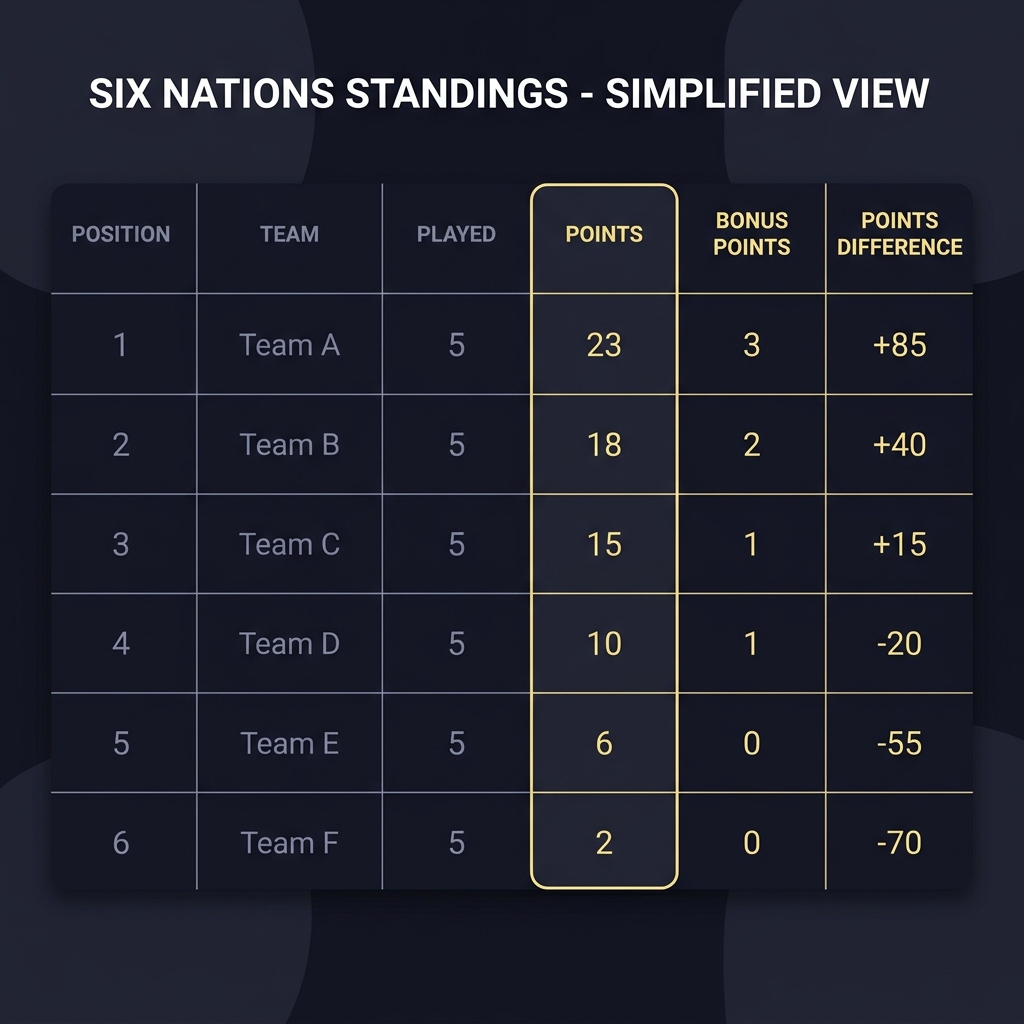
For coaches and followers, the Grand Slam route simplifies selection and tactics because the priority is consistent winning and controlled attacking rather than chasing specific bonus-point combinations.
When four wins can be enough: typical four-win permutations
Four wins can be sufficient when France combines those victories with one or more try bonuses and maintains a superior points difference to the nearest rival; in many seasons a four-win team with well-timed bonus points finishes clear on table points or wins tie-breaks BBC Sport permutations explainer. See Sky Sports permutation coverage as additional context Sky Sports permutations.
When teams finish level on table points, the first tie-breaker is points difference and the next is tries scored, so accumulating scoring margin and try counts matters as much as raw win totals Six Nations Rugby table rules.
That arithmetic means France should view four wins as a realistic path provided they secure at least some try bonuses and avoid heavy defeats that would damage their points difference.
Bonus points and margins: match-level levers that decide the table
A try bonus in a win converts a four-point result into a five-point haul and can be the difference between finishing above an otherwise identical four-win rival; teams chasing the title treat that extra point as a critical reward for attacking intent BBC Sport permutations explainer.
Collecting a losing bonus when behind is another practical lever. Salvaging a single point in a narrow defeat can keep France within reach late in the tournament and preserve mathematical chances going into the final round The Guardian permutations guide.
Match-by-match margins also feed the points difference tie-break; a conservative game management approach that limits the scale of losses can be as important as chasing an extra try when the wider table is tight.
Final-day calculations: Super Saturday permutations explained
Super Saturday often produces counterintuitive outcomes because the simultaneous fixtures let teams depend on rivals dropping points or on securing narrow results plus bonuses to leapfrog opponents, a pattern repeated in recent seasons' permutation coverage BBC Sport permutations explainer. Coverage also appears on ESPN ESPN permutations and national unions such as Scottish Rugby Super Saturday permutations.
A common decisive scenario is that France needs a win with a try bonus to stay ahead, or alternatively can win the title if they lose narrowly but gain a losing-bonus while a rival fails to collect necessary bonus points; reading the live table quickly requires checking both points totals and the likely tie-breakers The Guardian permutations guide.
When evaluating the final-day table, list the small set of achievable outcomes for each match, then eliminate combinations that cannot reach France's points target or cannot close the points-difference gap within plausible scorelines.
How models and odds frame France's chances
Independent probabilistic models incorporate fixtures, current form and home advantage to produce pre-tournament probabilities that help frame France's chances; these model snapshots are useful context when reading six nations odds Opta's supercomputer predictions.
Market prices and model probabilities do not always match; markets reflect money flow and sentiment while models focus on expected outcomes from data inputs, so both sources are informative in different ways RugbyVision tournament probabilities.
France can guarantee the title with a Grand Slam because of the three-point bonus; alternatively, four wins combined with try bonuses and a superior points difference often suffice, but outcomes depend on rivals, tie-break rules and live match margins.
Use models and odds as conditional signals that update with injuries, form and selection changes rather than as fixed forecasts. Funded Plays
Practical match plans for France: where to seek edges
A primary priority for France should be structured attacking phases that create try-scoring opportunities when the scoreboard position makes a try bonus both attainable and valuable; proactively hunting a try bonus in winnable matches is often the most efficient path to earning the extra table point BBC Sport permutations explainer.
Conversely, game management to protect points difference matters when the tournament is tight; limiting large defeats and converting penalties when available can preserve or build the margin that becomes decisive on tie-breaks The Guardian permutations guide.

Trade-offs are inevitable. A safe penalty to secure a narrow win may deny a try bonus, while an aggressive approach to chase a fifth try risks conceding points on the counter. Teams must choose depending on the table context.
Uncertainties that can shift France's odds: injuries, schedule and trends
Key injuries to playmakers or front-row personnel rapidly change model probabilities and on-field selection choices, with direct effects on both the likelihood of wins and the chance of scoring try bonuses Opta's supercomputer predictions.
Fixture order and home-away sequencing also matter; an early run of home matches or a favourable sequence can increase the chance of collecting try bonuses and building a healthy points difference that matters later in the tournament RugbyVision tournament probabilities.
Broader attacking trends in the international game influence how often teams collect try bonuses, so evolving tactical patterns are another uncertainty to monitor during a given Championship.
Common errors when interpreting permutations and odds
Overweighting single outcomes is a frequent mistake: a market price or model forecast is a snapshot, not a guarantee, and small changes in inputs like injuries or weather can reverse apparent certainties BBC Sport permutations explainer.
Ignoring tie-break mechanics is another common error. Without checking points difference and tries-scored rules, it is easy to assume a single win will be enough when on the numbers it will not Six Nations Rugby table rules.
As a rule, treat probabilities as conditional and update them as new, verifiable information arrives rather than anchoring on an early forecast.
Worked examples: three realistic France scenarios
Scenario A: Grand Slam achieved
Step 1, outcome: France wins all five matches and receives the three-point Grand Slam bonus. Step 2, effect: that combination produces a total that cannot be overtaken by a four-win team owing to the Grand Slam buffer and the official scoring rules Six Nations Rugby bonus points introduction.
Step 3, implication: on the final table there is no need to compute tie-breaks, because the undefeated team with the Grand Slam sits above any rival on points.
Scenario B: Four wins plus bonus points
Step 1, outcome: France wins four matches and secures two try bonuses across those wins, finishing with a points total that competes with any rival who also wins four or fewer matches. Step 2, check: compare the rivals' bonus-point totals and points differences to determine whether France finishes top on table points or wins tie-breaks BBC Sport permutations explainer.
Step 3, practical advice: when you see this pattern mid-tournament, compute the minimal scoring margin France needs in the last round to beat a rival on points difference if totals look likely to be equal.

Scenario C: Final-day narrow defeat with a losing-bonus
Step 1, outcome: France loses the last match by seven points or fewer and gains a losing-bonus point while their closest rival fails to secure the bonus points needed to surpass France on table points. Step 2, arithmetic: that single bonus point can be enough to preserve France's place if the rival's results fall short on both total points and tie-breaks BBC Sport permutations explainer.
Step 3, implication: following this scenario, always recompute points difference and tries scored to confirm the final order because a narrow margin can still change the ranking if totals are level.
A quick checklist for France followers and predictors
Track these items after each round: France results, bonus points for and against, rivals' results and bonus points, cumulative points difference, tries scored and significant injuries or suspensions Six Nations Rugby table rules. See a related guide here.
Rule of thumb: a Grand Slam guarantees the title; four wins are often enough if France collects try bonuses and keeps a superior points difference, but compute tie-breaks when totals are close.
Use model updates and market moves as context. Reconcile differences by checking the assumptions behind a model or a market price rather than treating either as definitive. See the Funded Plays blog for model updates.
Conclusion: bottom-line guidance without promises
Key takeaway one: the Grand Slam is the definitive route to the title because the three-point bonus ensures an undefeated side cannot be overtaken under the official rules Six Nations Rugby bonus points introduction.
Key takeaway two: four wins plus selective try bonuses and a healthy points difference is the usual alternative path, and live permutations often hinge on match-level try and losing-bonus outcomes, especially on Super Saturday BBC Sport permutations explainer.
Monitor official rule pages for tie-break clarifications and watch model updates for changes driven by injuries or selection changes. Use those inputs to refine probability judgments responsibly.
The simplest guaranteed route is a Grand Slam, because the undefeated team receives a three-point bonus that prevents a four-win rival from overtaking them under the official rules.
Yes, four wins plus one or more try bonuses and a superior points difference can be sufficient in typical seasons, but final confirmation depends on rivals' results and tie-breakers.
Use models and market odds as conditional indicators that update with injuries and form; they provide useful probability context but are not guarantees.
References
- https://www.sixnationsrugby.com/en/the-table-match-points-and-bonus-points
- https://www.sixnationsrugby.com/2016/11/30/bonus-points-to-be-introduced-for-2017-championships/
- https://www.bbc.co.uk/sport/rugby-union/68593578
- https://www.theguardian.com/sport/2024/mar/15/six-nations-permutations-who-can-win-title-and-how
- https://theanalyst.com/eu/2025/01/six-nations-2025-predictions-supercomputer/
- https://www.rugby.vision/projections/six-nations-2025
- https://www.fundedplays.com/challenges
- https://www.fundedplays.com
- https://www.fundedplays.com/blogs
- https://www.fundedplays.com/blogs/how-fundedplays-evaluations-work
- https://www.espn.com/rugby/story/_/id/48160402/six-nations-permutations-how-france-scotland-ireland-all-win-title
- https://scottishrugby.org/news-and-features/super-saturday-final-day-permutations/
- https://www.skysports.com/rugby-union/news/12321/13517320/six-nations-permutations-as-france-scotland-and-ireland-all-remain-in-the-trophy-fight