

Quick answer: should you change your approach as a challenge ends?
Short summary recommendation
Yes, but only conditionally: the right move near the finish is determined by rules, time remaining, and your current performance metrics. If you cannot verify those three factors quickly, do not change course. The question Should You Trade Differently Near the End of a Challenge should be settled by a short checklist rather than a gut reaction.
Think of the final period as an evaluation of process control. Small, deliberate adjustments that respect the challenge rules and your pre-committed risk limits are acceptable. Late, emotional shifts that ignore platform constraints or increase correlation risk are high-cost and often unnecessary.
Quick pre-end checklist to decide whether to change approach
Copy into a simple sheet and tick each item
When a small change is justified vs when to stay the course
Small changes make sense when they are driven by objective signals: a narrow shortfall to the target that can reasonably be closed with low-variance picks, confirmation that rules allow the trades you plan, and enough time or qualifying actions left to execute without concentrated exposure. If those conditions are not in place, staying the course is usually the best way to preserve your chance to qualify.
The top three factors to weigh are the challenge rules, the time remaining, and the performance metrics that show where you stand relative to targets and drawdown limits. Use those items to choose between protecting capital, maintaining process, or controlled acceleration.
What 'end of challenge' actually means on funded prediction platforms
Common timeframes and milestones
End of challenge can be the final hours before a deadline, the last day of a multi-day evaluation, or the last set of allowed selections if a platform caps actions. Different platforms treat the final window differently: some measure remaining calendar time, others count allowed attempts or qualifying trades. Some traders discuss single-trade approaches. When you plan, identify which of these definitions applies to your current challenge on Funded Plays.
For decision-making you should map the timeline into observable milestones: cutoff time for submissions, number of remaining qualifying actions you can place, and any scheduled events that could remove markets from eligibility. Treat those milestones as immutable constraints for the last-phase plan.
Rules and qualifying metrics that can change behavior
Platform rules such as drawdown limits, profit targets, and minimum activity requirements directly shape which endgame options are feasible. A tight drawdown limit reduces room for escalation, while a minimum activity requirement may force you to make qualifying actions even if you prefer to sit tight. Always re-scan the official rules before altering position sizing or frequency.
Remember that funded-style evaluation structures exist to test consistency and disciplined decision-making rather than to reward one-off gambles. Framing the end as a test of process, not an opportunity for a last-minute miracle, keeps choices aligned with long-term improvement and protects eligibility under the rules.
How incentives and psychology shift in the final phase
Common cognitive biases that appear late in a challenge
Time pressure and visible standings create predictable shifts in behavior. If you are behind, desperation risk-taking can push you to increase size or pick high-variance outcomes. If you are ahead, a survival bias can make you overly cautious, avoiding necessary activity and risking disqualification for inactivity. Loss aversion often causes people to accept suboptimal, ultra-conservative options that reduce expected edge.
Leaderboards and public rankings amplify emotional responses. When progress is visible to others, social comparison can nudge you away from your plan. Recognizing those bias patterns ahead of time helps you apply a corrective rule rather than reacting in the moment.

The incentive structure matters. Qualifying for a funded account or meeting a threshold to remain eligible often favors consistency and capital preservation, while marginal rewards for top placement can push risk appetite outward. Match your endgame choices to the true objective: is the priority qualification or chasing a top rank? That answer should determine whether you protect or accelerate.
If incentives push you toward aggression, counterbalance with guardrails such as reduced position size limits or stricter stop procedures so that any escalation remains controlled and reversible.
Check your endgame plan before you act
Please take a moment to review your endgame checklist and confirm that any late adjustments respect the rules and your pre-committed risk limits.
Core decision framework: a step-by-step method to choose your endgame action
Step 1: check objective metrics
Begin with a rapid verification checklist: confirm the official cutoff time, measure current drawdown against the limit, and calculate the distance to your profit or qualification target. Keep the check lightweight so you can act quickly without creating analysis paralysis.
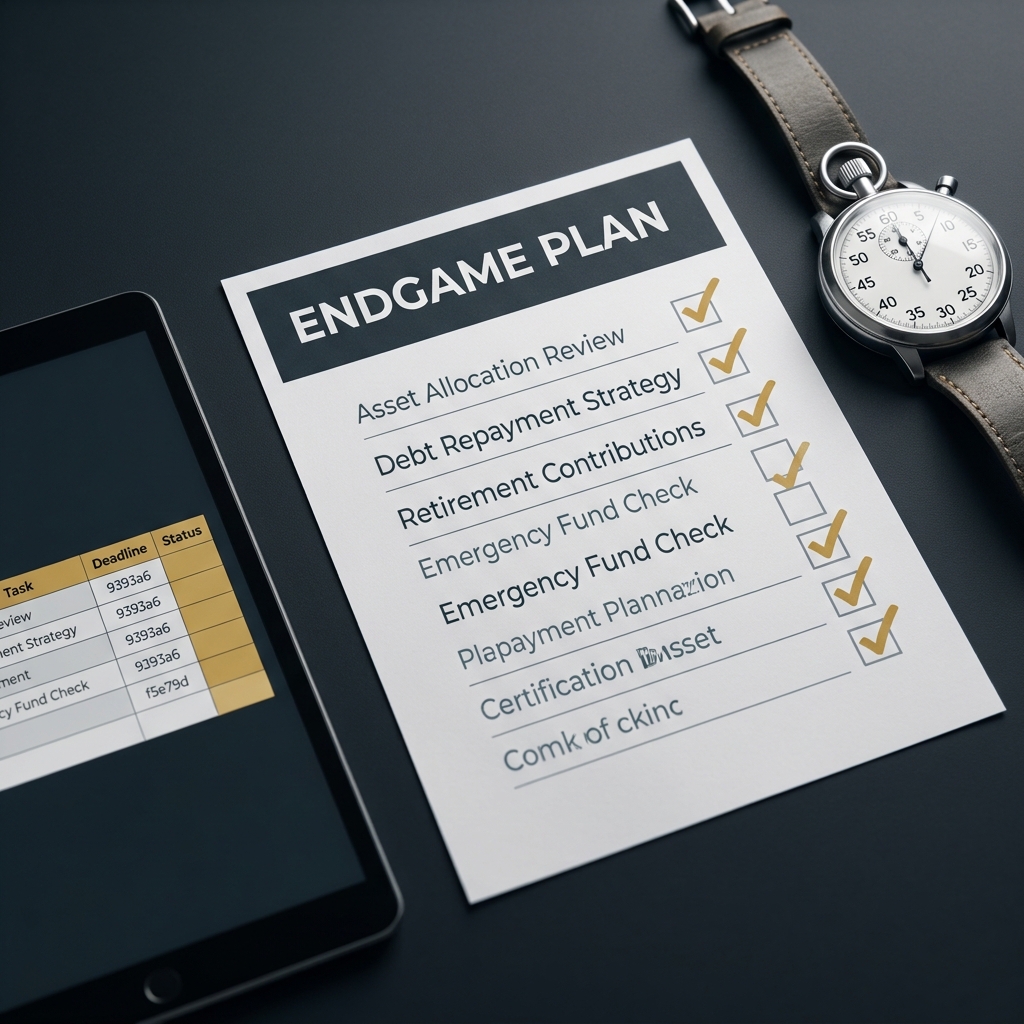
Record each metric in a one-line note. If any required metric is unclear because of platform lag or rule ambiguity, pause and seek clarification through official support channels rather than guessing.
Step 2: map available actions and constraints
List the trades or picks still allowed, estimate the variance of each option, and mark correlation between the remaining opportunities. If many remaining options are highly correlated, treat them as a single exposure and avoid stacking. Also confirm that platform rules do not invalidate certain markets or require minimum activity.
Classify actions into buckets: low-variance qualifiers, medium-variance edge plays, and high-variance gambles. That mapping lets you choose a coherent plan instead of a scatter of uncoordinated moves.
Step 3: choose and document a single plan
Choose one of three response strategies: protect, steady, or accelerate. Write the plan in a single sentence and log it before you act. Example: protect, reduce sizes to 50 percent of normal and only take low-variance qualifiers; steady, continue normal sizing while tracking exposure; accelerate, add limited higher-edge picks but cap total additional risk to a fixed fraction of remaining cushion.
Documenting the decision reduces second-guessing and helps you revert to the plan if stress rises. If an unexpected event occurs, such as a rule change or cancelled market, treat that as a valid trigger to re-run the three-step framework rather than improvising on the fly.
Decision criteria: trade, hold, or scale back?
Concrete signals that favor each choice
Protect when your position is close to the maximum drawdown, the time left is short, or your margin over the qualification threshold is small. These signals indicate that avoiding a damaging loss is more valuable than chasing incremental gains. If you protect, prioritize low-variance picks and lower position sizes to preserve eligibility.
Trade differently only when objective checks for rules, time, and performance support a disciplined, documented change; otherwise preserve capital and follow your pre-committed plan.
Steady is the right call when your metrics show sufficient cushion, your recent volatility matches your expectations, and there are enough qualifying actions left to execute a measured plan. Steady means process adherence: follow your usual selection rules, keep position sizing in line with your pre-set model, and avoid one-off bets that deviate from your documented edge.
How to weigh probability vs impact
When considering an aggressive move, ask two questions: what is the probability the move succeeds, and what is the impact on your remaining cushion if it fails. A low-probability, high-impact downside should be avoided near a deadline. Prefer small bets with higher probability of modest gains over large bets with long odds, unless the expected value and correlation profile justify scaling up under strict guardrails.
In short, weigh probability against impact using your documented heuristic, and prefer actions where the worst-case remains acceptable versus the potential upside. That balance is the core of responsible endgame decision making.
Practical tactics for the final phase: conservative, neutral, and aggressive playbooks
Conservative checklist and example actions
Conservative play focuses on capital preservation. Typical actions include reducing position sizing to a fraction of your standard allocation, selecting lower-variance events, tightening stop-loss levels, and meeting any minimum activity requirement with the lowest-variance qualifying picks available.
Mini-checklist: cap sizes, prefer low-variance picks, tighten stops, avoid stacking correlated events, and log each action immediately. These steps reduce the chance of a late negative swing and keep your account within drawdown limits.
Neutral playbook for steady finish
Neutral play is about process fidelity. Maintain your normal selection criteria, keep position sizes consistent with your model, and focus on execution quality. Use tempo control so you do not overload the final hours with too many simultaneous positions.
Neutral tactics include maintaining average edge, spacing selections to limit short-term correlation, and using an action log to stay disciplined. This approach preserves the expected value of your assessment while keeping risk manageable.
Aggressive but controlled escalation
If you choose to accelerate, do so with strict guardrails. Limit the total additional risk to a pre-defined fraction of remaining cushion, avoid highly correlated bets, and set explicit stop rules that will be followed automatically if possible. The idea is to increase upside while preserving the possibility to recover from failure.
Example guardrail: commit only a fixed percentage of remaining cushion to escalation, use smaller increments per position, and prepare a contingency to revert to protective sizing if the plan underperforms after a short, pre-defined window.

Example guardrail: commit only a fixed percentage of remaining cushion to escalation, use smaller increments per position, and prepare a contingency to revert to protective sizing if the plan underperforms after a short, pre-defined window.
Position sizing, limits, and platform rules you must re-check
How to recalculate size under final conditions
Recompute sizes relative to your virtual bankroll and the remaining drawdown cushion. A quick method is to calculate risk per action as a fraction of the cushion you are willing to put at risk, not as a fraction of the full bankroll. That keeps sizing aligned with the principal objective of avoiding disqualification.
For example, define your remaining cushion as the distance from current equity to the drawdown limit. Use a conservative fraction of that cushion for each new action so that a string of losses will not immediately trigger disqualification. Always write the chosen fraction into your action log before placing trades. For a step-by-step guide to passing funded challenges, see this walkthrough.
Rules that can invalidate trades or disqualify accounts
Before executing, re-read the platform rules about minimum trades, cancellation policies, and allowed markets. Some funded-style platforms restrict certain markets or void selections if events are cancelled, and failing to account for those provisions can invalidate otherwise valid actions. Check for any recent rule updates or notices that apply to your challenge (see how Funded Plays evaluations work).

A short note on tracking exposed correlations
High correlation across remaining selections can turn multiple small bets into a single large exposure. Map remaining picks by event, league, and outcome type to spot clusters. If many opportunities depend on the same game outcome or external factor, reduce aggregate exposure or diversify into truly independent plays.
Tracking correlation is especially important in the final hours, because a single surprise result can cascade through multiple correlated selections and wipe out a cushion that looked safe when positions were evaluated in isolation.
Common endgame mistakes and how to avoid them
Typical traps seen in evaluations
Frequent mistakes include revenge risk-taking after a setback, prematurely stopping all activity when modest continued action is required, and ignoring correlation risk by adding many similar picks. Another common error is strategy drift, where one shifts away from a tested process in hopes of a quick fix.
These mistakes usually stem from emotion or from failing to verify rules and metrics under stress. Plan for the psychological pressure and keep a short checklist to anchor decisions.
Concrete remedies to each mistake
If you catch yourself escalating from emotion, revert immediately to the pre-committed plan and reduce sizes. If you are tempted to stop activity entirely despite a requirement for qualifying actions, choose the lowest-variance picks that meet the rule. For correlation mistakes, pause and re-evaluate the full set of exposures before placing additional selections.
Finally, avoid last-minute strategy changes. If you must adjust, do so with a written, single-sentence plan and strict guardrails so that the change is reversible and auditable in post-mortem.
Three short scenarios: applied examples of endgame decisions
Scenario A: just under the target with 48 hours left
Facts: 48 hours remain, you are slightly under the profit target, drawdown cushion is comfortable, and several low-variance qualifying options remain. Decision: accelerate in a controlled way. Justification: probability of closing the gap with low-variance options is reasonable, and cushion allows modest risk.
Plan: favor qualifying, low-variance picks, limit additional risk to a small fraction of cushion, and set a clear stop to revert to protect if outcomes go against you. Contingency: if the first round of picks widens drawdown, switch immediately to protect and preserve qualification chance. For an extended roadmap to passing funded accounts, see this guide.
Scenario B: comfortably above target with narrow drawdown cushion
Facts: you are above the profit target but close to the drawdown limit and deadline is short. Decision: protect. Justification: the goal is to preserve eligibility and avoid a late disqualifying loss.
Plan: reduce sizes, avoid correlated exposures, meet any minimum activity with the lowest-variance options, and log actions. Contingency: if an unforeseen cancellation affects qualifying picks, pause and consult rules rather than replacing with a risky alternative.
Scenario C: behind target but many qualifying opportunities remain
Facts: you are behind the target, cushion exists, and several independent qualifying actions remain over multiple windows. Decision: steady to accelerate, depending on progress. Justification: with many opportunities and low correlation, measured increases in activity can be effective.
Plan: prioritize independent, higher-edge selections while keeping per-action risk small, monitor outcomes closely, and revert to protect if cumulative drawdown approaches the limit. Contingency: if variance depletes cushion quickly, pause and return to a protective posture.
Metrics and monitoring: what to watch in the last days
Live metrics dashboard essentials
Prioritize a small set of live numbers: current drawdown, distance to profit or qualification target, number of qualifying actions remaining, and recent volatility. Keep these metrics visible and update them at regular intervals so you can spot trends before they become crises.
Set manual checks or light alerts for thresholds that require action, such as drawdown approaching a pre-set fraction of cushion or a rapid string of losses in a short window. Alerts should prompt a re-run of the three-step framework rather than automatic panic moves.
Red flags that require immediate action
Red flags include sudden rule notices affecting market eligibility, a rapid increase in realized volatility that was not anticipated, or a cancellation that removes several qualifying options at once. Each of these requires you to stop, reassess, and possibly move to protect to avoid disqualification or invalidated actions.
Trailing metrics like recent streaks can mislead if treated as predictive; balance short-term signals with the aggregate performance that the challenge is designed to evaluate.
Balancing risk acceptance and capital preservation: final heuristics
How to think about acceptable risk in context
Use a non-numeric heuristic centered on the remaining cushion: only risk an amount per action that leaves you able to absorb several consecutive losses without violating drawdown limits. That framing keeps you focused on survivability rather than chasing a particular short-term upside.
Prioritize capital preservation when the cushion is thin or time is short. If the cushion is healthy and opportunities are independent, accept measured risk while keeping strict exit rules in place.
A simple heuristic for scaling exposure down
Scale exposure down by committing a fixed fraction of remaining cushion to new actions, and document that fraction. If the fraction is, for example, one quarter of the cushion, then three similar losses should not by themselves disqualify you. Writing the rule down creates accountability and reduces the chance of emotional deviation.
Keep the heuristic visible on your log so you follow it under pressure and can review adherence in your post-mortem.
How to rehearse and test endgame tactics with simulated runs
Designing short simulated final-period drills
Set up paper or virtual runs that emulate near-end states: pick a scenario with a small cushion, limited time, or a quota of qualifying actions and execute a 24 to 48 hour plan. Treat the drill as an experiment in decision adherence rather than outcome. The goal is to practice following the checklist and resisting emotion-driven changes.
Run several variations to practice protecting, steadying, and accelerating under pressure. Review examples on our blog.
What data to capture and review
Capture decision timestamps, actions taken, position sizes, and immediate outcomes. Note emotional state and any deviations from the plan. In the post-mortem, focus on whether you adhered to the documented plan and whether the guardrails prevented unacceptable outcomes.
Turn your learning into adjustments to the checklist and the documented heuristics so each rehearsal improves your real-world readiness for endgame decisions.
Final 48-hour checklist: concrete steps before the clock runs out
Immediate operational checks
Re-check the rules, freeze major strategy changes, set exposure caps, confirm the number of qualifying actions required, and log each planned action. Make sure cancellation and dispute policies are understood so you do not place trades that will be voided.
Keep the operational list concise so you can run through it quickly and then focus on disciplined execution during the final hours.
Final psychological and tactical reminders
Pause before each action, use your action log to avoid impulsive stacking, and default to the pre-committed plan if stress rises. If unusual news affects events, stop and reassess rather than reflexively increasing size to compensate.
These small behavioral rules are the practical application of good bankroll management and an effective endgame strategy.
Conclusion: disciplined endgame play and next steps after challenge end
Key takeaways
The central lesson is simple: process and discipline beat last-minute heroics. Use objective checks for rules, time, and metrics to decide whether to protect, steady, or accelerate, and document the choice before acting.
After the challenge ends, run a short post-mortem to capture what you learned and convert those lessons into updated heuristics and drills for next time.
How to convert lessons into long-term process improvements
Turn each endgame decision into a line in your operating checklist, practice the choices in simulated runs, and adjust your documented heuristics based on what consistently worked. Over time this approach improves qualification odds and reduces the cost of emotional mistakes.
Consistent post-mortems, disciplined rehearsals, and clear guardrails create a compounding advantage in funded-style evaluations and help you refine your overall bankroll management and endgame strategy.
Avoid changes when rules are unclear, time is very short, or you lack sufficient qualifying actions. Default to your pre-committed plan and documented guardrails.
Base sizes on the remaining cushion to drawdown, not the full bankroll. Commit only a conservative fraction of that cushion per action and document it before acting.
Yes. Short simulated drills that mimic near-end states build discipline, reveal emotional triggers, and help refine practical checklists for real challenges.
References
- https://www.fundedplays.com
- https://www.fundedplays.com/blogs
- https://www.fundedplays.com/blogs/how-fundedplays-evaluations-work
- https://www.fundedplays.com/challenges
- https://tradeify.co/post/passing-prop-firm-challenges-one-trade-a-day
- https://fortraders.com/blog/pass-funded-account-challenge-step-by-step
- https://citytradersimperium.com/how-to-pass-a-funded-account-challenge/