
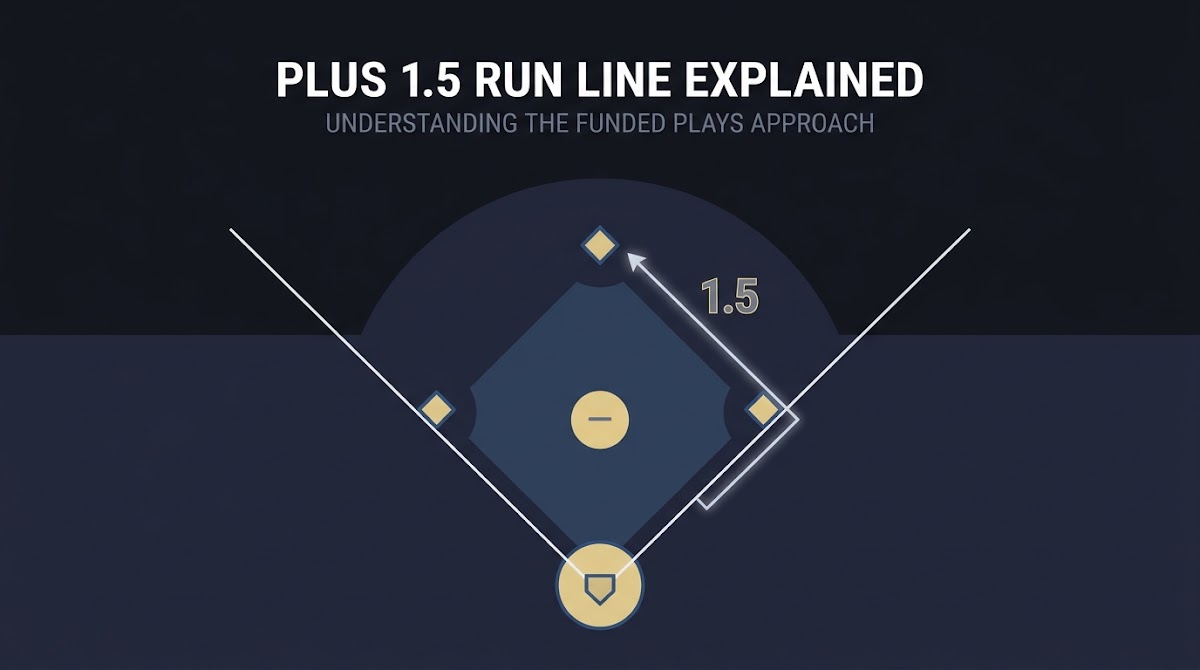
Quick answer: what does a +1.5 run line mean?
One-sentence definition
A +1.5 run line means the listed underdog can win the bet by winning the game outright or by losing by exactly one run; this is baseball's standard spread in U.S. markets and functions like a point spread that adds a 1.5-run cushion to the underdog's result.
Try a runline calculator and test the examples on the FundedPlays Challenges page
Try the step-by-step examples below or use a simple runline calculator to confirm payout and break-even numbers before staking real funds.
When you see a favorite listed at -1.5 and an underdog at +1.5, the outcome you need is different from a moneyline wager: the bet depends on the final margin relative to the 1.5 threshold, not only which team wins. Always confirm the operator's house rules before placing a run line bet because settlement and voiding policies can vary.
Why MLB uses a 1.5-run spread
The 1.5-run spread simplifies settlement by removing ties as possible outcomes and makes game outcomes easy to map to a win or loss for the bettor; baseball markets use ±1.5 as the default run line with alternate lines sometimes offered at different prices The Action Network explainer.
How the run line is like a point spread
Comparing run line and point spread in other sports
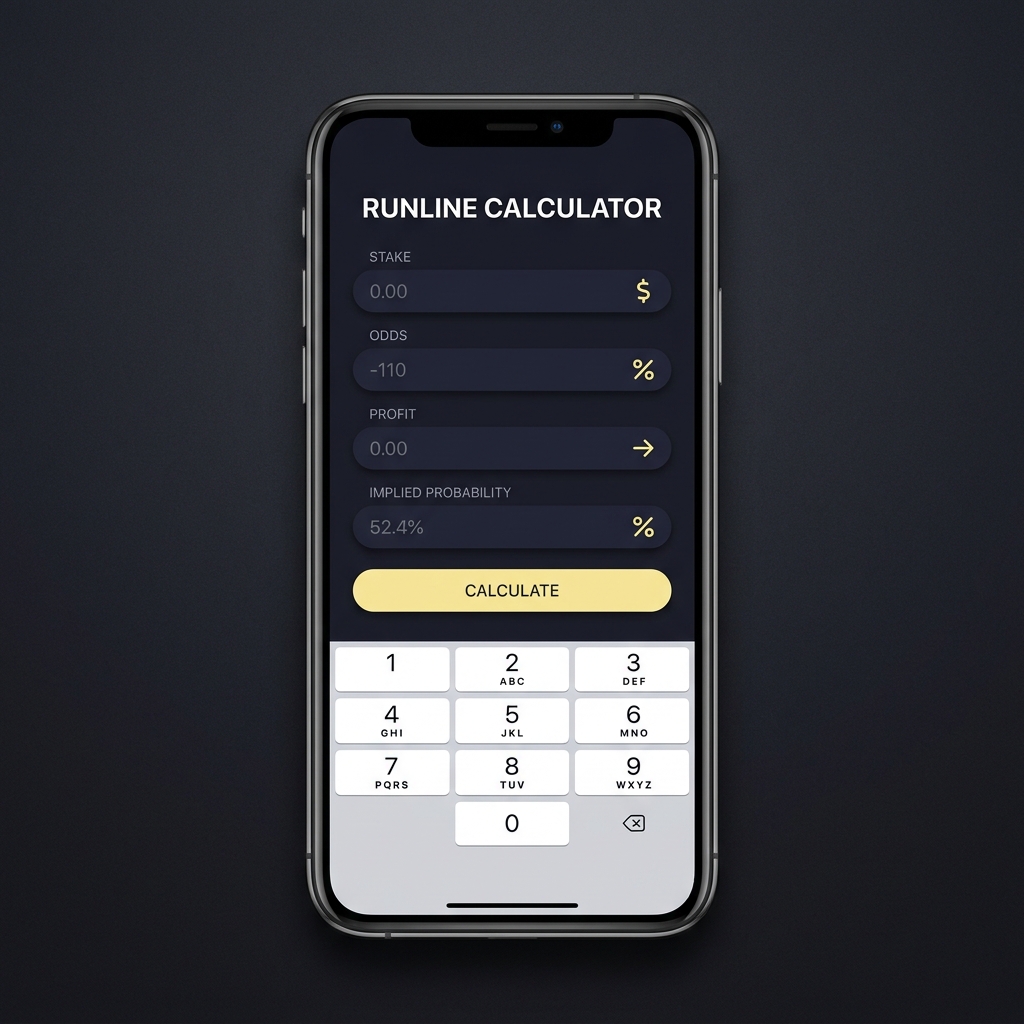
Use the American-odds formulas: for positive odds profit = stake * (odds / 100); for negative odds profit = stake * (100 / |odds|). Convert the odds to implied probability and compare that to your estimated chance of covering 1.5 to check break-even and value.
Alternate run lines and pricing
Sportsbooks may also post alternate run lines, such as ±2.5, at adjusted odds so bettors can trade between protection and payout; accepting a larger spread in your favor generally reduces your payout, while moving toward a tighter spread usually increases the price against you.
Because the run line requires a margin of victory, it is different than choosing a moneyline winner, where only the final winner matters. That difference is why evaluating run line opportunities sometimes requires a short calculation to see if the payout compensates for the additional margin requirement TheLines run line overview.
Using a runline calculator: step-by-step payout math
Converting American odds to payout
Run line payouts in U.S. markets use standard American-odds math: for positive odds, profit equals stake times (odds divided by 100); for negative odds, profit equals stake times (100 divided by the absolute value of the odds). These formulas let you compute exactly what a successful run line bet returns before fees or taxes Investopedia odds formulas and you can try a dedicated payout calculator such as Action Network's betting odds calculator.
Worked example: stake, odds, and return
Below is a compact, numbered how-to you can replicate on a phone or build into a runline calculator. Example inputs and steps follow the formulas above and show how to get profit and total return from a known stake and American odds.
Step 1: Note the American odds and your stake. Step 2: If odds are positive, calculate profit = stake * (odds / 100). Step 3: If odds are negative, calculate profit = stake * (100 / |odds|). Step 4: Total return = stake + profit. For a quick runline payout example, if you stake 100 on +150, profit = 100 * (150 / 100) = 150 and total return = 250; if the odds are -150 and you stake 100, profit = 100 * (100 / 150) = 66.67 and total return = 166.67 Investopedia odds formulas.

Implied probability and break-even for run line bets
Convert odds to implied probability
You can translate American odds into an implied probability to check whether the posted price offers value: for positive odds, implied probability = 100 / (odds + 100); for negative odds, implied probability = |odds| / (|odds| + 100). That conversion makes it easy to compare your own estimated chance of covering the run line against the market price Investopedia odds formulas.
compute profit and implied probability from stake and American odds
Enter positive or negative odds
How to check break-even rate for a run line wager
To run a break-even check, compute implied probability from the posted odds, calculate the profit on your stake, then ask whether your own probability estimate of covering the 1.5 margin exceeds the implied probability; if it does by a margin that covers vig and variance, the bet may offer long-term value Investopedia odds formulas.
For example, a +120 price implies a probability of 100 / (120 + 100) = 45.45 percent. If your model or reading of the matchup suggests a 52 percent chance of the underdog covering +1.5, the price has surface-level value before considering transaction costs and sample variance.
Typical pricing patterns: favorites at -1.5 and underdogs at +1.5
Why many favorites carry minus-money at -1.5
In many books the favorite listed at -1.5 will have minus-money pricing because backing a favorite to win by at least two runs is a harder outcome than the moneyline favorite simply winning, and the marketplace prices that protection into the odds; conversely, underdogs at +1.5 often appear at a weaker payout since the spread gives them more margin for error The Action Network explainer.
Interpreting plus-money on favorites and minus-money on underdogs
Occasionally you will see a favorite at -1.5 with plus-money or an underdog at +1.5 with minus-money; those patterns reflect how much protection or risk the book expects relative to the teams and can present arbitrage-like choices for skilled evaluators who can quantify margin probabilities Covers run line guide.
When you track run line prices across multiple operators, consistent patterns in which sides carry plus or minus money help you form a view of where the market is pricing margin and which books are offering relatively better value on a given side.
Alternate run lines and house rules to watch for
Common operator differences
Operators sometimes offer alternate run lines at different odds and may have specific settlement rules for things like suspended games, inning-based resolutions, or official game status; these variations directly affect whether your run line wager stands or is voided, so check the house rules for the operator you plan to use TheLines run line overview.
When a rule can change the outcome
Two common house-rule examples to confirm are whether a game must reach official status for the run line to settle and how the operator handles suspended or postponed contests; another is whether alternate lines are offered only pregame or also in live markets, since settlement timing can change your exposure.
Before placing the bet, verify those rules and note them in your record so you can review any disputed settlement later. See how evaluations document settlement considerations.
Decision framework: when to choose the run line vs the moneyline
Risk-reward trade-offs
Decide between run line and moneyline by comparing implied probabilities, payout, bankroll impact, and matchup factors like pitching depth and bullpen risk; run line bets add a margin element that raises variance compared to a straight moneyline and should be treated accordingly in your sizing and expectations The Action Network explainer.
When a run line offers better value
Use this numbered checklist to decide quickly: 1) Convert both prices to implied probability. 2) Compare those numbers to your model or view. 3) Check payout using a runline calculator. 4) Size the stake by your bankroll rules. 5) Confirm house rules and any alternate lines. If the run line's implied probability understates your chance to cover 1.5, the run line may offer better value than the moneyline Covers run line guide.
Remember that short-term results are noisy; the framework helps you apply consistent thinking to individual opportunities rather than chasing one-off outcomes.
Common mistakes and how to avoid them
Misreading margins
A frequent error is treating the run line like a moneyline and not accounting for the 1.5-run margin, which leads bettors to overestimate the true chance of a bet cashing; always convert odds to implied probability and run a break-even calc before assuming a price is fair Investopedia odds formulas.
Neglecting implied probability
Another mistake is ignoring implied probability and relying purely on gut feel or recent results; the simple fix is to compute implied probability, compare it to your estimate of margin outcomes, and only place bets where you see a clear edge after fees and variance.
Quick fixes include saving a short calculation template, using the tool above, and recording every run line wager so you can measure long-run performance rather than trusting single-game intuition. See the Funded Plays blog for keeping a simple record template.
Practical payout examples and worked scenarios
Example 1: favorite at -1.5 with plus-money
Example 1 walks through a favorite priced at -1.5 with plus-money. Suppose you see -120 on the favorite for a -1.5 run line and you plan to stake 100. Using the negative-odds formula, profit = stake * (100 / |odds|) which gives profit = 100 * (100 / 120) = 83.33 and total return = 183.33; the implied probability is |odds| / (|odds| + 100) = 120 / 220 = 54.55 percent, which you compare with your model to decide if the price is fair Investopedia odds formulas.

Example 2: underdog at +1.5 with minus-money
Example 2 shows an underdog at +1.5 priced at -130 with a 100 stake. Negative pricing on an underdog can occur when the market favors taking the spread; using profit = stake * (100 / |odds|) gives profit = 100 * (100 / 130) = 76.92 and total return = 176.92. The implied probability equals 130 / 230 = 56.52 percent, so you would only take this if your independent chance of the underdog covering exceeds that threshold BetMGM run line primer.
Each worked example shows how to go from odds to profit to total return and then to an implied probability that you can compare with your own view. Use these steps on a phone or in a basic spreadsheet to reproduce runline payout examples quickly and consistently.
Bankroll and risk management for run line strategies
Sizing bets for spreads

Using run line bets in a portfolio
Include run line bets as part of a diversified prediction portfolio rather than concentrating exposure on single-game swings; record stakes, odds, and outcomes and review them in regular samples to avoid overfitting to short strings of wins or losses.
Always remember that outcomes depend on individual performance and operator rules; no method guarantees success, so manage risk accordingly and use simulated funds or small stakes while you refine a run line approach.
Practical scenarios: when the run line changes the bet
Late-inning bullpen risk
Late-inning bullpen strength or weakness can shift whether you prefer the run line or moneyline: if a favorite's bullpen has a history of late runs allowed, taking the underdog at +1.5 can be a strategic hedge compared with risking the moneyline when a one-run loss still cashes the spread TheLines run line overview.
Starting pitcher injury or scratch
A last-minute starter scratch that brings in an unproven pitcher often increases margin uncertainty; if the expected margin widens toward a closer game, the +1.5 cushion may be worth the smaller payout compared with the moneyline, but do the math with your runline calculator before acting Covers run line guide.
Other scenarios that often change the choice include weather that suppresses scoring and line movement that reveals where public money is clustering; watching movement helps you spot when a run line has become more or less attractive over time.
Quick checklist before placing a run line bet
Five things to confirm
1) Confirm the operator's house rules for settlement. 2) Convert the posted odds to implied probability. 3) Compute profit and total return using a runline calculator. 4) Compare the run line to the moneyline and alternate lines. 5) Size the stake against your bankroll plan and record the bet.
Fast calculation checklist
If an alternate run line is available, compute the payout for each option and pick the combination of spread and price that best matches your edge per unit risk. Keep concise notes so you can analyze what worked and what did not once results accumulate.
Wrap-up: key takeaways and next steps
Summary bullets
The +1.5 run line gives the underdog a 1.5-run cushion and is baseball's standard spread; it requires a margin check in addition to identifying the likely winner The Action Network explainer.
Practice using a runline calculator to compute profit, total return, and implied probability before committing real stakes, and always verify the operator's house rules for settlement and alternate lines Investopedia odds formulas.
Next steps: try the worked examples above with your own numbers, keep clear records, and use small stakes or simulated funds to build confidence. Visit Funded Plays for additional resources.
It means the underdog wins the bet if they win the game outright or lose by one run; the favorite is usually -1.5 and outcomes depend on the margin.
For positive odds use profit = stake * (odds / 100); for negative odds use profit = stake * (100 / |odds|); total return is stake plus profit.
Compare implied probabilities, payout, bankroll impact, and matchup factors; choose the option that offers a clear edge after fees and variance.
References
- https://www.actionnetwork.com/education/what-is-the-run-line
- https://www.thelines.com/mlb-run-line/
- https://www.investopedia.com/terms/m/moneyline-bet.asp
- https://www.actionnetwork.com/betting-calculators/betting-odds-calculator
- https://therundown.io/betting-calculators/bet-payout-calculator
- https://www.foxsports.com/stories/betting/run-line-betting
- https://www.covers.com/education/betting-101/what-is-the-runline
- https://sports.betmgm.com/en/blog/mlb/what-is-run-line-betting-odds-explained/
- https://www.fundedplays.com/challenges
- https://www.fundedplays.com
- https://www.fundedplays.com/blogs
- https://www.fundedplays.com/blogs/how-fundedplays-evaluations-work