

Quick answer: is the run line the same as the moneyline?
Short summary
The short answer is no. In regulated U.S. markets, the run line and the moneyline are distinct wager types: the moneyline pays if the chosen team wins the game, while the run line works like a spread that depends on the margin of victory.
These distinctions mean the same American odds math applies to both markets, so the formulas you would use in a runline calculator are the same math used for moneyline payouts and implied probability calculations. For an official catalog view of approved market types, see the Massachusetts Gaming Commission sports-wagering catalog Massachusetts Gaming Commission sports-wagering catalog.
What you will learn
This article shows the exact definitions and regulatory context for run line versus moneyline, explains how to convert American odds to decimal and implied probability, and walks through several step-by-step runline calculator examples you can reproduce by hand or in a small tool.

runline calculator
We also include a sequence of worked examples that you can copy into a spreadsheet or a simple runline calculator to verify payouts and probabilities for either market.
What run line and moneyline each mean: definitions and regulatory context
The moneyline is a wager graded solely on which team wins the game; the margin of victory does not matter for settlement. This is the standard definition used in state sports-wagering catalogs that list moneyline as a separate approved market type, for example in state catalogs that enumerate accepted bet types and settlement rules Ohio Casino Control Commission sports-gaming catalog.
The run line is a spread-style market in baseball that includes the margin of victory. In most MLB markets the run line is set at plus or minus 1.5 runs, which means a favorite posted at -1.5 must win by two or more runs to cover, while an underdog at +1.5 can lose by one run and still cover the run line; state catalogs treat the run line as a separate approved market from the moneyline Colorado Division of Gaming sports betting catalog (see BetMGM's guide).
Practice payouts with a simple runline calculator
Try the worked examples in the examples section with your own stake sizes to see how payouts and implied probabilities change; these steps are the same calculations a simple runline calculator performs.
Because the run line changes the settlement condition, the price you see for a team on the run line will often differ from its moneyline price. Both markets use the same American odds format for pricing, so converting odds and calculating payout follows the same formulas across markets. For additional background on run line basics see PlayMichigan's run line guide.
How American odds, decimal conversion, and implied probability work (useful for a runline calculator)
American odds show the payout relationship in a compact form. Negative American odds indicate how much you must stake to win $100, while positive odds show how much profit you make on a $100 stake. This interpretation of American odds is the standard educational definition used in betting math resources Investopedia moneyline bet guide.
To compute payouts you commonly convert American odds to decimal odds, then multiply by the stake. For positive American odds A, decimal odds equal 1 + A/100. For negative American odds A, decimal odds equal 1 + 100/|A|. Once you have decimal odds, multiply by your stake to get payout, which is the total returned including the original stake; sources describing conversion methods provide these formulas and examples Pinnacle odds conversion guide.
Implied probability is derived from American odds with straightforward formulas. For negative odds A use p = (−A)/((−A) + 100). For positive odds A use p = 100/(A + 100). These formulas let a runline calculator report the book-implied chance behind any American line Investopedia implied probability guide.
Worked examples help make these steps concrete: later sections show numeric conversions for both favorite and underdog run line sides and give the same computations for the comparable moneyline quotes.
Exactly how a run line bet settles compared with a moneyline bet
Settling a moneyline bet is simple: if the team you backed wins the game, the bet wins; if they lose, the bet loses. That is the definition used by regulated catalogs when listing moneyline outcomes.
By contrast, a run line bet is decided by margin. With a typical -1.5 run line the favorite must win by two or more runs to win the run line bet, while an underdog at +1.5 covers even if it loses by a single run. This margin-based settlement is spelled out in state catalogs that list run line as a spread-style option Massachusetts Gaming Commission sports-wagering catalog.
No. The run line is a spread that depends on the margin of victory, while the moneyline pays based solely on which team wins; both use the same American odds math for payout and implied probability calculations.
Edge cases include suspended games, official scoring adjustments, or contests that do not reach official status; those local settlement rules are defined in each jurisdiction's catalog and can affect whether a run line or moneyline is graded as a win, loss, or void.
Because the run line uses margin-of-victory criteria, a team can lose the game but still “cover” the run line if the score margin is small enough. That is a practical difference that should be clear before placing a run line wager or using a runline calculator to model outcomes.
Using a runline calculator: step-by-step worked examples
Example 1, favorite on the run line - converting odds and computing payout. Suppose a favorite on the run line shows American odds of -150 and you plan to stake $50. Step 1, interpret the odds: negative odds mean you must stake $150 to win $100, which is the standard American odds interpretation.
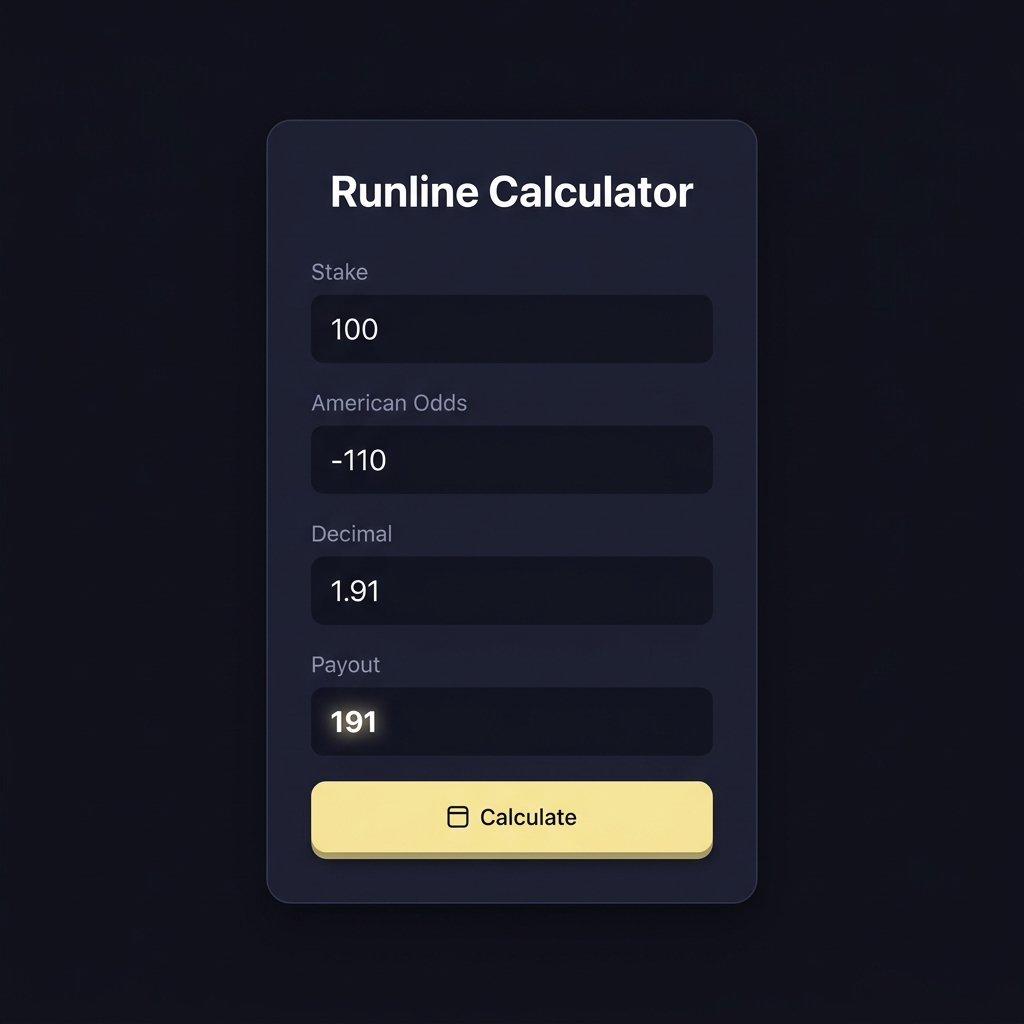
Step 2, convert -150 to decimal odds. For negative odds A = -150, decimal = 1 + 100/|A| = 1 + 100/150 = 1 + 0.666..., which equals 1.666...; these are the standard conversion steps a runline calculator performs Pinnacle odds conversion guide.
Step 3, compute payout for a $50 stake. Multiply decimal odds 1.666... by stake 50 to get total payout 83.33 including the stake; the net profit equals payout minus stake. Use these steps to verify any favorite-side run line payout quickly.
Example 2, underdog on the run line - implied probability. Suppose an underdog on the run line shows American odds of +210. Step 1, convert to decimal: for positive odds A = 210, decimal = 1 + A/100 = 1 + 2.10 = 3.10. Step 2, compute implied probability: for positive odds A, p = 100/(A + 100) = 100/(210 + 100) = 100/310 = 0.3226 or about 32.26 percent; the implied probability formula is standard and used in runline calculator logic Investopedia implied probability guide.
Quick check contrast: the comparable moneyline quotes will use the same odds math but settle differently. If the underdog outright wins, the moneyline bet pays; if the underdog loses by one and had +1.5 on the run line, the run line still covers.
When to pick the run line versus the moneyline: decision criteria
Price versus margin is the basic tradeoff. The run line usually reduces the price on heavy favorites because the bettor requires a larger margin of victory, while the moneyline pays for a straight win without a margin requirement. That tradeoff is the practical reason bettors move between these markets and is reflected in pricing behavior across books SportsLine's guide and other sportsbook resources.
Game context matters: choose the run line when you believe a mismatched favorite will win by multiple runs, or when the reduced price on the favorite improves value for your model. Choose the moneyline when you expect a close game, when backing an underdog who might win outright, or for live situations where simply winning matters more than margin.

Bankroll size and tolerance for variance also guide the decision: the run line can offer steadier payout profiles on favorites at the cost of needing larger wins, while moneyline exposure can swing more but rewards outright outcomes without margin conditions.
Common mistakes people make with run lines and moneylines
One common mistake is misreading the sign or margin: treating +1.5 as an automatic win rather than as an allowance for a one-run loss. Remember, +1.5 means the team can lose by one and still cover the run line; that distinction is why the run line is not the same as the moneyline and should be explicit before making a bet.
A second frequent error is confusing payout math with probability. Converting American odds to decimal and then to payout is mechanical, but interpreting the decimal as the true probability without removing the bookmaker margin leads to overconfidence. Use the implied probability formulas to compare market-implied chance against your own estimates Investopedia implied probability guide.
Finally, ignore state-specific settlement rules at your peril. Catalogs govern edge cases such as suspended or cancelled games and official scoring differences. Check the local catalog for how run line or moneyline bets are graded in those scenarios before placing a wager or finalizing calculator assumptions Colorado Division of Gaming sports betting catalog.
Regulatory snapshot: how U.S. state catalogs treat run line and moneyline
Several state-level catalogs explicitly list moneyline and run line as separate approved wager types, which demonstrates the regulatory recognition of their functional difference; examples include the Massachusetts and Ohio catalogs that enumerate approved markets and settlement rules Massachusetts Gaming Commission sports-wagering catalog.
Catalog contents are updated periodically, so always verify the current rules for your jurisdiction before assuming a specific settlement behavior; the catalogs show how core definitions remain stable while operational notes can change Ohio Casino Control Commission sports-gaming catalog.
Convert American odds to decimal and compute payout and implied probability
Use Side to interpret settlement
Because state catalogs and operator rules can vary on grading edge cases, the regulatory snapshot is primarily a reminder to check the current catalog for settlement language; the mathematical conversions used in a runline calculator do not change with jurisdiction, but the grading rules around suspended games can.
Three practical scenarios: favorite covers, underdog covers, and a moneyline upset
Scenario A, favorite at -1.5 covers by two or more. Suppose the favorite has American odds -140 and you stake $100. Step 1, convert to decimal: decimal = 1 + 100/140 = 1 + 0.714285 = 1.714285. Step 2, payout = decimal * 100 = 171.4285 total returned, net profit about 71.43. If the favorite wins by two or more runs the run line bet wins; if they win by only one run the run line loses while a moneyline bet would still win.

Scenario B, underdog at +1.5 loses by one but covers. Suppose the underdog has American odds +180 and you stake $50. Decimal = 1 + 180/100 = 2.80. Payout = 2.80 * 50 = 140 total return, net profit 90. If the underdog loses by one run a +1.5 run line still covers, so the run line bet wins while a moneyline on the underdog would lose.
Scenario C, moneyline upset. If the underdog wins outright and you had placed a moneyline bet at +220 with a $25 stake, decimal = 1 + 220/100 = 3.20, payout = 3.20 * 25 = 80 total returned, net profit 55. The run line settlement depends on the margin: if the underdog also covered the run line, both bets pay; if the underdog won by one and you had the favorite on -1.5, the favorite run line loses even though the favorite lost the moneyline.
Each scenario uses the same conversion math and highlights the settlement difference: run line outcomes require attention to margin, while moneyline outcomes require only the final winner. Use the numeric steps as copy-ready lines in a runline calculator or a spreadsheet model.
Summary and next steps: using a runline calculator responsibly
Summary and next steps: using a runline calculator responsibly
Key takeaways: the run line is not the same as the moneyline. The run line functions like a spread, typically set at ±1.5 in MLB, and requires a margin of victory for favorites to cover, while the moneyline settles on the winner only; state catalogs list these as distinct approved markets Massachusetts Gaming Commission sports-wagering catalog.
All the math a runline calculator needs is standard American odds conversion and implied probability formulas. Practice the conversions shown in the worked examples until you can do them reliably by hand, then implement them in a small tool or spreadsheet to check bets before placing them.
Next steps: try the step-by-step examples above with your own stake sizes in a simple runline calculator, and consult your local sports-wagering catalog to confirm settlement rules for edge cases before depending on a particular outcome.
The moneyline pays if the chosen team wins the game; the run line is a spread that depends on the margin of victory, typically ±1.5 runs in MLB.
Yes. American odds conversion to decimal and implied probability uses the same formulas for both markets and can be used in a runline calculator.
Check your state sports-wagering catalog or the operator's rules for guidance on suspended games, official scoring, and local grading practices.
References
- https://massgaming.com/sports-wagering/sports-wagering-catalog/
- https://casinocontrol.ohio.gov/sports-gaming/sports-gaming-catalog/
- https://sbg.colorado.gov/sports-betting-catalog
- https://www.investopedia.com/terms/m/moneyline-bet.asp
- https://www.pinnacle.com/en/betting-articles/educational/odds-conversion-formula
- https://www.investopedia.com/terms/i/implied-probability.asp
- https://www.fundedplays.com/challenges
- https://www.fundedplays.com
- https://www.fundedplays.com/blogs
- https://www.fundedplays.com/blogs/how-fundedplays-evaluations-work
- https://sports.betmgm.com/en/blog/mlb/difference-between-run-line-and-moneyline-in-mlb-betting-bm23/
- https://www.playmichigan.com/sports-betting/how-to-bet/runlines/
- https://www.sportsline.com/guides/mlb/