
What a 2.5 run line means in plain terms
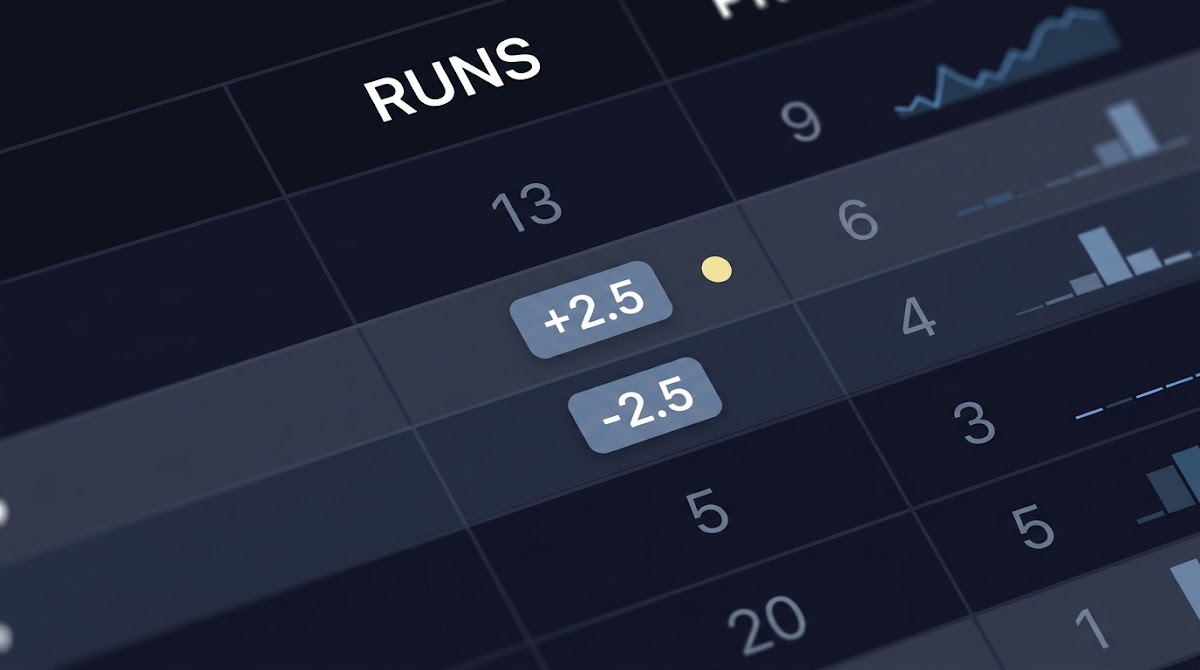
A 2.5 run line is an alternate MLB spread in which the favorite must win by three or more runs to cover, while the underdog covers if it loses by two runs or fewer or wins outright. This half run removes the possibility of a tie or push and forces a decisive grading outcome, which is the core reason sportsbooks offer half-run lines for baseball markets Run Line Definition and Example in Sports Betting.
The idea is simple: adjust the final score by the spread and see which side comes out ahead. For a -2.5 favorite, subtract 2.5 runs from the favorite's final score; for a +2.5 underdog, add 2.5 runs to the underdog's final score. Because no real baseball score can include a half run, the half-run guarantees there is a winner and avoids the refund scenarios that can complicate payouts.
Enter the side, the ±2.5 spread, your stake, and the American odds into a runline calculator; compute profit using the positive or negative American-odds formula, then add the stake to get total return.
Alternate run lines such as ±2.5 are offered in addition to the more common ±1.5 standard because bettors and markets have different appetites for margin and payout; in current U.S. markets alternate numbers beyond ±1.5 like ±2.5 are commonly listed and priced to reflect their probability How to Bet Baseball: Moneylines, Totals and Run Lines Explained.
Definition and the no-push half run
In plain language, the half-run on a 2.5 line prevents a push. A favorite listed at -2.5 must finish with at least a three-run margin of victory for a winning run line ticket. If the favorite wins by only two runs, a -2.5 wager loses. The half-run is a structural feature that removes ties by making the adjusted score impossible to equal.
How favorites and underdogs cover a 2.5 line

To see how covering works, picture a game that ends 5-3. A bettor on the favorite at -2.5 would have the favorite's score adjusted to 2.5 and therefore not cover, while a +2.5 wager on the underdog would cover after adding 2.5 to the underdog and comparing totals. This method of score adjustment is the standard grading approach used across baseball run line markets MLB Run Line Betting Explained.
How run line bets are graded and settled
Grading a run line is mechanical and depends on the stated spread. The steps are: 1) take the final official score; 2) add the spread to the underdog or subtract it from the favorite; 3) compare the adjusted totals; 4) determine which side has the higher adjusted total. This score adjustment method is how operators decide winners in ±2.5 scenarios Run Line Definition and Example in Sports Betting.

Example step by step: if the official final is Favorite 6, Underdog 4 and the line is Favorite -2.5, subtract 2.5 from 6 to get 3.5; compare 3.5 versus 4. The underdog covers because 4 is larger. Numbered steps like this help avoid simple math mistakes at settlement time.
House rules can change settlement in edge cases, so always confirm the operator's published rules before you place a bet. Variations can include how suspended or curtailed games are handled, whether a game must reach a minimum number of innings to grade, or how official scoring decisions affect totals; these operator-level distinctions are important because market listings for alternate lines and their settlement criteria can differ across jurisdictions How to Bet Baseball: Moneylines, Totals and Run Lines Explained.
Alternate lines like ±2.5 differ from the standard ±1.5 mainly in how much margin the favorite needs to cover and how prices move. Because a -2.5 favorite must win by at least three, its price will typically be longer than a -1.5 favorite, reflecting a lower probability of covering the larger margin.
Score adjustment method for grading a run line
Put simply: adjusted favorite score equals favorite runs minus the spread; adjusted underdog score equals underdog runs plus the spread. Whoever has the larger adjusted score wins the wager. This arithmetic is universal across run line grading and is the basis for settlement across most MLB markets How to Bet Baseball: Moneylines, Totals and Run Lines Explained.
House rules that can affect settlement
Common house-rule variants include minimum innings for a result, special treatment of games stopped for weather, and how official scoring changes are treated if they are announced after a game is final. Operators publish these details in their rules, and differences matter for alternate lines where a small run margin can change a result.
How to use a runline calculator: step-by-step
A runline calculator helps you convert a chosen side, spread, stake, and American odds into profit and total return. Typical inputs are: selected side, spread (for example ±2.5), stake amount, and the American odds for the quoted price. The calculator applies the American-odds formulas to show profit and total return on the wager. For an example of a general odds calculator see Action Network's Betting Odds Calculator.
Convert stake and American odds into profit and total return for a specified run line
Enter American odds as shown on your operator
To use the calculator: 1) enter whether you are backing the favorite or underdog; 2) set the spread to 2.5 or -2.5 as appropriate; 3) enter your stake; 4) type in the American odds. The tool returns net profit using the standard American-odds math and then adds the original stake to give total return. VSIN also publishes an online betting odds calculator that follows the same math Betting Odds Calculator. The formulas used by calculators follow established American odds conventions American Odds: What They Are and How to Calculate Payouts.
Be sure the calculator treats positive and negative American odds differently. For positive prices the profit equals stake times odds divided by 100; for negative prices the profit equals stake times 100 divided by the absolute value of the odds. Total return equals stake plus profit. Those rules are the exact arithmetic guts of any runline calculator you trust.
Inputs a runline calculator needs (runline calculator)
Required inputs are the side you choose, the spread (typically ±2.5 for this guide), the amount you will risk, and the American odds displayed by your operator. Optionally you might include a field to display the implied probability, but the basic calculator needs only the core four fields.
Stepwise example: calculate returns from given odds
Worked example setup: you back the favorite at -2.5 with a $100 stake and the posted odds are -150. Using the negative-odds formula you compute profit as 100 times 100 divided by 150, which produces a net profit of $66.67 and a total return of $166.67. That same arithmetic is what a runline calculator automates for you American Odds: What They Are and How to Calculate Payouts.
Calculating payouts and example scenarios
Understanding how payouts differ between favorites and underdogs on a 2.5 line helps you compare payoffs to moneyline options. The American-odds formulas are the standard here, so learning to apply them to both negative and positive prices is the main task American Odds: What They Are and How to Calculate Payouts.
Example A, favorite at negative odds on -2.5: suppose the favorite's price is -180 and you stake $100. Profit equals stake times 100 divided by 180, so profit = 100 * 100 / 180 = $55.56. Total return equals $155.56. The math shows why laying a bigger margin usually reduces payout compared with a moneyline win that requires a one-run margin or any-win outcome.
Example B, underdog at positive odds on +2.5: suppose the underdog is +220 at +2.5 and you stake $100. Profit equals stake times odds divided by 100, so profit = 100 * 220 / 100 = $220. Total return equals $320. Taking a plus spread increases margin for error but reduces or increases payout depending on the posted odds versus the moneyline alternative MLB Run Line Betting Explained.
Shifts from ±1.5 to ±2.5 usually cause odds to lengthen for favorites and shorten for underdogs, reflecting the changed probability that a team will win by a larger margin. Alternate run lines are priced so that the market balances supply and demand while reflecting the statistical chance of a larger victory margin MLB Run Line: What It Is and How Alternate Lines Work. Lines also offer an odds calculator you can use for quick conversions Lines Odds Calculator.

Example: favorite at negative odds on -2.5
Concrete calculation: favorite at -2.5 with odds -200, $100 stake. Profit = 100 * 100 / 200 = $50. Total return = $150. If the favorite wins 4-1, adjusted favorite score = 4 minus 2.5 = 1.5; adjusted underdog score = 1 plus 2.5 = 3.5; under these numbers the underdog would actually cover, which highlights why checking the underlying probability of a three-plus run win is essential Run Line Definition and Example in Sports Betting.
Example: underdog at positive odds on +2.5
Concrete calculation: underdog at +2.5 with odds +180, $100 stake. Profit = 100 * 180 / 100 = $180. Total return = $280. If the game ends 3-4 with the underdog losing by one, the +2.5 adjusted underdog score is 3 plus 2.5 = 5.5 and the underdog covers. Taking +2.5 increases the margin for error if you expect a close game or low scoring match.
When to consider using a 2.5 run line: decision criteria
Choose +2.5 when you want extra margin for error, such as backing an underdog in a likely low-scoring game or when the favorite's offense looks limited that day. Taking the underdog with a +2.5 cushion reduces the chance of a narrow loss turning your ticket into a loser, which is useful in tight pitching matchups or when the favorite's bullpen is uncertain MLB Run Line Betting Explained.
Consider -2.5 when you have strong evidence the favorite will win by multiple runs: dominant lineup, weak opponent pitching, or historical blowout tendencies. Laying -2.5 usually produces longer odds than the moneyline, so use it when the payout compensates for the added risk of a larger margin being required What Is the MLB Run Line? Examples and How It Differs From the Moneyline.
Practice runline math in a challenge environment
Try the math on your own with a simple stake and odds to see how risk and reward shift when you move from ±1.5 to ±2.5.
Practical criteria to weigh before choosing a 2.5 line include starting pitcher quality, bullpen depth, recent run production and suppression metrics, home and away splits, and situational context like lineup scratches or weather. Also check market availability: not every operator lists every alternate line, so confirm before you plan to place a bet MLB Run Line: What It Is and How Alternate Lines Work.
Situations where +2.5 is attractive
Take +2.5 when you expect a close, low run game or when the favorite is slightly stronger but not by much. The extra two-run buffer helps protect the wager against late mistakes and single-inning rallies.
Situations where -2.5 may make sense
Consider -2.5 when a favorite has an unusually strong lineup against an opponent with weak run prevention, or when the matchup history and park effects point to multi-run wins. Remember that asking a team to win by at least three runs raises the probability bar compared with a one-run win or simple moneyline victory.
Common mistakes and settlement pitfalls to avoid
A common error is misreading the spread or assuming a half-run can push. The half-run specifically prevents pushes, so treating ±2.5 like a ±2.0 or expecting refunds will lead to mistakes; use the standard grading adjustment to avoid this confusion Run Line Definition and Example in Sports Betting.
Another frequent mistake is using the wrong odds math. Positive and negative American odds require separate formulas; applying the wrong one will give you incorrect profit and total return figures. Stick to the established American-odds rules when you calculate payout values American Odds: What They Are and How to Calculate Payouts.
Watch for operator-specific settlement quirks such as how curtailed games are scored, whether a game must reach a minimum number of innings to count, and whether official scoring changes announced after the game affect final results. These rules can affect the outcome in close-run situations and differ across jurisdictions How to Bet Baseball: Moneylines, Totals and Run Lines Explained.
Practical scenarios: three worked examples you can follow
Scenario examples put the previous guidance into action with narrative reasoning, adjusted-score grading, and a compact payout calculation so you can follow a trade-off from decision to result. These step-throughs use the ±2.5 adjustment rule and American-odds math to show how outcomes resolve MLB Run Line Betting Explained.
Scenario practice can be useful in structured challenge settings and simulated bankrolls. If you prefer a skills-first environment to test decision frameworks, a funded sports prediction platform such as

Low-scoring pitcher duel: why +2.5 might be preferable
Pre-game reasoning: two strong starters, weak lineups, and a neutral ballpark suggest limited offense. You expect a tight score like 2-1 or 3-2. Taking +2.5 on the underdog increases your margin for a one-run or two-run loss to still cover. Calculation: if underdog is +150 and you stake $100, profit = 100 * 150 / 100 = $150, total return = $250. If final is 2-1, adjusted underdog = 2 plus 2.5 = 4.5 and the underdog covers.
High-offense matchup: when -2.5 could be reasonable
Pre-game reasoning: a powerful lineup faces a poor pitching staff in a hitter-friendly park. Expect multi-run innings and a likely blowout. If favorite is -220 at -2.5 and you stake $100, profit = 100 * 100 / 220 = $45.45, total return = $145.45. If final is 6-2, adjusted favorite = 6 minus 2.5 = 3.5 and adjusted underdog = 2 plus 2.5 = 4.5, in this example the favorite actually fails to cover; use pre-game run expectation metrics to reduce this risk MLB Run Line: What It Is and How Alternate Lines Work.
Late-game substitutions and their impact on a 2.5 line
Pre-game reasoning: late lineup changes, bullpen uncertainty, or a planned rest day can alter run expectations. If a favorite loses key hitters before the game or the closer is unavailable, the chance of a narrow win rises and covering -2.5 becomes harder. Always re-check lineups and late news before finalizing a wager to avoid being blindsided.
Quick reference: cheat sheet and final takeaways
One-page checklist before you bet: confirm the spread is ±2.5, verify American-odds math for profit and total return, check operator house rules for settlement, and compare the payout to the moneyline to ensure value. These steps reduce simple errors and help you select the right instrument for your expectation American Odds: What They Are and How to Calculate Payouts.
Key differences between ±1.5 and ±2.5: ±2.5 demands a larger margin from favorites and gives more buffer to underdogs, and odds shift to reflect that altered probability. Alternate run lines are tools for expressing different risk-reward preferences, not guarantees of profit, and availability and settlement rules can vary by operator and jurisdiction How to Bet Baseball: Moneylines, Totals and Run Lines Explained.
Final note: use a runline calculator to check exact payouts before committing funds, double-check house rules, and practice scenarios in simulation if possible to refine when a ±2.5 play fits your broader strategy.
A 2.5 run line is graded by adding 2.5 to the underdog or subtracting 2.5 from the favorite and comparing adjusted scores; the higher adjusted total wins.
For positive odds profit = stake * (odds/100); for negative odds profit = stake * (100/|odds|); total return = stake + profit.
No, a half-run like 2.5 removes the possibility of a push because real game scores cannot include half runs.
References
- https://www.investopedia.com/terms/r/runline.asp
- https://www.vsin.com/betting-101/how-to-bet-baseball-moneylines-totals-and-run-lines/
- https://www.covers.com/betting/mlb/run-line
- https://www.actionnetwork.com/betting-calculators/betting-odds-calculator
- https://vsin.com/tools/betting-odds-calculator/
- https://www.investopedia.com/terms/a/americanodds.asp
- https://www.thelines.com/mlb/run-line/
- https://www.lines.com/odds-calculator
- https://www.fundedplays.com/challenges
- https://www.fundedplays.com/blogs/how-fundedplays-evaluations-work
- https://www.fundedplays.com
- https://www.fundedplays.com/blogs
- https://www.actionnetwork.com/education/what-is-the-mlb-run-line
- https://www.lines.com/odds-calculator