

What a 1.5 run line means in plain terms
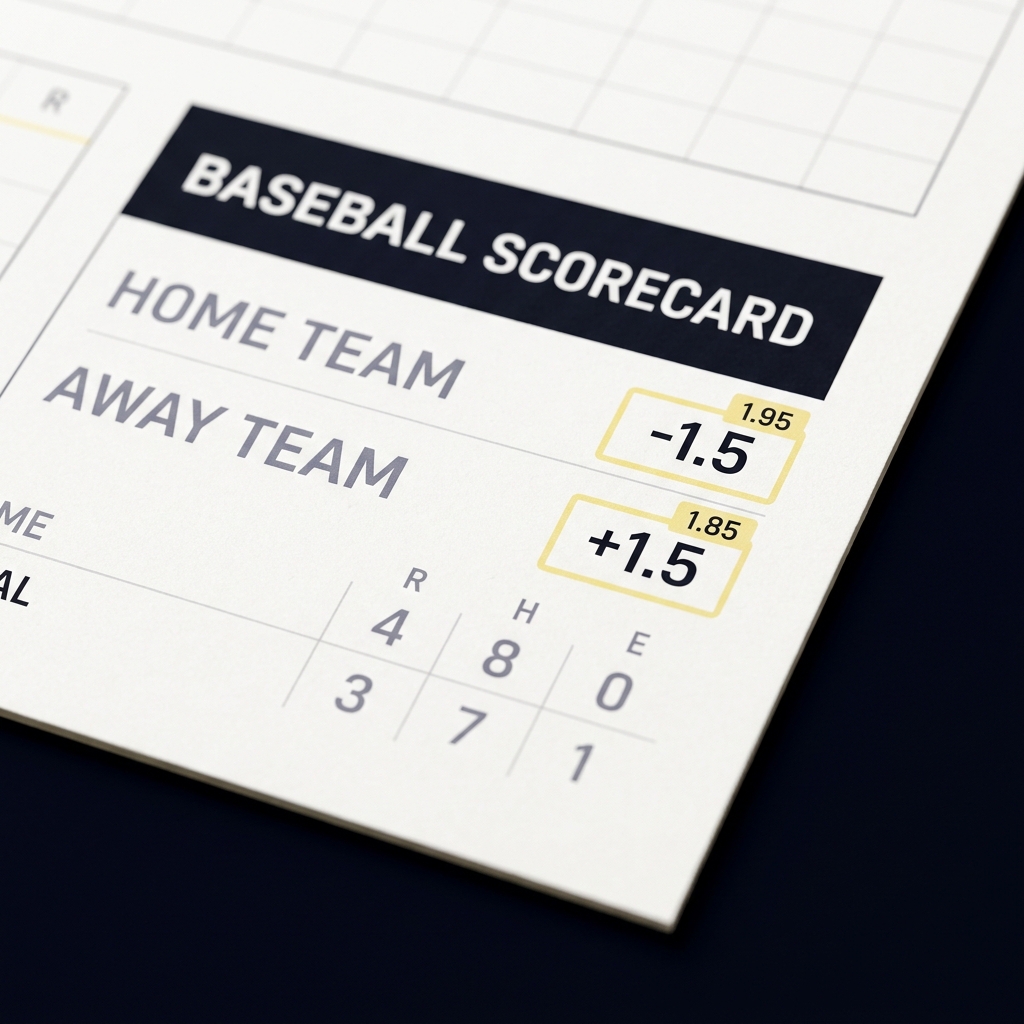
A 1.5 run line is baseballs most common spread-style market, where the listed favorite is shown at -1.5 and must win by two or more runs for that side to cash, while the underdog shown at +1.5 still wins the bet if it loses by one or wins outright. This setup avoids pushes that come with whole-number run lines and changes which outcomes count as winners or losers.
The reason sportsbooks and educational outlets present the run line at 1.5 is to eliminate tie outcomes and create clearer grading for bettors, which alters how prices are set on each side and how often each side covers. For a concise description of run line mechanics consult an industry explainer on the topic VSiN run line explainer.
A 1.5 run line adds a half-run handicap: a favorite at -1.5 must win by two or more to win the bet, while an underdog at +1.5 still wins the wager if it loses by one or wins outright, unlike the moneyline which only cares about the outright winner.
In practice, that means a bettor taking the underdog at +1.5 will still have a winning bet if the team loses by a single run, while a bettor on the favorite at -1.5 needs at least a two-run margin to cash, a distinction that makes the market behave differently from a straight moneyline.
Basic definition
Put simply, the run line applies a 1.5-run handicap to the final score so bets resolve without pushes; this is the standard presentation across major U.S. operators and mainstream educational sources, and it is the baseline most bettors encounter when reviewing baseball markets.
How favorite and underdog outcomes differ
When you read -1.5 next to a favorite, understand that the team must finish ahead by two or more runs on the official final score for that wager to win. When you see +1.5 on the underdog, that side covers if it wins outright or loses by a single run. This structure influences both risk and pricing in the market.

How run line bets are settled and graded
Run line wagers are graded using the official final score, and that official score almost always includes extra innings when finalizing results, unless an operator explicitly states otherwise in its house rules. When you check settlement language for a given market, look for the wording that confirms whether extra innings count toward the official result, since that changes outcomes for close games sportsbook house rules document. See extra innings analysis at FanGraphs The Math Behind the Extra Innings Home Field Disadvantage.
Operators can also include other settlement clauses that matter in edge cases, such as listed pitcher requirements or mercy-rule provisions in certain non-major-league games. Those operator-specific items can change how a run line bet is graded, so verifying the sportsbook help or rules page is a practical pre-bet step sportsbook rules page. See Caesars house rules for an example of operator documentation CHE Sportsbook House Rules.
Official final score and extra innings
Because most grading is tied to the official final score, extra innings are commonly counted for run line settlement. That means a game tied after nine that is decided in extras will still produce a valid two-run margin for a -1.5 favorite if that margin happens in extra innings, unless the operator says otherwise.
Operator house rules that can change settlement
Always check the sportsbook or operator house rules before placing a run line wager. Variations such as whether a listed pitcher must have started, or how postponed or abandoned games are handled, can affect whether a bet is voided, graded on a partial result, or settled using the official final score.
How run line pricing differs from the moneyline
The run line is a spread market: the handicap itself alters the statistical chance that a side covers, and sportsbooks reflect that in the odds. A favorite at -1.5 covers less often than it wins straight-up, so its price is usually longer than the moneyline; conversely, a +1.5 underdog covers more often, so its price is shorter than its outright odds would be. This key distinction explains why payout patterns differ between the two markets VSiN run line explainer.
Because the run line changes cover frequency compared with a moneyline, bettors should evaluate whether the handicap or the straight win market offers better value for a given matchup. The run line is effectively a way for sportsbooks to balance risk while offering alternative price points on the same game. See Funded Plays Funded Plays for related resources.

Why the favorite has longer odds at -1.5
The -1.5 handicap reduces the probability that the favorite covers, so sportsbooks lengthen the favorite's payout to balance liability and encourage action on the other side. That pricing reaction is standard market behavior whenever a handicap lowers the expected frequency of a winning outcome.
How handicap affects payout frequency
Because the underdog at +1.5 benefits from the extra run buffer, it will cover the line substantially more often than it wins outright. That higher expected cover frequency is reflected in shorter odds and smaller per-bet payouts compared with the favorite at -1.5.
Step-by-step: calculate payout and break-even from American odds
The run line uses the same American-odds math as other markets, so start by converting quoted odds to an implied probability and then compute the payout for your stake. Implied probability formulas for American odds are standard: for negative odds use probability = |odds|/(|odds|+100); for positive odds use probability = 100/(odds+100). For a full explanation of the formulas see an odds primer that covers American odds and implied probability Investopedia implied probability article.
Follow these numbered steps to compute breakeven and payout.
1) Convert the quoted American odds to implied probability using the formula above. Use the negative-odds formula when the price is listed with a minus sign and the positive-odds formula when the price is listed as a plus number.
2) Calculate the break-even percentage, which is the implied probability you would need to realize over time to avoid losing money at the quoted price. If your model indicates a higher chance than the implied probability, the wager may represent value.
3) Compute the payout for a chosen stake. For positive odds, profit = stake * (odds/100). For negative odds, profit = stake * (100/|odds|). The total return equals stake plus profit.
Convert American odds to implied probability
Example conversions: an American -150 price converts to an implied probability of |150|/(150+100) = 150/250 = 0.60 or 60 percent. A +130 price converts to 100/(130+100) = 100/230 = 0.435 or 43.5 percent. These conversions let you compare the market's expectation to your own win-rate estimate Investopedia American odds guide.
Compute payout for a sample stake
Worked stake example: if you risk 100 units at +130, expected profit on a winning bet is 100 * (130/100) = 130 units, so total returned is 230 units. If you stake 100 units at -150, profit on a win is 100 * (100/150) = 66.67 units, for a total return of 166.67 units. Those straightforward computations show how the same stake delivers different net returns depending on the American odds.
Use break-even analysis to decide if the quoted price makes sense for your model. If your estimated chance of winning exceeds the implied probability, the bet could be positive expected value for you, subject to correct model assumptions and consistent bankroll rules.
Using a runline calculator: when and how to apply one
A runline calculator automates the arithmetic above: enter the American odds and stake, and it returns implied probability, break-even, and net profit at a glance. That saves time when you need to compare markets quickly, especially during live line movement or when evaluating multiple games. See the Funded Plays blog Funded Plays blog for related tools.
Inputs typically include the American odds for each side and the stake amount; outputs usually show implied probability, net profit for a win, and total return. A dependable calculator reduces manual errors and helps you compare the run line to the moneyline in seconds VSiN run line explainer.
Use a calculator to check run line math and value
Try using a calculator to recheck the math on worked examples and to compare run line and moneyline value before committing a stake.
When you are evaluating live markets, a calculator helps you reprice quickly as odds shift. It does not remove the need to read house rules or to factor in non-price items like listed pitcher clauses, so treat it as a computation aid rather than a settlement authority.
What a runline calculator does
A runline calculator converts American odds into implied probability, computes potential profit for a chosen stake, and displays break-even percentages so you can compare market prices with your estimated win rates. Good calculators also let you toggle stake amounts to see how exposure changes with different bet sizes.
Practical uses for bettors and analysts
Typical uses include pre-game comparisons between book odds and your model, recalculating expected value during live shifts, and sizing stakes based on break-even thresholds. Remember that the calculator uses the displayed odds as its input, so any difference between displayed and actual live prices will change results.
When to prefer a run line versus a moneyline
Choose the run line when you believe your model or matchup analysis points to a margin of victory that comfortably clears the handicap and the run line price offers value versus the moneyline. Prefer the moneyline when you expect a tight game outcome or when the straight-up price is more favorable than the run line adjusted for implied probability.
Decision factors include your expected margin of victory, the relative prices on each market, bankroll sizing considerations, and any operator grading quirks that may affect outcomes. Also account for listed pitcher sensitivity if a sportsbook applies a listed-pitcher rule that could void or change a bet.
Rapidly compare run line and moneyline implied value for a single matchup
Use live odds as inputs
Situations that favor the run line
If your analysis expects a clear margin, or if the run line producer offers a price that implies a lower probability than your model's view, the run line can provide better value than the moneyline. This often happens when a favored team is strong but not priced at an attractive moneyline.
When the moneyline is the better choice
If you expect a close contest or your model shows a higher likelihood of a single-run outcome, the moneyline can be the smarter play because it pays for an outright win regardless of margin and avoids the handicap pressure of -1.5.
Common mistakes and pitfalls with run line betting
One frequent mistake is assuming run line settlement follows the same conventions you remember from a moneyline without checking the house rules. Differences like whether extra innings count or how postponed games are handled are common causes of disputes and unexpected voids, so confirm settlement language before wagering sportsbook house rules document.
Another mistake is misreading implied probability or applying payout numbers without converting odds first. Using the raw numbers without conversion can overstate or understate value and lead to poor staking decisions.
Ignoring settlement rules
Not every operator treats edge cases identically. For example, listed-pitcher rules or league-specific mercy rules can change whether a bet stands after a late-game pitcher change or an early game ending. Verify those clauses in the operator's rules to avoid surprises sportsbook rules page.
Misreading implied probability
Always convert American odds to implied probability when you evaluate value. Failing to do so means you cannot accurately compare the market chance with your own estimated win rate, which undermines responsible bankroll sizing and positive-expectation decision-making Investopedia implied probability article.
Practical examples: three run line scenarios worked through
Example 1: Underdog +1.5 cashes on a one-run loss. Suppose you take the underdog at +1.5 with +130 odds and risk 100 units. If the underdog loses 3-2, your +1.5 bet covers because the margin is one run; your net profit on a win at +130 is 130 units, and total return is 230 units. Use the American-odds math to confirm the payout.
Example 2: Favorite -1.5 needs a two-run win. If you back the favorite at -1.5 with -150 odds and risk 100 units, a 3-2 final score delivers a lose for the -1.5 wager despite an outright favorite victory by one. The -150 price converts to a 60 percent implied probability and a winning stake returns about 166.67 units including stake.
Example 3: Live line shift and quick recalc. Imagine a favorite opens at -1.5 with -140 but during play the price moves to -170. Re-run the implied probability conversion and your stake math to see how break-even changes, and decide whether the updated price still represents the value identified by your pre-game model VSiN run line explainer.
Underdog +1.5 cashes on one-run loss
Numeric clarity helps. At +130, the implied probability is 100/(130+100) = 43.5 percent and a 100-unit stake yields 130 units profit on a win. If your model estimates the underdog covers more than 43.5 percent of the time against that opponent, the bet may be attractive.

Favorite -1.5 needs two-run win
For -150, implied probability is 150/(150+100) = 60 percent. If you estimate a higher chance than 60 percent that the favorite will win by two or more runs, the -1.5 might be a value play, but remember the payout for a 100-unit stake is smaller than a +130 style return.
How regulators treat run line bets and why that matters
State regulator catalogs list the run line among approved baseball wager types, which reflects the market's standardization and the fact that regulators and operators recognize spread-style bets as legitimate forms of sports wagering in regulated U.S. markets Ohio sports gaming catalogue.
Regulatory treatment matters because it underpins published house rules, dispute resolution processes, and overall transparency. When regulators list run lines in their catalogs, bettors gain assurance that operator grading and settlement practices are subject to oversight and must be documented.
Run line in state catalogs
Regulators often publish catalogs or rule summaries that enumerate approved wager types, and in these documents the run line appears consistently as an approved baseball market. That helps standardize definitions and gives players a reference for what to expect in operator rules.
Implications for bettors
For bettors this means you can reasonably expect run line settlement norms to be documented and enforced, but operator-level variations still exist. Always consult the policy documents available to you through state regulators or the sportsbook help center when in doubt.
Tools and calculators: what to include in a reliable runline calculator
A reliable runline calculator should accept American odds for the favorite and underdog and a stake amount, and it should output implied probability, net profit, and total return. Those minimal inputs and outputs will let you perform the key checks described earlier quickly and without arithmetic errors Investopedia American odds guide.
Optional but useful features include multi-market comparison, live-odds refresh, and quick break-even toggles that let you input your estimated win rate to see whether the market implies value. A clear display of the conversion formulas is also helpful for verification.
Minimum inputs and outputs
At minimum, the calculator needs the American odds for each side and a stake input. The outputs should show implied probability for each side, net profit on a winning wager, and the break-even percentage so you can compare that number to your model or edge estimate.
Integration with odds sources
Integration with reliable odds feeds or the ability to copy and paste current prices speeds live decision-making, but remember that a calculator is only as good as its inputs and it does not replace checking house rules or accounting for line movement.
Quick checklist before placing any run line wager
Confirm the operator's house rules on official score, extra innings, and listed pitchers. Those settlement clauses determine whether a later change in a pitcher or an early game termination affects the wager outcome and are the single biggest source of disagreement between bettors and operators sportsbook house rules document. Read more on Funded Plays Funded Plays evaluations.
Convert the quoted American odds to implied probability and compare that percentage with your estimated win rate. If your estimate exceeds the market implied probability by a margin that justifies your staking plan, the wager may be worth further consideration.
Rule checks
Look for explicit language on extra innings, postponements, and listed-pitcher rules. If the sportsbook does not clearly state its settlement approach, treat that market as higher risk or avoid it until you can verify the policy.
Value and bankroll checks
Decide stake size using consistent bankroll rules that treat the handicap as part of the bet's risk profile not as a reason to increase exposure. A bigger payout on a particular side does not mean you should increase risk beyond your plan.
Common reader questions answered briefly
Does extra innings count? In most cases yes, extra innings are counted toward the official final score for run line settlement unless an operator explicitly states otherwise. Always verify the house rules for the specific sportsbook you use sportsbook rules page.
What if the favorite wins by one? A favorite that wins by a single run does not cover a -1.5 run line, so a -1.5 bet loses even though the favorite won outright. Conversely a +1.5 underdog still wins the run line bet in that same outcome.
Encouragement to check operator rules
For edge cases such as listed-pitcher changes or shortened games consult the operator's help pages before placing a wager to avoid surprises at settlement.
Final takeaways and responsible participation
Key points to remember: a 1.5 run line assigns a half-run handicap to prevent pushes; -1.5 requires a two-run margin for the favorite to win, while +1.5 lets the underdog lose by one and still cash. Use American-odds conversions to translate prices into implied probabilities before judging value Investopedia implied probability article.
Regulators list run lines as an approved wager type in state catalogs, which supports standardization, but operator-level house rules can still create important differences in settlement and grading. Always check those rules and apply disciplined bankroll management when wagering.
Responsible participation means treating run line betting as an exercise in probability and disciplined staking, not a shortcut to guaranteed returns. Confirm rules, compute break-even percentages, and size stakes relative to a plan that protects your bankroll.
Generally yes, extra innings count toward the official final score for run line settlement unless the sportsbook's house rules state otherwise.
A favorite winning by a single run does not cover a -1.5 run line, so a -1.5 bet loses while a +1.5 underdog bet would still cash.
No, a calculator helps with math and value comparison but does not replace reading the sportsbook's house rules or regulator documents for settlement details.
References
- https://www.vsin.com/betting/what-is-the-run-line-in-baseball-betting/
- https://www.fanduel.com/rules/baseball
- https://sportsbook.draftkings.com/help/rules/baseball
- https://blogs.fangraphs.com/the-math-behind-the-extra-innings-home-field-disadvantage/
- https://www.caesars.com/content/dam/empire/che/casino/sportsbook/pdf/che-sportsbook-house-rules-12-15-23.pdf
- https://www.investopedia.com/terms/i/implied-probability.asp
- https://www.investopedia.com/terms/a/americanodds.asp
- https://casinocontrol.ohio.gov/Sports-Gaming/Sports-Gaming-Catalogue
- https://www.fundedplays.com/challenges
- https://www.fundedplays.com
- https://www.fundedplays.com/blogs
- https://www.fundedplays.com/blogs/how-fundedplays-evaluations-work