

Quick answer: what a round robin odds calculator actually computes
A round robin odds calculator breaks a set of selected legs into many smaller parlays, counts how many unique tickets that produces, and totals cost and returns by summing each parlay outcome. The tool's job is bookkeeping: it enumerates combinations, converts each leg's American odds into decimal form, computes each parlay payout, and aggregates results to a single total figure.
Practically, the calculator uses the combination formula to count tickets and standard parlay math to compute each payout, but operator rules for pushes and voids can change the final numbers and should be checked before accepting results as final Encyclopaedia Britannica.
Explore structured prediction challenges and transparent rules on Funded Plays
Try the worked example below to confirm a calculator's output and to see how ticket counts and total cost add up.
Use a round robin odds calculator when you want many partial parlay shots from a fixed set of legs, rather than a single all-or-nothing parlay. The calculator is best for planning cost, estimating payout scenarios, and checking arithmetic before placing any selections.
Definition and math context: combinations behind round robins
Formally, pick n, the number of legs you want to include, and choose one or more parlay sizes k. For any chosen k, the number of unique k-leg parlays equals the combination C(n,k), which counts how many subsets of size k can be made from n items Encyclopaedia Britannica.
When a round robin specifies several parlay sizes, the total number of tickets equals the sum of C(n,k) across the selected k values. That arithmetic is the combinatorial backbone of every round robin odds calculator and it scales quickly as n or the set of k values grows.
Numeric example, simple and concrete: if n equals 5 and you choose only two-leg parlays, the ticket count is C(5,2) which equals 10. That means a single round robin configuration with n=5 and K={2} will produce ten individual two-leg parlay tickets, each priced at the stake per parlay.

How to compute the number of parlays step by step
Write down n, then list the set K of parlay sizes you want, for example K could be {2} or {2,3}. The explicit formula is number of tickets = sum over k in K of C(n,k). That sum gives the exact ticket count the calculator will generate Encyclopaedia Britannica.
A round robin counts tickets using sum of combinations sum_{k in K} C(n,k) and computes each parlay payout by converting American odds to decimal, multiplying leg decimals, and multiplying by stake; totals are the sum of all parlay payouts and total cost equals number of parlays times stake per parlay.
Step 1, choose n. Step 2, choose K. Step 3, compute each C(n,k) with a combinatorics function or simple factorial arithmetic, then add the results. For example, with n=6 and K={2,3} you compute C(6,2) and C(6,3) and sum them to get the total ticket count.
Edge cases: if K includes k=1 the round robin effectively includes singles; if K includes k equal to n then one ticket is a full-card parlay. Large n combined with multiple k values increases ticket counts and total cost rapidly, so check totals before committing.
Converting American odds to decimal and calculating a parlay payout
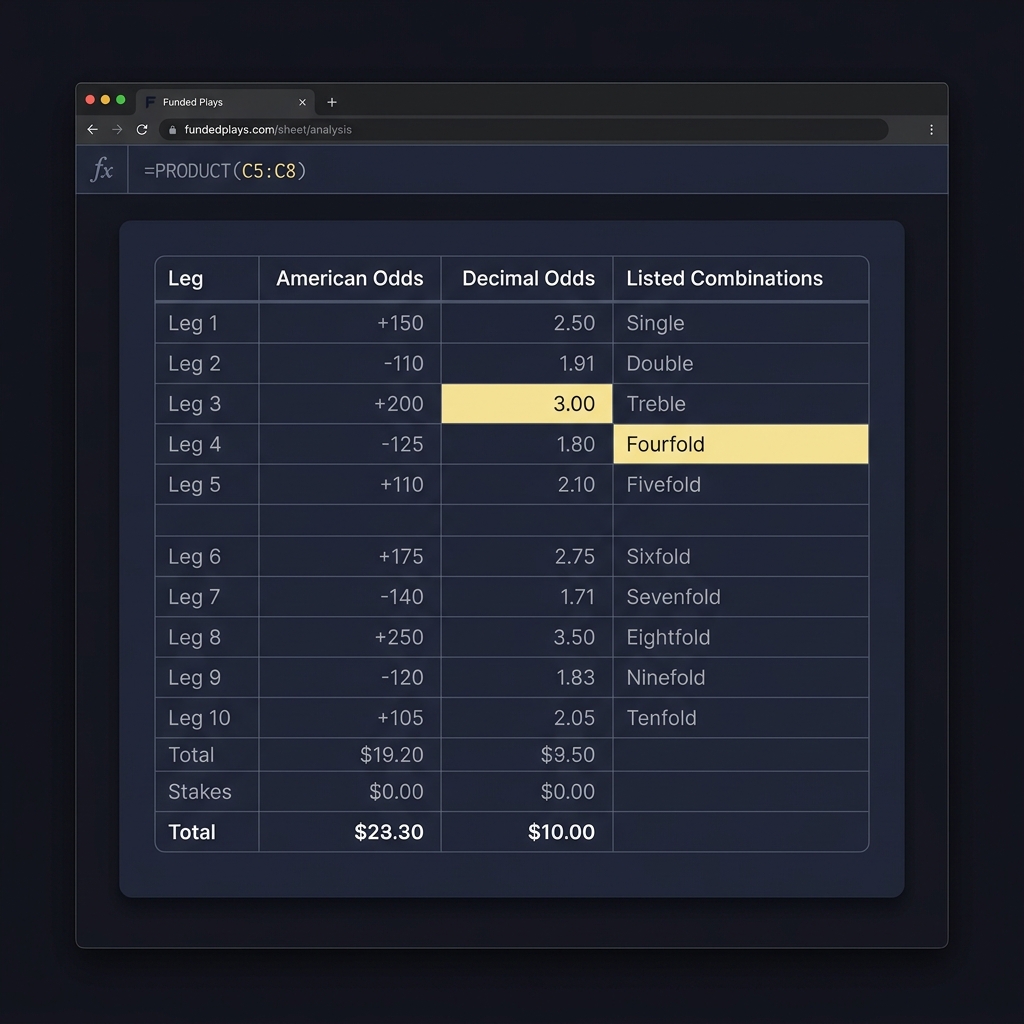
American odds convert to decimal odds using two simple rules: for positive American odds +A the decimal is 1 + A/100, and for negative American odds -B the decimal is 1 + 100/B. These conversion rules are the starting point for every parlay payout computation Investopedia.
Once each leg has a decimal value, the parlay decimal equals the product of all leg decimals in that ticket. The parlay payout equals the stake multiplied by that product. For example, if three legs have decimals 1.50, 1.80, and 2.10, the parlay decimal is 1.50 times 1.80 times 2.10, and the payout equals stake times that product.
When a leg is pushed or voided, common handling is to remove that leg from multiplication and treat the ticket as a smaller parlay, but exact behavior depends on the operator's rules and must be confirmed against their help documentation Investopedia.
From per-parlay returns to total round robin payout and cost
Total cost equals the number of generated parlays multiplied by the stake per parlay. Each parlay produces either a payout calculated as stake times the product of its decimal legs, or zero if it loses, with pushes handled per house rules; the calculator sums all individual parlay payouts to produce the round robin total FanDuel Help Center.
Example arithmetic, compact: if you have ten two-leg parlays and you stake 2 units per parlay, total cost is 20 units. If two of those parlays win for payouts of 10 and 14 units respectively, and the rest lose, the total payout is 24 units and the net result is payout minus cost.

Keep in mind that total payout is a simple sum of parlay payouts. A winning parlay with several legs multiplies decimal odds across its legs; losing parlays return zero except where pushes convert the ticket to a smaller parlay under operator rules.
How pushes, voids and house rules change calculator results
Different operators treat pushes and voids in different ways. A common approach is to remove the pushed leg from the parlay, reducing the effective parlay size for payout calculation, but other platforms may void the entire parlay depending on their terms, so always verify rules before trusting a calculator's output FanDuel Help Center.
Calculators implement pushes by either dropping the leg from multiplication or by marking affected combinations as adjusted. That decision changes both the payout for specific tickets and the number of winning combinations, so it can materially affect totals for a round robin built with close lines or with many legs that might push.
Practical note on correlations and same-game combinations
Calculators assume independence of legs when they compute per-parlay decimals and payouts. In real betting, correlated legs, for example two outcomes within the same game, can make probability interpretation of combined odds inaccurate and can invalidate independence assumptions behind simple payout expectations.
Quick checks to reduce correlation and same-game errors
Use before trusting probability interpretations
Many operators restrict same-game parlays or apply special eligibility rules, so a calculator's payout numbers remain correct as arithmetic, but may reflect combinations that are not allowed by a specific operator or that misrepresent joint probabilities when legs are correlated.
Step-by-step worked example you can verify manually
Inputs, set them first: n=4 legs, choose K equal to {2} so only two-leg parlays, stake per parlay equals 1 unit. Suppose the American odds are +150, -120, +200, and +110. Convert each to decimal first using the standard conversion formula, then list all C(4,2) parlays and compute each parlay payout Investopedia.
Decimal conversions: +150 becomes 1 + 150/100 = 2.50, -120 becomes 1 + 100/120 = 1.83 repeating, +200 becomes 1 + 200/100 = 3.00, +110 becomes 1 + 110/100 = 2.10. The four decimals are 2.50, 1.8333, 3.00, and 2.10.
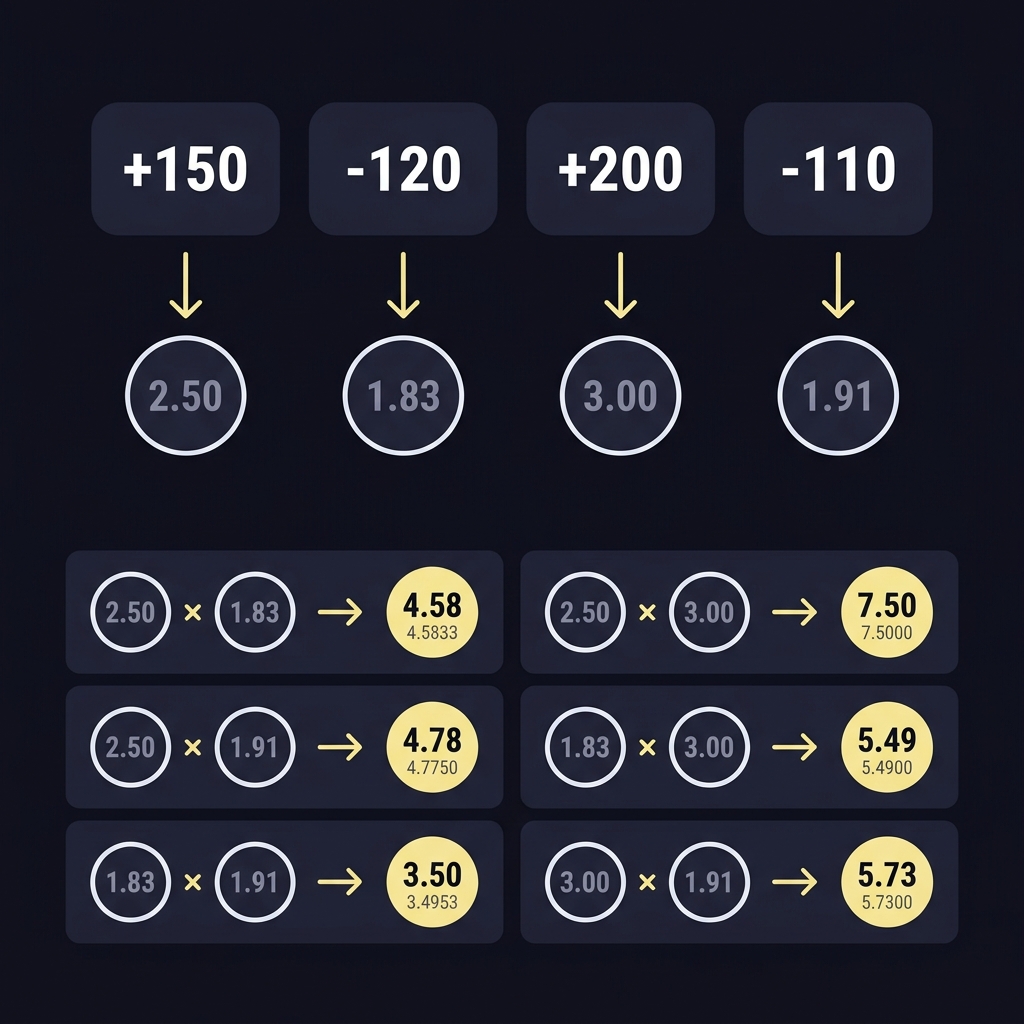
List all C(4,2) equals 6 parlays: legs 1-2, 1-3, 1-4, 2-3, 2-4, 3-4. For each, multiply the two decimals and multiply by stake 1 unit to get the payout. For example, parlay 1-2 payout is 2.50 times 1.8333 times 1 unit, parlay 1-3 payout is 2.50 times 3.00 times 1 unit, and so on. Sum the payouts to get total return, and subtract total cost, which is 6 times 1 unit, to get net result.
This manual calculation verifies an odds calculator that uses the same conversion and multiplication steps. If a platform shows different numbers, check which pushes or rounding rules it applies and confirm the decimal conversions used.
How to build a simple round robin odds calculator in a spreadsheet
Use COMBIN to compute C(n,k) for ticket counts and to validate your combination generation against expected totals AceOdds Pinnacle.
Suggested formulas, copy-paste friendly: convert American odds in cell A2 with an IF test for sign, for example =IF(LEFT(A2,1)="+",1+VALUE(MID(A2,2,99))/100,1+100/ABS(VALUE(A2))). Use PRODUCT(range) to compute a parlay decimal, and multiply by the stake cell for payout. Use helper columns or a small macro to enumerate combinations when n gets large.
Validation tips: compare spreadsheet outputs to the worked manual example above and to a trusted operator's help documentation for push handling. Save small test cases to ensure formulas do not change when copying rows or when rounding occurs.
Typical mistakes and pitfalls to avoid with round robin calculators
Common counting errors come from omitting one or more chosen parlay sizes when summing C(n,k) values. Always compute each C(n,k) that belongs to your K set and add them, then compare that sum to the number of generated rows in your spreadsheet or to the ticket count shown by a calculator Sportsbook Review Action Network.
Another frequent mistake is incorrect American to decimal conversion, especially with negative odds where the formula is 1 + 100 divided by the absolute value. Verify conversions with a small set of example odds before scaling a round robin to many tickets.
Finally, do not assume pushes work the same across operators. Failing to adjust for a platform's void rules can produce mismatched totals and unexpected net outcomes, so always check help pages for the exact push policy.
Choosing parlay sizes and stakes: decision criteria
Smaller k values increase coverage and the chance to cash partial wins, but they also produce more tickets for a given n, raising total cost and variance. Larger k values reduce ticket counts but require more correct legs per winning ticket, so balance expected confidence in legs against bankroll and ticket cost Action Network.
A practical rule of thumb is to compute total ticket count and total cost before placing a round robin, then decide whether that outlay is proportional to your bankroll and goals. Treat the calculator's output as payout arithmetic rather than a precise probability prediction when legs are correlated or when operator restrictions apply.
Scenarios and examples: when a round robin makes sense
Conservative scenario, partial coverage: if you expect several favorites to win but want to limit the risk of a single upset ruining everything, using two-leg parlays across those favorites gives multiple shots at partial wins while controlling per-parlay stakes. This structure is useful when you value repeated smaller wins over a single large all-or-nothing payout Action Network.
High upside scenario: if you target multiple underdogs and want several distinct parlay tickets to capture different combinations of correct outcomes, a round robin with larger k values can produce big payouts on some winning combinations while still offering several chances to cash. Remember, correlated legs and same-game rules may limit this approach or change the math.
Quick reference: formulas and checklist
Formula sheet, compact: combination C(n,k) for ticket counts, American to decimal conversion 1 + A/100 for +A odds and 1 + 100/B for negative odds, parlay decimal = product of leg decimals, parlay payout = stake times parlay decimal, total cost = number of parlays times stake per parlay.
Pre-check checklist: verify odds format, confirm the set K of parlay sizes, compute ticket count with COMBIN or C(n,k), confirm stake per parlay, and check operator push and same-game rules before trusting totals. Save manual worked examples for future validation in spreadsheets or calculators.
Conclusion and next steps for building or verifying a calculator
Round robin calculators combine combinatorics and standard parlay multiplication to produce ticket counts, total cost, and aggregate payouts. Use the worked example and the cheat-sheet to verify any tool, and double-check operator help documents for push and same-game behavior before placing selections.
After implementing a calculator, test it with small inputs and saved examples, confirm that your spreadsheet or tool matches manual arithmetic, and plan stakes in proportion to bankroll objectives rather than chasing theoretical maximum payouts.
It enumerates all parlays formed from your selected legs using combinations, converts American odds to decimal, computes each parlay payout, and sums costs and returns.
Pushes are operator-specific; common handling removes the pushed leg from the parlay and recalculates the payout, but check the platform help for exact rules.
Yes, correlations make independence assumptions invalid; the calculator still computes payouts arithmetically, but probability estimates require correlation adjustments.
References
- https://www.britannica.com/science/combination-mathematics
- https://oddsjam.com/betting-calculators/round-robin
- https://www.investopedia.com/terms/p/parlay.asp
- https://help.fanduel.com/s/article/What-is-a-Round-Robin
- https://www.fundedplays.com/challenges
- https://www.pinnacle.com/en/betting-articles/Betting-Strategy/how-to-calculate-parlay-payouts
- https://www.aceodds.com/bet-calculator/parlay/round-robin.html
- https://www.fundedplays.com
- https://www.fundedplays.com/blogs
- https://www.fundedplays.com/blogs/how-fundedplays-evaluations-work
- https://www.sportsbookreview.com/betting-calculators/round-robin-calculator/
- https://www.actionnetwork.com/education/round-robin-bet