

What we mean by high-variance markets and why risk management must change
Defining high variance: volatility, liquidity fragility, and regime risk
When practitioners talk about Risk Management for High-Variance Markets they mean markets where elevated volatility combines with episodes of liquidity fragility and sudden regime shifts, creating outsized tail risk and execution uncertainty. The International Monetary Fund highlighted these compound vulnerabilities in its April 2024 Global Financial Stability Report, noting that volatility and liquidity strains can interact and amplify losses IMF Global Financial Stability Report.
High-variance markets are not only more volatile on price charts, they are also more likely to produce correlation breakdowns, deeper intraday gaps, and rapid liquidity evaporation in specific instruments or venues. That combination raises the cost of execution and makes realized risk frequently different from ex ante forecasts. For managers this matters because sizing decisions, margin buffers and recovery plans must account for wider error bands than in calmer conditions.
Why standard risk rules break down in high-variance environments
Standard static rules such as fixed position sizes, constant leverage limits and naive stop levels can be brittle when realized volatility and liquidity shift quickly. A static size calibrated to average conditions will either leave capital under‑utilized when markets calm or produce catastrophic drawdowns when stress arrives. This mismatch is a core reason to adopt variance-aware sizing and explicit contingency planning.

In environments where execution quality and temporary dislocations matter, simulated or funded challenge platforms can be useful testing grounds to stress new rules without risking client capital. Such platforms allow teams to trial volatility scaling and stop-drawdown logic on representative flows while documenting outcomes for governance and iterative improvement, as described in how our evaluations work.
Core principles of a 2026-ready risk management program
Principle 1: measure variance and estimation uncertainty
A durable program starts by measuring variance and the uncertainty around key inputs, including realized volatility, expected edge and liquidity metrics. Measurement should be explicit, reproducible and include conservative adjustments for estimation error so that position sizing uses a defensible margin for uncertainty.
Principle 1 also calls for routine calibration of estimators and for conservative priors when sample sizes are small or when regime change is likely.
Get the implementation checklist on the FundedPlays Challenges page
Download the checklist in the implementation section to get starter settings and a pilot plan. The checklist is designed for teams that want to pilot variance-adjusted sizing before full rollout.
Principle 2: align limits, governance and stress testing
Limits, documented escalation and routine stress testing are core to how supervisors expect programs to operate. Modern supervisory frameworks emphasize regular severe-but-plausible stress tests and clear governance for actions when limits are breached Basel MAR30 Stress testing.
Governance closes the loop: owners, escalation paths and audit trails ensure that stress test results and real incidents lead to timely changes in sizing, hedging or capital buffers rather than ad hoc decision making.
Risk Management for High-Variance Markets
The combination of careful measurement and strong governance is the backbone of Risk Management for High-Variance Markets, and sets expectations for how sizing, stops and hedges are applied across strategies.
High-level framework: pairing variance-adjusted sizing with limits and hedges
How the pieces fit together in practice
The recommended framework layers several complementary controls. First, scale exposures by realized volatility or a volatility-implied target. Second, moderate aggressive sizing methods such as Kelly with a fractional multiplier. Third, set explicit drawdown and expected shortfall limits at the program level. Fourth, use targeted hedges for dominant risks rather than blunt, full-detachment actions. Finally, embed supervisory-style stress tests that translate scenario losses into governance actions.
Each piece addresses a different failure mode: volatility scaling handles fluctuating dispersion, fractional Kelly tempers estimation risk, drawdown limits cap realized ruin, hedges protect against concentrated factor moves, and stress tests align actions with worst-case thinking.
simple volatility scaling factor for position sizing
quick volatility scaling factor
The tradeoffs: growth versus drawdown protection
Combining tools reduces tail risk but introduces tradeoffs. Volatility scaling and smaller Kelly fractions lower expected long-term growth relative to full Kelly in idealized settings, but they typically improve risk-adjusted outcomes when estimation error and transaction costs are material. The pragmatic choice favors robustness and continuity over theoretical maximum growth in stationary, known environments.
Finding the right balance requires pilot testing, tracking realized costs and designing escalation rules so that unexpected interactions prompt human review rather than mechanical, repeated trades.
Variance-adjusted position sizing: volatility targeting explained
Realized volatility scaling and practical estimators
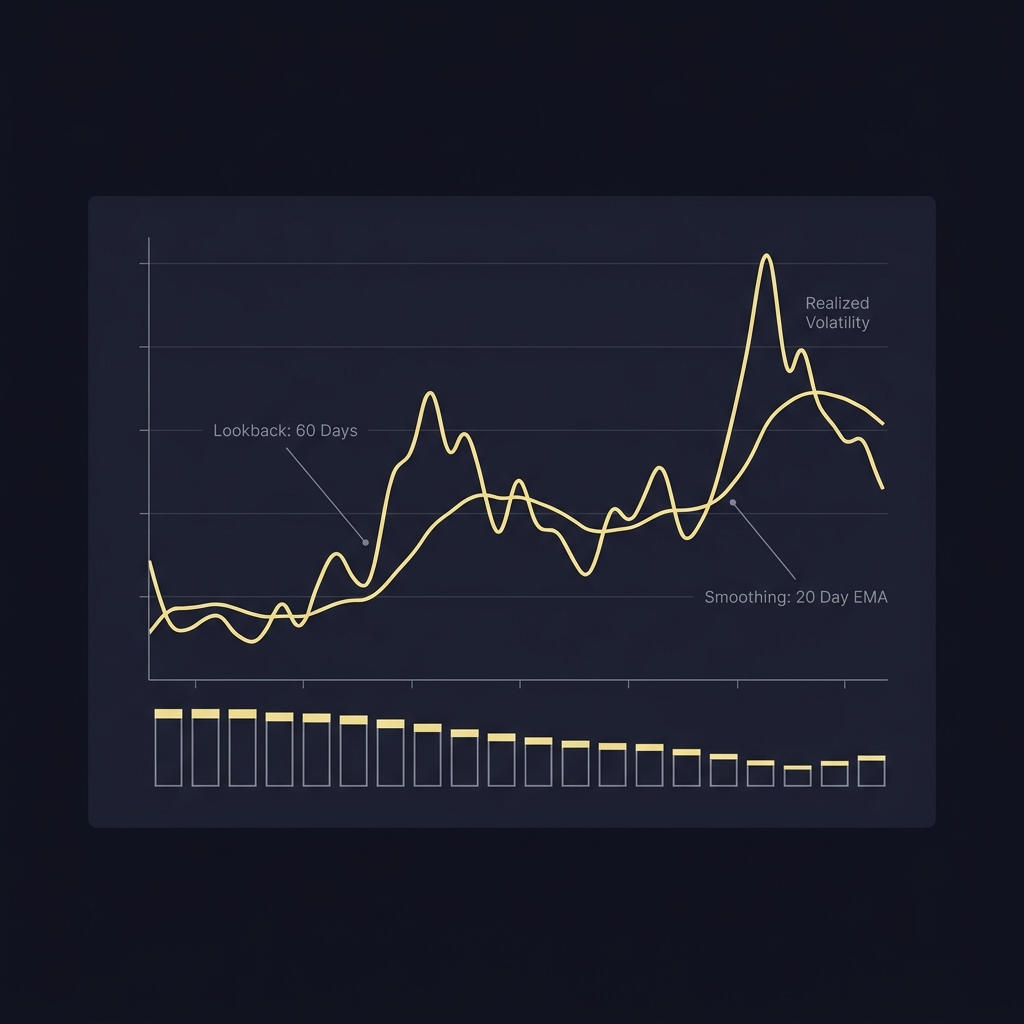
Volatility targeting scales exposure inversely with realized volatility so that target portfolio volatility remains approximately constant as market dispersion changes. Practically, teams compute a realized volatility estimator, choose a lookback window and apply smoothing to avoid excessive resizing during transient spikes.
Estimator choices matter. Common approaches include simple moving standard deviations of returns over 20 to 60 days, exponentially weighted estimators that respond faster to regime change, and realized variance measures derived from higher-frequency returns when available. Practical implementations often impose caps and floors to prevent extreme scaling in the presence of outliers.
Pros, cons and historical evidence
Academic and practitioner work on volatility-managed portfolios finds that scaling exposure by realized volatility has historically improved risk-adjusted returns and reduced drawdowns relative to static-weight portfolios, though past results do not guarantee future performance Volatility-Managed Portfolios.
On the downside, volatility targeting can increase turnover, cause procyclical selling into stress and, if poorly estimated, create sizing errors. Combining volatility targeting with caps, smoothing and governance mitigates many practical downsides.
Sizing with Kelly and fractional Kelly: theory and practical cautions
What Kelly optimality implies and why estimation error matters
The Kelly criterion prescribes growth-optimal bet sizes given known edge and variance. In theory it maximizes long-run compound growth, but it is highly sensitive to errors in edge and variance estimates. When forecasts are noisy, full Kelly can produce large realized drawdowns and unstable leverage.
Because estimation error is inevitable, practitioners typically reduce Kelly sizes by a conservative fraction. Fractional Kelly reduces sensitivity to misestimation and improves drawdown characteristics at the cost of lower theoretical long-run growth under perfect knowledge The Kelly Capital Growth investment criterion.
How to implement fractional Kelly in real portfolios
Useful rules of thumb include starting with small fractions such as 10 to 30 percent of full Kelly for live deployment, conducting forward simulations under plausible model error, and combining fractional Kelly with volatility scaling so that the absolute position sizes remain bounded during spikes. These are examples and not prescriptions; teams should pilot and document chosen fractions.
Operationally, fractional Kelly works best when edge estimates use shrinkage, cross validation and conservative priors so that the input to sizing reflects uncertainty rather than overfit historical backtests.
Stop-loss and drawdown rules: regime dependence and implementation tips
When stop rules help and when they can hurt
Stop-loss rules can limit tail losses and force de-risking when trends worsen, but they are regime dependent. In strongly trending markets stop rules can prevent cascading losses, yet in mean-reverting contexts they may truncate recoveries and increase turnover, producing worse outcomes When Do Stop-Loss Rules Stop Losses?.
Because their effectiveness varies by regime, stop rules should be calibrated with scenario analysis and combined with other controls like volatility targets and hedges rather than used in isolation.
Designing drawdown triggers and recovery rules
Design choices include absolute versus percentage stops, time-based stop variants that require a price to remain beyond a threshold for a minimum time, and recovery rules that only permit re-entry after performance metrics are restored. A sensible default is to separate local tactical stops from program-wide drawdown triggers that require governance review when breached.
Recovery paths should be explicit: define when re-sizing is allowed, whether to restore previous exposures incrementally and how stress test outcomes affect re-entry privileges.
Targeted hedging: which risks to hedge and how
Hedging the dominant risk factors versus blanket hedges
Targeted hedging focuses protection on the most material risk factors instead of broad, expensive blanket hedges. Identifying dominant factors requires both historical analysis and forward-looking scenario thinking so that hedges protect against plausible, high-impact moves.
Teams should combine variance-adjusted sizing, fractional Kelly fractions, explicit drawdown limits, targeted hedges and supervisory-style stress testing, then pilot and iterate under realistic execution assumptions.
Cost, slippage and hedge tuning
Hedges have costs in premiums, bid-ask spreads and basis risk. During stress events liquidity may thin, increasing slippage and reducing hedge effectiveness. The IMF report underscores the practical need for buffers and contingency plans in the face of liquidity fragility when designing hedges IMF Global Financial Stability Report.
Effective hedge tuning balances protection versus cost. Typical practices include layering hedges, using scaled option positions or variance swaps when available, and setting time-decay tolerances so that hedges remain effective across multi-day events.
Stress testing and scenario analysis aligned with supervisory practice
Designing severe-but-plausible scenarios
Supervisory guidance now expects regular stress tests using severe-but-plausible scenarios that include volatility spikes, liquidity squeezes and correlation breakdowns. Basel and ESMA updates in recent supervisory guidance reinforce the need for programmatic stress testing with documented escalation paths Basel MAR30 Stress testing. Interagency guidance from the Federal Reserve also addresses expectations for stress testing in banking organizations Federal Reserve guidance on stress testing.
Good scenarios mix historical episodes with hypothetical variants that reflect current exposures and market structure. Each scenario should map to expected losses, liquidity impact and operational responses so decision makers can translate results into action.
Embedding stress testing in routine governance
Stress tests should be scheduled regularly, with ad hoc runs after major market moves. Results belong in governance forums where owners, limits committees and front-office leads agree on remedial steps ranging from immediate hedges to strategy suspensions or parameter changes.
Reporting should include clear trigger thresholds for escalation, a list of responsible owners and a timeline for remediation and re-testing.
Governance, limits and operational controls
Setting drawdown and expected shortfall limits
Program-level limits such as drawdown caps and expected shortfall (ES) thresholds are complementary to tactical stops. Firm-level ES limits quantify tail exposure across strategies and tie directly to capital planning and contingency funding decisions. Embedding these metrics into routine monitoring makes breaches actionable rather than theoretical.
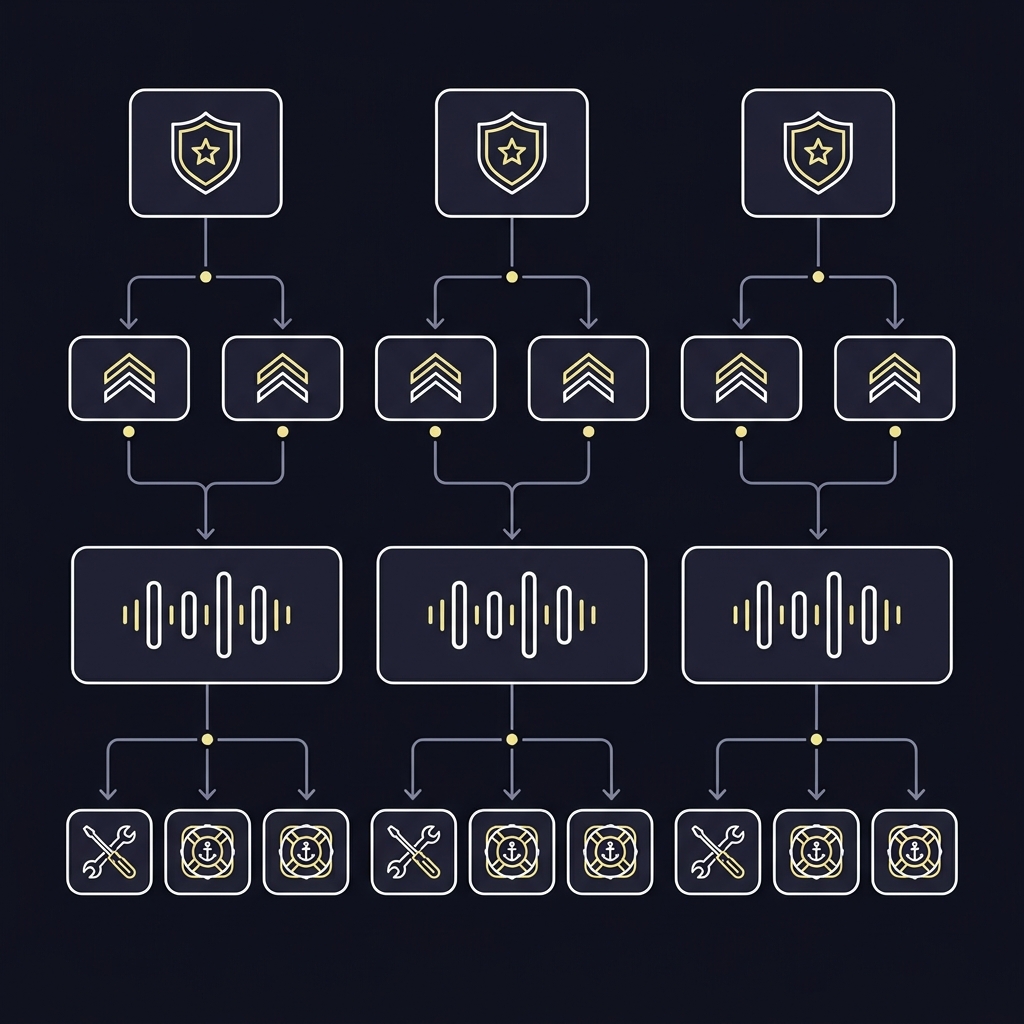
Document limits clearly: how they are calculated, the data sources used, who signs them off and what remediation steps follow when they are exceeded. This documentation is central to credible governance and auditability.
Roles, escalation and documented actions
Define owners for each control, specify escalation paths and keep timestamped records of decisions. When limits are hit, the playbook should state who can execute hedges, who must pause flows and what communication to stakeholders is required. Clear, practiced steps reduce confusion under stress.
Simulated drills and post-mortem reviews help ensure the governance process works when needed and that lessons lead to updated limits or procedures.
Measuring edge and managing estimation risk
Estimating edge: sample sizes and shrinkage
Estimating predictive edge requires realistic assumptions about sample sizes and the non-stationarity of signals. Small samples tend to overstate edge, so shrinkage toward conservative priors improves robustness when used in sizing rules such as Kelly or volatility scaling The Kelly Capital Growth investment criterion.
Practically, teams should use rolling windows, cross validation and Bayesian shrinkage techniques to temper extreme point estimates and to produce confidence intervals that feed into fractional sizing decisions.
Practical ways to limit overfitting in sizing rules
Limit overfitting by validating signals out of sample, testing across multiple market regimes and preferring simpler models that explain a larger share of observed variation. Forward testing in simulated funded accounts or challenge environments can reveal operational issues before live deployment.
Conservative edge inputs lead to smaller recommended Kelly fractions and clearer governance decisions when actual performance deviates from expectations.
Execution, transaction costs and the stop-rule hedge interaction
Estimating slippage and turnover from active rules
Rules that scale with volatility or trigger stops can materially increase turnover and slippage. Before rollout, estimate expected turnover under historical scenarios and include stress scenarios that widen spreads and reduce depth to see how costs evolve under stress When Do Stop-Loss Rules Stop Losses?.
Monitoring actual transaction costs and updating assumptions is essential. If realized costs are higher than modeled benefits, parameters must be adjusted or a more conservative approach adopted.
Practical sequencing: sizing, hedge placement and stop settings
Sequence actions to avoid conflicting trades. A practical ordering is: compute variance-adjusted size, decide whether to apply a protective hedge for dominant factor exposure, then place limit or stop orders with time-in-force rules aligned to execution objectives. Only after fills or confirmed hedge execution should stop triggers be relied upon to avoid double-counting protection.
Automated systems should include guardrails that prevent simultaneous, contradictory actions that increase market impact and create operational risk.
Common mistakes and how to avoid them
Over-reliance on single tools
Relying on a single control, such as full Kelly or a lone stop-loss rule, is a common pitfall. Single tools fail when their core assumptions break, so combining variance-adjusted sizing, fractional Kelly, drawdown limits and targeted hedges produces a more resilient program Volatility-Managed Portfolios.
Mixing complementary controls reduces the probability that a single failure mode causes catastrophic losses and makes governance responses more straightforward.
Underestimating tail and liquidity risk
Ignoring liquidity risk when calibrating stops or hedges exposes strategies to execution failure during stress. The IMF report cautions that liquidity fragility can amplify price moves, so contingency planning and reserve buffers are essential IMF Global Financial Stability Report.
Work to quantify liquidity risk across venues and instruments and stress these metrics alongside price moves in scenario testing.
Practical scenarios and short case studies
Scenario A: sudden volatility spike in a liquid market
Imagine a liquid equity index where realized volatility doubles intraday. A volatility-targeted rule reduces position sizes as variance rises, and a fractional Kelly multiplier further tempers recommended bets. Together these actions lower the portfolio's exposure and the likelihood of large mark-to-market losses.
Immediate checklist: reduce sizes per volatility rule, assess need for short-dated protective options, check stop thresholds and pause re-sizing until realized volatility stabilizes. Within days, review trade execution metrics and run a stress test with widened spreads.
Scenario B: liquidity squeeze with correlated drawdowns
In a liquidity squeeze, correlated asset moves and widening spreads can make hedges costly or ineffective. The framework calls for targeted hedges on dominant factors identified in scenario analysis and for pre-defined contingency budgets to pay for emergency coverage.
Actionable steps: activate contingency hedges if correlation thresholds exceed limits, temporarily tighten drawdown limits and notify governance owners. After the event, conduct a root cause review and update stress test parameters to reflect new insights.
A practical checklist to implement the framework
Quick technical checklist
1. Choose a volatility estimator and lookback window with smoothing and caps. 2. Select an initial target volatility and compute scaling factors. 3. Decide on a conservative Kelly fraction and combine it with volatility scaling. 4. Define tactical stop rules and program-level drawdown triggers. 5. Pilot rules in a simulated or challenge environment and record outcomes for governance.
These starter settings are examples, not prescriptions. Teams should document choices, pilot them under multiple regimes and revise based on observed costs and behaviors.
Governance and reporting checklist
1. Assign owners for measurement, sizing and limits. 2. Set stress test cadence and scenario templates. 3. Define escalation steps and communication protocols for breaches. 4. Maintain audit trails of rule changes and incident responses. 5. Schedule post-mortems after significant stress to update parameters.
An iterative approach of pilot, monitor and revise keeps the program responsive and reduces the chance of unanticipated interactions.
Closing: balancing growth and protection in uncertain markets
Key takeaways
Pairing variance-adjusted position sizing with fractional Kelly, explicit drawdown limits and targeted hedges creates a balanced program that trades some theoretical long-run growth for far greater resilience to estimation error and liquidity stress.
Regulatory and supervisory guidance now expects routine stress testing and clear governance, so embedding these practices into operational routines is essential for credible risk management ESMA updates money market funds stress test scenarios.
Further reading and next steps
Teams should pilot the combined framework in controlled environments, collect execution and cost metrics, and refine parameters through iterative stress testing. Related posts are available on our blog, and more information about the platform can be found at the Funded Plays homepage. The references cited offer technical depth on volatility management, Kelly theory and stop-rule research for readers who want deeper background.
Volatility targeting scales exposure inversely with realized volatility so positions shrink when dispersion rises, which tends to lower peak-to-trough losses compared with fixed sizes.
Full Kelly is growth-optimal under ideal assumptions but highly sensitive to estimation error; fractional Kelly with conservative inputs is commonly advised for live deployment.
Contingency hedges are typically activated when scenario metrics exceed pre-defined correlation or liquidity thresholds or when stress tests show unacceptable tail losses.
References
- https://www.imf.org/en/Publications/GFSR/Issues/2024/04/Global-Financial-Stability-Report-April-2024
- https://www.fundedplays.com/challenges
- https://www.fundedplays.com/blogs/how-fundedplays-evaluations-work
- https://www.bis.org/basel_framework/chapter/MAR/30.htm
- https://www.fundedplays.com/blogs
- https://www.fundedplays.com
- https://www.nber.org/papers/w21499
- https://link.springer.com/book/10.1007/978-1-4419-1826-5
- https://jpm.pm-research.com/content/40/3/45
- https://www.newyorkfed.org/medialibrary/media/research/staff_reports/sr696.pdf
- https://www.federalreserve.gov/frrs/guidance/interagency-supervisory-guidance-on-stress-testing-for-banking-organizations-with-total-consolidated-assets-of-more-than-10.htm
- https://www.bis.org/bcbs/publ/d427.pdf
- https://www.esma.europa.eu/press-news/esma-news/esma-updates-money-market-funds-stress-test-scenarios-2024