

What is reverse line movement? A plain-language definition
Reverse line movement is a market phenomenon where a point spread or total moves away from the side that is getting most of the public tickets, which suggests books are responding to money or respected accounts rather than raw ticket counts. The term helps separate simple popularity from money-weighted influence and is a market signal, not a guarantee of the outcome; treat it as one input among others.
To make this concrete, imagine most small tickets pile on the favorite but the number drifts toward the underdog as books adjust pricing or juice. That pattern, when verified across books, is what handicappers call reverse line movement and it points to sharper action on the less-popular side Action Network reverse line movement guide.

Key terms you need to know
Sportsbooks are the operators that set and adjust odds. Tickets are individual bets from the public. Sharp money describes large or respected accounts whose wagers carry more weight for a book. Public refers to the pool of smaller, recreational bettors.
Understanding these terms helps when reading multi-book data and comparing ticket percentage versus money percentage, because those two measures can tell different stories about where risk actually sits on a game.
How RLM differs from simple ticket splits
A ticket split reports how many individual bets are on each side, while money-weighted action reports where larger stakes land; those can diverge meaningfully and produce RLM when the larger stakes push prices opposite the ticket majority TheLines line movement explainer.
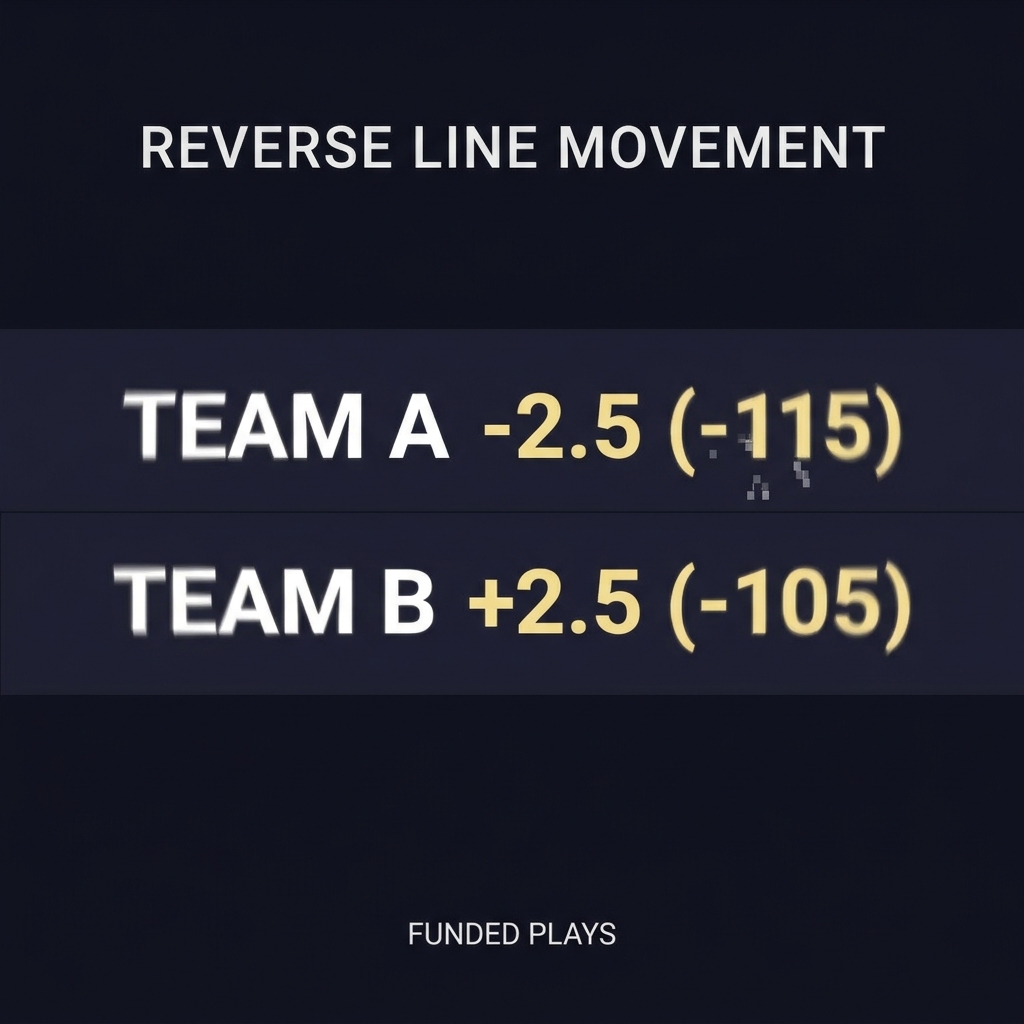
Because ticket counts are easy to see but money distributions are often opaque, RLM requires cautious verification rather than assuming a single-screen snapshot tells the whole story.
Why betting lines move: liability, limits, and respected action
How books set and adjust numbers
Sportsbooks set initial lines based on models, projections, and market expectations, then update those numbers as they take action to manage exposure. Adjustments reflect a combination of model updates and incoming wagers, not only public sentiment.
When large or respected accounts place money, books can move quickly to reflect that information and limit liability rather than simply following the majority of tickets VSiN betting 101 on line movement.
Liability management and respect for sharp accounts
Liability management means a bookmaker wants balanced exposure so a single result does not produce outsized loss. That can lead to moves that appear to go against the public if a book receives money on one side in amounts that threaten its limits.
Sportsbooks also use limits and internal risk controls to restrict or reprice large accounts; respected or professional bettors can prompt a book to shift lines even while most retail tickets remain on the opposite side Pinnacle on what moves betting odds.

How reverse line movement happens: typical mechanisms and signals
Reverse line movement often appears when books change the point spread by a half point, shift the juice, or both while the ticket share favors the other side. Those changes can include a move toward the public side or improved pricing for the underdog, which signals sharper support for that side.
Look for two common signals: the spread easing by a half point toward the underdog or the underdog’s price improving with reduced vigorish. Either action can indicate that books are honoring larger accounts on the dog even as smaller tickets favor the favorite Action Network reverse line movement guide.
Test RLM with a quick verification checklist
Try the verification checklist below before letting a single move change your pick; use RLM as contextual input, not a decision shortcut.
Books also manage risk by adjusting juice, which is the commission built into odds. A book may keep the outward spread but increase the underdog’s juice, subtly shifting how profitable that side is to bettors and revealing where money is concentrated.
Isolated ticks on one book are weaker signals; coordinated adjustments across several operators carry more weight as evidence of real, money-driven movement TheLines on line movement.
Common patterns that produce RLM
Common patterns include a half-point capitulation toward the underdog, a series of rapid moves that reverse earlier public-driven pricing, or a steady change in juice that favors the less-bet side. These patterns often happen when a few large wagers hit after the market opens and books reprioritize risk.
Monitor timing and velocity: fast, synchronized shifts across books suggest sharper influence, while slow, isolated ticks often reflect retail betting flows or algorithmic repricing rather than significant money-weighted bets VSiN line movement guide.
How juice and pricing shifts reveal the hidden action
When juice moves in a way that makes one side more expensive, that is a way books steer small bettors and protect themselves. A decrease in vigorish on the underdog while the favorite holds most tickets is a subtle RLM signal worth noting.

How to verify RLM across books: money vs ticket splits and consensus checks
Why single-book screens can mislead
Single-book screens show only one operator's prices and maybe their ticket splits; they rarely show the full money-weighted picture and can be misleading if used alone. Public split reporting lacks standardization, so it is risky to assume a visible ticket majority equals money majority.
Confirming reverse line movement means looking beyond one screen and checking multiple markets to see if a move is isolated or part of a coordinated cross-book change Covers guide on what line moves tell us.
Practical steps to confirm RLM
Step 1, check multi-book consensus: open several odds pages and compare the sequence of moves. Step 2, examine money versus ticket splits when available; a money-weighted shift is more meaningful than ticket counts alone. Step 3, look for time-correlated moves and juice changes that align across operators.
These practical checks help you decide whether a visible move is genuine RLM or an isolated repricing that should be ignored Covers on reading line movement.
Concrete example: an NFL spread that shows reverse line movement
Start with a standard scenario: an NFL spread opens at -3 with the favorite attracting roughly 70 percent of visible tickets. If the market then moves toward -2.5 or -2 while underdog pricing becomes more attractive, that pattern fits the classic description of reverse line movement and suggests sharper support on the dog.
Step by step, the move looks like this: opening line set at -3, heavy ticket flow on the favorite, one or more large wagers land on the dog, several books reduce the favorite to -2.5 or -2 and adjust juice toward the underdog, and the market consensus shifts despite the ticket majority Action Network example.
Treat it as a possible signal that larger or respected accounts influenced the market; verify across multiple books, check juice and money-weighted evidence, and use closing line value tracking to see if acting on the move improves results.
In that example, the best interpretation is that larger or respected accounts backed the underdog, prompting books to protect liability and reprice even though most retail bettors favored the favorite. The signal implies sharper action on the dog but not guaranteed value by itself TheLines on RLM example.
The example explained step by step
First, document the initial split and early pricing. Second, note the timing of the move and which books changed numbers. Third, record whether juice shifted in tandem with the spread. Those details help distinguish true RLM from ordinary volatility.
Finally, resist treating the move as conclusive evidence; use it to question your assumptions and to decide whether further checks or model alignment make the change actionable.
What the move suggests about sharper support
When the described pattern appears, it suggests that sharper money landed on the underdog and books moved to reflect that exposure. Sharp support on the dog can mean the dog is undervalued by retail bettors, but it can also reflect information or hedging not visible to public screens.
Because reverse line movement is an indirect indicator, confirm with closing line behavior and postgame analysis before concluding you have a repeatable edge TheLines on confirming line signals.
How to integrate reverse line movement into a betting process
Where RLM fits in a checklist-driven workflow
RLM should be one line item in a disciplined pre-bet checklist: model output, matchup factors, line history, RLM evidence, juice, and bankroll rules. Use a rulebook that states when RLM will override or modify a pick and when it will not.
For example, require multi-book confirmation plus either money-weighted evidence or model alignment before adjusting stake size because that reduces the chance of chasing noise VSiN on disciplined line checks.
Combining RLM with quantitative checks
Combine RLM with closing line value, historical model deviations, and a written staking plan. Track whether following RLM alters your closing line value over a meaningful sample before making it a core rule.
Document each RLM-influenced bet and review outcomes quarterly to see whether the signal consistently improves CLV or ROI; treat the process like a performance experiment rather than a tip sheet Pinnacle on CLV.
How reverse line movement relates to closing line value and long-term edge
Closing line value is widely regarded as a stronger long-term indicator of betting edge than any single in-game signal because CLV measures whether you consistently secure better prices than the market's final consensus.
Use RLM as a complementary input: it can flag where sharp money might be going, but CLV tells you if your choices actually beat the market over time Pinnacle on closing line value.
quick CLV calculation to log whether RLM-led bets beat the close
record RLM Indicator as 1 if you acted on RLM
Keep a simple tracking sheet that records whether an RLM signal influenced your decision and compare the bet price to the closing line; over dozens of bets this will show whether RLM helped improve CLV.
Why CLV is often a stronger long-run signal
Beating the closing line means you consistently obtain prices better than the market consensus at kickoff. That pattern translates directly into long-term expectation if replicated over many bets.
Because RLM can be noisy, prioritize CLV in your evaluation and use RLM to justify adjustments only when it correlates with improved closing line outcomes in your own tracking Pinnacle on measuring CLV.
Common mistakes and traps when interpreting reverse line movement
Overweighting single-book ticks
A common error is assuming any single-book tick equals sharp action. Many isolated moves lack money-weighted evidence and prove to be noise, especially in volatile markets where algorithmic repricing happens frequently.
Always seek multi-book confirmation and money percent data when possible before changing a decision based solely on a single tick TheLines on single-book noise.
Confusing popularity with sharpness
Popularity means many small bettors back a side; sharpness means larger, respected accounts place money. Conflating the two leads to poor reactions and chasing public sentiment instead of following meaningful information.
To avoid this trap, compare ticket counts to money-weighted splits and track whether juice or coordinated moves accompany the ticket majority Covers on ticket versus money splits.
Other biases to watch
Recency bias and confirmation bias can cause bettors to overweight an RLM instance that supports a favored view. Keep decision logs and objective rules to reduce these cognitive traps.
Systematic logging and periodic reviews help you identify when bias influenced a choice rather than genuine market evidence.
When RLM is most and least reliable: market conditions that matter
Fast-moving screens and synchronized steam
In fast-moving U.S. markets, coordinated steam or synchronized moves across multiple books usually carry more signal because they imply money moved quickly and consistently across operators.
When multiple operators line up on the same move within a short window, treat that as stronger evidence of sharper influence than a single isolated change VSiN on synchronized moves.
Low-liquidity or niche markets
Thin markets, proposition lines, and niche events are less reliable for interpreting RLM because limited liquidity means any single large balance can cause outsized swings that do not reflect broader sharp consensus.
In those markets, require higher confirmation standards or ignore RLM unless money-weighted data is clear and repeatable Covers on liquidity and RLM.
Quick decision checklist: should RLM change your pick?
Multi-book confirmation: did more than one operator move in a time-correlated way
Money vs ticket split: is there evidence money-weighted action differs from ticket majority
Juice movement: did vigorish shift to favor the less-bet side
Model alignment: does the adjusted line fit your model or matchup edge
Timing and velocity: was the move rapid and coordinated rather than slow and isolated
If several checks are negative, do not let RLM alone change your stake or selection; log the instance for later review TheLines checklist.
Three short scenarios that illustrate different RLM outcomes
Scenario A: Coordinated RLM confirming a model
A model shows value on an underdog, several books move half a point toward that dog with reduced juice, and the closing line supports a profitable entry. Here RLM aligned with model output and the outcome improved closing line results Action Network scenario.
Scenario B: Isolated tick that proved noisy
A single operator drops the favorite by a quarter point with no juice change and no money-weighted evidence; the move reverts and the tick was noise. In this case, the single-book RLM signal was weak and should have been ignored TheLines on isolated ticks.
Scenario C: Juice shift without money confirmation
Juice moves make the underdog cheaper but no multi-book pattern or money split confirms the change; the juice shift created an appearance of RLM but lacked supporting evidence and was unreliable Covers on juice signals.
Tracking results: measuring whether RLM helps your closing line value
Simple metrics to record
Record timestamp, book prices before and after the move, ticket versus money splits when available, whether RLM influenced your decision, your stake, and the closing line. Those fields let you compute a simple CLV and analyze patterns over time.
Compare bet price to closing price and track CLV per bet; aggregate results over dozens of decisions before changing your process based on apparent gains Pinnacle on tracking CLV.
How to analyze outcomes over time
Use basic aggregates: average CLV when you acted on RLM, win rate, and ROI. Focus on sample sizes large enough to reduce variance before concluding that RLM helps or hurts your edge.
A disciplined review schedule, such as monthly or quarterly, helps detect whether following RLM consistently improves closing line outcomes.
Responsible use and the limits of reverse line movement
RLM as an input, not a promise
Reverse line movement highlights where sharper money may be landing but it is not a guarantee of success. Treat RLM as a contextual input and maintain bankroll rules and model checks alongside it.
Novice users should use RLM conservatively and advanced users should test it systematically within a tracked framework so decisions remain evidence-based and disciplined Pinnacle on responsible use.
Ethical and practical participation notes
Remember outcomes depend on individual performance and platform or book rules. Platforms that simulate funded accounts and evaluation challenges can provide a low-risk way to practice interpreting RLM without staking real funds. Learn more about how our evaluations work on the Funded Plays site: how our evaluations work.
Use practice environments to validate whether reacting to RLM improves your process before applying it in real-liability situations. See Funded Plays for practice options: Funded Plays.
Conclusion: practical next steps and further reading
Key takeaways: reverse line movement means a line moved away from the side receiving most tickets, often because books honored money-weighted action; verify it with multi-book checks and juice analysis; and prioritize closing line value as the primary measure of long-term edge TheLines summary.
Action plan: verify any RLM instance across several books, log outcomes with timestamps and prices, and compare CLV results over a meaningful sample. For deeper reading, consult the cited educational resources on line movement and CLV. Visit our blog for practical posts and case studies: our blog.
Reverse line movement is when a line moves away from the side receiving the majority of tickets, suggesting larger or respected accounts drove the change rather than the public.
Confirm true RLM by checking multiple books for time-correlated moves, comparing money versus ticket splits when available, and looking for juice or half-point shifts.
No. RLM is an informational input, not a promise of success; use it with closing line value, models, and bankroll rules.
References
- https://www.actionnetwork.com/education/reverse-line-movement
- https://www.fundedplays.com/challenges
- https://www.thelines.com/line-movement/
- https://www.vsin.com/betting-101/line-movement/
- https://www.pinnacle.com/en/betting-resources/educational/what-moves-betting-odds
- https://www.covers.com/betting/line-movement
- https://www.pinnacle.com/en/betting-resources/educational/closing-line-value
- https://www.covers.com/guides/what-line-moves-can-tell-us
- https://oddsindex.com/guides/reverse-line-movement-guide
- https://www.fundedplays.com
- https://www.fundedplays.com/blogs
- https://www.fundedplays.com/blogs/how-fundedplays-evaluations-work